
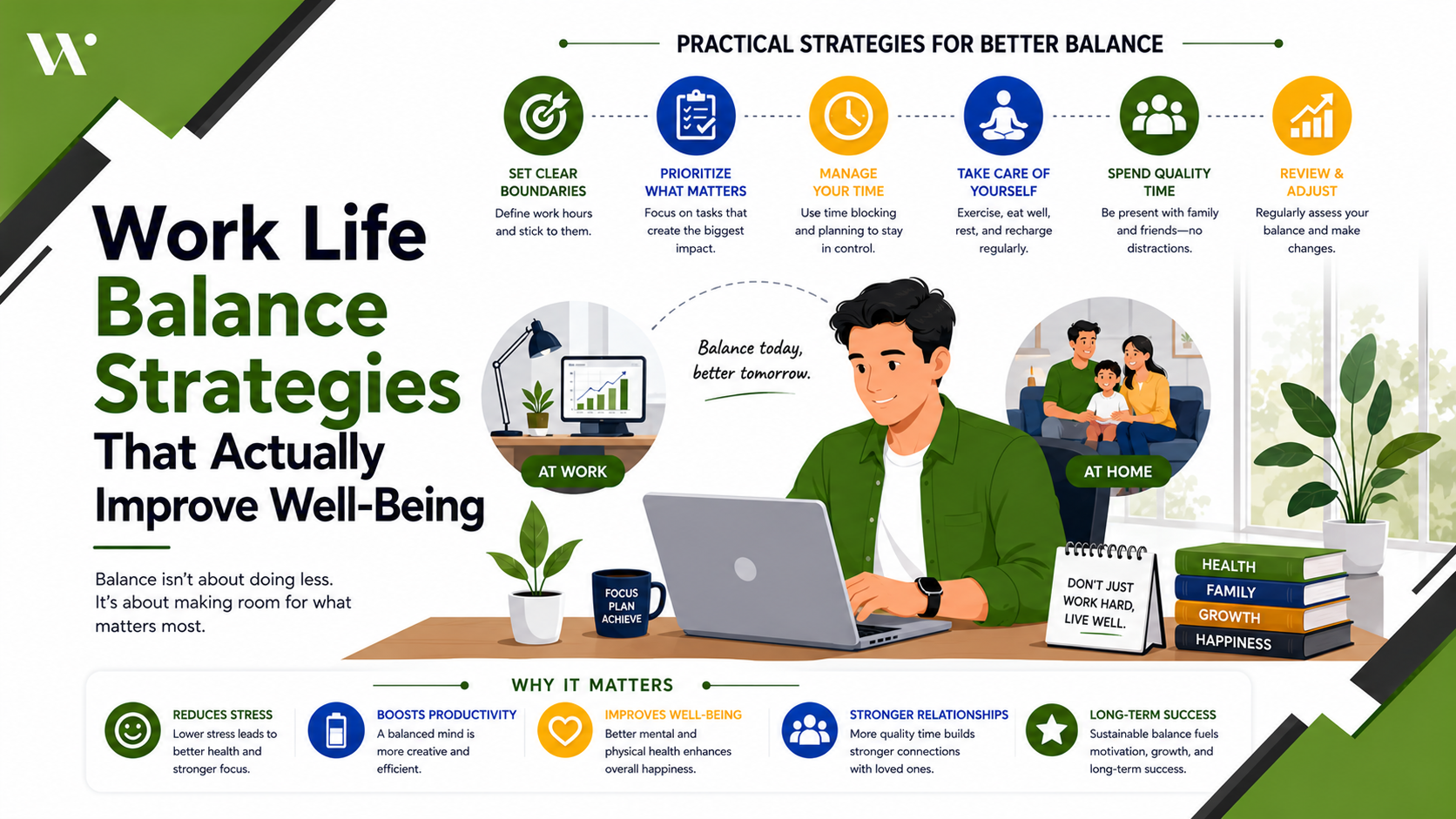






Work life balance strategies are practical methods for protecting your personal time, reducing chronic stress, and staying productive without burning out. The most effective approaches share three core elements: clear boundaries between work and personal life, deliberate time management, and consistent self-care. This is what that looks like in practice:
- Set firm boundaries. Define when work starts and stops, and communicate those limits to colleagues and family.
- Manage your time with intention. Use structured methods like time blocking or the Eisenhower Matrix to protect personal hours.
- Control your technology. Disable after-hours notifications and keep work and personal devices separate.
- Build in recovery. Regular breaks, physical movement, and sleep are not optional extras. They are the foundation.
- Lean on social support. Strong relationships at work and at home buffer against burnout more reliably than any productivity app.
None of this requires a life overhaul. Research consistently shows that incremental changes targeting specific daily pressure points outperform radical resets when it comes to long-term habit maintenance.
11 Work Life Balance Strategies You Can Start Using This Week
1. Set a fixed end-of-work time
Your brain needs a shutdown signal. Saying “I’ll finish when I’m done” guarantees that work expands to fill every available hour. Pick a specific time, commit to it, and treat it the way you would treat a flight departure. Research on boundary-setting tactics identifies a fixed end time as the single most effective protective factor against work stress spilling into personal life.

2. Create a transition ritual
The commute used to do this automatically. Without one, remote and hybrid workers often find themselves mentally still at work hours after closing the laptop. A transition ritual, whether a 10-minute walk, changing clothes, or making tea, signals to your brain that work is over. Studies by Ashforth et al. found that these micro-rituals significantly reduce work-related rumination during personal time.

Pro Tip: If you work from home, physically leave your workspace, even if that just means stepping outside for five minutes. The spatial shift reinforces the mental one.
3. Use time blocking to protect personal hours
Personal time tends to be the first thing sacrificed when work presses. Time blocking reverses that. Schedule exercise, family dinner, and personal projects in your calendar with the same status as a client meeting. When someone proposes a work commitment during a personal block, “I have a commitment at that time” is a complete sentence. You do not owe an explanation. Planning your week on Sunday evening, before work fills the gaps, is one of the most practical time management tips productivity researchers consistently recommend.
4. Apply the Eisenhower Matrix to your task list
Not every task deserves the same urgency. The Eisenhower Matrix sorts tasks into four quadrants: urgent and important (do now), important but not urgent (schedule), urgent but not important (delegate), and neither (drop). Most people spend their days reacting to the urgent-but-not-important pile, which is exactly where personal time gets eaten. Spending 10 minutes each morning sorting your list this way shifts you from reactive to deliberate.
5. Take strategic micro-breaks throughout the day
Working through lunch and skipping breaks does not make you more productive. It makes you slower and more error-prone by mid-afternoon. Frequent cycles of focused work followed by breaks maximize daily output, as research shows that taking regular breaks enhances productivity and reduces fatigue. Frequent micro-breaks reduce fatigue and musculoskeletal discomfort by 30-40%, improving physical well-being during the workday.
6. Disable after-hours work notifications
Muting notifications is not enough. Knowing they could arrive creates a state researchers call “telepressure,” the compulsion to stay mentally available even when you are technically off. Disabling work notifications entirely after hours breaks that cycle. Keep work email and Slack off your personal phone if you can. The psychological difference between “I chose not to check” and “there is nothing to check” is real and measurable in stress levels.
Pro Tip: Set up a separate browser profile or device for work. Separating technology profiles reduces anticipatory stress and makes it easier to mentally switch off after hours.
7. Define a dedicated workspace at home
If you work from home, the physical space where you work matters. Working from the couch or bed blurs the spatial boundary between rest and effort, making it harder to mentally detach. A dedicated workspace, even a specific chair at a specific table, creates a cognitive association: when you are there, you work; when you leave, you do not. This spatial component of effective boundary setting is one of the most underused tools for remote workers.
8. Use physical exercise as a stress buffer
Thirty minutes of moderate exercise five days a week is the World Health Organization’s minimum recommendation, and brisk walking counts. Exercise works as both a stress buffer and a transition ritual. Running or going to the gym right after work amplifies the benefit of both: it burns off cortisol from the workday and creates a clear physical marker between professional and personal time. You do not need a gym membership. A consistent walk after closing your laptop does the job.
9. Identify your daily pressure points
Sustainable improvement comes from targeting specific friction points, not from overhauling everything at once. What actually derails your evenings? Late-night emails? Skipped lunches? Checking your phone first thing in the morning? Pick one pressure point, test a small change for two weeks, and observe what shifts. This incremental approach builds habits that last, rather than ambitious systems that collapse under the first busy week.
10. Build a support system at work and at home
Work life harmony is not a solo project. Communicate your boundaries to your manager, your colleagues, and your family. Boundaries that are not communicated get violated, usually without malice. Find colleagues who share the same approach to balance. When no one on a team answers emails on Saturday, the social norm protects everyone. Outside of work, invest in friendships and community. A rich social network is one of the most reliable buffers against overwork, backed by decades of research on work-family enrichment.
11. Practice “good enough” on the right tasks
Perfectionism drives overwork more than most people realize. Not every deliverable requires your best work. Some tasks require excellence; many require only competence. Learning to distinguish between the two, and applying effort accordingly, frees up time and mental energy for what genuinely matters. This is not about lowering your standards. It is about applying them where they count.
What work life balance actually means, and why it matters
Work life balance is better understood as a dilemma to manage rather than a fixed state to achieve. Life priorities shift. A new job, a new baby, a health challenge: each one changes what balance looks like. Expecting a permanent equilibrium sets you up for guilt every time the scales tip, which they always will.
What the concept actually points to is this: your professional and personal lives both deserve deliberate attention, and neither should consistently consume the other. Research published in PMC shows that achieving this equilibrium reduces stress, improves physical health, and increases overall satisfaction. The productivity gains are real too. Workers who maintain better balance tend to be more focused, make fewer errors, and stay in their roles longer.
Workplace culture shapes this more than most individuals realize. Organizations that give employees control over when, where, and how they work see measurable improvements in well-being and output. The Work and Well-Being Initiative, a joint effort between Harvard and MIT, identified three core pillars for improving worker well-being: autonomy over work, manageable work demands, and strong workplace social relationships. When those three conditions exist, chronic stress and burnout drop. When they do not, no amount of personal productivity hacking fully compensates.
How to recognize when your balance is off
Most people do not notice imbalance until it has already done damage. The warning signs tend to appear gradually, which is exactly why they get ignored. Watch for these:
Psychological signs:
- Persistent anxiety or dread about work, even on weekends
- Difficulty concentrating or making decisions
- Feeling emotionally detached from people you care about
- Chronic irritability that you cannot trace to a specific cause
Physical signs:
- Frequent headaches, muscle tension, or digestive issues
- Sleep problems, either trouble falling asleep or waking up exhausted
- Getting sick more often than usual
Behavioral signs:
- Skipping meals, exercise, or social plans because of work
- Checking work messages first thing in the morning and last thing at night
- Withdrawing from hobbies or relationships that used to matter
- Reduced output despite working longer hours
The last one is particularly telling. Chronic overwork does not produce more results. It produces fatigue, which produces errors, which produces more time spent fixing them. If your hours are going up but your output is not, that is a clear signal that recovery time has been cut too far.
What research and experts say about managing balance
The framing matters. Phyllis Moen, PhD, professor of sociology at the University of Minnesota and co-author of Overload: How Good Jobs Went Bad and What We Can Do About It, puts it plainly:
That framing shifts the conversation from “how do I do more” to “how do I design work that fits my life.” It is a meaningful difference.
The research on boundary setting reinforces this. Effective boundaries involve three components: temporal (a fixed end time), spatial (a dedicated workspace), and ritual (a transition activity). All three work together to create what psychologists call cognitive separation, the mental ability to actually leave work behind when you step away from it. Relying on only one component, say, a fixed end time without a ritual or a workspace boundary, tends to produce partial results.
Technology management is where most people underinvest. Separating work and personal technology profiles or devices reduces anticipatory stress and makes psychological distance from work genuinely achievable during off-hours. This is not about willpower. It is about removing the cue that triggers the behavior.
Pro Tip: Avoid stacking multiple productivity methods at once. Apply one targeted technique to your specific bottleneck, whether that is focus, prioritization, or switching off, before adding another. Method stacking usually produces confusion, not results.
The digital marketing professionals at Webspidersolutions apply these same principles when building sustainable digital marketing workflows for clients. Managing complex campaigns without clear time boundaries and task prioritization leads to exactly the kind of reactive, high-stress work patterns that erode both output quality and personal well-being.
Key Takeaways
The most sustainable path to better work life balance combines firm boundaries, deliberate time management, and consistent recovery, applied incrementally rather than all at once.
| Point | Details |
|---|---|
| Balance is a dilemma, not a destination | Expect priorities to shift; manage the tension rather than seeking a permanent fix. |
| Boundaries need three components | Temporal, spatial, and ritual boundaries together create genuine cognitive separation from work. |
| Micro-breaks cut fatigue significantly | Frequent short breaks reduce musculoskeletal discomfort by 30-40% and sustain work engagement across the day. |
| Technology management reduces stress | Disabling after-hours notifications and separating work and personal devices lowers anticipatory stress. |
| Incremental changes stick | Targeting one daily pressure point at a time builds habits that last longer than full-system overhauls. |
Webspidersolutions helps businesses build efficient digital marketing strategies that respect both performance goals and the human capacity behind them. If you are looking for a structured approach to growing your online presence without burning out your team, explore our SEO strategy guide for a step-by-step framework built around sustainable execution.