






TL;DR:
- Most small to medium-sized business blogs lack purpose, leading to inconsistent posting and stagnant traffic. Implementing a documented strategy focused on clear goals, audience needs, and keyword mapping transforms blogs into authority-building, lead-generating assets. Regular evaluation and structured content pillars ensure continuous growth and relevance in search rankings.
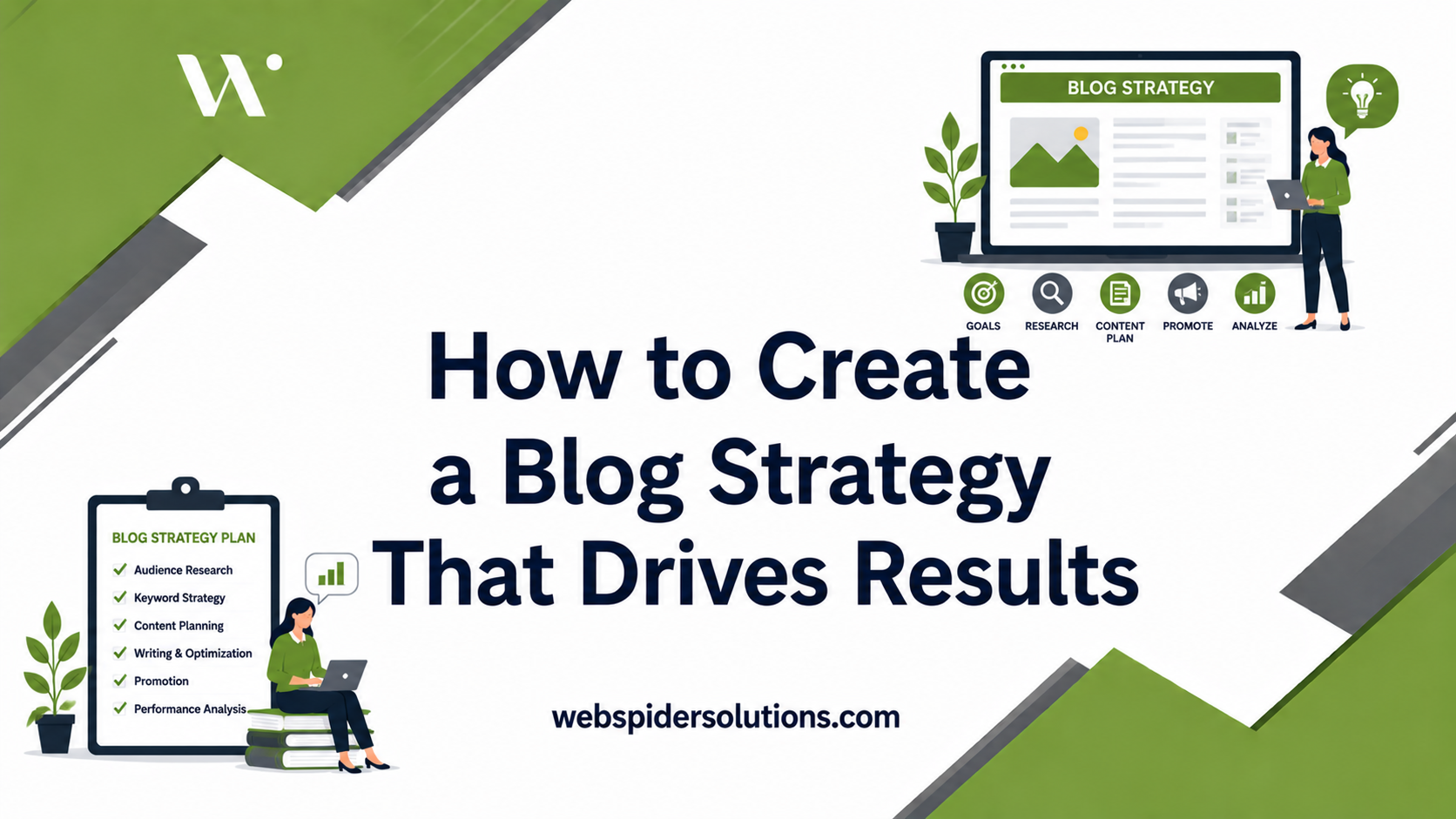
Most small to medium-sized business blogs share the same problem: they exist without a purpose. Posts go up sporadically, topics are chosen on gut instinct, and six months in, traffic is flat. Learning how to create a blog strategy changes all of that. A documented plan turns your blog from a content dump into a lead-generating, authority-building machine. This guide walks you through every step, from setting objectives and mapping keywords to building editorial calendars and measuring ROI, so your blog works as hard as the rest of your marketing.
Table of Contents
- Key takeaways
- How to create a blog strategy: foundations first
- Building the strategy step by step
- Common mistakes that kill blog strategies
- Verifying and optimizing your strategy over time
- What I have learned about strategic blogging
- Ready to build a blog strategy that actually works?
- FAQ
Key takeaways
| Point | Details |
|---|---|
| Start with clear objectives | Align every blog goal to a specific business outcome like leads, traffic, or brand authority. |
| Build around topic clusters | Connecting pillar pages with supporting posts signals topical authority to search engines. |
| Map keywords before writing | Keyword mapping determines content format, intent, and internal linking before a word is written. |
| Measure with the right models | Multi-touch attribution shows content’s full role in the pipeline, not just last-click conversions. |
| Refresh and adapt regularly | Updating keyword clusters and content performance data quarterly prevents strategy decay. |
How to create a blog strategy: foundations first
Before you write a single word, you need to get three things right: your goals, your audience, and your keyword map. Skip any one of these and you are building on sand.
Define goals that connect to revenue
Vague goals like “get more traffic” are useless. Instead, tie every blog objective to a business metric. Do you want to generate 50 new leads per month from organic search? Reduce paid ad spend by building organic authority in a specific niche? Cut sales cycle length by educating prospects before they talk to your team? Write those down. They become the filter through which every content decision passes.
A useful framework is to segment goals into three tiers: awareness (new visitors and impressions), engagement (time on page, return visits, email sign-ups), and conversion (demo requests, contact form submissions, purchases). Your content marketing plan should map directly to each tier.
Know your audience at a granular level
“SMB owners” is not an audience. “Operations managers at manufacturing companies with 20 to 100 employees who are evaluating their first CRM” is. The more specific you get, the more useful your content becomes. Build simple audience profiles that capture:
- The primary problem they need solved right now
- The questions they type into Google before they know your brand exists
- The format they prefer (how-to guides, comparisons, case studies)
- The stage of the buying journey they are in when they find you
Solving real user problems builds trust and authority far more durably than targeting keywords alone. Google rewards people-first content, and so do readers.
Keyword research and competitive analysis
A repeatable keyword research workflow moves through five stages: seed keywords, expansion, filtering, clustering, and mapping. Do not treat these as optional steps. Each stage filters out noise and sharpens your focus.
Keyword mapping guides your site structure, content format decisions, and internal linking. It tells you whether a topic needs a new page or whether you should update an existing one. It also prevents you from accidentally publishing two posts that compete against each other in search results, a problem called keyword cannibalization.

Pro Tip: Group keyword variations into clusters based on SERP overlap, not just semantic similarity. Two keywords that share three or more of the same top-ranking pages belong in the same cluster and should be served by one piece of content.
Here is a simple table to categorize your initial keyword pool before mapping:
| Keyword type | Purpose | Example |
|---|---|---|
| Pillar keyword | Anchors a broad topic page | “CRM software for small business” |
| Cluster keyword | Supports the pillar with specific subtopics | “how to import contacts into CRM” |
| Long-tail keyword | Captures high-intent, low-volume searches | “best CRM for plumbing companies under 50 employees” |
| Competitor keyword | Identifies gaps and comparison opportunities | “CRM alternative to [competitor]” |
Building the strategy step by step
With your foundation in place, you can now build the actual plan. This is where most businesses stall because they try to do too much at once. Work through these steps in order.
- Choose your content pillars. A content pillar is a broad topic that represents a core area of expertise for your business. For a digital marketing agency, pillars might include SEO, content marketing, and paid advertising. Limit yourself to three to five pillars at the start. Every post you write will belong under one of them.
- Map cluster content to each pillar. Each pillar page should connect to eight to fifteen supporting cluster articles. Pillar pages with cluster articles improve crawlability and signal deep topical authority to search engines and AI-driven ranking systems. A pillar on “content marketing” might link out to clusters on editorial calendars, content repurposing, blog measurement, and more.
- Document your content workflow. Who writes? Who edits? Who publishes and promotes? Undefined workflows are the number one reason blog strategies collapse after three months. Create a simple brief template that captures: target keyword, search intent, target URL, content type, word count estimate, internal links to include, and the CTA at the end.
- Build your editorial calendar. Start with a 90-day calendar. Map your keyword clusters to publishing slots, alternating between pillar-level content and cluster articles. Creating a blog content calendar based on keyword mapping keeps your publishing rhythm consistent and ensures every post serves the larger SEO architecture.
- Set measurable KPIs. Each blog goal from step one needs a number attached to it. Organic sessions, keyword rankings, email subscribers from blog CTAs, and assisted conversions are all valid KPIs. Track them monthly.
Pro Tip: Use a simple spreadsheet to track every post’s target keyword, publish date, current ranking position, monthly traffic, and conversion events. Review it at the end of each month. Patterns emerge fast.
Here is a comparison of two common content approaches to clarify why a structured plan outperforms ad-hoc posting:
| Approach | SEO impact | Content ROI | Scalability |
|---|---|---|---|
| Ad-hoc posting | Low, isolated pages rarely rank | Hard to attribute | Does not scale |
| Cluster-based strategy | High, topical authority compounds | Measurable across funnel | Scales with each new cluster |
Common mistakes that kill blog strategies
Even well-planned blogs run into predictable problems. Knowing what they are before they hit saves you weeks of lost momentum.
Treating posts as isolated articles rather than parts of an interconnected system is the most common reason blogs fail to rank. A post with no internal links, no pillar connection, and no supporting content gets indexed and forgotten. Structure matters more than volume.
Here are the other mistakes worth watching:
- Keyword cannibalization. Publishing two posts that target the same keyword splits your ranking potential. Effective keyword clustering by SERP overlap prevents this before it starts.
- Inconsistent publishing. A month of five posts followed by two months of silence signals unreliability to both readers and search engines. A realistic calendar you can stick to beats an ambitious one you cannot.
- Ignoring analytics. Your data tells you what is working and what is not. Blogs that run without a monthly analytics review drift from their goals without anyone noticing until it is too late.
- Measuring only last-touch conversions. Most blog readers do not convert on the first visit. Multi-touch attribution models allocate credit across all the content touchpoints a prospect interacted with before converting, giving you a far more accurate picture of which posts are actually driving pipeline.
A blog that publishes consistently around three to five well-defined content pillars will outperform a blog with three times the output but no structural coherence. Focus beats volume every time.
Verifying and optimizing your strategy over time
Publishing is not the end of the process. An effective blog strategy requires regular review and adjustment. Most businesses set-and-forget their blogs. That is where you can pull ahead.
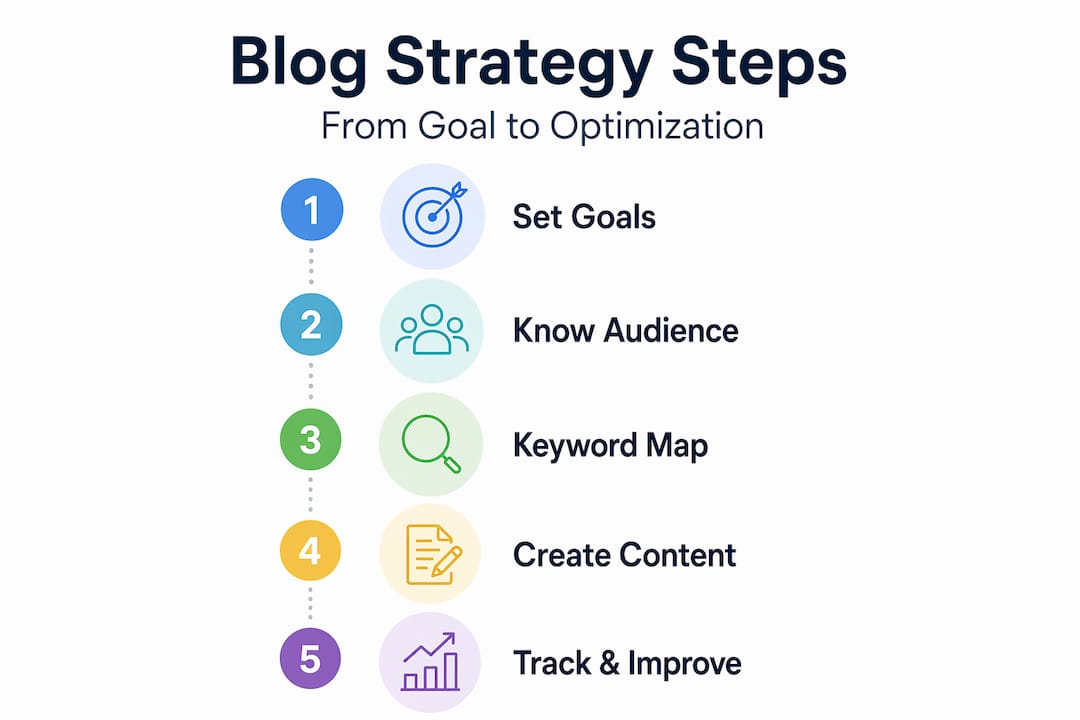
Start with a monthly analytics review focused on these metrics:
| Metric | What it tells you | Review frequency |
|---|---|---|
| Organic sessions per post | Which topics attract search traffic | Monthly |
| Average engagement time | Whether content matches reader intent | Monthly |
| Assisted conversions | Content’s role across the buying journey | Monthly |
| Keyword ranking changes | Whether topical authority is building | Monthly |
| Bounce rate by content type | Whether content format fits the audience | Quarterly |
B2B blog conversion rates typically fall between 2% and 5% for gated assets, with content ROI benchmarks running 3x to 5x content spend. Use those numbers as reference points, not targets. Your baseline matters more than industry averages at the start.
Refresh your keyword research every quarter. Search behavior shifts, new competitors enter the space, and AI-generated content floods certain keyword categories. Staying current protects rankings you have already earned.
On the technology side, publishing content that ranks and converts now benefits from tools like auto SEO, AI-assisted visuals, and personalized lead magnets. Use them to your advantage, but keep human editorial review in the loop. AI tools accelerate content creation, but quality and brand voice still require human judgment.
Pro Tip: Every six months, audit your top 20 posts by traffic. Update outdated statistics, add new internal links to recently published cluster content, and refresh the CTA to match your current offer. Existing content that ranks is your fastest path to more traffic with less effort.
What I have learned about strategic blogging
Most of the SMBs I have worked with approached blogging the same way: pick a topic, write a post, share it once on social media, wonder why nothing happened. The frustration is real. But the problem is never the writing.
What I have seen work, consistently, is treating the blog as a system. Every post has a place in a larger architecture. Pillar pages act as hubs. Cluster articles feed authority up through internal links. The whole structure becomes more valuable with every piece you add, not just when individual posts rank.
I have also noticed that the businesses that grow fastest from their blogs are the ones that start with the question their customer is already asking. Not “what do we want to say,” but “what does our reader need to know right now.” That shift changes everything about how you plan, write, and promote content.
The other hard truth: results from a well-built blog strategy rarely show up in the first 90 days. I have watched businesses give up at month two when they were three months away from their first compound growth spike. Stay consistent with your content pillars strategy and keep measuring. The data will tell you when to adjust.
— webspider
Ready to build a blog strategy that actually works?
If this guide has shown you what is possible, Webspidersolutions can help you execute it. From keyword mapping and pillar page architecture to ongoing content production and performance tracking, the team at Webspidersolutions brings the technical depth and content expertise SMBs need to compete in organic search. Start by reviewing the SEO strategy guide that covers the 14 foundational steps every business should take before scaling content output. You can also explore SEO campaign services designed to align your blog directly with business growth goals.
FAQ
What is a blog strategy?
A blog strategy is a documented plan that defines your blogging goals, target audience, content pillars, keyword approach, publishing schedule, and success metrics. It connects every post to a specific business outcome rather than treating content as a standalone activity.
How long does it take to see results from a blog strategy?
Most well-structured blog strategies begin showing measurable organic traffic growth between three and six months after consistent publishing starts. Compound growth, where multiple posts rank simultaneously, typically kicks in around the six to twelve month mark.
How do topic clusters improve blog SEO?
Topic clusters group related content around a central pillar page, with internal links connecting cluster articles back to the pillar. This structure signals topical authority to search engines, improves crawlability, and helps multiple pages rank for related keyword variations.
What KPIs should I track for my blog?
Track organic sessions, keyword rankings, average engagement time, email sign-ups from blog CTAs, and assisted conversions. Content marketing benchmarks suggest targeting a 2% to 5% conversion rate on gated assets as a performance reference point.
How often should I update my blog strategy?
Review your editorial calendar and keyword clusters monthly. Conduct a full strategy audit, including competitive analysis and pillar page performance review, every six months to keep your approach aligned with current search behavior and business goals.