
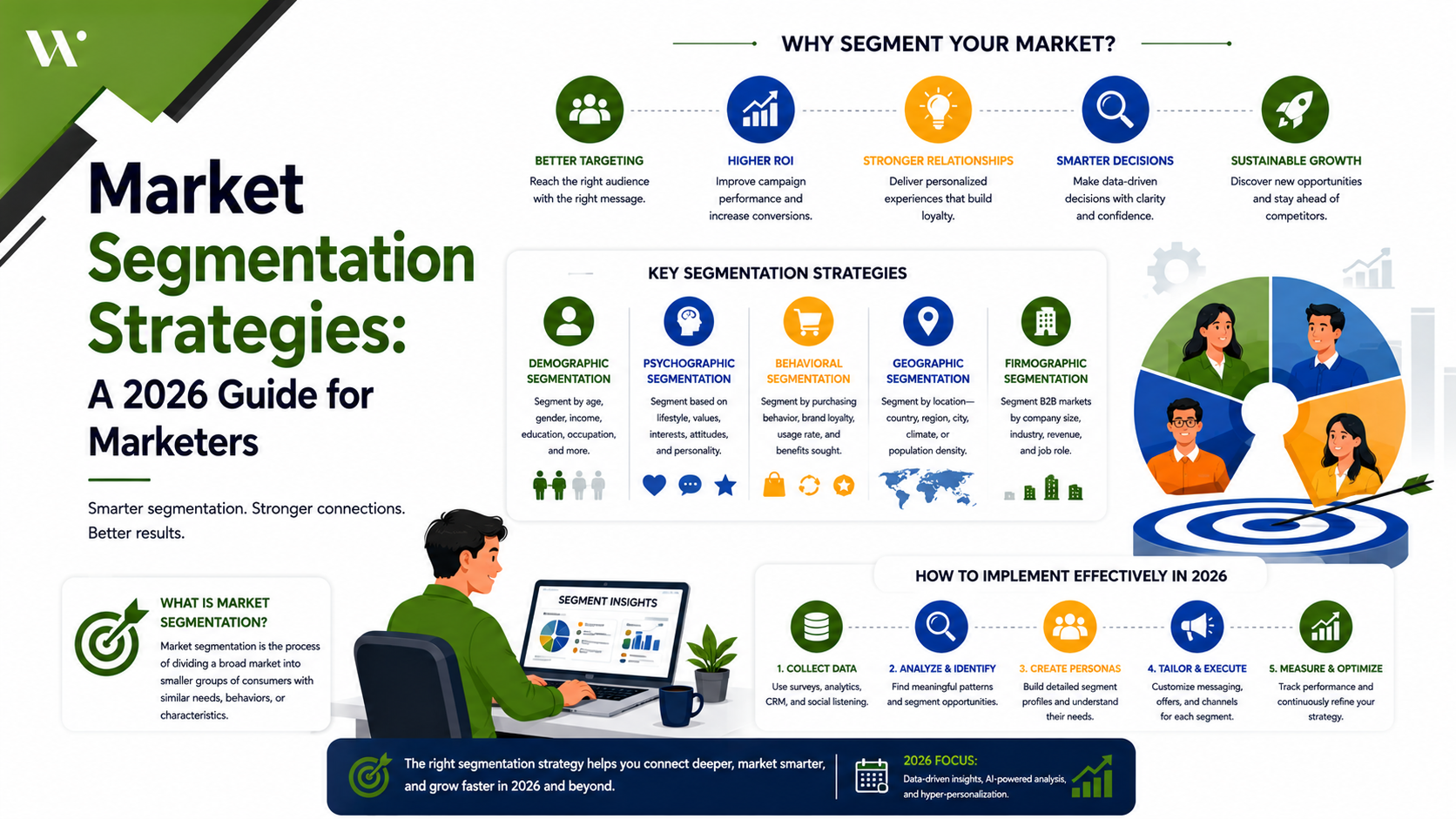






Market segmentation strategies are the methods marketers use to divide a broad customer base into smaller, distinct groups so they can target each one with precision. Done well, segmentation is the difference between a campaign that converts and one that burns budget. The four core target market strategies are undifferentiated (one message for everyone), differentiated (separate offers per segment), concentrated or niche (all resources on one segment), and micromarketing (hyper-personalized targeting at the individual or local level). Each fits a different competitive situation and resource level.
Choosing the right approach starts with understanding your segmentation bases. The most widely used are:
- Demographic: Age, income, gender, education, household structure
- Geographic: Region, city tier, climate, urban vs. rural density
- Psychographic: Values, lifestyle, motivations, personality traits
- Behavioral: Purchase frequency, loyalty, benefits sought, usage patterns
- Firmographic: Industry, company size, revenue, tech stack (B2B-specific)
For a segment to be worth pursuing, it must pass four tests: it should be measurable (you can quantify its size and value), accessible (you can reach it through owned, earned, or paid channels), substantial (large enough to justify dedicated investment), and actionable (your team can actually build and execute a plan for it). These criteria, often called the MSAA framework, filter out the segments that look interesting on paper but drain resources in practice.
The strategic payoff is real. Segmentation drives faster growth, sharper competitive positioning, and more efficient operations by aligning your marketing, product, and data strategies around who your customers actually are, not just what you want to sell.
Table of Contents
- What are the main types of market segmentation?
- How to build a market segmentation strategy step by step
- Why market segmentation delivers measurable business growth
- Segmentation in practice: what it looks like when it works
- Modern best practices in segmentation: what has changed and what still matters
- How Webspidersolutions turns segmentation insight into marketing results
- Key Takeaways
What are the main types of market segmentation?
Segmentation types are not mutually exclusive. Most mature programs layer two or three together for a richer picture of the customer.
- Demographic segmentation is the most accessible starting point. Age, income, gender, and education are easy to collect and form the first layer of any customer profile. If your product resonates with parents, for example, demographic data lets you build distinct messages for that group versus grandparents buying the same item as a gift. The limitation is that two people with identical demographics can have completely different needs and buying behavior.
- Geographic segmentation groups customers by where they live and operate. For a US-based brand, this might mean adjusting messaging for the Southeast versus the Pacific Northwest, or tailoring seasonal promotions to climate zones. For global products, geography also affects pricing expectations, regulatory requirements, and language preferences.
- Psychographic segmentation goes deeper, sorting customers by values, attitudes, and lifestyle. It is harder to quantify than demographics but often more predictive of purchase behavior. A customer who identifies as environmentally conscious will respond to a sustainability message in ways that pure demographic data would never reveal.
- Behavioral segmentation focuses on what customers actually do: their purchase history, loyalty program engagement, website activity, and the specific benefits they seek. This type is particularly useful for allocating marketing budget, because it tells you which customers are most likely to act on a given offer.
- Firmographic segmentation applies to B2B markets. Instead of age or lifestyle, you segment by industry, company size, annual revenue, and technology stack. A software vendor targeting mid-market financial services firms is using firmographic logic.
- Technographic segmentation is an emerging layer that groups customers by the tools and platforms they use, whether mobile or desktop, which apps they rely on, and their overall technology adoption patterns. It is especially relevant in SaaS and B2B contexts where the buyer’s existing tech stack shapes what they will actually buy.
Segmentation bases commonly include all of the above, often layered with value or needs-based models for prioritization. A needs-based layer asks what problem the customer is trying to solve, which tends to be the strongest predictor of willingness to pay and long-term retention.
Pro Tip: Don’t treat demographic data as a strategy. Use it to scaffold more advanced layers that incorporate behavior and psychographics. The combination produces segments that are both reachable and meaningful.
How to build a market segmentation strategy step by step
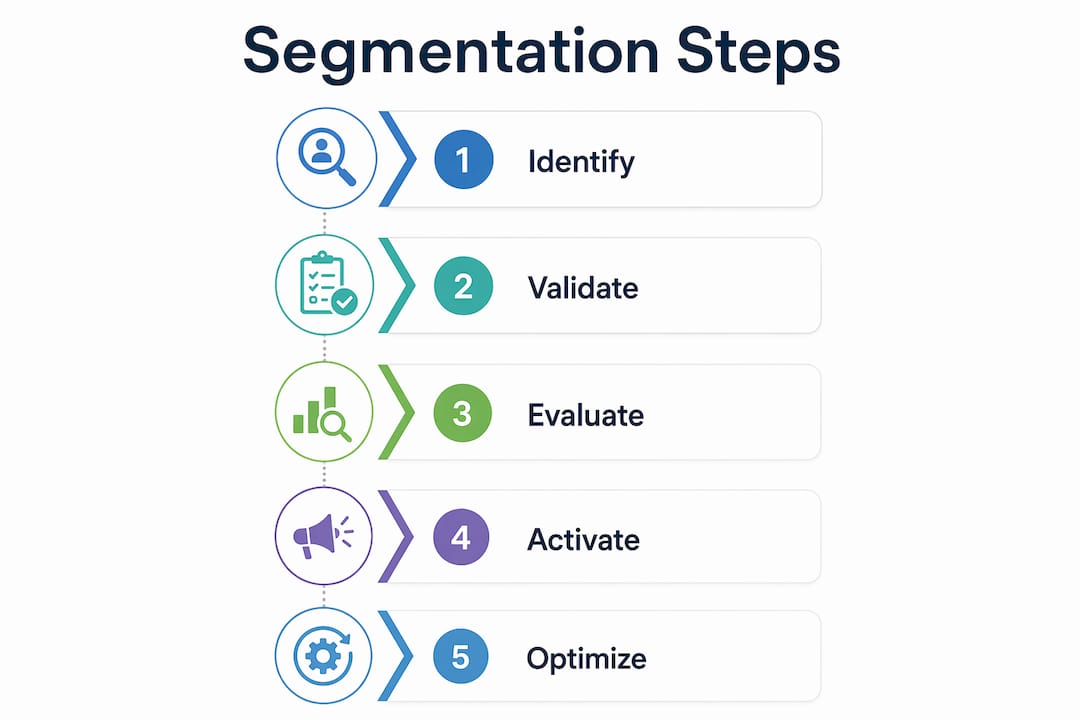
A segmentation strategy that actually gets used follows a clear process. Here is a five-step framework drawn from enterprise practice.
- Define your market. Align your team on the total addressable market, the core customer types within it, and the business goal segmentation is meant to serve. Retention, acquisition, and product expansion each require different segmentation logic. Starting without this clarity produces segments that no one knows how to act on.
- Select your segmentation variables. Choose the bases (demographic, behavioral, firmographic, etc.) that match your business goal and the data you actually have. A company with rich transaction history should lean on behavioral variables. One entering a new market may start with demographic and geographic data from secondary research.
- Analyze and validate segments. Use surveys, CRM analytics, and business intelligence tools to confirm that your proposed segments are distinct, addressable, and valuable. K-means clustering is the most widely used algorithmic method for this step, appearing in about 40% of scholarly segmentation studies. It groups customers statistically by minimizing variance within each segment.
- Operationalize segmentation. Sync your segments across your data layer, marketing stack, and activation channels. A segment that lives only in a slide deck is not a segment. It needs to be visible in your CRM, your email platform, and your paid media targeting before it has any real value.
- Test and refine continuously. Segmentation is not a one-time project. Campaign performance data, market shifts, and new customer behavior all require you to revisit and update your segments. The MSAA framework (Measurable, Substantial, Accessible, Actionable) is the right filter to apply at each refinement cycle, ensuring you only keep segments that justify continued investment.
After validation, evaluate surviving segments on two dimensions: attractiveness (size, growth rate, margin potential) and your ability to win (existing capabilities, brand permission, channel access). The STP framework (Segmentation, Targeting, Positioning) structures this decision cleanly: segment the market, target the most viable group, and position your offer around that group’s specific needs.
Pro Tip: Involve domain experts at the analysis stage. Algorithms can produce statistically distinct groups that are operationally useless. A sales leader or product manager who knows the customer will catch those problems before you build campaigns around them.

Why market segmentation delivers measurable business growth
Segmentation is not a marketing exercise. It is an operational capability that touches product, sales, and customer success.
- Better targeting, higher engagement. Generic messages are easy to ignore. When you speak directly to a segment’s specific needs and motivations, engagement and conversion rates improve. Segmentation increases the effectiveness of go-to-market strategies by aligning products, messages, and experiences to what customers actually want.
- Reduced wasted spend. High-performing teams direct budget toward the audiences most likely to act. Segmentation ensures campaigns are prioritized for those groups, cutting spend on audiences with low purchase intent.
- Stronger product development. Segmentation identifies feature gaps, emerging behaviors, and innovation opportunities. Product teams that receive clear segment-level feedback build things customers will actually use.
- Sharper competitive positioning. In crowded categories, segmentation provides the foundation for meaningful differentiation across brand positioning, pricing, and product design. It gives companies the clarity to position around specific customer needs rather than defaulting to generic value propositions.
- Higher customer retention. Customers stay longer when they feel understood. Segment-specific lifecycle touchpoints, relevant offers, and personalized support all contribute to satisfaction and loyalty.
- Cross-functional alignment. When sales, marketing, product, and customer success teams share a common segmentation schema, they prioritize the same customers and speak with a consistent voice. That alignment reduces internal friction and speeds execution.
- Expanded reach without diluted relevance. Segmentation allows you to expand reach without diluting relevance, building targeted strategies that scale across products, markets, and buyer types without reverting to one-size-fits-all messaging.
For financial services marketers specifically, this kind of precision targeting is particularly valuable. The independent advisor target market guide for 2026 illustrates how narrowing your focus to a well-defined segment consistently outperforms broad-market approaches in both acquisition cost and client lifetime value.
Segmentation in practice: what it looks like when it works
The most instructive examples of segmentation come from situations where the strategy forced a real decision, not just a categorization exercise.
A national retailer selling outdoor gear might initially segment by demographics: age 25–45, household income above $75,000, suburban and rural zip codes. That gets them to a reachable audience. But when they layer in behavioral data, they discover two distinct groups within that demographic: weekend campers who buy once or twice a year and serious hikers who buy frequently, seek technical performance, and respond to gear reviews. The messaging, pricing, and channel strategy for each group diverge sharply. The serious hiker segment, despite being smaller, generates a disproportionate share of revenue and referrals.
In B2B, a software company targeting mid-market businesses might use firmographic segmentation to identify companies with 100–500 employees in financial services and healthcare. But the real segmentation insight comes from behavioral data: which companies are actively evaluating new tools (high purchase intent) versus which are locked into existing contracts (low near-term opportunity). That behavioral layer transforms a static firmographic list into a prioritized pipeline.
The lesson across both examples is the same: the most useful segmentation variable is usually the one that predicts purchase behavior, not the one that is easiest to measure. Need intensity, as noted in target market analysis research, is one of the strongest predictors of willingness to pay and long-term retention. Segments with high need intensity are where sustainable businesses are built.
Modern best practices in segmentation: what has changed and what still matters
The biggest shift in segmentation practice over the past few years is the move from periodic projects to always-on processes. Static segments refreshed quarterly by an analyst are giving way to dynamic customer segmentation using AI and machine learning, which updates segments in real time as customer behavior evolves.
This shift has real implications. A marketer can now describe a target audience in plain language (“high-value subscribers likely to churn who haven’t engaged in 30 days”) and have an AI-driven system translate that into a precise, data-backed audience without writing SQL or waiting for a data engineering ticket. That speed changes how quickly teams can test and iterate.
But the technology does not eliminate the need for human judgment. Domain expert involvement in algorithmic segmentation is essential to ensure segments are operationally meaningful, not just statistically distinct. An algorithm might surface a cluster of customers who share behavioral patterns but have no common need that your product can address. A product manager or sales leader will catch that. An algorithm will not.
Statistic callout: K-means clustering appears in roughly 40% of scholarly segmentation studies, making it the most widely used algorithmic approach. It remains the default starting point for teams moving from rule-based to data-driven segmentation.
A few other practices that separate mature segmentation programs from amateur ones:
- Avoid over-fragmentation. Most mature companies target fewer than 10 segments, often only 4. Creating too many segments complicates execution, blurs messaging, and dilutes resources across groups too small to activate efficiently.
- Prioritize need intensity. Segments where customers feel a strong, recurring pain are more profitable and more retentive than segments defined purely by demographic convenience.
- Build for activation. Segments that cannot be pushed into your CRM, email platform, or paid media targeting are not segments. They are academic exercises. Design segmentation with your activation systems in mind from the start.
- Validate with data, not assumptions. Psychographic and behavioral segmentation in particular can drift into qualitative guesswork. Regular reanalysis against actual purchase and engagement data keeps segments grounded.
For teams building audience segmentation into their digital marketing programs, the integration point between segmentation logic and channel execution is where most value is either captured or lost. Getting that connection right, from data layer to campaign activation, is the work that separates teams that segment from teams that actually benefit from it.
Pro Tip: Combine traditional MSAA filtering with modern clustering methods. Run K-means to discover natural groupings, then apply MSAA criteria to filter out the segments that are statistically real but commercially unviable. You will end up with fewer segments that are far easier to activate.
How Webspidersolutions turns segmentation insight into marketing results
Most marketing teams can identify their segments. Fewer can activate them across SEO, paid media, content, and social in a way that actually moves revenue. That gap between insight and execution is exactly where Webspidersolutions works.
Webspidersolutions is a full-service digital marketing agency that builds and executes channel strategies grounded in audience segmentation. Whether your priority is SEO campaign performance, paid advertising, content marketing, or social media, the team at Webspidersolutions translates your segment definitions into targeted campaigns that reach the right people at the right moment. No generic messaging, no wasted spend on audiences that will never convert.
The concrete difference: instead of running one campaign to your entire database, you get segment-specific messaging, channel selection, and bidding logic built around the customers most likely to act. That precision reduces cost per acquisition and improves lifetime value, the two metrics that matter most to growth-focused marketing leaders.
Ready to put your segmentation to work? Request a consultation with Webspidersolutions and see how targeted digital execution turns customer insight into measurable growth.
Key Takeaways
Effective market segmentation strategies require selecting the right segmentation bases, validating segments with MSAA criteria, and activating them across channels with discipline and real-time data.
| Point | Details |
|---|---|
| Four core targeting strategies | Undifferentiated, differentiated, concentrated, and micromarketing each fit different resource levels and competitive situations. |
| MSAA validation is non-negotiable | Every segment must be measurable, substantial, accessible, and actionable before you commit resources to it. |
| K-means clustering leads analytics | K-means appears in roughly 40% of segmentation studies, making it the most widely used method for discovering natural customer groups. |
| Avoid over-fragmentation | Mature programs target fewer than 10 segments, often only 4, because too many segments dilute messaging and complicate execution. |
| Webspidersolutions activates segments | Webspidersolutions translates segmentation insight into targeted SEO, paid media, and content campaigns that reduce wasted spend and improve ROI. |