





TL;DR:
- Most successful agencies operate with layered, adaptive SEO strategies rather than relying on basic optimizations. They focus on technical, on-page, off-page, and content pillars, consistently auditing and refining each to sustain rankings. Integrating SEO into overall marketing efforts and fostering internal education are crucial for long-term, impactful results.
Most marketing agencies believe that publishing keyword-rich blog posts and fixing a few title tags is enough to rank and win new business online. It isn’t. The agencies that consistently dominate search results aren’t just running basic SEO checklists. They’re operating with layered, adaptive strategies that account for technical infrastructure, semantic content architecture, client vertical diversity, and measurable business outcomes. If your agency’s own website isn’t ranking for the services you sell, that’s a signal worth taking seriously. This article lays out exactly what it takes to build and sustain real SEO performance at the agency level.
Table of Contents
- Understanding SEO challenges unique to marketing agencies
- The pillars of effective SEO for marketing agencies
- On-page SEO: The details marketers can’t afford to miss
- Integrating SEO with your agency’s marketing strategy
- What most agencies overlook about SEO success
- Take your agency’s SEO impact to the next level
- Frequently asked questions
Key Takeaways
| Point | Details |
|---|---|
| SEO for agencies is specialized | Marketing agencies face unique challenges and require strategies tailored to multiple client verticals. |
| On-page basics are not enough | Strong results require rigorous execution of all core on-page, off-page, and technical elements. |
| Integrated strategies drive growth | SEO success depends on seamless integration with content marketing and broader business strategy. |
| Continuous adaptation is vital | Regularly updating your SEO playbook ensures sustained online visibility and business growth. |
Understanding SEO challenges unique to marketing agencies
Marketing agencies occupy a strange position in the SEO world. You’re expected to be the experts, but often your own website gets the least attention. Client work takes priority, and internal marketing falls to the bottom of the queue. Sound familiar?
But the problem runs deeper than bandwidth. Agencies face a genuinely different set of SEO hurdles compared to a single-industry brand.
The competitive landscape is brutal. You’re not just competing with other agencies in your city. You’re competing with global platforms, freelancer marketplaces, and well-funded digital consultancies for terms like “social media agency,” “PPC management services,” or “SEO for law firms.” Google’s algorithm updates in 2024 and 2025 have consistently rewarded deep topical authority over keyword stuffing, which means thin agency pages get crushed.
Multiple client verticals create real confusion. If your agency serves healthcare clients, e-commerce brands, and B2B SaaS companies simultaneously, your own website has to demonstrate authority across very different subject areas. A one-size-fits-all content approach doesn’t work here. You need topic clusters, clear service pages, and industry-specific landing pages that each carry their own SEO weight. Effective agency SEO growth strategies treat each service vertical as its own SEO territory.
Technical and on-page gaps are more common than you’d think. Many agency websites are built to impress visually, not to perform technically. JavaScript-heavy designs, slow load times, missing metadata, and shallow internal linking structures quietly undermine rankings.
“On-page SEO for agencies must explicitly address both human readability and search-engine indexing needs, including metadata, internal linking, image alt text, heading structure, and link quality.”
Here’s what agencies frequently miss on their own sites:
- Metadata that’s incomplete or auto-generated rather than intentional
- Internal links that don’t reflect page hierarchy or topical relevance
- Image alt text that’s either missing or stuffed with keywords
- H1 to H3 heading structures that confuse crawlers and readers alike
- User experience signals like bounce rate and dwell time that hurt rankings silently
Understanding these gaps is step one. Fixing them strategically is step two.
The pillars of effective SEO for marketing agencies
With an understanding of the unique SEO landscape for agencies, let’s establish the foundational pillars that drive success.
Strong agency SEO isn’t built on one tactic. It requires four reinforcing pillars working together. Weakening any one of them limits the entire structure.
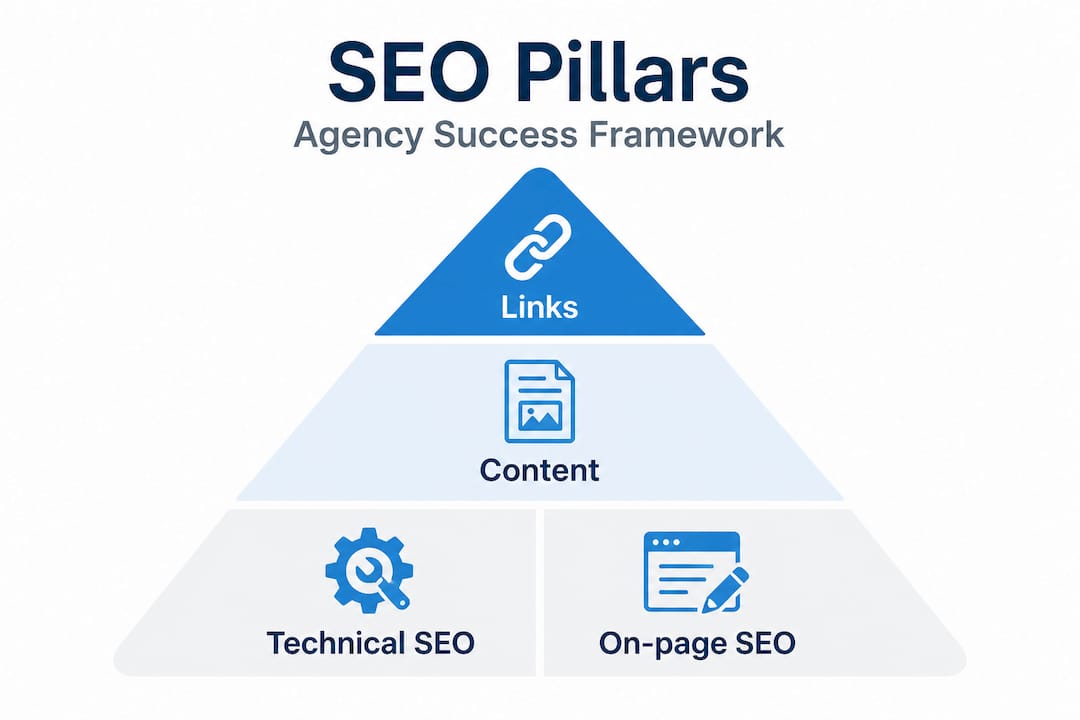
| SEO pillar | What it covers | Why it matters for agencies |
|---|---|---|
| On-page SEO | Title tags, headers, meta descriptions, alt text, internal links | Signals topical authority and improves crawlability |
| Off-page SEO | Backlinks, PR, guest posts, partnerships | Builds domain authority and referral trust |
| Technical SEO | Site speed, mobile optimization, indexation, structured data | Ensures search engines can properly access and rank your pages |
| Content strategy | Topic clusters, intent matching, readability | Attracts the right audience and supports conversion |
Each pillar needs dedicated attention. Here’s a numbered breakdown of how agencies should approach them:
- Audit your on-page elements first. Start with a full review of title tags, H1 through H3 headings, and meta descriptions across every core service page. On-page SEO best practices recommend that every page serves a single clear intent so that both humans and crawlers know exactly what the page is about.
- Build an off-page strategy around thought leadership. Guest posts on industry publications, podcast appearances, and co-authored reports generate high-authority backlinks naturally. These off-page SEO techniques outperform link-buying schemes and carry long-term domain equity.
- Make technical SEO a scheduled priority, not a one-time fix. Core Web Vitals, crawl errors, duplicate content, and canonical tag issues need ongoing monitoring. A site that was technically clean six months ago might have new problems today.
- Align content with real search intent. Google’s Helpful Content system rewards pages that genuinely answer the question a searcher is asking. Agencies that churn out content for keyword volume rather than reader value are leaving rankings on the table.
Pro Tip: Build an agency-specific on-page SEO checklist that gets applied to every new service page, case study, and blog post before it goes live. Include metadata review, internal link audit, image alt text check, and heading structure validation as non-negotiables.
On-page SEO: The details marketers can’t afford to miss
Now that we’ve identified the strategic pillars, let’s unpack the most foundational: on-page optimization and its practical impact.
On-page SEO is where intent meets execution. It’s also where most agency websites quietly fail because the details are easy to overlook at scale.

Understanding what is on-page SEO means recognizing that it’s not just about placing keywords in headlines. It’s about creating a document structure that search engines can parse and users can trust. Here’s what that looks like in practice:
Title tags: Keep them under 60 characters, front-load the primary keyword, and make them compelling enough to earn the click. A title tag like “SEO Services for B2B Companies | Web Spider Solutions” is both keyword-relevant and action-oriented.
H1 through H3 headers: Use one H1 per page, aligned with the page’s core topic. H2s should cover major subtopics, and H3s can handle supporting details. This hierarchy helps Google understand the depth of your content and helps readers skim efficiently.
Image alt text: Every image should have a descriptive alt attribute that explains what the image shows in plain language. “SEO dashboard showing organic traffic growth for a B2B client” is far more useful than “image1.jpg” or keyword-stuffed text.
Contextual internal links: Linking from one page to another using descriptive anchor text (not “click here”) passes ranking signals and helps Google map your site’s topic structure. A well-linked agency site ranks higher because Google understands how your content relates.
Here’s a look at the real impact of targeted on-page fixes for agency websites:
| On-page fix | Common before-state | Impact after optimization |
|---|---|---|
| Title tag optimization | Duplicate or missing tags | 10 to 25% improvement in click-through rate |
| Internal linking | Orphaned pages, no hierarchy | Improved crawl depth and page indexation |
| Image alt text | Missing or keyword-stuffed | Accessibility compliance + image search traffic |
| Meta descriptions | Auto-generated, repetitive | Higher snippet relevance, better CTR |
| Header structure | Single long H2 list | Improved featured snippet eligibility |
Common on-page pitfalls agencies fall into:
- Over-optimizing a single keyword to the point of unnatural repetition
- Using the same meta description across multiple service pages
- Ignoring broken internal links that bleed crawl budget
- Skipping schema markup (structured data) that could earn rich search results
Pro Tip: Run a crawl using a tool like Screaming Frog or Ahrefs every quarter and export a full list of missing metadata, broken links, and duplicate content. Prioritize fixes by page traffic and conversion value. A solid technical SEO checklist will make this process repeatable and consistent for your team.
Integrating SEO with your agency’s marketing strategy
With deep on-page refinements in place, it’s time to see how SEO harmonizes with broader agency marketing efforts.
SEO doesn’t live in a silo. The agencies that grow fastest treat SEO as an integral part of every marketing decision, not a post-production checkbox. When content, branding, PR, and SEO teams work from the same playbook, the results compound.
Here’s a step-by-step workflow for integrating SEO across your agency’s marketing function:
- Start every new content piece with keyword and intent research. Before a writer touches a brief, your SEO team should confirm the target keyword, identify competing pages, and outline the semantic terms that should appear naturally throughout the content.
- Map every piece of content to a specific funnel stage. Top-of-funnel blog posts should answer broad industry questions. Middle-of-funnel content like case studies and comparison guides should address buyer concerns. Bottom-of-funnel service pages should speak directly to purchase intent.
- Build content clusters around your core service areas. If your agency specializes in paid search, create a hub page on PPC management and link out to supporting articles about ad copy testing, bidding strategies, and remarketing. Strong content marketing services tie these clusters together into a coherent topical authority structure.
- Use SEO data to inform PR and partnership decisions. If a specific topic is generating organic traffic, pitch related guest posts to high-authority publications in that niche. Backlinks earned through relevant content are far more valuable than generic link exchanges.
- Report SEO metrics in business language, not just search metrics. Ranking improvements and traffic gains matter, but what leadership and clients care about is leads, pipeline, and revenue. Tie organic traffic to form fills, phone calls, and conversion events so that SEO ROI becomes undeniable.
Common obstacles agencies run into when integrating SEO and marketing:
- Siloed teams where SEO, content, and paid media don’t share data or strategy
- KPIs that focus on vanity metrics like impressions rather than business outcomes
- No iteration cycle, where campaigns launch and never get updated based on performance
- Agencies that don’t know how to find the right SEO agency for their own specific needs, and end up hiring generalists instead of specialists
The fix is a shared editorial calendar with SEO built in from the start, weekly cross-team syncs, and a clearly defined reporting dashboard that connects organic performance to revenue.
Effective on-page execution is most powerful when it’s tied to a broader strategy that drives real business goals, not just traffic numbers.
What most agencies overlook about SEO success
Here’s the uncomfortable truth: most agencies follow the same set of tools and checklists, and most agencies plateau at the same level of mediocrity. Everyone is using similar crawl tools, referencing the same keyword research platforms, and publishing content that looks and reads almost identically. So why do some agencies consistently outrank the rest?
The difference isn’t the tools. It’s the thinking behind them.
Standard checklists can’t account for the real-world complexity of agency SEO. They don’t know that your key service page gets most of its traffic from a narrow regional audience. They don’t know that your primary competitor dominates “near me” searches because of a local citation strategy you haven’t addressed. They don’t know that your clients’ industries have distinct seasonal search patterns that should shape your content calendar.
What high-performing agencies build instead is a living playbook. Not a static document that gets written once and forgotten. An actual system that gets reviewed quarterly, updated based on algorithm changes, tested against real performance data, and shared across the whole team. A strong SEO strategy guide gives you the framework, but your team has to adapt it to your specific competitive context.
The other thing most agencies underestimate is the role of internal education. SEO changes constantly. The agencies that stay ahead invest in ongoing learning, not just tool subscriptions. When your content writers understand search intent, your developers understand Core Web Vitals, and your account managers can speak fluently about SEO performance in client meetings, everything gets better.
Custom strategy beats templates every time. Not because templates are useless, but because templates are starting points, not destinations.
Take your agency’s SEO impact to the next level
If the strategies in this article resonate, the next move is to put a real system behind them. Web Spider Solutions has built detailed guides, hands-on SEO campaigns, and proven frameworks specifically designed for agencies and B2B businesses operating in competitive markets. Whether you’re looking to restructure your site architecture, launch targeted SEO campaigns, or learn how AI-driven SEO services delivered measurable results for a real client, the resources are here. Start with a free SEO audit to identify your highest-priority gaps, then explore the SEO strategy guide to map out the specific steps your agency needs to take in 2026 and beyond.
Frequently asked questions
What are the most critical on-page SEO factors for agencies?
Essential on-page factors include header tags, metadata, internal linking, and image alt text because they address both user and indexing needs simultaneously, which is especially important for agencies managing multiple service pages.
How do agencies show clients the ROI of SEO?
Track improvements in rankings, organic traffic, and lead quality, then connect those metrics directly to client revenue so that SEO stops being a cost line and becomes a growth driver.
Can AI tools replace strategic SEO for agencies?
AI tools support data analysis, content drafting, and technical audits, but they can’t replace the custom strategies and real-world adaptability that experienced SEO professionals bring to complex agency environments.
How often should agencies update their SEO strategies?
Review and adjust your strategy at minimum every quarter to stay aligned with Google algorithm updates, competitor moves, and shifts in client industry search trends.