






TL;DR:
- Most B2B companies mistakenly treat SEO as a quick switch, expecting instant results in rankings and leads.
- Unlike consumer SEO, agency SEO targets decision-makers with long sales cycles, reliance on account-based keywords, and trust-building content strategies.
- Effective B2B SEO requires continuous optimization, stakeholder-specific content, and measurement of pipeline impact rather than vanity metrics.
Most B2B companies treat SEO like a light switch. You flip it on, wait for rankings to climb, and expect leads to follow. But digital agency SEO doesn’t work that way. The strategies that drive consumer brands up Google’s first page rarely translate to B2B environments, where decision-makers conduct months-long research across multiple channels before ever contacting a vendor. The gap between conventional SEO thinking and what actually works for B2B agencies is wide, and closing it requires a fundamentally different playbook.
Table of Contents
- What makes digital agency SEO unique?
- Core components of a winning digital agency SEO strategy
- Latest trends shaping digital agency SEO in 2026
- How to measure and optimize your digital agency SEO campaigns
- Expert perspective: What most B2B brands miss about digital agency SEO
- Ready to elevate your B2B SEO results?
- Frequently asked questions
Key Takeaways
| Point | Details |
|---|---|
| Agency SEO is specialized | B2B digital agencies must use targeted strategies distinct from general SEO to win complex sales. |
| Comprehensive frameworks matter | Successful digital agency SEO aligns technical, content, and link-building efforts for measurable results. |
| Stay current with trends | Following the latest SEO and marketing trends is vital in the fast-evolving 2026 landscape. |
| Measure what matters | Prioritize lead quality and engagement over basic traffic stats to prove real SEO impact. |
What makes digital agency SEO unique?
Before diving into tactical steps, let’s clarify what sets agency SEO apart.
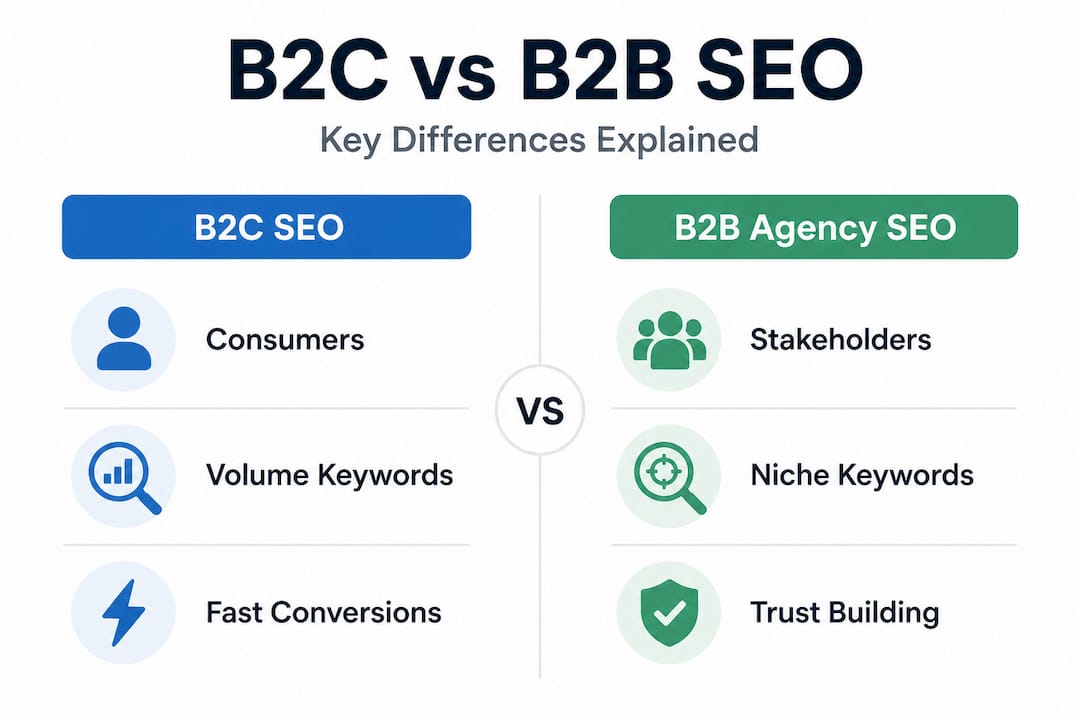
B2B agency SEO isn’t simply a stripped-down version of consumer SEO. It operates under completely different rules, timelines, and success metrics. Consumer SEO targets broad audiences who make fast, emotionally driven purchases. Agency SEO targets decision-makers, procurement teams, and C-suite executives who need hard data, vendor credibility, and industry authority before they even consider a conversation.
Here’s a side-by-side comparison to make this clear:
| Factor | B2C SEO | B2B Digital Agency SEO |
|---|---|---|
| Target audience | Individual consumers | Business stakeholders, buying committees |
| Sales cycle | Days to weeks | Months to over a year |
| Keyword intent | Transactional, emotional | Informational, navigational, research-driven |
| Content type | Product pages, reviews | Case studies, whitepapers, technical guides |
| Conversion goal | Immediate purchase | Qualified lead, demo request, consultation |
| Measurement | Revenue per click | Pipeline influenced, MQL to SQL rate |
| Ranking priority | Volume-driven keywords | Account-based, intent-specific keywords |
One of the biggest misconceptions is that chasing high-volume keywords equals more business for an agency. In reality, account-based keyword targeting (selecting keywords that mirror the language your ideal client accounts actually use) drives far better results. A keyword like “enterprise content marketing agency for SaaS” has a fraction of the volume of “content marketing agency,” but it attracts the exact buyer you want.
Digital agencies also face structural challenges that most SEO guides never address. Multiple stakeholders are involved in every buying decision. A Chief Marketing Officer might find you through organic search, but the final contract goes through a procurement team and legal department. Your SEO strategy needs to support every stage of that journey, not just the top-of-funnel discovery phase.
As the SEO Strategy Guide: 14 Must do Steps to Get Ready for 2025 makes clear, B2B SEO strategies must adapt to industry trends each year to stay effective. What worked 18 months ago may actively hurt your rankings today.
Here are the core SEO essentials every digital agency must have in place:
- Data-driven content creation built around buyer intent signals, not just keyword volume
- Multi-channel integration so your SEO strategy connects with LinkedIn, email nurture, and paid search
- Advanced analytics tracking that ties organic traffic to pipeline and revenue
- Technical SEO foundations including Core Web Vitals, structured data, and crawl efficiency
- Stakeholder-specific content addressing pain points at each level of the buying committee
Your digital marketing strategy steps must account for these factors from the very beginning, not as an afterthought.
Core components of a winning digital agency SEO strategy
Now that you know why agency SEO is unique, let’s break down the system that actually gets results.
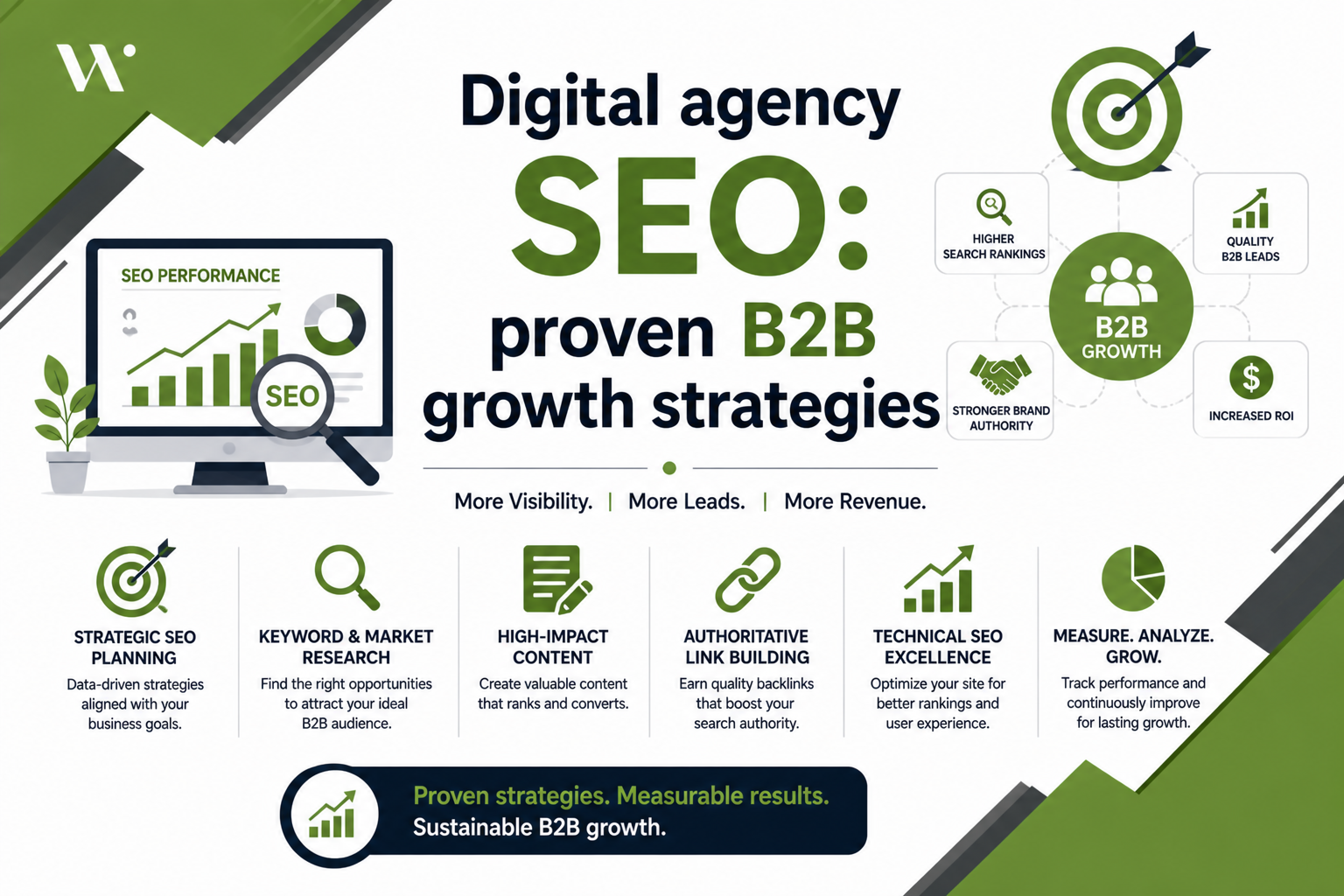
A strong B2B SEO strategy isn’t built on a single tactic. It’s a layered system where each component reinforces the others. Missing any one pillar creates gaps that competitors will exploit. As the SEO Strategy Guide confirms, a strategic SEO plan must address content, technical, and link-building pillars simultaneously.
Here’s the step-by-step framework agencies use to build rankings that last:
- Conduct a full technical SEO audit. Identify crawl errors, slow page speeds, broken internal links, duplicate content, and indexation issues. Tools like Screaming Frog, Semrush, and Ahrefs surface these problems fast. Fix the foundation before you build anything else on top of it.
- Map keywords to buyer intent stages. Create a keyword matrix that assigns terms to awareness, consideration, and decision stages. A buyer searching “what is account-based marketing” is at awareness. A buyer searching “best ABM agency for manufacturing companies” is ready to evaluate vendors. Both need different content strategies.
- Build topical authority through content clusters. Google rewards sites that demonstrate deep expertise on a subject. Structure your content around pillar pages (broad topics) and cluster pages (specific subtopics) to signal authority. For example, a pillar page on “B2B content marketing” links out to clusters covering content audits, distribution channels, and content ROI measurement.
- Optimize for conversion, not just traffic. Every page ranking in organic search should have a clear next step for the reader. Case studies should link to consultation requests. Blog posts should link to relevant service pages or gated assets. Traffic without conversion intent is wasted effort.
- Build authoritative backlinks through strategic outreach. Links from industry publications, partner sites, and authoritative directories signal trust to Google. Pitch original research, data-driven reports, or expert commentary to earn links that compound over time.
- Optimize for featured snippets and structured data. Many B2B queries trigger featured snippets or knowledge panels. Formatting content with clear headers, concise answers, and FAQ schema markup helps capture this real estate.
| Strategy Component | Recommended Tools | Expected Outcome |
|---|---|---|
| Technical SEO audit | Screaming Frog, Google Search Console | Improved crawl efficiency, faster indexing |
| Keyword mapping | Ahrefs, Semrush, Google Keyword Planner | Higher-intent traffic, better alignment |
| Content cluster development | Clearscope, Surfer SEO, MarketMuse | Topical authority, improved rankings |
| Link building | BuzzStream, Hunter.io, HARO | Domain authority growth, referral traffic |
| Conversion optimization | Hotjar, Google Analytics 4, Optimizely | More qualified leads from organic traffic |
| Structured data markup | Schema.org, Google Rich Results Test | Featured snippets, enhanced SERP visibility |
Pro Tip: Use AI-driven SEO tools like Surfer SEO or Clearscope to analyze top-ranking competitor pages before you write anything. These tools surface semantic keywords and content gaps that manual research consistently misses. Agencies that use AI and machine learning for SEO analysis are gaining measurable competitive advantages over those still relying on intuition alone.

You can explore the top SEO tools to find the right stack for your agency’s specific workflow.
Latest trends shaping digital agency SEO in 2026
To get ahead, you must keep up with the new trends that define agency SEO in 2026.
The SEO landscape rarely stays still for long. Search engine algorithms and user intent evolve rapidly, and agencies that don’t update their approach get left behind. The key digital marketing trends in 2026 demand a sharper, more adaptive strategy than anything B2B companies needed three years ago.
According to research on algorithm updates, Google makes thousands of changes to its search ranking systems each year, meaning what earns rankings today may not hold them tomorrow without continuous optimization.
Here are the five most important trends B2B agencies need to address right now:
- EEAT (Expertise, Experience, Authority, Trust): Google now evaluates not just what your content says but who is saying it. B2B agencies need named authors with documented credentials, real case studies with measurable outcomes, and third-party validation through reviews and media mentions. Generic content without a human expert behind it is increasingly invisible.
- Zero-click search results: More queries than ever resolve directly on the search results page through featured snippets, People Also Ask boxes, and AI-generated overviews. B2B agencies need to optimize for brand presence within these features, not just clicks. If Google summarizes your expertise in a featured snippet, that still builds authority even without a visit.
- AI-generated content and quality signals: Google’s focus has shifted from detecting AI-written content to evaluating quality regardless of origin. Thin, generic content fails whether a human or a machine wrote it. Agencies winning in 2026 pair AI efficiency with genuine subject matter expertise to produce content that stands out.
- Voice and conversational search: B2B buyers increasingly use voice search for quick research on mobile devices. Conversational, question-based content formatted for natural language queries is gaining ground. Structuring FAQ sections and direct-answer content blocks helps capture this traffic.
- Data privacy and first-party signals: With third-party cookies fading out, agencies must build first-party data strategies. Email subscriptions, gated content downloads, and CRM integrations give you behavioral data about potential clients that organic search alone cannot provide.
Pro Tip: Use Google Trends to monitor sudden spikes in search behavior within your target industry. When a new pain point emerges (a regulatory change, an industry disruption, a new technology), being the first agency with high-quality content on that topic earns authority before competitors even notice the shift.
The AI and machine learning revolution isn’t a future concern. It’s already reshaping which agencies rank and which ones stagnate.
How to measure and optimize your digital agency SEO campaigns
Now, let’s make sure all your efforts are moving the metrics that matter.
Measurement is where most B2B agencies fall apart. They track rankings and organic traffic but never connect those numbers to actual business outcomes. When the CMO asks whether SEO is driving revenue, the answer is “we rank on page one for these keywords.” That’s not good enough.
SEO is only as valuable as the measurable outcome it produces for your business. Here’s a practical measurement framework built for B2B agency environments:
- Define your core metrics upfront. Establish what success looks like before a campaign launches. For most B2B agencies, the right metrics are organic-attributed MQLs (marketing-qualified leads), pipeline influenced by organic, keyword rankings for target accounts, and engagement depth (time on site, pages per session, scroll depth).
- Set up proper tracking infrastructure. Use Google Analytics 4 with event-based tracking configured for key conversions: form submissions, demo requests, content downloads, and chatbot interactions. Integrate GA4 with your CRM (HubSpot, Salesforce, or similar) so you can track a lead from first organic touchpoint all the way to closed revenue.
- Conduct monthly performance reviews. Compare current performance against baselines and identify which pages are gaining or losing rankings, which content drives the most qualified traffic, and where users drop off in the conversion path. Monthly reviews catch problems before they compound.
- Run quarterly content audits. Identify underperforming pages and either update them with fresh data and expanded coverage or consolidate them with stronger pages through redirects. Stale content is a ranking liability. Refreshing it signals to Google that your site is actively maintained.
- Test and iterate continuously. Run A/B tests on page titles, meta descriptions, and calls to action. Small improvements in click-through rate compound significantly over time when multiplied across dozens of ranking pages.
The most common measurement mistake is tracking vanity metrics. Page views sound impressive in a boardroom slide. But a page that generates 10,000 views and zero qualified leads is underperforming a page that generates 200 views and three demo requests. Key SEO best practices always tie content performance to business outcomes.
Pro Tip: Build a B2B-specific reporting dashboard in Looker Studio (formerly Google Data Studio) that pulls data from GA4, Google Search Console, and your CRM. Filter views by company size or industry segment to show stakeholders exactly which accounts are engaging with your organic content.
Expert perspective: What most B2B brands miss about digital agency SEO
Here’s an inside view from the agency frontlines.
After working through dozens of B2B SEO engagements, one pattern becomes impossible to ignore. Companies that struggle with organic search aren’t failing because of poor keyword research or technical errors. They’re failing because they’re borrowing consumer tactics and applying them wholesale to a fundamentally different sales environment.
Consumer SEO optimizes for conversion speed. B2B SEO must optimize for trust accumulation. That’s a different problem requiring a different architecture. The brands winning in B2B organic search have built what we call a trust engine, a layered content system that nurtures a potential client from first awareness through months of passive engagement before a single sales conversation happens.
The contrarian insight most agencies resist: more content doesn’t mean better SEO. We’ve seen B2B companies publish 30 blog posts a month and watch their qualified lead count stay flat. Meanwhile, a competitor publishes four deeply researched pieces per quarter, earns backlinks from industry publications, and generates more pipeline from organic than from paid search combined. Depth beats volume, almost every time.
The hardest lesson from the frontlines is that SEO and sales pipeline must be aligned strategically, not just connected loosely. Your best-performing organic content should directly address the objections your sales team hears every week. When those two functions communicate, keyword strategy stops being a marketing exercise and becomes a revenue driver.
Top agencies also treat their SEO frameworks as living documents, not annual projects. Algorithm updates, competitor moves, and shifts in buyer behavior require quarterly reviews and real adjustments. The agencies that treat a digital marketing strategy as something you build once and revisit yearly are the same ones wondering why their rankings eroded without warning.
Ready to elevate your B2B SEO results?
If you’re ready to turn these insights into real results, here’s how we can help.
At Web Spider Solutions, we work specifically with B2B companies that need an SEO strategy aligned with their sales cycle, not recycled from a consumer playbook. Our complete SEO strategy guide walks you through every component of a modern agency approach, from technical foundations to content architecture to measurement frameworks. If you’re ready to move from theory to action, our SEO campaign services are built to drive qualified pipeline from organic search. Request a free audit today and find out exactly where your current strategy is leaving rankings and revenue on the table.
Frequently asked questions
How is digital agency SEO different from traditional SEO?
Digital agency SEO focuses on complex B2B sales funnels, highly targeted keywords, and building long-term buyer trust, while traditional SEO usually targets broader audiences seeking faster consumer conversions. As B2B SEO strategies must adapt to industry trends annually, the gap between these two approaches continues to widen.
What metrics should B2B companies track for SEO success?
Prioritize qualified leads, organic-attributed pipeline, keyword rankings for target accounts, and engagement depth from decision-maker audiences rather than surface-level vanity metrics. SEO value is only real when it ties directly to measurable business outcomes.
How often should a digital agency update its SEO strategy?
Agencies should review and refresh their strategies every quarter to stay ahead of Google’s ongoing algorithm updates and shifting buyer behavior patterns. Search algorithm changes are too frequent and impactful to leave strategy reviews to an annual calendar.
Does AI really make a difference in digital agency SEO?
AI tools give agencies a meaningful advantage by surfacing ranking opportunities faster, analyzing competitor content at scale, and improving content relevance through semantic analysis. The impact of AI and machine learning on modern SEO is no longer theoretical. It’s measurable.
Recommended