




Most B2B marketers plug SaaS into the same email playbook they use for eCommerce or traditional software, and then wonder why conversions stall. SaaS email is a different discipline. You’re not selling a one-time purchase; you’re building a relationship that renews every month or year. Email ROI reaches $36–$42 for every dollar spent, but only when your campaigns match the SaaS lifecycle. This guide covers the campaign types, benchmarks, personalization tactics, and deliverability rules you need to turn email into a real revenue engine.
Table of Contents
- How SaaS email marketing differs from other industries
- Essential SaaS email campaign types
- Benchmarks and KPIs for SaaS email success
- Segmentation, personalization, and automation strategies
- Deliverability and compliance: SaaS must-dos for 2026
- Case studies: Real-world SaaS email wins and lessons learned
- Take your SaaS marketing to the next level
- Frequently asked questions
Key Takeaways
| Point | Details |
|---|---|
| Focus on lifecycle campaigns | SaaS success relies on onboarding, re-engagement, renewal, and feature education emails aligned to the user journey. |
| Measure what matters | Track activation, feature adoption, churn, and revenue—not just opens and clicks—to gauge true SaaS email ROI. |
| Segment and personalize | Advanced segmentation and behavioral triggers outperform generic newsletters in driving conversions and preventing churn. |
| Prioritize deliverability | Strong list hygiene, authentication, and engagement-first practices are vital for inbox placement in 2026. |
How SaaS email marketing differs from other industries
SaaS email is not about urgency or flash sales. It’s about proving value, repeatedly, to users who can cancel at any time. That fundamental difference changes everything from your subject lines to your send schedule.
SaaS email requires trust-building over urgency, ROI proof over product hype, and composite segmentation that combines user role with actual usage data. A marketing manager at a 200-person company needs a completely different message than a solo founder on a free trial. Sending the same email to both is a fast track to unsubscribes.
Here’s what makes SaaS email structurally different from other sectors:
- Longer sales cycles mean a single email rarely closes a deal. You need sequences that nurture over weeks or months.
- Renewal and expansion revenue require ongoing activation emails, not just acquisition campaigns.
- Multiple stakeholders in one account (admin, end user, finance) each need role-appropriate messaging.
- Feature education is a core campaign type, not an afterthought.
- Behavioral data from your product is your most powerful segmentation tool.
“The biggest mistake SaaS teams make is treating email like a broadcast channel. It’s a conversation that should reflect exactly where each user is in their journey.”
Before any of this works, your technical foundation must be solid. SPF (Sender Policy Framework), DKIM (DomainKeys Identified Mail), and DMARC (Domain-based Message Authentication) are the three authentication protocols that tell inbox providers your emails are legitimate. Without them, even great content lands in spam. Pair authentication with a proper IP and domain warm-up when launching new sending infrastructure, and you’ll protect your sender reputation from day one. For a broader view of how this fits into your overall growth plan, SaaS digital marketing strategies can show you how email connects to SEO, paid media, and content.
Essential SaaS email campaign types
Every stage of the SaaS customer journey has a corresponding email campaign. Miss one, and you leave revenue on the table.
Core SaaS campaigns include onboarding sequences, feature adoption emails, renewal reminders, product updates, upsell offers, re-engagement flows, customer education, and cross-sells. Each one serves a specific job. Here’s how they map to the lifecycle:

| Campaign type | Purpose | Lifecycle stage | Key success metric |
|---|---|---|---|
| Onboarding sequence | Drive first activation | Post-signup (days 1–14) | Activation rate |
| Feature adoption | Increase product stickiness | Active users | Feature usage rate |
| Product updates | Retain and re-engage | Ongoing | Click-to-feature rate |
| Customer education | Build expertise and loyalty | All stages | Content engagement |
| Renewal reminder | Reduce involuntary churn | 30/14/7 days pre-renewal | Renewal rate |
| Upsell and cross-sell | Expand account revenue | Active, engaged users | Upgrade conversion rate |
| Re-engagement/win-back | Recover inactive users | 30+ days inactive | Reactivation rate |
The triggers that fire these campaigns matter just as much as the content. Common behavioral triggers include:
- User signs up but never completes setup
- Trial expires without conversion
- User hasn’t logged in for 30 days
- New feature launches relevant to user’s plan
- Account approaches usage limit
- Renewal date is approaching
Building email strategies for business growth around these triggers, rather than arbitrary calendar dates, is what separates high-performing SaaS teams from average ones. You can also repurpose product walkthroughs and demos using video tactics for SaaS marketing to make onboarding emails far more engaging.
Benchmarks and KPIs for SaaS email success
Knowing which campaigns matter is half the battle. Here’s how you measure and benchmark success specifically for SaaS.
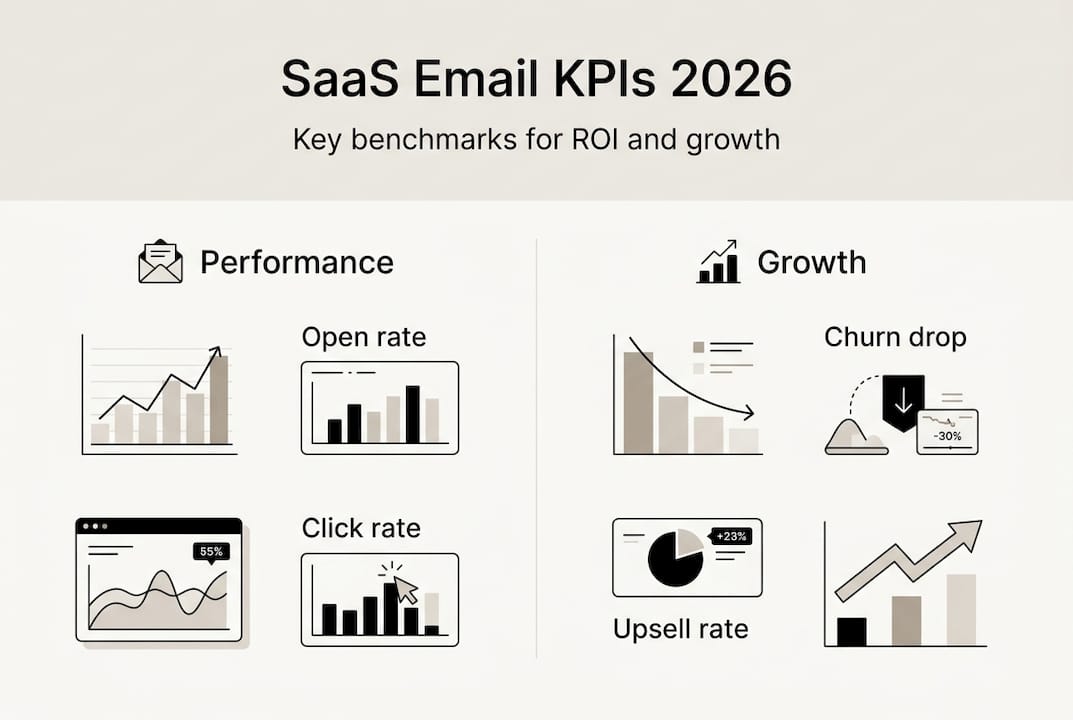
Current 2026 email benchmarks show open rates between 26.9% and 42% across all industries, though these figures are inflated by Apple Mail Privacy Protection. For SaaS and B2B specifically, realistic open rates sit at 20–36% and click-through rates at 3–5%. ROI holds at $36–$42 per dollar spent when campaigns are well-targeted.
Here’s how SaaS stacks up against other sectors:
| Metric | SaaS/B2B | eCommerce | General B2B |
|---|---|---|---|
| Open rate | 20–36% | 15–25% | 18–28% |
| Click-through rate | 3–5% | 1–3% | 2–3.5% |
| Unsubscribe rate | <0.3% | <0.5% | <0.4% |
| ROI per $1 spent | $36–$42 | $30–$38 | $28–$36 |
Open rates are a vanity metric in isolation. The KPIs that actually matter for SaaS are activation rates, feature adoption rates, churn reduction, and monthly recurring revenue (MRR) influence. A 40% open rate means nothing if nobody activates a feature or renews their plan.
The critical KPIs to track for SaaS email:
- Activation rate: Percentage of new signups who complete a key action within 14 days
- Feature adoption rate: Users who engage with a promoted feature after an email
- Churn reduction rate: Decline in cancellations attributable to re-engagement or renewal campaigns
- MRR influence: Revenue directly tied to email-driven upgrades or renewals
For a complete picture of performance, explore top SaaS marketing KPIs to align your email metrics with broader business goals.
Pro Tip: Connect your email platform to your CRM and product analytics tool. This lets you attribute MRR changes directly to specific campaigns, not just track clicks in isolation.
Segmentation, personalization, and automation strategies
After establishing what and how to measure, let’s focus on maximizing results through smarter targeting and automation.
Segment by usage, role, and engagement score, and personalize beyond the first name. Use actual feature usage data, company size, and pain points to craft messages that feel written for one person, not a list of thousands. A power user who logs in daily needs a very different email than someone who signed up last week and hasn’t returned.
Behavior-triggered emails outperform time-based sends by 2–3x in conversions. Sending a re-engagement email because someone hit 30 days of inactivity is far more effective than sending a weekly newsletter on Tuesday at 10am regardless of user behavior.
Here’s how to build a simple automated re-engagement flow:
- Identify inactivity threshold: Flag users who haven’t logged in for 30 days.
- Send email 1 (day 30): Friendly check-in with a single CTA to return to the product.
- Wait 5 days: If no action, send email 2 with a specific feature highlight relevant to their role.
- Wait 7 days: If still inactive, send email 3 with a direct offer (discount, extended trial, or a free strategy call).
- Final step (day 50): Send a “we’re about to remove you” email. This one often has the highest reactivation rate of the sequence.
- Suppress non-responders: Move them to a low-frequency list to protect deliverability.
For deeper personalization, personalization strategies for SaaS can help you go beyond basic merge tags. And if you need help crafting the actual copy, SaaS content writing tips offer a practical starting point.
Pro Tip: A/B test CTA placement and send timing, not just subject lines. Moving a CTA from the bottom to the middle of an email can lift clicks by 15–20% in some SaaS campaigns.
Deliverability and compliance: SaaS must-dos for 2026
Even the best SaaS email content won’t work if it doesn’t land in the inbox. Here’s what you need to stay compliant in 2026.
Deliverability in 2026 requires warming up new IPs and domains gradually, monitoring Google Postmaster Tools daily, segmenting your most engaged users for initial sends, and ensuring full authentication alignment following Gmail and Yahoo’s updated sender requirements. These are not optional best practices anymore. They’re table stakes.
Common deliverability pitfalls to avoid:
- Sending to purchased or unverified lists
- Ignoring bounce notifications and letting hard bounces accumulate
- Using spam-trigger words in subject lines (“free,” “guaranteed,” “act now”)
- Failing to include a clear, one-click unsubscribe option
- Sending high-volume campaigns from a cold domain
- Neglecting re-permission campaigns for lists older than 12 months
SPF, DKIM, and DMARC alignment is now a baseline requirement, not a bonus. Keeping bounce rates below 0.5% and spam complaint rates below 0.1% is essential for maintaining inbox placement across major providers. Gmail and Yahoo both enforce these thresholds actively in 2026.
List hygiene is not a quarterly task. It’s ongoing. Remove hard bounces immediately, suppress chronic non-openers every 90 days, and run re-permission campaigns before you reach the complaint threshold.
Pro Tip: Set up a dedicated subdomain for marketing emails (for example, mail.yourapp.com) separate from your transactional email domain. This protects your core domain reputation if a campaign underperforms.
Case studies: Real-world SaaS email wins and lessons learned
To bring all these strategies to life, here are stories and numbers from companies using SaaS email marketing right.
Case study 1: Onboarding overhaul
A mid-market project management SaaS had a 60% drop-off between signup and first project creation. They rebuilt their onboarding sequence around behavioral triggers instead of a fixed 5-day drip. Users who hadn’t created a project within 48 hours received a targeted email with a 2-minute video walkthrough. Activation rate jumped from 22% to 41% in 90 days.
Case study 2: Churn prevention through education
A B2B analytics platform noticed that users who never engaged with their reporting feature churned at 3x the rate of those who did. They launched a 3-part education sequence triggered when a user hadn’t accessed reports after 14 days. Churn in that segment dropped by 28% within one quarter.
Case study 3: Win-back campaign
A SaaS HR tool ran a win-back flow for users inactive for 45 days. The final email in the sequence, a plain-text message from the CEO, generated a 19% reactivation rate. Behavior-triggered sequences outperform time-based sends by 2–3x, and this campaign proved exactly that.
“The plain-text CEO email outperformed every designed template we’d ever sent. Authenticity converted where polish failed.”
Key lessons from these examples:
- Trigger emails on product behavior, not calendar dates
- Education campaigns reduce churn as effectively as discount offers
- Simple, personal emails often outperform heavily designed ones
- Measure activation and feature adoption, not just opens
For fresh ideas on keeping your audience engaged beyond email, creative SaaS content ideas can complement your campaigns with content that builds brand trust.
Take your SaaS marketing to the next level
The strategies in this guide work. But executing lifecycle campaigns, behavioral automation, segmentation, and deliverability management simultaneously takes more than good intentions. It takes a system. At Webspider Solutions, we help SaaS and B2B digital marketing services clients build exactly that, from campaign architecture to ongoing optimization. Whether you’re starting from scratch or fixing a broken funnel, our team brings the digital marketing skills to move fast and measure what matters. Ready to see what a purpose-built SaaS email strategy looks like for your product? See SaaS marketing solutions and let’s build something that actually grows your MRR.
Frequently asked questions
What email open and click rates should SaaS marketers expect in 2026?
SaaS email open rates average 20–36% and click-through rates 3–5% in 2026. Note that open rates are partially inflated by Apple Mail Privacy Protection, so weight your decisions toward click and conversion data.
Which SaaS email campaigns help reduce churn?
Re-engagement flows for users inactive over 30 days and customer education sequences targeting underused features are the most proven churn-reduction tactics in SaaS email.
How can I improve SaaS email deliverability in 2026?
Warm up new domains gradually, align SPF, DKIM, and DMARC records, and keep hard bounces below 0.5% and spam complaints below 0.1% for reliable inbox placement.
What’s the best way to personalize SaaS email campaigns in 2026?
Segment by user role and feature usage rather than just name. Behavior-based triggers tied to actual product activity consistently outperform static, time-based personalization.