
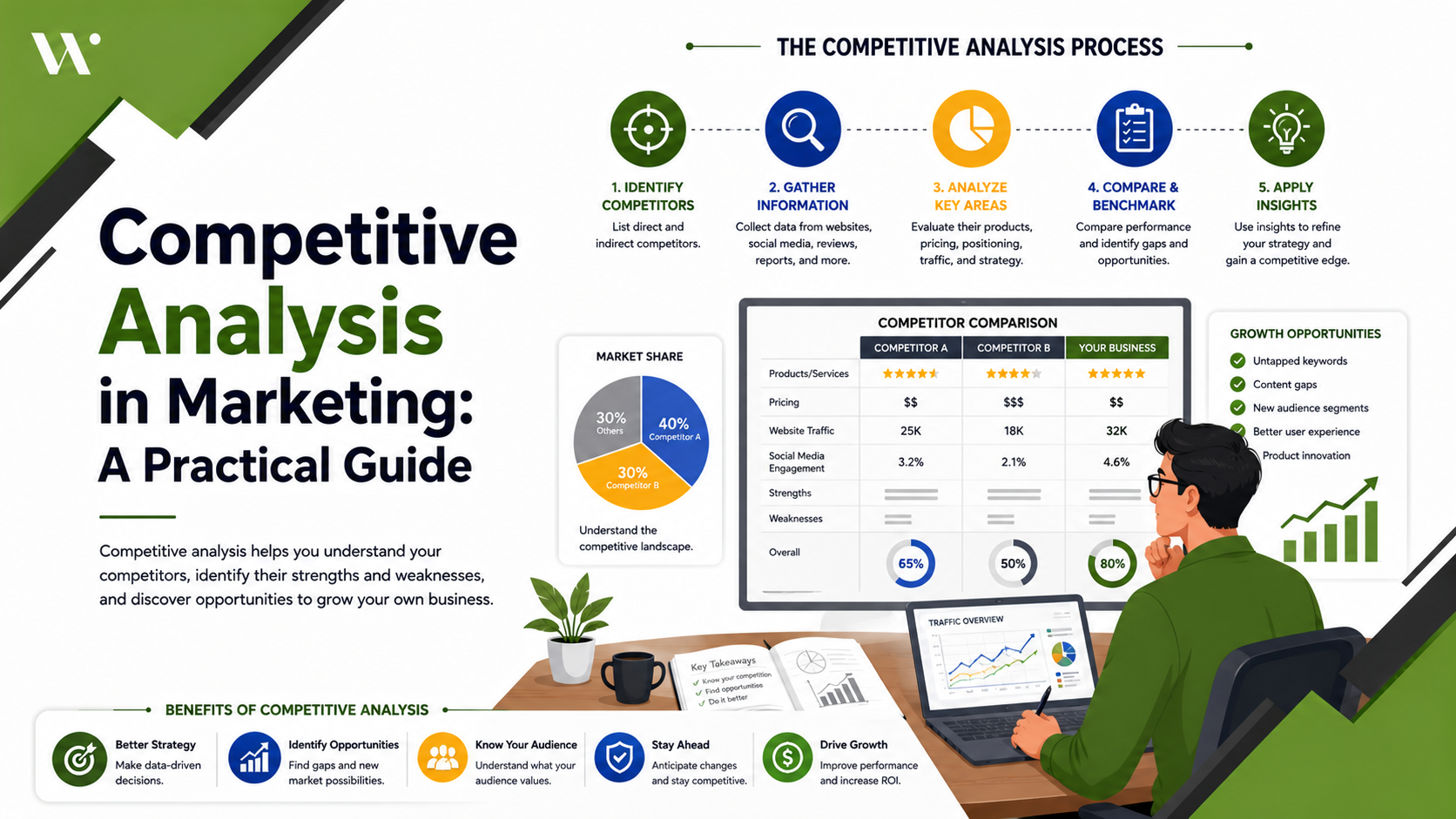






Competitive analysis in marketing is the systematic process of researching your competitors’ strengths, weaknesses, positioning, pricing, and messaging so you can make smarter decisions about your own strategy. The U.S. Small Business Administration frames it plainly: competitive analysis helps you learn from businesses competing for your potential customers, and that learning is what creates sustainable revenue. If you skip it, you’re essentially flying blind while everyone else has a map.
What competitive analysis in marketing actually does for your business
Done right, competitor research tells you where the market is crowded, where it’s open, and what customers are not getting from anyone yet. That last part is the real prize. The U.S. Small Business Administration recommends assessing these specific areas when you evaluate the competitive field:
- Market share: Who owns what slice of the audience, and how defensible is it?
- Strengths and weaknesses: Where do rivals excel, and where do they consistently fall short?
- Market entry windows: Are there timing or positioning gaps you can move into?
- Barriers to entry: Regulations, switching costs, brand loyalty, or distribution advantages that protect incumbents.
- Indirect and substitute competitors: Players who solve the same customer problem through a different product or category.
The benefits go beyond awareness. A thorough analysis helps you sharpen your value proposition, prioritize product features, allocate your ad budget more precisely, and write messaging that lands because it speaks to gaps your competitors ignore. For marketing professionals managing campaigns and for business owners setting direction, this kind of structured research replaces guesswork with evidence.
How to identify and categorize your competitors

Most businesses undercount their real competition. They track the two or three names everyone knows and miss the indirect players quietly pulling customers away. A more useful approach is to identify several key competitors and sort them into three tiers.

Direct competitors sell the same product or service to the same customers. If you run a B2B SEO agency in the United States, other U.S. SEO agencies targeting mid-market companies are your direct competitors. Indirect competitors solve the same underlying problem through a different solution. A company that sells marketing automation software competes indirectly with an agency because both promise more leads. Substitute competitors are the alternatives customers reach for when they decide not to buy from anyone in your category at all, like hiring an in-house marketing coordinator instead of an agency.
Tiering your competitors focuses your effort where the threat is highest. You can’t research everyone at the same depth, so direct competitors get the most attention, indirect ones get periodic monitoring, and substitutes get tracked mainly for messaging shifts. To build your initial list, combine SEO keyword research (who ranks for your core terms), customer interviews (who else did they consider?), and market data from sources like the U.S. Census Bureau’s business data tools. Document each competitor in a profile that captures their core offer, primary audience, pricing tier, and main marketing channels before you go any deeper.
Pro Tip: Ask your sales team which names come up most often when prospects say they’re “also looking at” someone else. That list is often more accurate than any keyword tool.
Step-by-step process to conduct a thorough competitor analysis
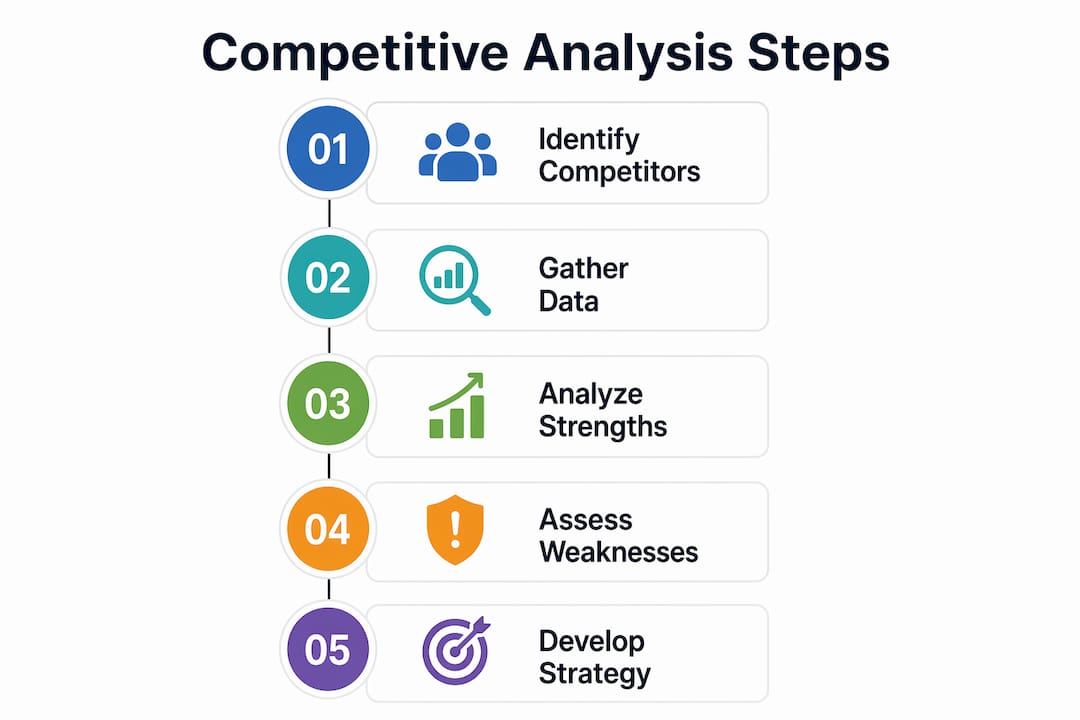
A structured, stepwise process is what separates a useful competitive analysis from a pile of browser tabs. Here’s how to run one that actually produces decisions:
- Identify your competitors. Use the tiering method above. Aim for several names across direct, indirect, and substitute categories.
- Define your research dimensions. Decide upfront what you’re measuring: product features, pricing models, brand positioning, marketing channels, messaging tone, and estimated market share. Defining dimensions before you collect data keeps the research focused.
- Collect your data. Pull from public sources: competitor websites, landing pages, pricing pages, job postings, press releases, customer reviews, and social media. Job postings alone reveal a lot about where a competitor is investing.
- Build a competitor comparison matrix. A side-by-side grid with competitors as columns and your research dimensions as rows makes gaps and patterns visible at a glance. Tools like structured competitor matrices help organize complex data efficiently.
- Run a SWOT analysis per competitor. For each rival, map out their Strengths, Weaknesses, Opportunities they’re pursuing, and Threats they face. SWOT is the bridge between raw data and strategic insight.
- Find the gaps. Cross-reference your SWOT findings to identify underserved customer segments, unaddressed pain points, or channels no one is using well.
- Build an action plan. Assign owners, timelines, and specific tactics to each gap you decide to pursue. Data without action doesn’t move the needle.
Pro Tip: Assign one team member the role of “devil’s advocate” before you finalize conclusions. Confirmation bias is the single biggest threat to accurate competitive analysis. Someone whose job is to challenge the group’s assumptions will surface blind spots that consensus thinking buries.
Update the full analysis every 6–12 months. Digital marketing tactics and PPC strategies shift fast enough that analysis older than a year can lead to decisions based on a market that no longer exists.
What data to collect and which tools actually help
Competitive data falls into two buckets, and you need both. Relying on just one leads to strategic blind spots.
Qualitative sources tell you the story behind the numbers:
- Brand messaging and tone across website copy, ads, and social media
- Customer sentiment from review platforms like G2, Trustpilot, and Google Reviews
- Case studies and testimonials that reveal which customer problems a competitor emphasizes
- Social media engagement patterns, including what content gets shared and what gets ignored
Quantitative sources give you the hard benchmarks:
- Organic traffic estimates and keyword rankings from SEO tools
- Pricing models and published rate cards
- Social follower counts and posting frequency
- Financial indicators from public filings or databases like the Bureau of Labor Statistics
Organize everything in a dedicated research folder per competitor. Include screenshots of their homepage copy, pricing pages, top-performing ads, and customer reviews. This prevents your analysis from drifting toward general impressions and keeps it grounded in actual evidence.
The table below shows a practical structure for organizing competitor data across key dimensions:
| Dimension | What to capture | Where to find it |
|---|---|---|
| Positioning | Core value proposition, tagline | Competitor homepage, About page |
| Pricing | Tiers, entry price, free trial | Pricing page, sales calls |
| Top channels | SEO, paid search, social, email | SEO tools, ad libraries |
| Messaging tone | Formal, casual, technical, emotional | Website copy, social posts |
| Customer sentiment | Common praise and complaints | G2, Trustpilot, Google Reviews |
| Content strategy | Blog topics, format, frequency | Blog, YouTube, LinkedIn |
Pro Tip: For analyzing marketing data at scale, pair your qualitative folder with a spreadsheet that tracks quantitative metrics quarterly. The combination shows you not just where competitors stand today but which direction they’re moving.
How to turn competitive analysis findings into marketing strategy
Findings are only valuable when they change what you do. Competitive analysis results should directly update your positioning statements, product roadmap, messaging, and sales materials. Here’s how that translation works in practice:
- Refine your positioning statement. If three direct competitors all lead with “fast delivery,” and your research shows customers actually care more about accuracy, you have a clear opening. Lead with accuracy.
- Prioritize product features. When your matrix shows a gap, say no competitor offers a self-serve onboarding option, that’s a roadmap signal, not just a marketing note.
- Design differentiated messaging. Use the language customers use in reviews of your competitors’ products. Their exact words about frustrations and wishes are your copywriting brief.
- Exploit channel gaps. If your competitors are all running paid search but none have a meaningful LinkedIn presence, and your audience is B2B, that’s a low-competition channel worth testing.
- Tailor your sales content. A one-page comparison sheet that addresses the specific weaknesses you’ve documented in competitor products gives your sales team a concrete tool, not just talking points.
The goal is finding whitespace, the underserved segments and unmet needs where you can differentiate rather than just compete on the same terms as everyone else. Copying a competitor’s strategy rarely works because you’re always a step behind. Finding what they’re missing is where the real advantage lives.
Competitive intelligence also feeds directly into paid search strategy. Knowing which keywords competitors bid on, what ad copy they test, and where their landing pages are weak lets you build PPC campaigns that target the gaps rather than fighting for the same clicks at inflated CPCs.
Expert insights from Webspidersolutions on doing this well
The mechanics of competitive analysis are teachable. The discipline to do it consistently and honestly is harder. At Webspidersolutions, working with clients across competitive digital markets, a few patterns show up repeatedly in the analyses that actually change strategy versus the ones that sit in a folder.
Assign the devil’s advocate role formally. Teams almost always find what they’re looking for in competitor research. If you expect a competitor to be weak on content, you’ll find evidence of that and discount the evidence of their strengths. Giving one person the explicit job of arguing the opposite forces the group to confront uncomfortable data.
Document with specifics, not summaries. A research folder that says “Competitor X has good content” is useless. One that includes screenshots of their top three blog posts by traffic, their exact meta descriptions, and the review quotes where customers praise their support team is a working document. Detailed competitor folders with exact marketing materials and customer feedback are what separate rigorous strategy from educated guessing.
Don’t confuse competitor marketing claims with market reality. A competitor’s website says they’re the “industry leader.” Their Trustpilot reviews say response times are slow and billing is confusing. The reviews are closer to the truth. Always cross-reference what competitors say about themselves with what their customers say.
Update on a schedule, not just when something feels off. Markets shift before you notice the shift. Building a marketing strategy without current competitive data is like navigating with last year’s GPS maps. Set a calendar reminder every six months and treat the update as a standing deliverable, not an optional project.
The goal is differentiation, not imitation. The most common misuse of competitive analysis is using it to copy what’s working for rivals. That approach puts you permanently in second place. The right question is always: what are they not doing, and why might customers want that?
Real-world examples of competitive analysis in action
Abstract frameworks are easier to apply when you can see them in a concrete situation. Here are two scenarios that illustrate how competitive analysis shapes real marketing decisions.
A SaaS company repositioning against a crowded field
A mid-sized project management software company ran a full competitor matrix and discovered that every major player in their space led with “collaboration” as their core message. Customer reviews across those competitors, however, showed a recurring complaint: the tools were powerful but took weeks to set up. The company repositioned around “ready in a day” and built their entire content strategy around onboarding speed. They didn’t build a new product. They found a gap in how the existing product was being communicated, and the messaging shift drove a measurable increase in trial signups within one quarter.
A local service business identifying channel gaps
A regional HVAC company in the Midwest ran a basic competitive analysis using Google search results, Google Business Profile reviews, and a manual audit of competitor websites. They found that all three of their direct competitors had strong Google Ads presence but almost no organic content. None had a blog, none had FAQ pages, and none had optimized their service pages for long-tail search terms. The company invested in a content program targeting those terms and, within eight months, was ranking on the first page for searches their competitors were paying to appear on. The competitor analysis process didn’t require expensive tools. It required looking carefully at what was already visible.
Ethical boundaries in gathering competitive intelligence
Competitive intelligence is legitimate and legal when it draws on publicly available information. The line gets crossed when the methods involve deception, unauthorized access, or misrepresentation.
Ethical sources include competitor websites, published pricing, job postings, press releases, public financial filings, patent databases, industry reports, customer reviews on public platforms, and social media. Attending industry conferences and listening to competitor presentations is also fair game. These sources give you a substantial amount of usable intelligence without any ethical risk.
What crosses the line: posing as a potential customer to extract proprietary pricing or roadmap information, accessing competitor systems without authorization, hiring employees specifically to extract confidential data, or using non-public information obtained through deception. Beyond the ethical problems, these approaches carry legal exposure under trade secret law and the Computer Fraud and Abuse Act.
A practical rule: if you’d be uncomfortable explaining your data collection method to a journalist or a judge, don’t use it. The publicly available information is extensive enough that there’s no need to go further. The U.S. Small Business Administration and most business strategy frameworks treat public market research as the standard, and that standard covers everything a well-run competitive analysis actually needs.
Key Takeaways
Competitive analysis in marketing works when it combines structured data collection, honest interpretation, and a clear commitment to finding differentiation rather than copying what rivals already do well.
| Point | Details |
|---|---|
| Use a tiered competitor list | Identify 5–7 competitors across direct, indirect, and substitute categories to focus research effort. |
| Balance data types | Pair quantitative metrics (traffic, pricing, market share) with qualitative insights (reviews, messaging) to avoid blind spots. |
| Update every 6–12 months | Analysis older than a year risks decisions based on a market that has already shifted. |
| Document with specifics | Research folders with screenshots, exact copy, and review quotes produce better strategy than summary impressions. |
| Find whitespace, not templates | The goal is identifying what competitors miss, not replicating what they do. |