

Pay per click advertising is making waves for businesses that want fast results without wasting time. But while most people think the highest bidder always wins, that’s not how the game is played. The real winners are the ones who combine smart keyword choices with relevance, and that’s why simply spending more does not guarantee your ad will show up first in Google’s results. There is a deeper formula at work, and once you see how it runs behind the scenes, you’ll understand why some companies pay less and get better results.
Quick Summary
| Takeaway | Explanation |
|---|---|
| PPC advertising is performance-based. | Businesses only pay when ads are clicked, making it cost-effective compared to traditional advertising. |
| Keyword selection is crucial. | Choosing the right keywords helps target the specific audience and improves ad visibility. |
| Continuous optimization is necessary. | Regularly updating and refining campaigns ensures better performance and return on investment. |
| Ad relevance impacts placement. | High-quality ads related to user searches improve rankings and visibility in PPC campaigns. |
| Use diverse advertising platforms. | Different PPC platforms offer unique targeting options and can enhance marketing effectiveness. |
What is PPC Advertising and How Does it Work?
PPC (Pay Per Click) advertising represents a targeted digital marketing strategy where businesses pay a fee each time their online advertisement gets clicked. Unlike traditional advertising models that charge for ad placement, PPC operates on a performance-based model that allows companies to directly purchase targeted website visits.
The Core Mechanics of PPC Advertising
At its fundamental level, PPC advertising functions as an auction-based system where advertisers bid on specific keywords relevant to their target audience. When potential customers search for those keywords, the advertiser’s ad may appear in prominent positions on search engine results pages or digital platforms. Discover more about our PPC advertising strategies to maximize your digital marketing potential.
The process involves several critical components:
- Keyword Selection: Carefully choosing search terms potential customers might use
- Ad Creation: Developing compelling ad copy that attracts user attention
- Bid Management: Setting competitive prices for ad placement
- Landing Page Optimization: Ensuring the destination page converts clicked traffic
Understanding PPC Platform Dynamics
According to Cornell University’s digital marketing research, PPC platforms like Google Ads, Facebook Ads, and Microsoft Advertising have sophisticated algorithms that determine ad placement. These systems evaluate multiple factors beyond just the monetary bid, including:
- Ad relevance to search query
- Historical click-through rates
- Quality of the linked landing page
- Advertiser’s overall account performance
This means businesses cannot simply outspend competitors but must create high-quality, relevant advertising experiences to succeed in PPC marketing. The most effective campaigns combine strategic keyword targeting, compelling ad copy, and well-designed landing pages that provide genuine value to potential customers.
The Importance of PPC Advertising in Digital Marketing
PPC advertising has emerged as a critical strategy for businesses seeking immediate, measurable, and targeted digital marketing results. Unlike organic marketing strategies that require substantial time and effort to generate visibility, PPC provides an accelerated pathway to reach potential customers precisely when they are searching for specific products or services.
Strategic Visibility and Instant Market Engagement
In today’s competitive digital landscape, businesses need rapid methods to connect with their target audience. Learn about our comprehensive PPC best practices to maximize your digital marketing effectiveness. According to American Marketing Association research, PPC advertising offers several transformative advantages for businesses:
- Immediate Traffic Generation: Instant visibility on search engine results pages
- Precise Audience Targeting: Granular control over demographic and geographic reach
- Measurable Performance: Real-time tracking of ad performance and return on investment
- Budget Flexibility: Complete control over advertising spend and campaign parameters
Cost-Effective Marketing with Predictable Outcomes
PPC advertising stands out as a data-driven marketing approach that provides unparalleled transparency and control. Businesses can allocate their marketing budgets strategically, knowing exactly how much they spend per click and tracking the direct correlation between advertising expenditure and generated revenue.
The key differentiator of PPC is its performance-based model. Unlike traditional advertising methods where businesses pay for potential exposure, PPC ensures that marketing budgets are spent exclusively on verifiable customer interactions. This approach transforms advertising from a speculative expense into a precise, measurable investment in business growth.
Key Concepts and Terminology in PPC Advertising
Understanding PPC advertising requires familiarity with specific terminology that defines how digital advertising campaigns function. These technical terms provide marketers with a precise language to discuss strategy, performance, and optimization techniques.
Essential PPC Advertising Definitions
Explore our comprehensive guide to PPC advertising mechanics to gain deeper insights into these fundamental concepts. According to research from the Association of College & Research Libraries, key PPC terminology includes:
- Keywords: Specific search terms that trigger your advertisements
- Impressions: Number of times your ad appears on search results
- Click-Through Rate (CTR): Percentage of people who click your ad after seeing it
- Conversion: Specific action taken by a user after clicking your advertisement
Advanced PPC Performance Metrics
Beyond basic definitions, successful PPC campaigns rely on understanding nuanced performance indicators. These metrics provide granular insights into advertising effectiveness:
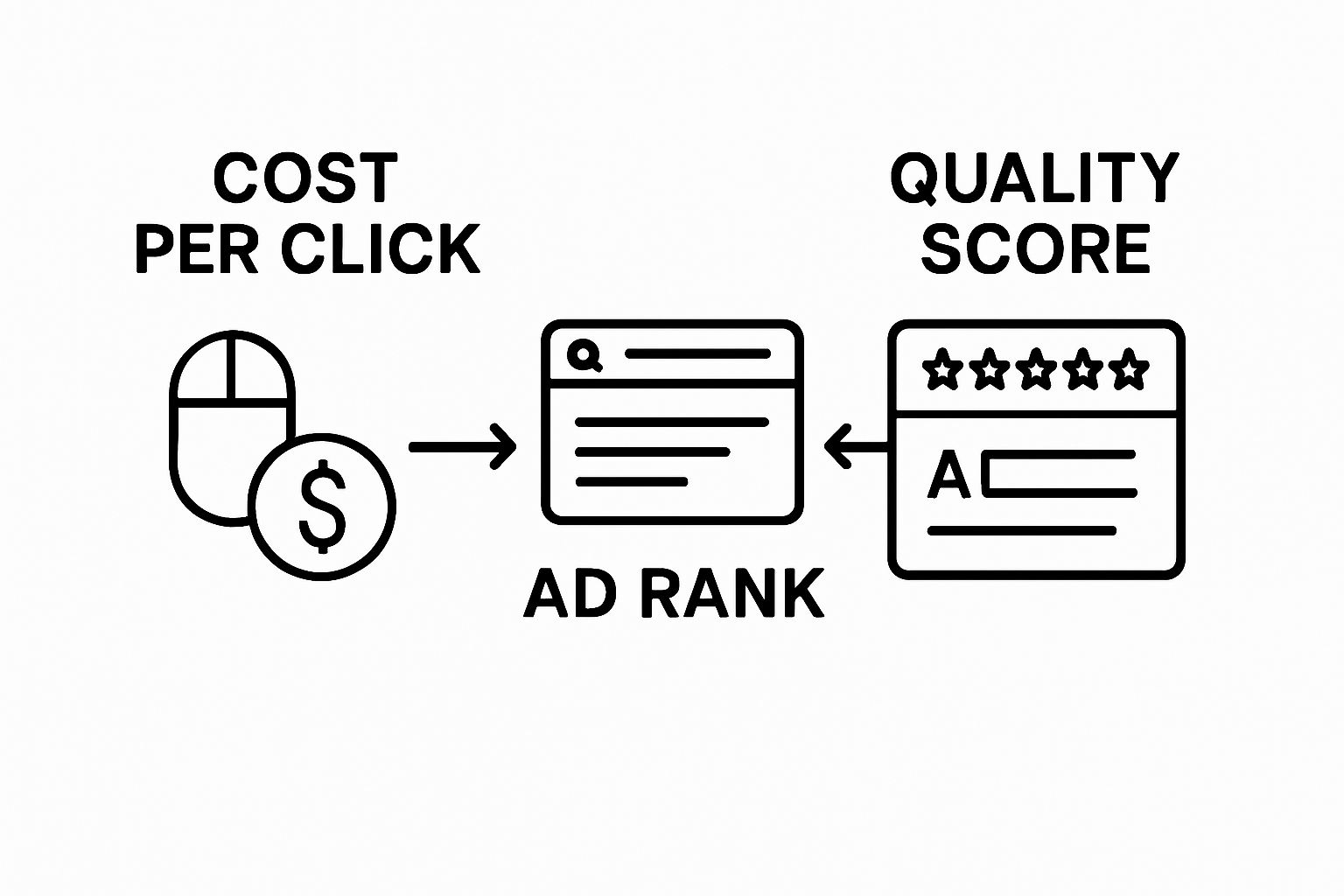
- Cost Per Click (CPC): The actual price paid for each individual ad click
- Quality Score: Google’s rating of your advertisement’s relevance and quality
- Ad Rank: Determines your advertisement’s position in search results
- Bid Strategy: Approach used to set maximum prices for ad placements
PPC advertising transforms complex digital marketing strategies into measurable, actionable data points.
Here is a table summarizing key PPC advertising definitions for quick reference.
| Term | Definition |
|---|---|
| Keywords | Specific search terms that trigger your advertisements |
| Impressions | Number of times your ad appears on search results |
| Click-Through Rate (CTR) | Percentage of people who click your ad after seeing it |
| Conversion | Specific action taken by a user after clicking your advertisement |
| Cost Per Click (CPC) | The actual price paid for each individual ad click |
| Quality Score | Google’s rating of your advertisement’s relevance and quality |
| Ad Rank | Determines your advertisement’s position in search results |
| Bid Strategy | Approach used to set maximum prices for ad placements |
Types of PPC Advertising: What You Need to Know
PPC advertising encompasses multiple digital marketing channels, each offering unique strategies for businesses to connect with potential customers. Understanding these diverse advertising types enables marketers to craft targeted, effective campaigns that maximize their digital marketing investments.
Search Engine PPC Advertising
Search engine PPC represents the most traditional and widely recognized form of paid digital advertising. Learn more about advanced PPC strategies to optimize your marketing approach. According to computational research on sponsored search advertising, this advertising type involves:
- Text-based ads appearing alongside organic search results
- Keyword-driven targeting mechanisms
- Immediate visibility for specific search queries
- Direct link to landing pages or product pages
Diverse PPC Advertising Platforms
Beyond traditional search engine advertising, businesses can leverage multiple PPC advertising platforms to reach their target audiences:
- Display Network Advertising: Visual ads appearing on websites across the internet
- Social Media PPC: Targeted advertisements on platforms like Facebook, Instagram, and LinkedIn
- Remarketing Campaigns: Ads targeting users who have previously interacted with your website
- Shopping Campaign Advertisements: Product-specific ads with images and pricing information
Each platform offers unique targeting capabilities and audience engagement opportunities.
The following table provides an overview of the main types of PPC advertising discussed in the article, highlighting their core features and targeting methods.
| PPC Type | Description | Primary Targeting Method |
|---|---|---|
| Search Engine PPC | Text-based ads next to organic results | Keyword targeting |
| Display Network Advertising | Visual ads on websites across the internet | Audience and website placement |
| Social Media PPC | Ads on platforms like Facebook and Instagram | Demographic and interest targeting |
| Remarketing Campaigns | Ads targeting previous website visitors | Cookie and behavior targeting |
| Shopping Campaign Advertisements | Product-specific ads with images and pricing | Product and feed-based targeting |
Best Practices for Effective PPC Campaigns
Successful PPC campaigns require strategic planning, continuous optimization, and a deep understanding of digital advertising dynamics. Businesses must approach their paid advertising efforts with precision and adaptability to maximize return on investment and achieve meaningful marketing outcomes.
Strategic Campaign Planning
Discover how we manage comprehensive PPC campaigns for optimal performance. According to MIT OpenCourseWare’s digital marketing research, effective campaign planning involves:
- Clear Goal Setting: Define specific, measurable objectives
- Audience Segmentation: Identify and target precise customer demographics
- Keyword Research: Select high-intent, relevant search terms
- Budget Allocation: Distribute resources strategically across platforms
Continuous Campaign Optimization
Successful PPC campaigns are never static. They require ongoing refinement and data-driven adjustments to maintain performance. Critical optimization strategies include:
- Regular Performance Monitoring: Track key metrics like click-through rates and conversion rates
- A/B Testing: Experiment with different ad copies, designs, and landing pages
- Negative Keyword Management: Eliminate irrelevant search terms that drain budget
- Quality Score Improvement: Enhance ad relevance and landing page experience
By implementing these best practices, businesses can transform their PPC advertising from a simple marketing expense into a sophisticated, high-performing customer acquisition channel.

Unlock the True Power of PPC for Your Business
Have you ever felt like your business is missing out on qualified leads or losing ground to faster, better-optimized competitors despite all your marketing efforts? Many organizations struggle to master the details of PPC advertising, from keyword strategies and bid management to maximizing ad quality score. If tracking ROI and understanding complex performance metrics seem overwhelming, you are not alone. The good news is that you do not have to tackle PPC challenges in isolation. Our Paid Advertising solutions are designed to help businesses overcome the unique obstacles described in this article by turning confusing metrics and wasted spend into measurable growth.
Take control of your digital future today. Visit Web Spider Solutions to see how our expert team uses analytics-driven PPC management and creative strategy to generate real results. Ready to stop guessing and start growing? Explore how we help businesses like yours dominate search and capture high-value leads. Act now to transform your digital marketing strategy and watch your business reach new heights.
Frequently Asked Questions
What is PPC advertising?
PPC, or Pay Per Click advertising, is a digital marketing strategy where businesses pay a fee each time their ad is clicked. It allows companies to purchase targeted website visits through an auction-based model focused on specific keywords.
How does PPC advertising work?
PPC advertising works by allowing advertisers to bid on keywords related to their audience. When a user searches for those keywords, ads may appear in prominent positions on search engine results pages, driving traffic to the advertiser’s website.
What are the benefits of using PPC for my business?
The benefits of PPC include immediate traffic generation, precise audience targeting, measurable performance metrics, and budget flexibility. PPC can help businesses connect with potential customers quickly and effectively, providing a direct correlation between ad spend and revenue generation.
How can I optimize my PPC campaigns for better results?
To optimize your PPC campaigns, focus on regular performance monitoring, A/B testing different ad copies and landing pages, managing negative keywords, and improving your Quality Score by enhancing ad relevance and user experience on landing pages.

 Top-rated