






TL;DR:
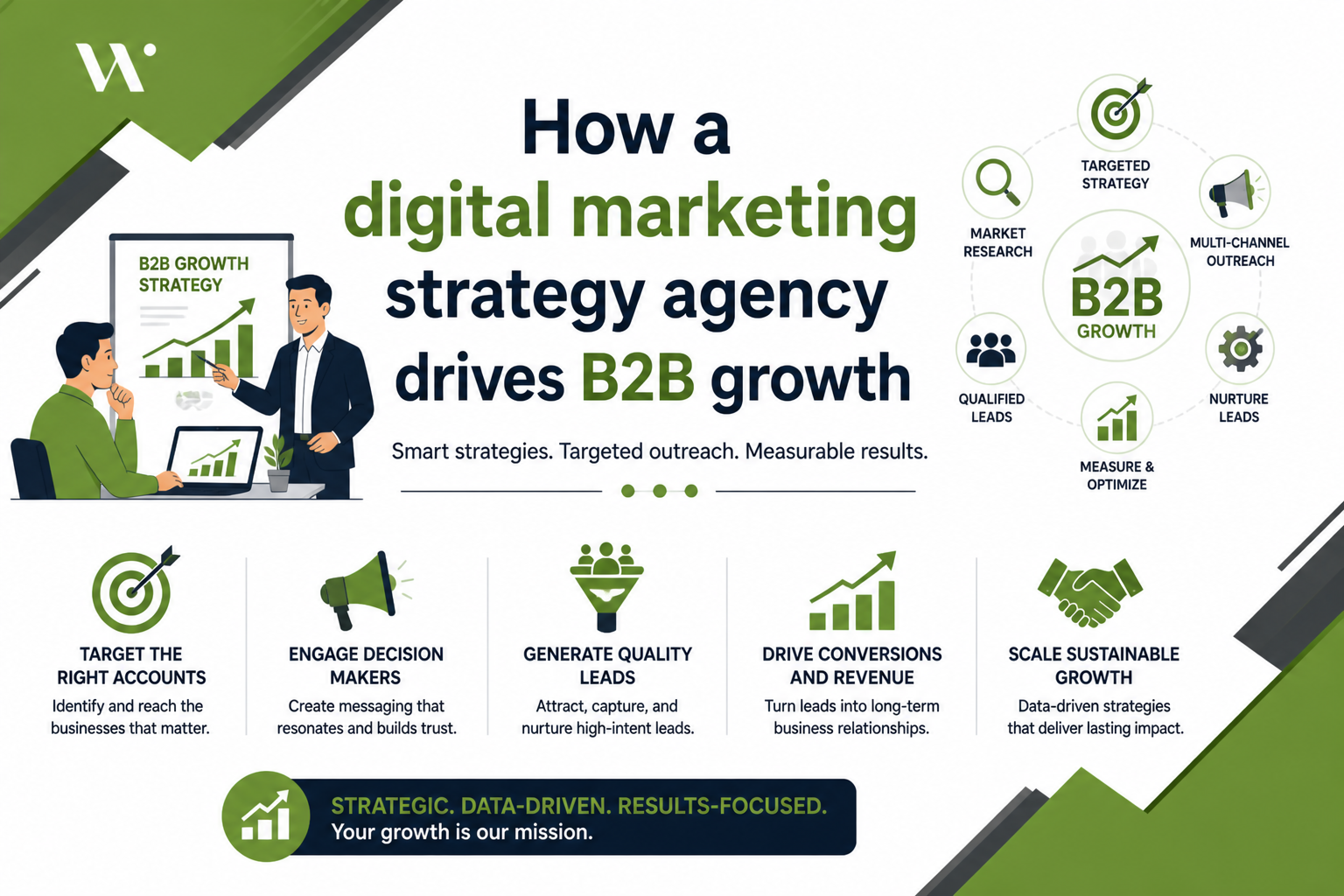
- Specialized digital marketing agencies create tailored strategies focused on specific markets and buyer journeys.
- A multi-channel system integrating SEO, PPC, and content is essential for B2B growth.
- Building strong agency relationships that share data and trust leads to better measurable revenue results.
Most B2B marketing directors have been there: you hire an agency, get a polished deck full of promises, and six months later the pipeline looks exactly the same. The problem is rarely effort. It’s fit. Generic marketing strategies, built for broad audiences and average buyers, consistently underperform in competitive B2B sectors like SaaS and healthcare where decision cycles are long, buyers are highly informed, and the margin for wasted spend is thin. A specialized digital marketing strategy agency changes that equation by building plans around your specific market, your buyer’s actual journey, and metrics that matter to your revenue team.
Table of Contents
- Why your B2B business needs a digital marketing strategy agency
- Core pillars of a successful digital marketing strategy for B2B
- How agencies customize strategies for SaaS, healthcare, and other B2B sectors
- Questions to ask when choosing a digital marketing strategy agency
- Measuring ROI from your digital marketing agency partnership
- Perspective: What most decision-makers overlook about agency value
- Discover how the right agency drives your growth
- Frequently asked questions
Key Takeaways
| Point | Details |
|---|---|
| Specialization matters | B2B companies thrive with agencies that offer tailored, industry-specific strategies. |
| Multi-channel is essential | Winning agency strategies blend SEO, PPC, social, and content marketing for maximum impact. |
| Customization trumps generic | Customized plans address regulatory and market differences across industries like SaaS and healthcare. |
| Measure what matters | Effective agency partnerships use KPIs and transparent reporting to tie investment to business goals. |
| Choose partners, not vendors | The real value of an agency comes from strategic collaboration, not transactional services. |
Why your B2B business needs a digital marketing strategy agency
Fragmented marketing is the quiet budget killer most leadership teams underestimate. Your SEO team optimizes for traffic. Your paid search team optimizes for clicks. Your content team publishes for engagement. But if those efforts don’t share a unified strategy tied to your revenue goals, you’re spending money on noise in an already saturated market. B2B buyers in SaaS and healthcare don’t respond to generic messaging. They respond to relevance, credibility, and specificity.
This is where B2B digital marketing solutions built around your sector make a measurable difference. Specialized agencies bring expertise that compounds over time. They’ve already learned the expensive lessons in your vertical so you don’t have to pay for that education through failed campaigns.
“Agencies bring deep channel expertise that sustains growth in competitive sectors.”
The core benefits of working with a specialized agency go well beyond execution:
- Strategic alignment across every channel, so paid media supports organic search which supports email nurture, all pointing toward the same conversion goal.
- Access to advanced tools like competitive intelligence platforms, marketing automation stacks, and attribution software that are cost-prohibitive for most in-house teams to license independently.
- Cost efficiency through optimized spend allocation. Experienced agencies know which channels convert in your sector and which drain budget without meaningful return.
- Measurable ROI through defined KPIs tied directly to pipeline and revenue, not vanity metrics.
- Faster iteration because agencies test across multiple clients simultaneously, bringing winning tactics to your campaigns faster than any single in-house team can.
Effective strategy planning for growth requires this kind of layered thinking. Without it, even the most talented internal team is flying blind in a market where competitors are moving fast and buyers expect precision.
Core pillars of a successful digital marketing strategy for B2B
Once you recognize why an agency gives competitive advantage, it’s important to understand the framework they use for consistent growth. The most effective B2B strategies don’t rely on a single channel. They build what’s called a multi-channel system where each channel amplifies the others.
A multi-channel approach combining SEO, PPC, and targeted content works best for B2B sector growth, and the data from competitive verticals consistently supports this. Here’s the practical sequence agencies use to build that system:
- Audit existing digital presence. Before launching anything new, understand what’s working, what’s wasted, and where the biggest gaps are relative to competitors.
- Define the ideal customer profile (ICP). In B2B, this means mapping titles, firmographics, pain points, and buying triggers. A SaaS ICP looks very different from a healthcare system procurement lead.
- Set measurable goals per channel. Organic search goals differ from paid search goals. Establish targets before spend begins, not after.
- Build content aligned to funnel stages. Top-of-funnel content educates. Mid-funnel content compares and differentiates. Bottom-funnel content converts.
- Activate paid amplification. Use PPC and paid social to accelerate what’s organically working. Don’t use paid as a crutch for content that doesn’t resonate.
- Implement analytics and attribution. Every touchpoint should feed your reporting system so you can see exactly which channels contribute to closed revenue.
The table below breaks down each pillar by purpose, best practice, and how to measure it:
| Channel | Purpose | Best practice | Key measurement |
|---|---|---|---|
| SEO | Long-term organic visibility | Target commercial intent keywords at scale | Organic traffic and qualified lead volume |
| PPC | Immediate demand capture | Test ad copy and landing page variations weekly | Cost per acquisition (CPA) |
| Content marketing | Build authority and nurture buyers | Map content to buyer journey stages | Time on page, MQL conversion rate |
| LinkedIn and social | Reach decision-makers and build brand trust | Publish thought leadership and sponsor high-performing posts | Engagement rate, follower quality, pipeline influenced |
| Email marketing | Retain and convert known leads | Personalize sequences based on behavior triggers | Open rate, click-through rate, revenue attributed |
| Analytics | Tie every channel to business outcomes | Use multi-touch attribution, not last-click | Pipeline contribution, customer acquisition cost |
Pro Tip: Don’t wait until a campaign ends to check analytics. Build a live dashboard that your team reviews weekly. The agencies generating the best ROI for B2B clients use integrated marketing approaches where analytics inform every decision in near real time, not just at monthly reporting meetings.

How agencies customize strategies for SaaS, healthcare, and other B2B sectors
Knowing the foundational pillars is only step one. Genuine growth comes from customization that fits your exact sector. And sector-specific customization is where most generic agencies fall completely flat.
Agencies that specialize in competitive verticals begin with thorough digital marketing audits that map your current digital footprint against your competitive landscape. This audit covers technical SEO health, content gaps, paid search performance, brand search volume, and backlink authority. It tells the agency exactly where you stand before they recommend where to go.
Custom strategy is essential for navigating industry regulations and buyer journeys that differ dramatically from sector to sector. Consider the contrast between SaaS and healthcare:
| Factor | SaaS B2B | Healthcare B2B |
|---|---|---|
| Regulatory environment | Light to moderate (privacy, data security) | Heavy (HIPAA, FDA guidelines, credentialing) |
| Average sales cycle | 30 to 90 days | 6 to 18 months |
| Primary buyer persona | IT leaders, operations managers, CTOs | Hospital administrators, CMOs, procurement officers |
| Content format that converts | Product demos, comparison pages, free trials | Clinical white papers, peer-reviewed case studies, webinars |
| Key trust signal | G2 reviews, integration capabilities | Accreditations, regulatory compliance documentation |
| Channel priority | Google Ads, LinkedIn, product-led SEO | Healthcare trade publications, LinkedIn, event sponsorship |
Three sector-specific elements agencies must address for either vertical:
- Compliance and legal guardrails. Healthcare content must avoid unsubstantiated claims. SaaS content promoting data handling must align with privacy regulations. Agencies that skip compliance review create liability, not leads.
- Sales funnel length. A healthcare procurement decision may involve 8 to 12 stakeholders over 12 months. Your marketing strategy must nurture across that entire timeline, not just close at the top of funnel.
- Content format preferences. A SaaS buyer in evaluation mode wants a live demo or ROI calculator. A hospital system administrator wants peer-validated evidence, not a slick product video.
Getting these nuances right is the difference between a campaign that generates qualified pipeline and one that generates impressions nobody converts from.
Questions to ask when choosing a digital marketing strategy agency
Custom strategies are vital, but success depends on picking the right partner. So here’s how to evaluate agencies wisely before you sign anything.
Evaluating relevant experience and transparent reporting is key to selecting the right agency, and most decision-makers skip the critical questions during the pitch phase because the decks look impressive. Don’t get sold on aesthetics. Get sold on evidence.
Here are the five most important questions to ask every agency you consider:
- What’s your experience in my specific industry? Ask for client names, campaign summaries, and measurable outcomes in your vertical. Generic claims about “working across industries” are a red flag.
- How do you customize strategy for each client? If the answer involves templates or packages, keep looking. Real strategy starts with your specific business situation, not a pre-built menu.
- What does your reporting process look like? You should receive regular dashboards, scheduled review calls, and access to live performance data. Agencies that report only on vanity metrics are not aligned with your revenue goals.
- Who will actually be working on my account? Many agencies pitch senior talent and deliver junior account managers. Ask specifically which team members handle strategy versus execution.
- Can you share references from clients in my sector? A confident agency with real results will have no hesitation connecting you with past or current clients for a reference call.
Pro Tip: Ask for a real case study with specific numbers, including starting baseline, strategy applied, and results achieved over a defined timeframe. Any agency serious about choosing the right agency conversations will have these ready without hesitation.
Watch out for two major red flags during evaluation. First, promises of quick results. In B2B, meaningful organic growth takes 3 to 6 months minimum. Anyone promising page one rankings or massive lead volume in 30 days is either lying or about to do something that harms your domain long-term. Second, one-size-fits-all packages. If an agency quotes you before they’ve asked about your buyer personas, competitive landscape, or current analytics, the package they’re selling was built for someone else.
Measuring ROI from your digital marketing agency partnership
Effective evaluation completes the loop, ensuring your investment with an agency delivers what your business needs. The biggest mistake B2B marketing directors make after hiring an agency is not defining success criteria upfront. Without agreed-upon KPIs, every reporting conversation becomes subjective.
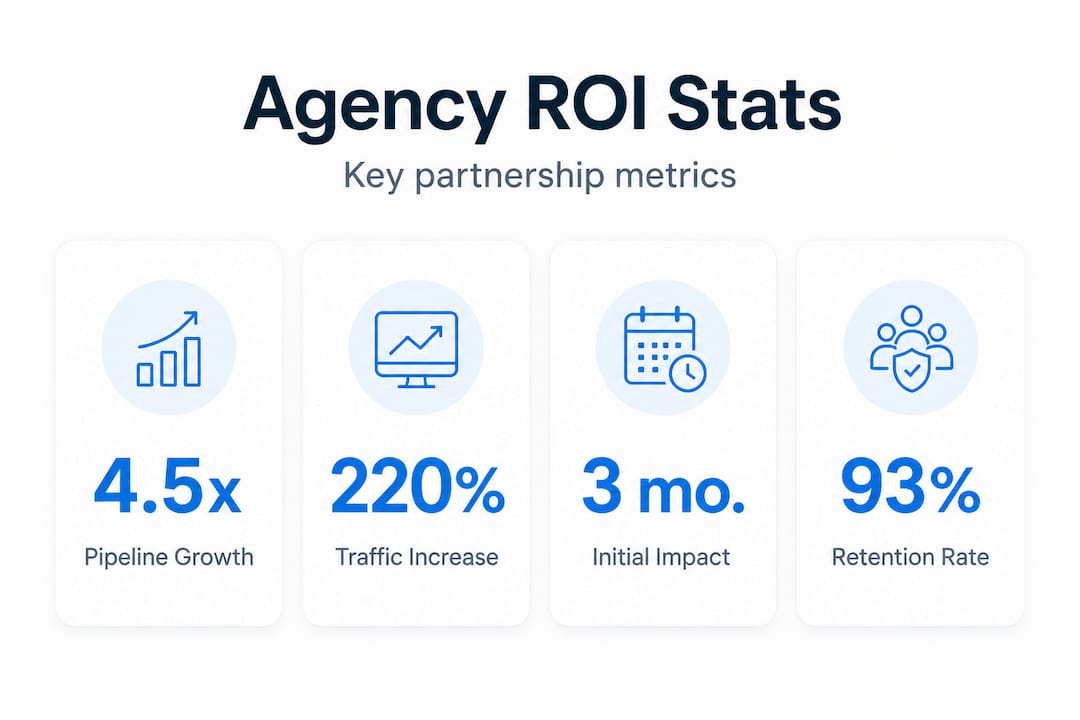
Tying marketing spend directly to business outcomes ensures value and ongoing alignment with your growth objectives. Your step-by-step strategy guide should include defined KPIs from day one.
The metrics that matter most for B2B agency partnerships:
- Qualified leads (MQLs and SQLs). Not all leads are equal. Track how many leads from agency activity actually meet your ICP criteria and progress through your pipeline.
- Sales pipeline contribution. What dollar value of open pipeline can be attributed to agency-driven campaigns? This connects marketing to your revenue team’s reality.
- Website engagement quality. Look at time on page, pages per session, and conversion rate by channel, not just total traffic.
- Cost per acquisition (CPA). How much are you spending to acquire each new customer through each channel? This number should improve over time as the agency learns your market.
- Return on ad spend (ROAS). For paid campaigns specifically, every dollar spent should show increasing return as targeting and creative improve.
Smart reporting expectations from your agency should include:
- Monthly performance reports with a written summary, not just data dumps.
- Clear month-over-month and year-over-year trend analysis.
- Proactive recommendations when performance dips, not just explanations after the fact.
- Competitive monitoring updates so you know when competitors shift strategy.
- Transparent spend allocation showing exactly where your budget went and what it produced.
Pro Tip: Insist on quarterly strategy reviews, not just monthly performance calls. The quarterly review should re-examine your ICP, reassess competitive positioning, and evaluate whether the current channel mix is still the best allocation of your budget. Agencies that skip this level of strategic review tend to drift into execution mode, optimizing tactics while losing sight of the bigger picture.
Perspective: What most decision-makers overlook about agency value
Here’s the uncomfortable observation most agency articles won’t say out loud: the agency you hire will give you exactly the relationship you allow.
Most B2B marketing directors approach agency relationships transactionally. They want deliverables on a timeline and a report at the end of the month. The agency obliges, produces the agreed scope of work, and everyone wonders why the needle isn’t moving. The problem isn’t the agency’s capability. It’s the nature of the relationship itself.
The companies that extract exceptional value from agency partnerships treat the agency like a growth partner with access to internal context. They share CRM data. They loop agencies into sales calls to hear real buyer objections. They give feedback that’s specific and honest rather than vague. In return, those agencies can refine strategy based on real-world signal, not just platform analytics.
There’s also a deeper issue with how leaders evaluate agency value. Most focus on cost per deliverable. How much per blog post? What’s the monthly retainer for PPC management? This framing misses the point entirely. The right question is: what business outcome does this investment unlock? An agency managing comprehensive marketing services across SEO, paid, and content isn’t selling you tasks. They’re selling leverage over your market.
The agencies that genuinely move revenue think in systems. They’re looking at how a thought leadership piece on LinkedIn supports the search intent of a buyer who later clicks a Google Ad, fills out a demo request, and becomes a six-figure contract. That’s not magic. It’s disciplined, interconnected strategy executed consistently over time. And you only get there when the relationship between your team and your agency is built on data, trust, and shared accountability.
Discover how the right agency drives your growth
If this article has surfaced gaps in how your current marketing approach is structured, the smartest next step is an honest assessment of where you actually stand. A free digital marketing audit gives you that baseline without any commitment. Web Spider Solutions works with B2B companies in competitive verticals to build strategies that connect SEO, PPC, and integrated content into measurable growth systems. Whether you’re starting from a fragmented setup or looking to scale what’s already working, our team builds the kind of tailored strategy your sector demands. Explore our SEO strategy guide to see how we approach organic growth for ambitious B2B teams.
Frequently asked questions
What makes a digital marketing strategy agency different from a typical marketing firm?
A strategy agency creates deeply customized, data-driven plans for each client based on their specific sector, buyer journey, and competitive landscape, rather than offering tailored growth strategies pulled from a generic service catalog.
How long does it typically take to see results from an agency-driven B2B strategy?
Most B2B companies see initial performance improvements within 3 to 6 months, with more substantial pipeline and revenue impact becoming clear by the 12-month mark as measurable results compound across channels.
Should I expect regular reports from my agency?
Yes, reputable agencies provide scheduled performance reports, live dashboard access, and strategic recommendations, because transparency and reporting are baseline traits of any agency worth your retainer.
Can digital marketing strategy agencies help with compliance in regulated industries?
Yes, experienced agencies build compliance guardrails directly into content creation, paid ad copy, and campaign strategy for sectors like healthcare and SaaS, because navigating industry regulations is a non-negotiable part of effective marketing in those verticals.
Recommended