






TL;DR:
- B2B marketing involves longer sales cycles, multiple decision-makers, and logic-driven messaging.
- Customer lifetime value in B2B is 5 to 10 times higher than in B2C, emphasizing retention.
- Building trust through proof, personalization, and long-term nurturing is crucial for success.
Most marketers underestimate how different B2B marketing really is from selling to consumers. The deals are larger, the relationships run deeper, and the revenue compounds over time in ways that B2C rarely matches. Yet many small and medium-sized businesses still apply consumer-focused tactics to business audiences and wonder why results fall flat. Understanding what makes B2B marketing distinct is not just an academic exercise. It directly changes how you allocate budget, craft messaging, and build pipelines that generate consistent, high-value growth for your organization.
Table of Contents
- How B2B marketing really differs from B2C
- The hidden value: Bigger deals, repeat business, and retention
- Building trust and generating quality leads
- Why now: The competitive advantage of B2B in 2026 and beyond
- Our view: The real-world payoff of choosing B2B marketing
- Get expert help to amplify your B2B marketing results
- Frequently asked questions
Key Takeaways
| Point | Details |
|---|---|
| Longer sales cycles | B2B deals take more time and input from several decision-makers, demanding a long-term strategy. |
| Repeat, high-value clients | The value of each B2B customer is often 5-10 times that of B2C thanks to repeat orders and lasting relationships. |
| Trust and relationships | Trust-building efforts drive lead generation and customer loyalty in B2B environments. |
| Competitive advantage in 2026 | Focusing on B2B marketing now positions your company ahead as markets demand smarter, more targeted efforts. |
How B2B marketing really differs from B2C
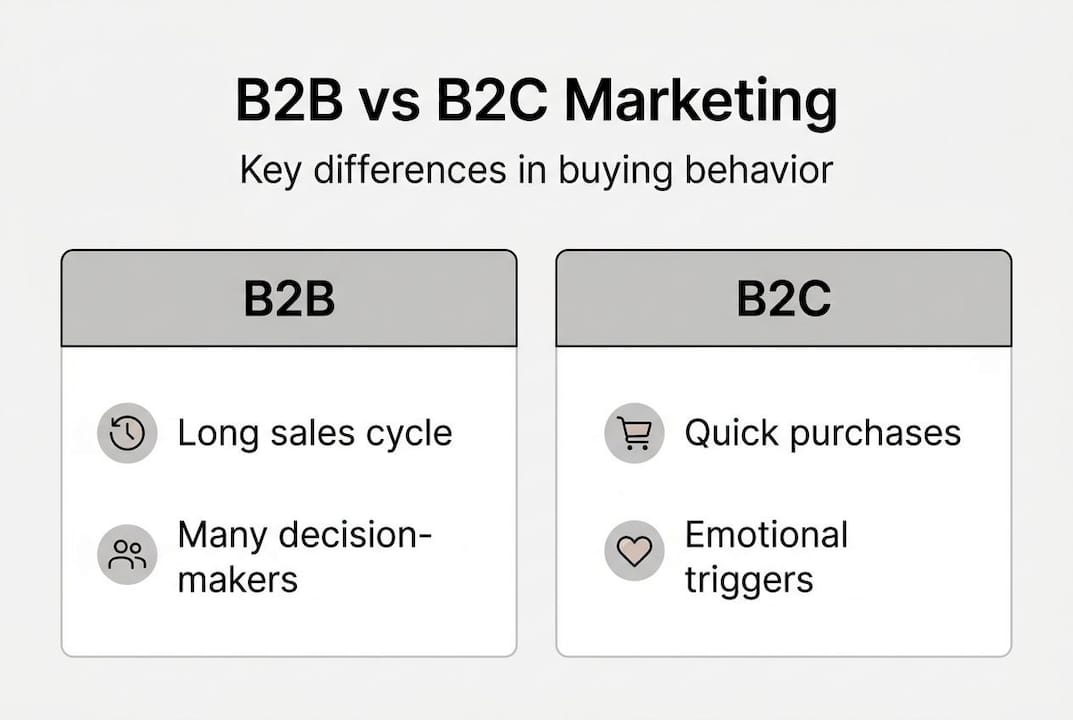
The most obvious difference between B2B and B2C marketing is time. A consumer might decide to buy a product in minutes. A business purchase, especially a significant one, can take anywhere from three months to well over a year. Longer sales cycles and multiple decision-makers (often six to ten people per deal) mean your marketing must work harder and smarter across every stage of the funnel.
In B2C, emotional triggers like urgency, desire, and social proof drive most conversions. B2B buyers respond to logic. They want ROI projections, risk assessments, and clear evidence that your solution solves a specific business problem. This means brand messaging in B2B must be precise, data-backed, and role-specific. What the CFO needs to hear is not the same as what the operations manager needs.
Here is a side-by-side look at how these two models compare:
| Attribute | B2B | B2C |
|---|---|---|
| Sales cycle length | 3 to 18 months | Hours to days |
| Decision-makers | 6 to 10 people | Usually 1 person |
| Messaging focus | ROI, logic, risk reduction | Emotion, desire, urgency |
| Relationship type | Long-term partnership | Transactional |
| Content depth | In-depth, technical | Short, engaging |
| Purchase value | High | Low to medium |
The relationship element deserves extra attention. B2B buyers are not just purchasing a product or service. They are choosing a partner they may work with for years. That means trust, consistency, and follow-through matter far more than a clever ad. Understanding B2B sales cycles helps you design campaigns that stay relevant across every phase of that extended journey.
Key differences to keep top of mind:
- B2B content must address multiple stakeholders at once
- Nurturing matters more than conversion speed
- Thought leadership builds credibility before any sales conversation starts
- Personalization at the account level, not just the individual level, drives results
Pro Tip: Before creating any content, map out every role in your target buyer’s committee. Then write at least one piece specifically for each stakeholder’s concerns. A CFO cares about cost savings; a department head cares about implementation ease.
“B2B marketing is not about convincing one person. It is about building consensus across an entire organization.” This shift in mindset changes everything about how you plan campaigns.
The hidden value: Bigger deals, repeat business, and retention
Here is what the numbers actually say. B2B customer lifetime value runs five to ten times higher than in B2C, despite a higher initial cost per lead. That gap is where the real leverage lives.

| Metric | B2B | B2C |
|---|---|---|
| Average order value | $5,000 to $500,000+ | $20 to $500 |
| Customer lifetime value | 5 to 10x higher | Baseline |
| Cost per lead (CPL) | $90 to $150 | $20 to $50 |
| Customer acquisition cost (CAC) | Higher upfront | Lower upfront |
| Repeat purchase rate | Very high | Variable |
The math here is compelling. Yes, customer acquisition costs in B2B are steeper at the start. But once you land a client, the economics flip dramatically in your favor. Repeat business in B2B is not just likely; it is expected. Clients who trust you become your most stable revenue source.
Retention is where B2B marketers often leave money on the table. Here is a simple framework to improve it:
- Implement a CRM system to track every touchpoint and flag accounts showing signs of disengagement
- Use B2B remarketing to re-engage existing clients with relevant offers and updates
- Schedule quarterly business reviews to demonstrate ongoing value and surface upsell opportunities
- Create client-specific content, such as performance reports and benchmarking data, that reinforces your partnership
- Build CRM-driven retention strategies that automate follow-ups and flag renewal windows before they become risks
Pro Tip: A 5% increase in customer retention can boost profits by 25% to 95%. In B2B, where deal sizes are large, even retaining one extra client per quarter can transform your annual revenue picture.
The B2B digital marketing services that deliver the most consistent returns are the ones built around retention as much as acquisition. Most brands obsess over new leads. The smartest ones obsess over keeping the clients they already have.
Building trust and generating quality leads
In B2B, trust is not a soft concept. It is a hard commercial requirement. Before any decision-maker signs a contract, they need proof. That means case studies showing measurable results, testimonials from recognizable companies, and ROI calculators that let prospects model the value themselves.
The most effective B2B lead generation tactics in 2026 include:
- Content marketing: Long-form guides, white papers, and webinars that demonstrate deep expertise
- Account-based marketing (ABM): Targeting specific high-value companies with personalized campaigns instead of casting a wide net
- Industry events and partnerships: Face-to-face credibility still converts at a higher rate than digital-only touchpoints
- Collaborative B2B relationships: Co-marketing with complementary brands to reach new audiences with built-in trust
- SEO and thought leadership: Ranking for the questions your buyers are already asking
Once you attract a lead, the nurturing process begins. B2B sales cycles of 3 to 18 months mean most leads are not ready to buy immediately. Your job is to stay relevant and valuable until they are.
A structured nurturing approach looks like this:
- Awareness stage: Deliver educational content that addresses industry pain points without pushing a sale
- Consideration stage: Share comparison content, case studies, and product-specific resources for shortlisted buyers
- Decision stage: Offer demos, trials, ROI tools, and direct conversations with your sales team
Explore proven lead generation strategies and real-world B2B marketing examples to see how this plays out across different industries. And do not underestimate the power of lead nurturing as a system, not just a tactic.
Pro Tip: Map every piece of content to a specific buyer stage and a specific role in the decision committee. A piece written for a CFO at the decision stage is ten times more effective than generic content aimed at no one in particular.
Why now: The competitive advantage of B2B in 2026 and beyond
The B2B marketing landscape is shifting fast. Buyers expect the same personalized, digital-first experiences they get as consumers. Companies that adapt now will build a structural advantage that compounds over time. Those that wait will find the gap increasingly hard to close.
B2B customer lifetime value runs 5 to 10x higher than B2C, which means every improvement in acquisition quality or retention rate has an outsized impact on your bottom line. That leverage is the reason why investing in B2B marketing strategy now pays dividends for years.
The top opportunities B2B marketers can seize today:
- Personalization at scale: Use data and automation to deliver account-specific messaging without manual effort
- AI-driven content: Accelerate production of high-quality, targeted content while maintaining strategic oversight
- Video and interactive content: Buyers increasingly prefer video demos and interactive tools over static PDFs
- First-party data strategies: As third-party cookies disappear, owning your audience data becomes a competitive moat
- Integrated digital campaigns: Align SEO, paid media, and content into a single, coordinated growth engine
Review the most effective marketing strategies for 2026 to see which of these opportunities fit your current stage of growth.
The brands winning in B2B right now are not necessarily the ones with the biggest budgets. They are the ones measuring the right things. Lead volume is a vanity metric. What matters is lead quality, pipeline velocity, and customer lifetime value.
Pro Tip: Replace your lead volume KPI with a composite score that includes lead quality rating, average deal size, and projected LTV. This single change will realign your entire marketing team around outcomes that actually drive revenue.
Our view: The real-world payoff of choosing B2B marketing
Here is something most marketing content will not tell you: the biggest mistake B2B brands make is treating their marketing like a sprint. They run a campaign, measure it after 60 days, declare it a failure, and pivot. Then they repeat the cycle. This short-term thinking destroys the very thing that makes B2B marketing powerful, which is compounding trust and recurring revenue.
We have worked with B2B clients across competitive industries, and the pattern is consistent. The ones who commit to a 12 to 18-month strategy, stay consistent with content, and invest in remarketing for engagement to stay visible with warm audiences, see returns that dwarf what any short campaign could produce. One retained client often generates more revenue than ten new ones acquired through scattered tactics.
The counterintuitive truth is that patience in B2B is not passive. It is a deliberate, strategic choice to play a longer game where the rewards are exponentially larger. Recurring revenue from loyal clients is the most durable growth engine a business can build.
Get expert help to amplify your B2B marketing results
If you are ready to move beyond guesswork and build a B2B marketing engine that generates consistent, high-quality leads, we can help. At Web Spider Solutions, we specialize in helping SMEs manage B2B campaigns that drive real pipeline growth, from strategy through execution. Whether you need to balance branding and performance or build a full digital campaign management system, our team brings the expertise and tools to make it happen. Reach out today for a free consultation and find out exactly where your B2B marketing can improve.
Frequently asked questions
What is the biggest advantage of B2B marketing?
The biggest advantage is higher revenue per customer and long-term, repeat business. B2B lifetime value runs 5 to 10x higher than B2C, making each client relationship significantly more profitable over time.
How do B2B and B2C marketing differ?
B2B involves longer sales cycles of 3 to 18 months, more decision-makers, and focuses on logic and ROI, while B2C is faster and driven primarily by emotion and impulse.
Why is trust-building so important in B2B?
Because B2B purchases are high-value and long-term, buyers demand proof, transparency, and a reliable relationship before committing. B2B messaging emphasizes long-term relationships and ROI evidence far more than B2C does.
What can B2B marketing teams do to increase retention?
They should use remarketing, CRM, and tailored content to nurture ongoing relationships and re-engage existing clients regularly. B2B repeat business and lifetime value make retention strategies among the highest-ROI investments a team can make.
Recommended