






TL;DR:
- Choosing the right digital marketing agency involves understanding various fee models, including retainers, project-based, hourly, and performance-based structures. Agency costs vary widely depending on size, service scope, campaign objectives, and transparency, which influences the value and clarity of the relationship. SMBs should prioritize clear scope, measurable targets, and upfront questions to ensure a suitable, accountable partnership aligned with growth goals.
Picking a digital marketing agency feels straightforward until you start getting quotes. One agency charges $800 a month. Another wants $8,000. A third sends a 12-page proposal with performance tiers, setup fees, and a line item for “strategic oversight” that nobody can define. The confusion is real, and it costs SMBs money, time, and in some cases, entire marketing budgets spent on the wrong fit. This guide cuts through the noise, explains every major fee model, identifies what drives prices up or down, and gives you a practical framework to compare agencies without getting burned.
Table of Contents
- The most common agency fee models
- Factors that influence agency fees
- Comparing agency fee structures: how to choose what fits your business
- Performance-based fees and hybrids: what SMBs should know
- Why transparency beats lowest cost in agency selection
- Get a tailored agency quote for your digital growth
- Frequently asked questions
Key Takeaways
| Point | Details |
|---|---|
| Fee models explained | Digital marketing agencies use monthly retainers, project fees, hourly rates, and hybrid performance-based models. |
| Cost drivers matter | Agency fees depend on your goals, campaign complexity, and desired results—not just the type of service. |
| Compare before committing | Assess the fee structure and scope to ensure the agency fits your business needs and budget. |
| Transparency over price | Clear, upfront pricing and detailed deliverables are more valuable than simply choosing the lowest quote. |
The most common agency fee models
With agency fee confusion in mind, let’s clarify each major pricing model SMBs will encounter when shopping for digital marketing support.
Common digital marketing agency fee models include monthly retainers, project-based fixed fees, and hourly billing, and performance-based or hybrid models may include a base plus a percentage of results such as attributed revenue. Each model serves a different type of client relationship, and understanding the mechanics behind each one is the first step toward making a confident decision.
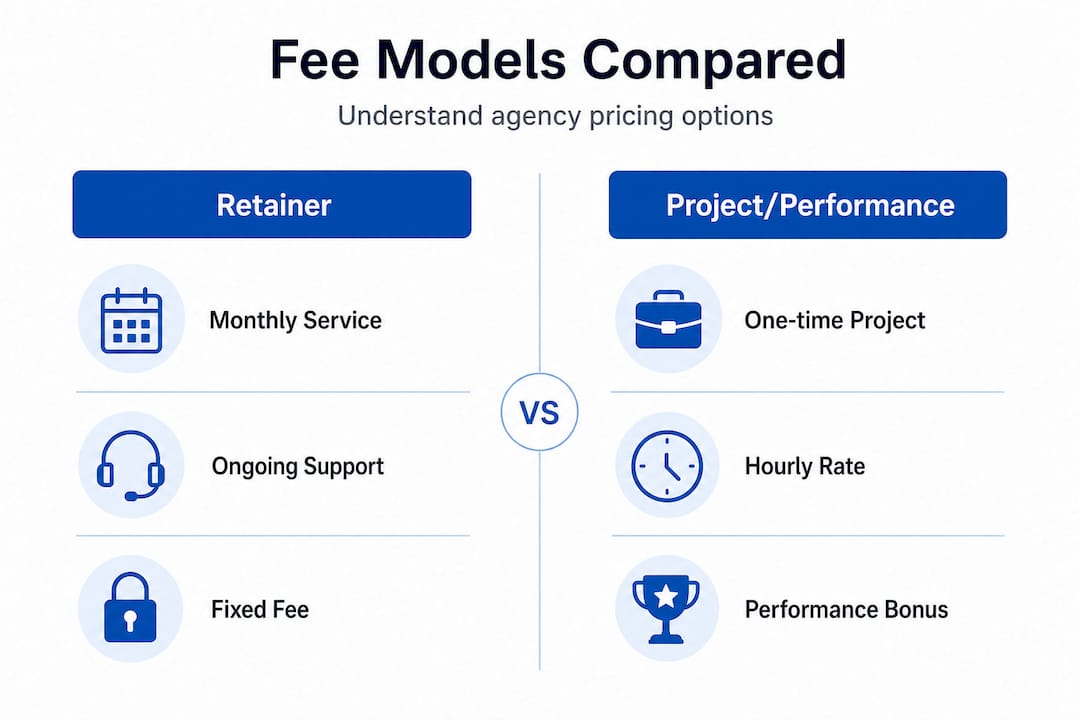
Monthly retainers are the most popular structure for ongoing campaigns. You pay a fixed amount each month in exchange for a defined set of services, think SEO management, paid advertising oversight, social media content, or some combination. Retainers typically run anywhere from $1,500 per month on the lower end to $15,000 or more for full-service campaigns targeting competitive markets. The appeal is predictability. You know what you’re spending, and the agency knows what they’re delivering.
Project-based fees apply when you need a one-time deliverable, like a website redesign, a content audit, or a paid advertising campaign setup. Fees here vary enormously. A basic website build might run $3,000 to $8,000. A full rebranding project with content strategy and paid media setup could exceed $30,000. Refer to this digital marketing pricing guide for a broader breakdown of what each service tier typically costs.
Hourly billing is common with boutique consultants and niche specialists. Rates vary based on expertise and geography. Junior-level work might run $75 to $100 per hour. Senior strategists and agency leads often bill $150 to $300 per hour or higher. Hourly models work well for short engagements or audits but become expensive fast when scope creeps.
Performance-based and hybrid models are gaining popularity, especially in paid advertising and lead generation campaigns. Here, the agency charges a base fee plus a percentage of revenue, leads, or ad spend managed. For context, reviewing marketing platforms comparison data shows how these hybrid setups vary across platforms and service types.
You can also check publicly reported agency pricing benchmarks to understand what agencies in your industry and region actually charge.
Here’s a side-by-side comparison of each model:
| Fee model | Typical range | Best for | Key risk |
|---|---|---|---|
| Monthly retainer | $1,500 to $15,000/month | Ongoing campaigns, SEO, social | Scope creep without clear deliverables |
| Project-based | $3,000 to $50,000+ | Web design, one-time launches | No ongoing optimization included |
| Hourly billing | $75 to $300/hour | Consultations, audits | Costs balloon without a cap |
| Performance/hybrid | Base + 5 to 20% of results | PPC, lead gen, e-commerce | Hard to attribute results fairly |
Pros and cons at a glance for SMBs:
- Monthly retainers: Predictable costs and consistent strategy, but you may pay for work that underdelivers if KPIs aren’t locked in from day one
- Project-based: Clear scope and defined deliverables, but no ongoing support unless you buy a separate retainer
- Hourly billing: Flexible and scalable, but costs can spiral if the project runs long
- Performance models: Aligned incentives when structured fairly, but contract language around attribution can get murky fast
Factors that influence agency fees
Having defined the core fee models, let’s examine what makes agency quotes vary so widely, even for seemingly identical scopes of work.
Clutch reports pricing benchmark metrics, based on client reviews, for advertising agencies including average hourly rate ranges and average project and monthly costs. Even within those benchmarks, there’s a massive spread, and it comes down to several specific factors.
Agency size and reputation play a huge role. A boutique five-person shop may charge $2,500 per month for an SEO retainer. A mid-size agency with 50 employees and a strong case study portfolio may charge $6,000 for the same deliverables. Larger agencies carry higher overhead, more specialized staff, and the credibility that often comes with documented results. That costs money.

Service scope is probably the biggest driver. Running a single Google Ads campaign is fundamentally different from managing SEO, PPC, social media, email marketing, and website performance simultaneously. Each added channel increases strategy complexity, reporting requirements, and team hours. If you’re curious about what to look for in affordable agency options, the short answer is to find agencies that offer clear service tiers rather than opaque bundles.
Campaign objectives also shift pricing significantly. A brand awareness campaign is cheaper to run than a direct response campaign optimized for conversion rate and cost per acquisition. The latter requires continuous testing, analytics interpretation, and strategic adjustments, all of which add billable hours or justify a higher retainer rate.
Here’s a practical look at how these factors affect fees:
| Factor | Low-cost scenario | High-cost scenario |
|---|---|---|
| Agency size | 1 to 5 person boutique | 50+ person full-service agency |
| Services included | Single channel (e.g., SEO only) | Multi-channel (SEO, PPC, social, content) |
| Campaign goals | Awareness, organic growth | Aggressive lead gen, revenue targets |
| Reporting depth | Monthly summary | Weekly dashboards, custom analytics |
| Contract length | Month-to-month | 12-month minimum |
Before signing anything, make sure you’ve done proper marketing budget planning so you know how much flexibility you have. And when you’re narrowing down candidates, consult a solid guide on selecting an agency to make sure you’re asking the right questions at the right stage.
Pro Tip: Before you receive any quotes, document your goals, target audience, and the specific outcomes you want (leads, traffic, revenue). Agencies that see a clear brief will give you more accurate proposals, and you’ll have a fair benchmark to compare responses.
Comparing agency fee structures: how to choose what fits your business
Once you understand why fees differ, the next step is making an informed comparison rather than defaulting to whoever responded fastest or quoted the lowest number.
Agency fee models span from simple hourly billing to complex hybrid structures, and the right fit depends entirely on your business stage, growth goals, and how much management capacity your internal team has.
Here’s a step-by-step framework you can use right now:
- Define your growth objective first. Do you need more organic traffic, qualified leads, or direct e-commerce revenue? Each goal maps differently to fee structures. Lead gen campaigns often work better on hybrid models. Long-term SEO growth suits retainers.
- Set a realistic monthly budget range. Most growing SMBs allocate 7 to 12 percent of target revenue to marketing. Know your number before you start talking to agencies, not after.
- Request itemized proposals. Ask each agency to break down exactly what’s included: hours per service, deliverables per month, reporting cadence, and who on their team handles your account.
- Evaluate the contract terms. Month-to-month contracts offer flexibility but may mean less agency investment in your long-term strategy. Annual contracts usually unlock lower rates, but they carry more risk if the relationship sours.
- Compare value, not just cost. A $4,000-per-month agency that generates $40,000 in revenue beats a $1,500-per-month agency that generates nothing measurable. Always tie pricing conversations back to expected return.
- Ask about reporting and attribution. How will you know if it’s working? Agencies that can’t clearly explain how they track performance should raise flags.
When choosing an agency, one of the most overlooked steps is asking what happens when performance targets aren’t met. Who adjusts the strategy, and at what cost?
Key pricing benchmarks to keep in mind: Entry-level retainers start around $1,000 to $2,500 per month. Mid-market campaigns with multi-channel support typically run $4,000 to $10,000 per month. Enterprise-grade strategy and execution can exceed $15,000 to $25,000 per month, depending on scope and agency reputation.
For SMBs pursuing aggressive growth, reviewing B2B growth strategies alongside your agency shortlist can help you identify which service types will actually move your revenue needle.
Pro Tip: Never accept a proposal that uses vague terms like “ongoing optimization” or “strategic support” without defining exactly what those activities include and how many hours they represent each month.
Common mistakes SMBs make when comparing fees include: choosing the cheapest option without verifying results, assuming all-inclusive packages cover every needed service, and skipping contract reviews until after work has begun. Each of these errors is avoidable with a bit of upfront discipline.
Performance-based fees and hybrids: what SMBs should know
For ambitious SMBs, performance models can offer upside, but it’s crucial to understand the details and potential pitfalls before agreeing to one.
Performance-based and hybrid models typically pair a lower base retainer with a percentage of attributed revenue, leads generated, or ad spend managed. For example, an agency might charge $2,000 per month as a base plus 10 percent of revenue generated from their campaigns. This structure aligns incentives, but it also introduces complexity around how results get measured and credited.
The rationale for agencies hiring remotely partly explains why performance-based models are growing: distributed agency teams lower overhead, which makes performance pricing more feasible for both parties. Some agencies pass those savings to clients through lower base fees while structuring performance upside.
Pros and cons of performance-based fees for SMBs:
- Pro: Agency is directly incentivized to drive results, not just deliverables
- Pro: Lower upfront commitment if the base retainer is well-negotiated
- Pro: Scales naturally as your revenue grows
- Con: Attribution disputes are common, especially in multi-channel campaigns
- Con: Costs can spike unexpectedly if performance exceeds expectations
- Con: Agencies may prioritize short-term wins over long-term brand building
- Con: Contract language around “attributed revenue” is often vague and disputed
Before agreeing to a performance model, get answers to three specific questions. First, how exactly is attribution measured? Last-click? First-click? Multi-touch? Second, what’s the monthly cost cap if performance dramatically exceeds projections? Third, what metrics define “results” in the contract?
Businesses looking at comprehensive marketing services that cover multiple channels should be especially careful with performance models because attribution across SEO, PPC, and social becomes genuinely difficult to isolate.
Industry norms suggest that performance fees typically represent 10 to 20 percent of the attributed result, layered on top of a base fee ranging from $1,000 to $5,000 per month depending on campaign complexity.
Why transparency beats lowest cost in agency selection
Here’s a perspective that changes how most SMBs approach this decision, and it comes from seeing where things go wrong over and over again.
The biggest mistakes in agency relationships almost never come from paying too much. They come from contracts where nobody agreed on what “done” looks like. An agency charges $2,000 a month, delivers vague “social media management,” and 90 days later the client has no idea if it worked. The real cost isn’t the retainer; it’s the three months of lost opportunity.
Transparency in pricing and deliverables is worth more than any discount. When an agency shows you exactly what you’re paying for, exactly who handles your account, and exactly how they’ll report results, that’s a relationship built on accountability. That accountability is what actually drives performance over six to twelve months.
Hard-won lessons for SMBs: ask questions that feel uncomfortable. “What happens if we don’t hit targets?” “How many other clients does your account manager handle?” “Can we see a sample report from a similar client?” Agencies that answer those questions clearly are the ones worth working with.
The agency best practices conversation always comes back to this: a slightly higher fee from a transparent, responsive agency consistently outperforms a bargain contract from one that can’t explain its own deliverables.
Don’t optimize for cost. Optimize for clarity.
Get a tailored agency quote for your digital growth
Moving from insight to action, here’s how you can get a customized, transparent proposal from an agency that values clarity.
Web Spider Solutions works with SMBs that are serious about using digital marketing to grow revenue, not just check boxes. Whether you need SEO, paid advertising, social media management, content strategy, or a full-service campaign across multiple channels, every engagement starts with a transparent scope, defined deliverables, and measurable targets. No mystery line items. No vague “strategic support” language. If you’re ready to stop guessing what your agency is actually doing, start by reading our guide on agency selection advice, then reach out to request a proposal built around your specific goals and budget. You’ll get a clear, itemized quote that reflects exactly what you need and nothing you don’t.
Frequently asked questions
How much should SMBs budget for digital marketing agency fees?
Most SMBs allocate between $2,500 and $10,000 per month depending on scope, channels, and growth targets, with fee structures ranging from simple retainers to complex hybrid models. Starting with a clear objective and a defined budget helps narrow the agency field quickly.
What factors make agency fees higher or lower?
Agency reputation, number of services included, campaign complexity, and performance expectations are the primary drivers, and published benchmarks show wide variation even within the same service category. A single-channel campaign managed by a boutique shop will always cost less than a multi-channel engagement with a full-service agency.
Are performance-based fees riskier for SMBs?
Performance-based fees can create meaningful upside or unexpected costs, so SMBs should define attribution methods, monthly cost caps, and success metrics before signing anything. Reviewing model details around how hybrid fees are structured helps you spot contract language that could backfire.
Is it common for agencies to mix fee models?
Yes, hybrid approaches that combine a flat monthly base with performance bonuses are increasingly common, particularly for paid advertising and lead generation campaigns. Hybrid structures work best when both parties agree upfront on exactly how results are measured and attributed.