






TL;DR:
- Regular competitor analysis significantly boosts revenue growth and profitability.
- Including indirect competitors and using AI tools uncovers hidden market threats.
- Implementing structured insights through tactical actions sustains competitive advantage.
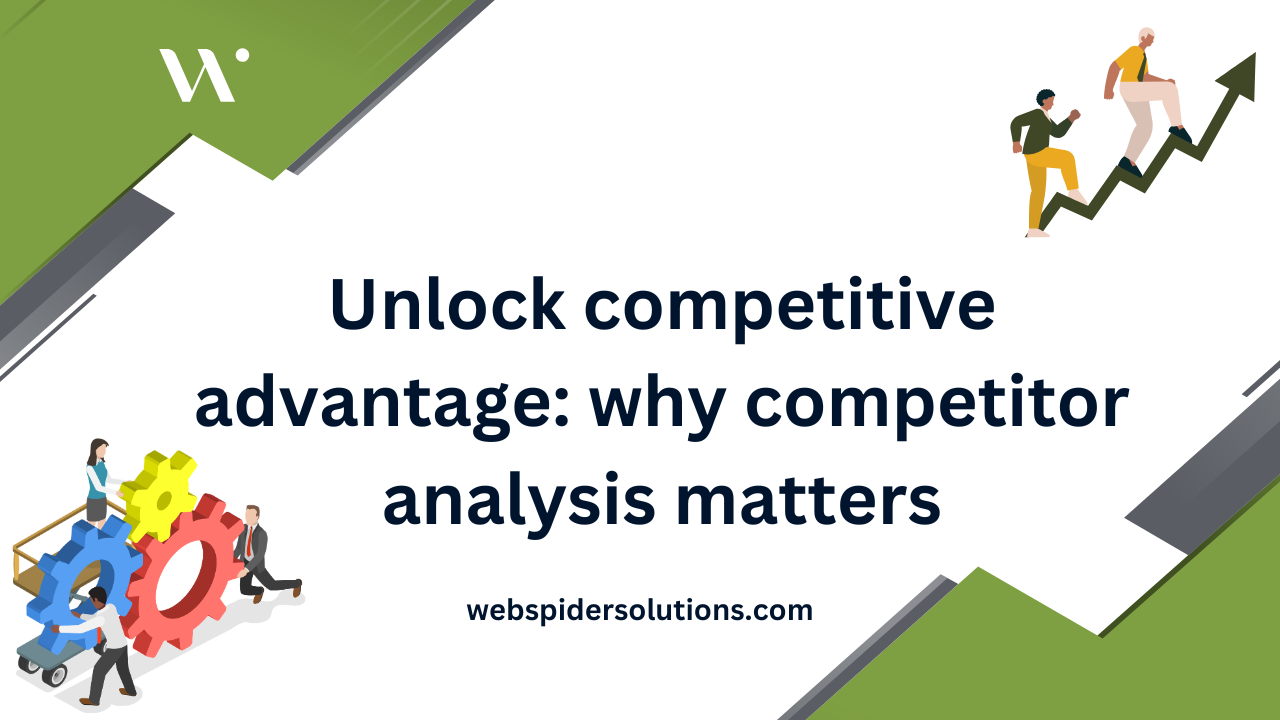
Unlock competitive advantage: why competitor analysis matters
Most business owners think they know who their competition is. They track the obvious players, monitor a few pricing pages, and call it done. But firms misidentifying threats experience 180 basis points lower EBITDA margins than those who get it right. That gap represents real money leaving your business every quarter. Competitor analysis, when done properly, is one of the highest-leverage activities a marketing manager or business owner can invest time in. This guide breaks down what it actually involves, why the data behind it is hard to ignore, and how you can translate competitor intelligence into smarter decisions that move the needle.
Table of Contents
- Understanding competitor analysis: What it is and why it’s essential
- How competitor analysis drives business growth and profitability
- Key steps and frameworks for effective competitor analysis
- Turning competitor insights into strategic actions
- What most business owners miss about competitor analysis
- Next steps: Put competitor analysis to work for your business
- Frequently asked questions
Key Takeaways
| Point | Details |
|---|---|
| Boost profitability | Regular competitor analysis can improve margins and drive business growth. |
| Identify threats & opportunities | Analyzing both direct and indirect competitors reveals strategic risks and new areas for advantage. |
| Turn insights into action | Successful businesses transform competitor knowledge into positioning, campaigns, and battlecards. |
| Leverage advanced tools | AI and structured frameworks make competitor analysis more accurate and actionable. |
| Avoid common mistakes | Ignoring indirect competitors or relying on occasional reviews can cost you market share. |
Understanding competitor analysis: What it is and why it’s essential
Competitor analysis is the structured process of researching, evaluating, and monitoring the businesses competing for your customers’ attention and dollars. It goes far beyond knowing who sells a similar product. Done right, it gives you a clear picture of the market landscape, the strategic moves your rivals are making, and the gaps they’re leaving wide open for you to fill.
The SBA defines the process as identifying direct and indirect competitors, gathering data on their products, pricing, marketing, and customer feedback through websites, reviews, and social media, then analyzing everything through proven frameworks before turning insights into concrete actions like battlecards and positioning adjustments. That definition is worth sitting with, because most businesses only do the first part. They identify competitors and stop there.
There are two types of competitors you need to track:
- Direct competitors sell the same product or service to the same audience. If you run a digital marketing agency targeting B2B SaaS companies in the Midwest, your direct competitors are other agencies with the same niche and geography.
- Indirect competitors solve the same customer problem but through a different method. In the same example, that might be a software tool that lets companies manage their own campaigns, or a freelance marketplace where businesses hire individual specialists instead of an agency.
Ignoring indirect competitors is one of the most expensive mistakes companies make. Many businesses that were disrupted over the past decade were not beaten by a competitor they recognized. They were displaced by someone solving the same problem in a different way.
The data collected in a thorough analysis typically spans several categories:
- Product features, quality, and roadmap signals
- Pricing structures and discount strategies
- Marketing channels, messaging, and content themes
- Customer reviews, complaints, and sentiment patterns
- SEO rankings, paid ad strategies, and social media engagement
- Sales team positioning and sales materials
“Competitive analysis is not a one-time event. It’s an ongoing practice that keeps your strategy calibrated to the real market, not the one you imagined two years ago.”
Businesses that engage in competitor analysis basics as a recurring discipline consistently make better resource allocation decisions. They know where rivals are weak, which customer complaints go unaddressed, and which marketing messages are resonating in the market. That intelligence is extraordinarily valuable when you’re deciding where to invest your budget next quarter.
One often overlooked element is the role competitor analysis plays in risk management. When you know a competitor is aggressively expanding into a market segment you currently own, you can respond proactively rather than reactively. That difference, between leading and playing catch-up, can determine whether a business thrives or struggles over a three to five year horizon.
How competitor analysis drives business growth and profitability
The intuitive case for competitor analysis is easy to make. But the empirical case is where things get genuinely compelling. The numbers reveal just how much of a performance gap exists between businesses that analyze competition systematically and those that do it casually or not at all.
According to structured research, regular competitor analysis produces 2.3x higher revenue growth for companies using structured benchmarking, 18 to 22% higher profitability when AI-enhanced tools are incorporated, and top performers are 2.5x more aligned on their competitive advantage than their lower-performing peers.

Here is a comparison of how different levels of analysis maturity translate into business outcomes:
| Analysis maturity level | Revenue growth impact | Profitability impact | Strategic alignment |
|---|---|---|---|
| No formal analysis | Baseline | Baseline | Low |
| Periodic manual review | +0.8x revenue growth | Marginal | Moderate |
| Structured benchmarking | +2.3x revenue growth | Significant gains | High |
| AI-enhanced continuous analysis | +2.3x or higher | 18 to 22% higher | Very high |
These are not incremental differences. A 2.3x revenue growth gap is a company that doubles while its competitor stagnates. An 18 to 22% profitability improvement can be the difference between a business that funds its own growth and one that constantly chases external capital.
So where does this lift come from? The answer is in precision. Businesses with mature competitor analysis practices make fewer expensive mistakes. They don’t enter markets where a competitor already dominates without a clear differentiation plan. They don’t undercharge because they have real pricing intelligence. They don’t waste ad spend on channels that are not converting because they can see where competitors are pulling back.
When working on building marketing strategies, competitor intelligence shapes everything from the channels you prioritize to the messaging frameworks you test first. You’re not guessing. You’re building on real market evidence.
Pro Tip: Most businesses track competitor pricing and product features but overlook customer sentiment. Review platforms like G2, Trustpilot, and Google Reviews are gold mines for understanding what your competitors’ customers wish were different. That’s where your opportunity to differentiate is hiding.
The companies that see the largest competitive advantage from this process are those that treat it as a strategic discipline rather than a one-off task. They assign ownership, build processes, and create feedback loops so that competitor intelligence flows directly into marketing, sales, and product decisions on a regular cadence.
Key steps and frameworks for effective competitor analysis
Knowing that competitor analysis matters is one thing. Knowing exactly how to do it well is another. Let’s walk through a practical approach that works for both business owners who are doing this themselves and marketing managers who are building out a repeatable process for their team.
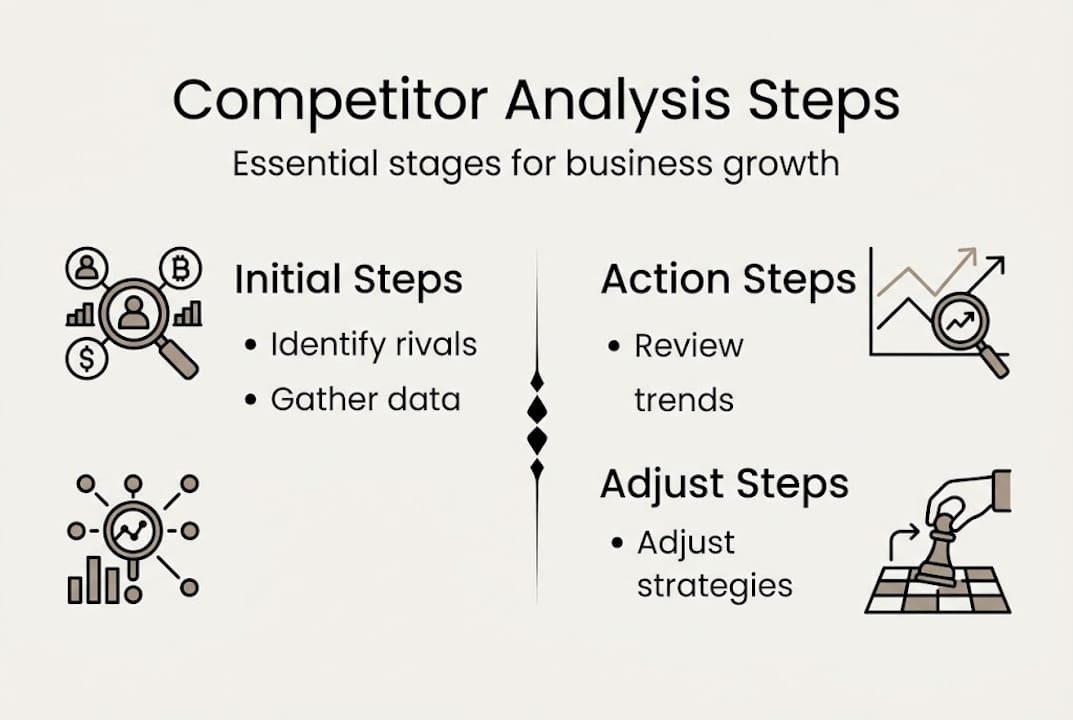
Here is a step-by-step process you can start using immediately:
- Identify your competitors. List direct competitors first, then indirect ones. A useful exercise is to search for your own product category on Google, check who’s running ads, and look at who appears in review platforms in your space. Aim for 5 to 10 competitors in total.
- Define what you’re measuring. Decide upfront which data categories matter most for your goals. If you’re focused on digital acquisition, prioritize SEO rankings, ad strategies, and content. If you’re in a pricing-sensitive market, focus on pricing structures and promotional patterns.
- Gather your data. The SBA recommends collecting information from competitor websites, customer reviews, social media profiles, and third-party tools. Free options include Google Alerts, SimilarWeb, and SpyFu. Paid tools like Semrush, Ahrefs, and Crayon offer deeper visibility.
- Apply a structured framework. The most used frameworks include SWOT analysis (Strengths, Weaknesses, Opportunities, Threats), Porter’s Five Forces for market-level competitive pressure, and perceptual mapping to visualize how customers perceive you versus rivals.
- Synthesize into insights. Data without interpretation is just noise. Create a one-page summary per competitor that highlights their strategic positioning, key vulnerabilities, and recent moves.
- Take action. Build battlecards for your sales team, adjust your positioning, update your keyword strategy, and revise your value proposition where needed.
Here’s a quick comparison of manual versus AI-enhanced approaches:
| Approach | Speed | Depth | Cost | Best for |
|---|---|---|---|---|
| Manual analysis | Slow | Moderate | Low | Early-stage businesses |
| Tool-assisted manual | Moderate | High | Medium | Growing companies |
| AI-enhanced platforms | Fast | Very high | Higher | Scaling businesses |
For your digital marketing strategy planning, incorporating competitor data at every phase ensures your plan reflects real market conditions rather than assumptions. And before launching any major campaign, running a digital marketing audit that includes a competitive benchmark will show you exactly where you stand relative to the market.
Pro Tip: Avoid the trap of only analyzing competitors who look like you. Some of the most important signals come from market leaders in adjacent industries. They often adopt tactics 12 to 18 months before those tactics become mainstream in your space.
Turning competitor insights into strategic actions
Collecting data is only valuable if it changes what you do. This is the stage where most businesses stall. They gather information, put together a slide deck, and then return to business as usual. The gap between insight and action is where competitive advantage is either built or lost.
Here is how to make competitor intelligence operational across your business:
- Update your positioning. If your analysis reveals that competitors are all messaging around speed and efficiency, and customers are complaining that none of them deliver on that promise, you have an opening. Reframe your positioning around reliability and proof. Let their gap become your claim.
- Build battlecards. A well-structured battlecard is a one-page reference document your sales team can use in live conversations. It lists competitor strengths you can acknowledge, weaknesses you can exploit, and specific objection-handling language when a prospect brings up a rival.
- Optimize your digital campaigns. Knowing which keywords a competitor ranks for organically tells you where they’re investing in SEO. Knowing which terms they’re buying in paid search tells you what’s converting. Both signals are useful for prioritizing your own media spend.
- Refine your content strategy. Look at the topics your competitors cover well and the ones they ignore. The ignored topics are often underserved questions your shared audience is asking. Owning those conversations builds authority in spaces your rivals have left empty.
- Align your product roadmap. Customer complaints about competitor products are essentially a free product brief. If their customers consistently mention a missing feature or a friction point, that’s a prioritization signal for your own development or service delivery.
Pro Tip: Set a quarterly competitor review cadence. Assign a specific team member to own each major competitor, and have them present a brief update at your quarterly strategy meeting. This keeps intelligence fresh and ensures someone is always watching for market shifts.
For scaling businesses, integrating competitor insights into B2B campaign strategies dramatically improves targeting precision. If you’re an SMB building your digital presence, a step-by-step digital strategy approach that incorporates competitive benchmarking will save you from expensive trial-and-error. And for businesses ready to scale their analysis, understanding AI in digital marketing will show you how automation can make this process continuous rather than periodic.
What most business owners miss about competitor analysis
Here is the uncomfortable truth: most competitor analysis fails not because people skip the process, but because they only watch the competitors they already know about. They monitor the obvious rivals, feel informed, and move on. The real threats are usually coming from somewhere they’re not looking.
Misidentifying competitive threats leads to significantly lower profitability, and that’s not a small effect. It’s measurable, material, and persistent. The business that’s losing market share to an indirect competitor it never tracked will never fully understand why its numbers are softening.
We’ve seen this repeatedly. A traditional retailer monitors its brick-and-mortar competitors while a subscription model quietly captures its best customers. A professional services firm tracks other firms while a software platform automates what those clients used to pay for. The real competitor is rarely the most obvious one.
The businesses that get the most from competitor analysis are those that use AI-assisted link building and broader AI tools to surface signals they would never find manually. Pattern recognition at scale changes what’s visible. What looks like normal market noise to a human analyst is a detectable shift to an AI-trained model.
The lesson is this: build a process that intentionally includes competitors you don’t recognize yet. Monitor emerging categories. Watch adjacent markets. Treat ambiguity as a signal, not an excuse to look away.
Next steps: Put competitor analysis to work for your business
Competitor analysis is only as valuable as the actions it drives. If you’re ready to move from concept to execution, Web Spider Solutions has the resources and expertise to help you get there. Whether you’re building your first structured framework or optimizing an existing process, our SEO strategy guide is a strong starting point for understanding where search visibility fits into your competitive positioning. You can also explore how our work has driven measurable results for clients through our Mangalmay success story, or learn how AI is reshaping SEO and competitive intelligence at scale. Our team is ready to help you turn competitor data into a genuine market advantage.
Frequently asked questions
What are the main benefits of competitor analysis for small businesses?
Competitor analysis helps small businesses identify market trends, improve positioning, and increase profitability through smarter decision-making. Businesses that analyze regularly consistently outperform those that don’t across revenue and margin metrics.
How often should businesses perform competitor analysis?
Businesses should perform competitor analysis at minimum on a quarterly basis to stay ahead of evolving market conditions and emerging threats. Markets shift faster than annual reviews can capture.
What are the first steps to begin competitor analysis?
Start by identifying your direct and indirect competitors, then gather data on products, pricing, marketing, and customer feedback from websites, reviews, and social platforms before applying a structured framework.
Can AI improve competitor analysis results?
AI-enhanced analysis achieves 18 to 22% higher profitability by processing competitive signals faster and at greater depth than manual methods allow. It also surfaces indirect threats that human review typically misses.
What is a battlecard and how does it help?
A battlecard is a concise, single-page document summarizing a competitor’s strengths and weaknesses, giving your sales and marketing teams a ready reference during live prospect conversations and campaign planning.