






TL;DR:
- PPC offers small businesses immediate visibility and targeted traffic in competitive markets.
- Long-tail keywords, precise targeting, and ongoing optimization lower costs and improve ROI.
- Agility and customer insight outperform large budgets, emphasizing testing and local personalization.
Most small business owners assume PPC is a game only big brands can win. That belief costs them real revenue. The truth is that AI-driven bidding and broad match now dominate paid search in 2026, yet SMBs consistently gain an edge through niche long-tail targeting and sharper data strategies. This guide cuts through the noise. You’ll learn exactly how PPC fuels online growth for smaller companies operating in tough markets, what tactics actually move the needle, and how to navigate rising platform complexity without burning through your budget.
Table of Contents
- Why PPC matters for online business growth
- Core components of a growth-focused PPC strategy
- Navigating competitive markets: How SMBs can win with PPC
- Measuring PPC success and maximizing ROI
- The truth most PPC guides miss: Agility and focus beat overspending
- Accelerate your online growth with strategic PPC support
- Frequently asked questions
Key Takeaways
| Point | Details |
|---|---|
| PPC drives fast growth | Smart PPC lets SMBs earn quality leads and compete with big brands almost instantly online. |
| Strategy matters more | Long-tail keywords, tight targeting, and ongoing optimization often beat big budgets. |
| Measure and adapt | Regularly monitor ROAS and campaign performance to continually improve your PPC results. |
| Leverage AI wisely | AI tools boost efficiency, but hands-on data and audience insights make SMB campaigns truly effective. |
Why PPC matters for online business growth
With that myth dispelled, let’s examine the concrete reasons PPC is indispensable for online business growth.
Organic search rankings take months to build. PPC puts you at the top of search results today. For SMBs trying to compete in crowded markets, that speed is not a luxury. It’s a survival tool. You can capture high-intent traffic while your SEO efforts are still gaining ground, and you can do it without waiting for Google’s algorithm to notice you.
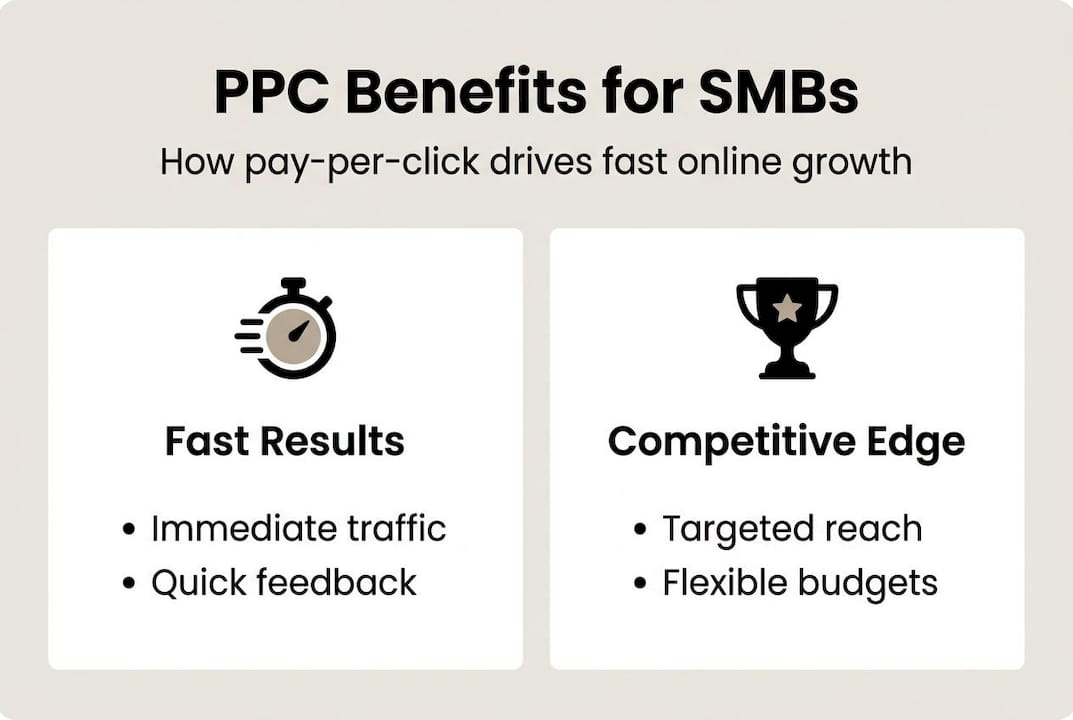
The benefits of paid advertising go well beyond visibility. PPC lets you target customers based on what they’re actively searching for, where they’re located, what device they’re using, and even what time of day they’re most likely to convert. That precision is something traditional advertising simply cannot match.
Here’s what PPC delivers for growth-focused SMBs:
- Immediate search visibility even when organic rankings are still developing
- Intent-based targeting that puts your ad in front of buyers, not browsers
- Scalable budgets that grow with your results rather than demanding upfront commitment
- Fast testing cycles to validate offers, messaging, and landing pages in days, not months
- Measurable ROAS (Return on Ad Spend) that ties every dollar to real business outcomes
ROAS is the metric that separates smart PPC from wasteful spending. It tells you how much revenue you generate for every dollar spent on ads. If you spend $1,000 and generate $4,000 in revenue, your ROAS is 4x. As platform complexity rises, monitoring ROAS is critical for online growth because it keeps your decision-making grounded in real data rather than vanity metrics.
“PPC is not about outspending your competitors. It’s about outsmarting them with better targeting, tighter messaging, and relentless optimization.”
The PPC benefits for business growth also include a feedback loop that SEO cannot replicate. You can run an ad today, collect data by tomorrow, and make informed decisions by next week. That speed of learning is invaluable when you’re operating with limited resources and need every campaign dollar to count.
Core components of a growth-focused PPC strategy
Understanding PPC’s impact, what makes a campaign truly growth-ready?
A well-built PPC campaign is not a single ad. It’s a system. Each component depends on the others, and weakness in one area drags down the entire effort. Here are the five pillars every SMB needs to get right:
- Keyword research with a long-tail focus. Broad, high-volume keywords are expensive and competitive. Long-tail keywords like “affordable dental implants in Austin” cost less per click and attract buyers who are much closer to making a decision. They’re the foundation of affordable, qualified traffic.
- Ad copy that matches user intent. Your ad needs to speak directly to what the searcher wants. A person searching “emergency plumber near me” needs to see urgency and availability in your copy, not a generic tagline. Match the message to the moment.
- Smart targeting using demographics, location, and audience lists. Layering targeting signals lets you reach the right people and exclude the wrong ones. Remarketing lists, in-market audiences, and geographic targeting all sharpen your spend.
- Ongoing ROAS monitoring and bid adjustments. Set-it-and-forget-it campaigns bleed money. Weekly reviews of keyword performance, bid strategies, and budget allocation keep your campaigns efficient.
- Landing page alignment for higher conversion rates. Sending paid traffic to a generic homepage is one of the most common and costly mistakes SMBs make. Every ad group should connect to a landing page built around that specific offer.
The PPC fundamentals for SMBs that drive real results also require lifecycle segmentation. As lifecycle segmentation and long-tails become essential for SMBs competing in high-CPC niches, knowing where your customer is in their buying journey changes everything about how you bid and what you say.
Pro Tip: Build separate campaigns for cold audiences and warm retargeting audiences. Cold traffic needs education and trust signals. Warm traffic needs a clear, direct offer. Mixing them into one campaign dilutes both messages and wastes budget.
Review the PPC best practices that apply specifically to your industry before setting up your first campaign. The rules around ad copy, compliance, and bidding vary significantly between sectors like healthcare, finance, and e-commerce.
Navigating competitive markets: How SMBs can win with PPC
Once the basics are in place, here’s how to outmaneuver larger players, even when budgets are tight.

High-CPC industries like finance, legal, and healthcare can see cost-per-click rates exceeding $50 or even $100 for broad keywords. Competing head-to-head with enterprise brands on those terms is a fast way to drain your budget with little to show for it. The smarter play is precision.
| Tactic | Enterprise approach | SMB advantage |
|---|---|---|
| Keyword strategy | Broad match, high volume | Long-tail, high intent |
| Bidding | AI-automated, data-heavy | Focused manual + smart bidding |
| Targeting | National, wide reach | Hyper-local, niche segments |
| Messaging | Brand awareness focus | Direct response, specific offers |
| Budget | Massive, sustained spend | Lean, tested, reinvested |
Large brands rely on AI bidding systems fed by enormous datasets. They have years of conversion history that train their algorithms. SMBs don’t have that yet. But what SMBs do have is agility. You can pivot a campaign in hours. You can test a new offer this week. You can go deep into a local market that a national brand treats as an afterthought.
Key tactics for winning in competitive PPC markets:
- Use long-tail keyword qualifiers like “best,” “near me,” “affordable,” and “for small business” to filter out unqualified clicks
- Apply negative keywords aggressively to stop paying for irrelevant searches
- Build remarketing lists from your website traffic and past customers to lower acquisition costs
- Comply with platform-specific ad policies to avoid disapprovals that waste time and budget
As long-tail qualifiers and lifecycle segmentation help SMBs compete in high-CPC industries, the businesses that win are the ones that know their customer better than any algorithm does. That firsthand knowledge is your moat.
Pro Tip: Segment your campaigns by buyer stage. Run separate campaigns for awareness (informational keywords), consideration (comparison keywords), and decision (transactional keywords). This lets you control messaging and budget at each stage of the funnel.
Explore PPC advertising for SMB success to see how targeted strategies have helped businesses in competitive sectors grow without overspending. The powerful PPC benefits available to SMBs are real, but only when the strategy is built around your specific market position.
Measuring PPC success and maximizing ROI
The final puzzle piece: knowing what’s working and amplifying what moves the needle.
Running PPC without proper tracking is like driving with your eyes closed. You might get somewhere, but the odds are not in your favor. Conversion tracking is the non-negotiable starting point. Set it up in Google Ads, connect it to your CRM or analytics platform, and assign a real dollar value to each conversion action.
Here are the key metrics every SMB should track:
| Metric | What it measures | Why it matters |
|---|---|---|
| ROAS | Revenue per ad dollar spent | Overall campaign profitability |
| Cost per lead (CPL) | Ad spend divided by leads generated | Efficiency of lead generation |
| Quality Score | Ad relevance, CTR, landing page experience | Affects cost and ad placement |
| Click-through rate (CTR) | Clicks divided by impressions | Measures ad copy effectiveness |
| Conversion rate | Conversions divided by clicks | Measures landing page performance |
Once tracking is live, build a regular review cycle. Weekly check-ins catch problems fast. Monthly reviews reveal trends. Quarterly audits identify structural waste, such as keywords that spend heavily but never convert.
The optimization process follows a clear loop:
- Audit for waste. Identify keywords, placements, or audiences that consume budget without producing conversions.
- Pause or reduce bids on underperforming segments.
- Reinvest in winners. Shift budget toward campaigns and ad groups with proven ROAS.
- Test new variables. Run A/B tests on ad copy, landing pages, and bidding strategies to find incremental gains.
- Document and repeat. Keep a record of what you tested and what changed. This builds institutional knowledge over time.
“The businesses that grow fastest with PPC are not the ones with the biggest budgets. They’re the ones with the tightest feedback loops.”
As monitoring ROAS becomes vital with rising platform complexity, the SMBs that build disciplined reporting habits now will have a significant advantage. Use the PPC ROI guide for SMBs to understand how to structure your tracking and reporting from day one. Understanding why use PPC advertising from a data perspective helps you make the case internally for continued investment as results compound.
The truth most PPC guides miss: Agility and focus beat overspending
With the hard skills and tactics covered, let’s address a key mindset shift for winning with PPC.
Most PPC advice is written for enterprise teams with dedicated analysts, six-figure budgets, and months to run experiments. When SMBs follow that playbook, they often end up chasing broad keywords, copying competitor messaging, and wondering why their cost-per-lead keeps climbing.
The real edge for smaller businesses is not found in a bigger budget. It’s found in knowing your customer in a way no algorithm can replicate. You know the objections your prospects raise on sales calls. You know the neighborhood where your best clients live. You know the seasonal patterns in your industry. That knowledge, fed into tightly focused campaigns, beats generic best practices every time.
Nimble campaign changes, hyper-local targeting, and creative offers built around real customer pain points are what set SMBs apart. AI tools help you bid smarter, but they can’t replace the insight you bring from actually talking to your customers. Understanding how PPC works in practice means recognizing that the data you collect from your own customers is your most valuable asset in any paid campaign.
Constant testing, not constant spending, is what delivers lasting results.
Accelerate your online growth with strategic PPC support
Ready to take the next step in PPC mastery? At Web Spider Solutions, we work directly with SMBs in competitive industries to build PPC strategies that generate real leads and measurable revenue. Whether you’re just getting started or looking to fix a campaign that isn’t performing, our team brings the data, tools, and hands-on experience to make your ad spend work harder. Explore PPC advertising explained to build your foundation, review the PPC advertising benefits that apply to your business, and see how our approach to PPC for SMB success can accelerate your growth. Let’s build something that scales.
Frequently asked questions
What is the main advantage of PPC for small businesses?
PPC provides immediate visibility and targeted traffic, letting small businesses compete quickly with much larger brands. Niche long-tail targeting enables SMBs to reach high-intent buyers without competing on expensive broad keywords.
How do I know if my PPC campaigns are profitable?
Track your ROAS and compare it to your cost per lead or sale. Monitoring ROAS is vital as platform complexity increases, and profitability simply means your ad revenue consistently exceeds what you spend to generate it.
How can SMBs lower PPC costs in competitive industries?
Use long-tail keywords, precise audience targeting, and ongoing campaign optimization to reduce wasted spend. Long-tail qualifiers and segmentation help SMBs control costs even in high-CPC sectors.
Do I need to use AI tools for PPC in 2026?
AI bidding is now standard across major platforms, but SMBs still succeed by combining automation with first-party data and focused strategies. AI-driven bidding dominates in 2026, yet the businesses that win layer it with genuine customer insight rather than relying on automation alone.
Recommended