







Cross channel marketing connects all your favorite platforms so customers get a seamless experience no matter where they interact with your brand. Here is something that might surprise you. Companies that master this approach can increase customer engagement by up to 89 percent and drive revenue gains of 40 percent over less sophisticated competitors. Most businesses still treat each channel as its own island, missing out on the power of a truly unified strategy.
Table of Contents
- What Is Cross Channel Marketing And How Does It Work?
- The Importance Of Cross Channel Marketing In Today’s Business Landscape
- Key Components Of An Effective Cross Channel Marketing Strategy
- Challenges And Solutions In Implementing Cross Channel Marketing
Quick Summary
| Takeaway | Explanation |
|---|---|
| Cross channel marketing enhances customer engagement. | This strategy connects multiple platforms, increasing real-time customer interactions and relationships. |
| Data integration is essential for success. | Collecting and analyzing customer data from various sources leads to personalized marketing efforts and improved customer experiences. |
| Consistent messaging builds brand loyalty. | Unified communication across channels reinforces brand identity and ensures customers receive coherent messaging. |
| Personalization drives higher retention rates. | Tailoring marketing approaches based on individual behaviors leads to improved customer satisfaction and loyalty. |
| Technological infrastructure supports integrated strategies. | Sophisticated systems are necessary to track interactions and enable seamless data sharing across all platforms. |
What is Cross Channel Marketing and How Does it Work?
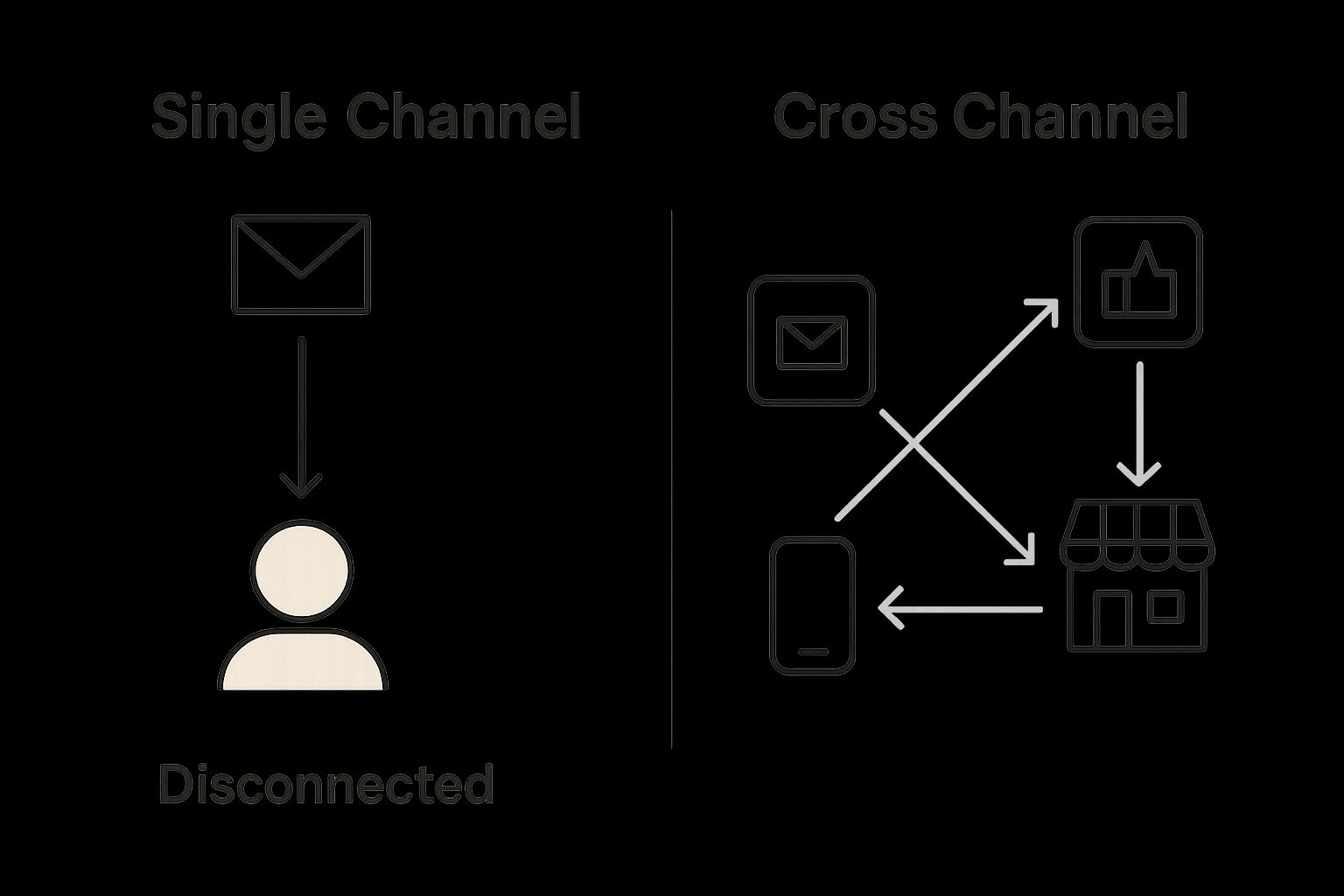
Cross channel marketing represents a strategic approach that enables businesses to create seamless, interconnected customer experiences across multiple communication platforms and touchpoints. Unlike traditional single channel marketing strategies, this method integrates various digital and offline channels to deliver consistent messaging and personalized interactions.
Understanding the Core Concept
At its fundamental level, cross channel marketing focuses on providing customers with a unified brand experience regardless of how or where they interact with your business. This means creating synchronized communications across platforms like social media, email, websites, mobile apps, physical stores, and advertising channels.
The primary goal is to remove barriers between different marketing channels and create a holistic customer journey. For instance, a customer might first encounter your brand through a social media advertisement, receive a follow-up email, and then complete a purchase through your mobile app or website. Cross channel marketing ensures these interactions feel connected and intentional.
Key Operational Mechanics
Successful cross channel marketing relies on several critical operational components:
- Data Integration: Collecting and synthesizing customer data from multiple sources to create comprehensive user profiles
- Consistent Messaging: Maintaining uniform brand voice and communication across all platforms
- Personalization: Tailoring interactions based on individual customer behaviors and preferences
According to Harvard Business Review, companies that excel at cross channel marketing can increase customer engagement by up to 89% and retention rates by significant margins.
Learn more about digital marketing campaigns that can help you implement the McKinsey Researchse sophisticated marketing strategies effectively. Cross channel marketing transforms fragmented customer interactions into smooth, intuitive experiences that build stronger connections between brands and their audiences.
The Importance of Cross Channel Marketing in Today’s Business Landscape
In an increasingly digital and competitive business environment, cross channel marketing has transformed from a strategic option to a critical necessity for organizations seeking sustainable growth and customer engagement. Modern consumers expect seamless, personalized experiences that transcend traditional communication boundaries.
Competitive Advantage and Customer Expectations
Today’s customers interact with brands through multiple touchpoints, demanding consistent and interconnected experiences. Cross channel marketing directly addresses these evolving consumer expectations by creating unified communication strategies that recognize and respond to individual preferences across different platforms.
Businesses that successfully implement cross channel marketing gain significant competitive advantages. They can track customer interactions more comprehensively, develop more nuanced understanding of consumer behavior, and deliver targeted messaging that resonates with specific audience segments.
Economic and Performance Implications
The economic impact of cross channel marketing is substantial. McKinsey Research indicates that effective personalization strategies can generate 40% more revenue for companies compared to their less sophisticated counterparts.
Key performance benefits include:
- Enhanced customer retention rates
- More efficient marketing spend allocation
- Improved conversion metrics across digital platforms
- Greater insight into customer journey dynamics
Explore how digital marketing can transform small business strategies and understand the profound impact of integrated marketing approaches. Cross channel marketing represents not just a technological strategy, but a fundamental shift in how businesses conceptualize customer relationships in the digital age.
Key Components of an Effective Cross Channel Marketing Strategy
Developing a robust cross channel marketing strategy requires a comprehensive approach that integrates technology, data analytics, and customer-centric design. Successful implementation demands a nuanced understanding of how different marketing components work together to create seamless customer experiences.
Strategic Data Management and Integration
Data serves as the fundamental backbone of cross channel marketing. Organizations must establish sophisticated systems that collect, analyze, and synthesize customer information from multiple touchpoints. This involves creating unified customer profiles that track interactions across digital and physical channels, enabling more personalized and contextually relevant communications.
Effective data integration allows businesses to understand customer behaviors, preferences, and potential future actions. By leveraging advanced analytics and machine learning technologies, companies can develop predictive models that anticipate customer needs before they arise.
Technology and Infrastructure Requirements
Implementing a successful cross channel marketing strategy requires sophisticated technological infrastructure. Companies need robust platforms that can:
- Aggregate data from multiple sources seamlessly
- Provide real-time customer interaction tracking
- Enable automated personalization
- Support multichannel communication
- Ensure data privacy and security
Explore our comprehensive digital marketing strategy guide to understand how technology empowers cross channel marketing approaches. According to Salesforce Research, companies with integrated customer views can increase marketing effectiveness by up to 65% and customer satisfaction rates significantly.
The ultimate goal is creating an ecosystem where customer interactions feel intuitive, personalized, and frictionless across every engagement point.
To clarify the critical elements of a successful cross channel marketing strategy, the following table summarizes and explains each component covered in this section.
| Key Component | Description |
|---|---|
| Strategic Data Management | Collects, analyzes, and unifies customer data from multiple touchpoints for insights. |
| Data Integration | Merges information from various sources to build complete customer profiles. |
| Consistent Messaging | Ensures a cohesive brand voice and communication across all platforms. |
| Personalization | Tailors interactions based on individual user behaviors and preferences. |
| Advanced Technology | Utilizes systems for real-time tracking, automation, and seamless data sharing. |
| Security and Privacy | Maintains stringent standards to protect customer information across channels. |

Challenges and Solutions in Implementing Cross Channel Marketing
Cross channel marketing, while immensely powerful, presents complex implementation challenges that require strategic planning and sophisticated technological solutions. Organizations must navigate intricate technological, organizational, and strategic obstacles to create truly integrated marketing experiences.
Technological Complexity and Integration Barriers
The primary challenge in cross channel marketing lies in seamlessly connecting disparate technological systems. Many businesses struggle with legacy infrastructure that prevents smooth data integration and communication between different marketing platforms. This technological fragmentation can lead to disjointed customer experiences and inefficient marketing processes.
Successful implementation requires robust technological ecosystems that can:
- Synchronize data across multiple platforms
- Provide real-time communication capabilities
- Support complex customer journey mapping
- Maintain stringent data privacy standards
- Enable sophisticated analytics and reporting
Strategic Organizational Alignment
Implementing cross channel marketing is not just a technological challenge but also an organizational cultural shift. Marketing teams must develop new collaborative skills, break down traditional departmental silos, and adopt more holistic, customer-centric approaches.
Explore our comprehensive guide on understanding digital marketing challenges to gain deeper insights into overcoming implementation obstacles. McKinsey Research emphasizes that maintaining consistent messaging and experience across channels is critical for customer satisfaction and marketing effectiveness.
The most successful organizations view cross channel marketing not as a technical project, but as a comprehensive business transformation strategy that requires continuous learning, adaptation, and customer-focused innovation.
The table below highlights key statistical advantages found in the article, illustrating how mastering cross channel marketing can drive business performance.
| Performance Metric | Cross Channel Marketing Result | Source |
|---|---|---|
| Customer Engagement Increase | Up to 89% | Harvard Business Review |
| Revenue Gains | Up to 40% over less sophisticated peers | McKinsey Research |
| Marketing Effectiveness | Increase up to 65% | Salesforce Research |
| Customer Retention Improvement | Significant rise (exact % not specified) | Harvard Business Review |
| Customer Satisfaction Rates | Significant improvement | Salesforce Research |
Ready to Master Cross Channel Marketing and Drive Real Growth?
Are you facing the challenge of disconnected customer experiences and missed opportunities across your marketing channels? If optimizing data integration, aligning messaging, and achieving measurable business growth feel overwhelming, you are not alone. Many businesses struggle to build the seamless cross channel strategies discussed above. At Web Spider Solutions, we understand how hard it can be to unify digital touchpoints and create high-performing, consistent campaigns.
Why settle for average results when you can transform every customer interaction? Visit our Paid Advertising page to explore targeted services that amplify your brand on every platform. Take the next step now and see how our integrated digital strategies at Web Spider Solutions can turn marketing complexity into competitive advantage. Book your free consultation today and unlock the full potential of your cross channel marketing.
Frequently Asked Questions
What is cross channel marketing?
Cross channel marketing is a strategic approach that integrates multiple communication platforms and touchpoints to create a seamless and interconnected customer experience. It ensures consistent messaging across various channels like email, social media, websites, and physical stores.
Why is cross channel marketing important for businesses?
Cross channel marketing is crucial because it meets modern consumer expectations for personalized and cohesive experiences. It helps businesses gain a competitive advantage, improve customer engagement, and boost retention rates by delivering unified communication strategies.
What are the key components of an effective cross channel marketing strategy?
Key components include strategic data management for creating unified customer profiles, consistent messaging across all platforms, and the use of advanced technology for real-time tracking and automated personalization.
What challenges do organizations face when implementing cross channel marketing?
Organizations often face challenges such as technological complexity, integration barriers among disparate systems, and the need for organizational alignment to cultivate a customer-centric approach. Overcoming these challenges requires strategic planning and advanced technological solutions.
Recommended