







TL;DR:
- Keyword research connects your content to audience demand by analyzing search terms used by potential customers.
- Successful methods include brainstorming seed keywords, utilizing multiple tools, analyzing competitors, mining social platforms, and applying AI discovery.
Keyword research is the process of identifying and analyzing the search terms your audience uses to find products or services like yours. Done well, it is the single most reliable way to connect your content with real demand. Tools like Google Keyword Planner, SEMrush, and Ahrefs give you the raw data. But the best keyword research techniques go further. They match search intent to content format, prioritize business value over raw volume, and pull signals from sources most marketers ignore. Modern keyword research has shifted from chasing high-volume terms to targeting keywords most likely to drive conversions or brand awareness directly.
What are the main keyword research techniques?
Keyword research methods fall into six proven categories. Each one surfaces a different layer of demand, and the strongest SEO programs use all of them together.
- Brainstorm seed keywords. Start with the core topics your business owns. A SaaS company selling project management software might start with “task tracking,” “team collaboration tool,” or “project timeline software.” These seeds feed every other step.
- Use dedicated keyword tools. Google Keyword Planner, SEMrush, Moz Keyword Explorer, Mangools, and WordStream each generate keyword ideas, search volume estimates, and difficulty scores from their respective data sets. Run your seeds through at least two tools. Different tools surface different keyword sets, and the overlap reveals your highest-confidence targets.
- Run competitor keyword gap analysis. Pull a competitor’s domain into SEMrush or Ahrefs and identify keywords they rank for that you do not. This is one of the fastest ways to find proven, in-demand terms with a clear ranking benchmark already in place.
- Mine social platforms and forums. Industry forums and social media reveal keywords that traditional tools miss entirely. Reddit threads, Amazon reviews, LinkedIn comments, and Quora answers show you the exact language real buyers use. That language rarely appears in a keyword tool’s suggestion list.
- Analyze first-party data. Google Search Console shows you the queries already driving impressions and clicks to your site. These are real searches from real people who found you relevant. They are also the easiest keywords to improve rankings for because you already have some authority.
- Apply AI-powered keyword discovery. AI tools improve keyword discovery by surfacing conversational, intent-rich prompts that traditional volume-based tools do not capture well. Tools like ChatGPT and Perplexity can generate question-based keyword variants that mirror how people actually phrase queries in AI search environments.
Pro Tip: Check your Bing Webmaster Tools alongside Google Search Console. Bing’s AI-powered search reports surface query patterns from Copilot and Bing Chat that often predict where Google’s AI Overviews are heading next.
How do you analyze and prioritize keywords for SEO impact?

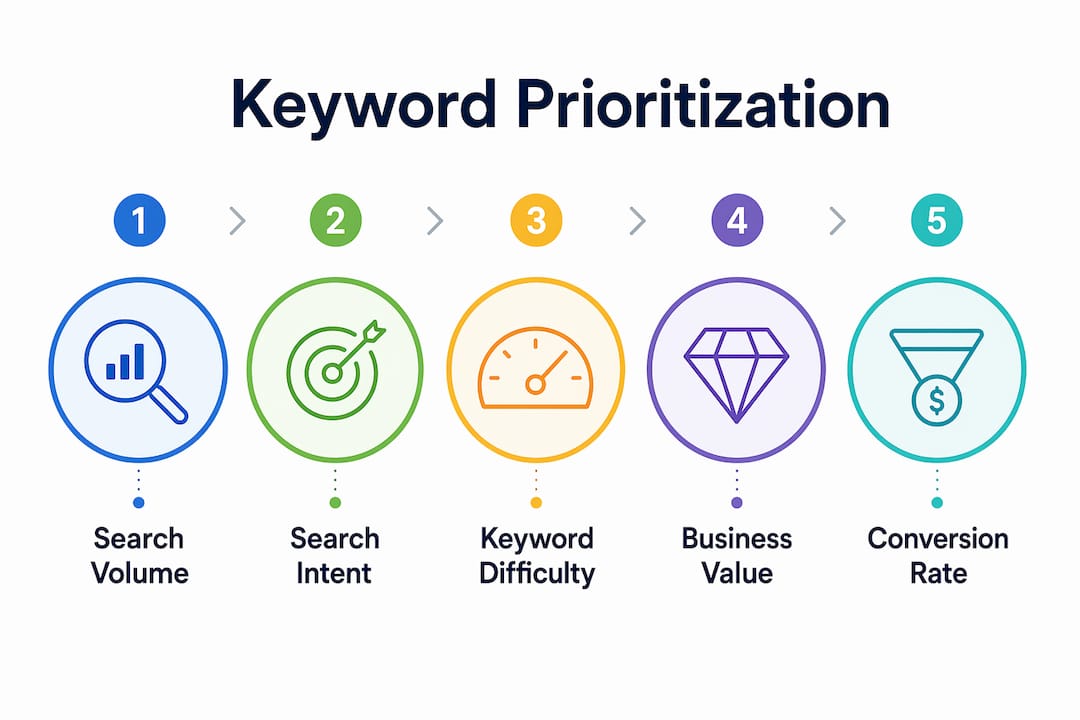
Not every keyword deserves equal attention. A scoring model across five dimensions helps you sequence your targeting efficiently.
The five dimensions of keyword prioritization
| Factor | What to evaluate |
|---|---|
| Search volume | Monthly search estimate; higher is not always better if intent is weak |
| Search intent | Informational, navigational, commercial, or transactional |
| Keyword difficulty | Tool-generated score; treat as directional, not absolute |
| Conversion potential | Does this keyword signal buying intent or research behavior? |
| Business relevance | Does ranking for this term actually help your business goals? |
Search intent is the most critical dimension. Two keywords with identical volume may require completely different content formats. “Best CRM software” signals a comparison article. “Buy Salesforce license” signals a product or pricing page. Publishing the wrong format for either query means you will not rank, regardless of how well you write.
Keyword difficulty scores from tools like Ahrefs and SEMrush give directional guidance. They do not account for your domain authority or the quality of your existing content. A site with strong topical authority can rank for a “hard” keyword faster than a newer site targeting an “easy” one. Always interpret difficulty scores in context.
Pro Tip: Build topic clusters from your seed keywords. A cluster groups one primary keyword with 8–15 related long-tail variants under a single content hub. This approach signals topical depth to Google and positions your content for multiple related queries at once.
For long-tail keyword methods, the conversion rate advantage is real. Long-tail terms carry lower volume but higher specificity. A marketer searching “keyword research techniques for B2B SaaS” is much closer to a buying decision than one searching “SEO tips.”
What are the best practices for keyword research?
Strong keyword research methods mean nothing if you apply them poorly on the page. These are the mistakes that cost rankings most often.
- Avoid keyword cannibalization. One primary keyword per page is the rule. When two pages on your site compete for the same head term, Google splits its ranking signals between them. Neither page wins. Assign one primary keyword per URL and support it with a cluster of secondary and related terms.
- Match content format to intent exactly. Mismatching content format to search intent is the number one cause of ranking failure. A keyword like “how to do keyword research” needs a step-by-step guide. A keyword like “SEMrush vs Ahrefs” needs a comparison article. Publishing a product page for either will not rank.
- Write for authority, not density. Forcing a keyword into every paragraph signals low quality to both readers and search engines. Write the most authoritative answer to the query. The keyword appears naturally when you do that well.
- Audit and refresh keyword data regularly. Search trends shift. A keyword that drove traffic in 2024 may have lost volume or changed intent by 2026. Quarterly audits of your top-performing pages catch these shifts before rankings drop.
- Map keywords to pages systematically. Build a simple spreadsheet with one row per URL, one column for the primary keyword, and columns for secondary keywords. This prevents duplication and gives you a clear view of gaps in your coverage.
Pro Tip: Use Google Search Console’s “Performance” report filtered by page to see which queries each URL already ranks for. This tells you which secondary keywords to add to existing content rather than creating new pages.
How is keyword research changing in 2026?
The rules of SEO keyword analysis are shifting faster than most marketers realize. The biggest change is the move from volume-first to business value-first keyword selection. AI search tools like Google’s AI Overviews and Perplexity now answer high-volume informational queries directly in the results page. That reduces click potential for generic terms significantly. The keywords worth targeting are the ones that still drive visits and conversions.
Several practical shifts define effective keyword strategies in 2026:
- Research across multiple platforms. Google is not the only search engine that matters. Amazon, Reddit, YouTube, Pinterest, and ChatGPT all function as search engines for specific audiences. Mining these platforms surfaces intent-rich queries that Google Keyword Planner will never show you.
- Prioritize conversational query formats. AI search environments favor longer, natural-language queries. “What is the best keyword research tool for a small business with no SEO experience?” is a real AI prompt. Structuring content to answer these formats improves visibility in AI-generated responses.
- Cross-check with AI tools. AI-powered tools help cross-check keyword research results by identifying gaps and surfacing related intent clusters that traditional tools miss.
- Measure click potential, not just volume. A keyword with 10,000 monthly searches but a Google AI Overview answering it directly may deliver fewer clicks than a keyword with 500 searches and no AI result. Factor click-through rate estimates into your prioritization model.
- Future-proof with topic depth. Broad, shallow content loses to deep, specific content as AI search raises the quality bar. Building topic clusters from seed keywords ensures your content covers a subject thoroughly enough to compete in both traditional and AI search results.
Understanding how AI and machine learning are reshaping SEO is now a core skill for any marketer running a serious keyword program.
Key takeaways
Effective keyword research requires matching business value, search intent, and content format together. Volume alone does not predict ranking success or conversion.
| Point | Details |
|---|---|
| Business value over volume | Target keywords that drive conversions or brand awareness, not just high traffic numbers. |
| Intent determines format | Match every keyword to the correct content type: guide, comparison, product page, or tool. |
| One primary keyword per page | Avoid cannibalization by assigning one head term per URL and clustering related terms around it. |
| Use multiple research sources | Combine Google Search Console, SEMrush, forums, and AI tools to find the full range of demand. |
| Audit keyword data regularly | Search trends shift quarterly. Refresh your keyword map to protect existing rankings. |
What I have learned from years of keyword research work
The biggest mistake I see digital marketers make is treating keyword research as a one-time task. You run the tools, build a list, publish the content, and move on. That approach worked in 2018. It does not work now.
What actually moves rankings is continuous refinement. I have watched sites lose 30% of their organic traffic in a single quarter because they never updated keyword targets after Google rolled out AI Overviews. The keywords that drove their traffic shifted intent. The content format no longer matched. Rankings dropped, and no one noticed until the damage was done.
The tool combination I trust most is Google Search Console for first-party data, SEMrush for competitor gap analysis, and manual forum research for intent signals. No single tool gives you the full picture. The human judgment layer, deciding which keywords actually align with your business model, is the part no tool replaces.
One more thing: stop chasing keyword difficulty scores as if they are objective facts. They are estimates. I have ranked a new page for a “hard” keyword in six weeks because the existing top-ranking content was outdated and shallow. Difficulty scores tell you about competition, not about your ability to produce a better answer.
The marketers who win at SEO keyword analysis in 2026 are the ones who combine tool data with real audience research and update their strategy every quarter. Automation helps. Human insight decides.
— webspider
How Webspidersolutions can help you put this into practice
Keyword research is only as valuable as the strategy it feeds. Webspidersolutions works with digital marketers and business owners to build SEO programs that connect keyword data to real content and campaign execution. The SEO strategy guide covers 14 preparation steps that put keyword research into a full ranking framework. For businesses that want to see what AI-driven SEO execution looks like in practice, the Mangalmay AI SEO case study shows how a structured keyword and content program produced measurable digital growth. If you are ready to move from research to results, the SEO campaigns service is the next step.
FAQ
What is the difference between head keywords and long-tail keywords?
Head keywords are short, high-volume terms like “SEO tools.” Long-tail keywords are longer, more specific phrases like “best SEO tools for small business owners in 2026.” Long-tail terms carry lower volume but higher conversion potential because they reflect more specific intent.
How do I find keywords my competitors rank for?
Enter a competitor’s domain into SEMrush or Ahrefs and run a keyword gap report. This shows you every keyword they rank for that your site does not, giving you a ready-made list of proven targets.
How often should I update my keyword research?
Quarterly audits are the standard. Search trends, AI search behavior, and competitor content change fast enough that annual reviews leave you reacting to ranking drops rather than preventing them.
What is keyword cannibalization and why does it hurt rankings?
Keyword cannibalization happens when two pages on your site target the same primary keyword. Google splits its ranking signals between both pages, so neither ranks as well as a single, focused page would.
Does search intent really matter more than search volume?
Yes. Two keywords with the same volume can require completely different content formats. Publishing the wrong format means you will not rank regardless of content quality. Intent determines format, and format determines rankings.