






TL;DR:
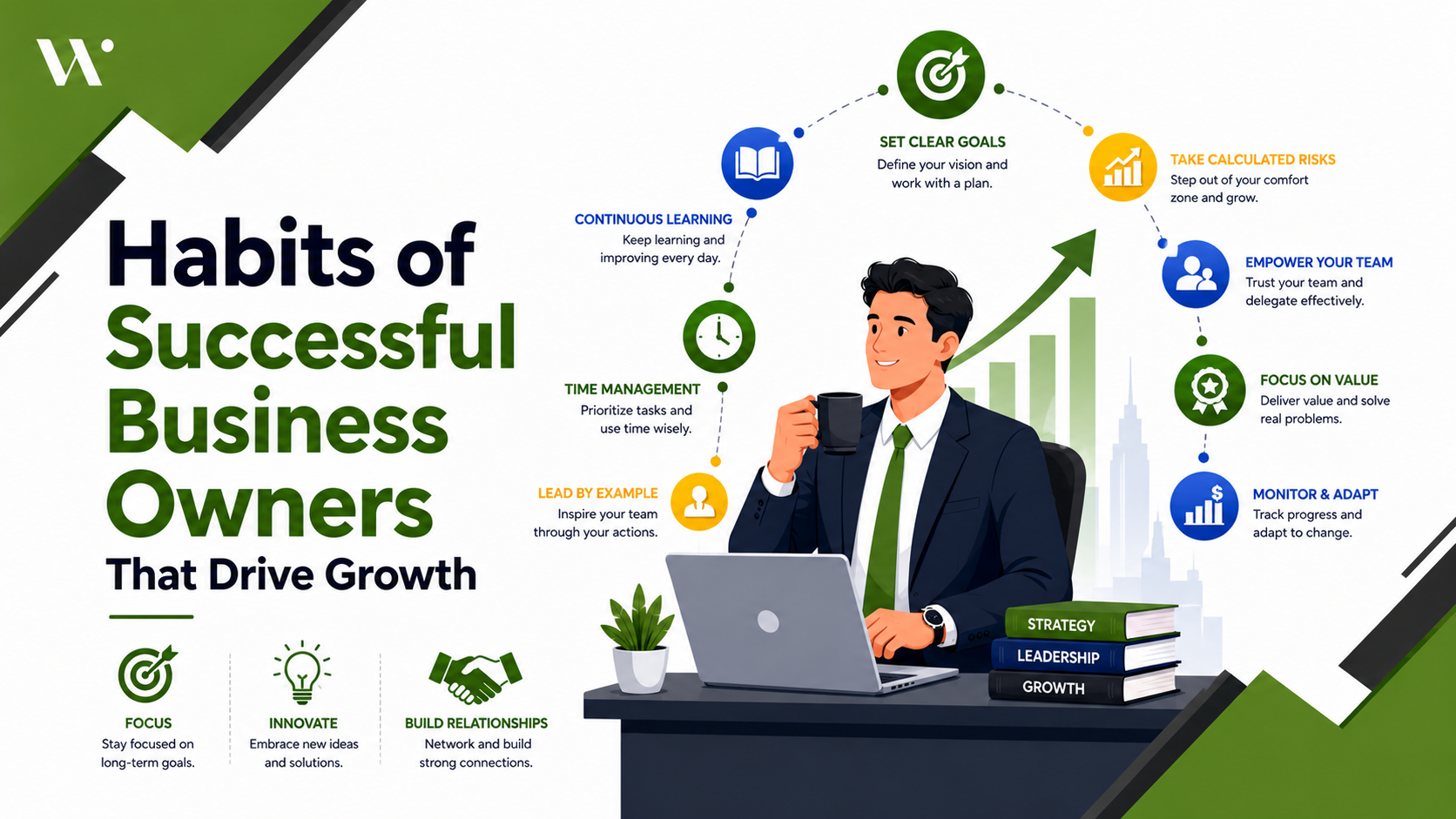
- Successful business owners develop consistent, purposeful habits like time-blocking and relationship building that support long-term growth. These routines, rooted in traits such as conscientiousness and openness, enable focused work, strategic connections, and continuous learning for sustained success. Implementing small daily practices helps owners execute effectively and adapt to market changes over time.
The habits of successful business owners are defined as consistent, purposeful daily actions that compound over time into measurable business results. These are not personality quirks or lucky breaks. Research from a meta-analysis of 23 studies confirms that traits like conscientiousness and openness directly predict whether a venture survives its first three years. The owners who build lasting companies share repeatable routines: they protect their best thinking time, build relationships with intention, and treat learning as a daily practice rather than an occasional event.

1. What are the core habits of successful business owners?
Successful owners operate from a system, not a mood. Their daily decisions follow a structure designed to preserve mental energy and support high-level thinking rather than mere busyness. The difference between a thriving owner and a struggling one often comes down to what they do before 10:00 AM.
The most consistent habits across high-performing owners include:
- Protecting deep work time every morning before meetings start
- Running their business with clear performance metrics and weekly reviews
- Following up with clients and contacts within 24 hours of any interaction
- Maintaining a “Stop Doing List” to cut low-impact tasks from their schedule
- Reading or listening to industry content for at least 20 minutes daily
These behaviors are not glamorous. They are repeatable, and that repetition is exactly what makes them powerful.
2. Time-blocking and protecting your “Genius Zone”
Time-blocking is the practice of scheduling specific hours for specific types of work, and it is the single most effective productivity habit for business owners. Research cited by University College London shows that time-blocking reduces cognitive load and improves decision quality throughout the day. When you stop deciding what to work on and start executing a pre-set plan, your brain conserves energy for the work that actually matters.
The “Genius Zone” refers to the 10–15 hours per week where you do your highest-value work. These are the hours where your unique skills produce results no one else on your team can replicate. Protecting that window is not a luxury. It is a business strategy.
Here is how to build this habit:
- Block 2–3 hours each morning for deep, focused work before checking email
- Schedule meetings in the afternoon to protect your peak cognitive hours
- Use calendar software to create recurring blocks that others cannot override
- Review your schedule each Sunday and move any deep work that got displaced
Pro Tip: Set your phone to Do Not Disturb during your Genius Zone hours. Even a single notification can cost you up to 23 minutes of focused attention, according to research from the University of California, Irvine.
Successful owners also maintain a “Stop Doing List” that removes low-impact tasks from their calendar entirely. They automate, delegate, or delete anything that does not require their direct involvement. This is how they create the space to do their best work consistently.
3. Why building power relationships is a non-negotiable habit
Relationships are not a soft skill. They are a business asset with measurable returns. Strategic relationship-building is one of the top habits shared by self-made millionaires, with a clear focus on cultivating influential connections that open doors to resources, knowledge, and opportunities.
“Powerful relationships constitute a form of currency that successful entrepreneurs actively cultivate. The return on that investment compounds over years, not weeks.”
The Rich Habits Study found that owners who prioritize what researcher Tom Corley calls “power relationships” consistently outperform peers who rely on transactional networking. The distinction matters. Power relationships are built on genuine value exchange, not business card swaps at events.
Daily habits that build strong professional relationships include:
- Reaching out to one meaningful contact each day with a specific, relevant message
- Sending a follow-up within 24 hours after any client interaction or meeting
- Introducing two contacts who would benefit from knowing each other
- Attending one industry event or online community per month with a clear goal
The follow-up habit alone separates average owners from great ones. A brief text or email sent within 24 hours of a service interaction builds client trust and drives long-term retention. Most owners skip this step. The ones who do it consistently build reputations that generate referrals without asking.
4. What personality traits correlate with entrepreneurial success?
Personality is not destiny, but it is a strong predictor. A meta-analysis of 23 studies identifies specific traits that consistently predict both starting a venture and keeping it alive past the three-year mark. Understanding these traits helps you recognize where you are strong and where you need systems to compensate.
| Trait | Effect on business success |
|---|---|
| Conscientiousness | Strongest predictor of venture survival beyond 3 years; drives follow-through and execution |
| Openness | Linked to opportunity recognition, creative problem-solving, and willingness to pivot |
| Moderate neuroticism | Encourages calculated risk-taking and realistic concern about failure without paralysis |
| Lower agreeableness | Supports tough, unpopular decisions required for scaling and long-term sustainability |
Conscientiousness is the trait that matters most for survival. It shows up as reliability, attention to detail, and the ability to finish what you start. Owners high in conscientiousness build systems, meet deadlines, and follow through on commitments even when motivation is low.
Moderate neuroticism is the most counterintuitive finding. A small amount of anxiety about failure is protective. It keeps owners from taking reckless risks and pushes them to prepare thoroughly. Too much anxiety becomes paralyzing, but too little produces overconfidence. The owners who manage this balance well tend to make better decisions under pressure.
Openness to experience drives the habit of continuous learning. Owners high in openness actively seek new information, question their assumptions, and spot opportunities others miss. This trait is trainable through deliberate practice, even if it does not come naturally.
5. How continuous learning and reflection sustain long-term growth
Learning embedded in a daily routine produces better results than learning treated as a separate activity. Continuous learning keeps founders adaptable and informed, leading to better decisions during market shifts and competitive pressure. The owners who read articles, listen to podcasts, and study adjacent industries consistently outperform those who rely on past experience alone.
Reflection is the habit that turns experience into wisdom. Without structured reflection, you repeat the same mistakes with more confidence. Embedding reflection as a daily habit builds a feedback loop that improves decision quality over time. Even five minutes of end-of-day journaling produces measurable gains in self-awareness and strategic clarity.
Practical habits for continuous learning and reflection:
- Read one business or industry article each morning before checking social media
- Keep a decision journal where you record major choices and their outcomes
- Schedule a 30-minute weekly review to assess what worked, what did not, and why
- Listen to one podcast episode during commutes or exercise instead of passive entertainment
Pro Tip: Do your weekly review on Friday afternoon, not Monday morning. Friday review lets you close the week with clarity and start Monday with a plan already in place.
The owners who grow fastest are not the ones who work the most hours. They are the ones who learn from every campaign, client interaction, and setback and adjust their approach accordingly. Reflection without action is journaling. Action without reflection is guessing. The combination is what builds a genuinely adaptive business.
6. How intrinsic motivation shapes the entrepreneurial mindset
Intrinsic motivation, defined by Self-Determination Theory as autonomy, mastery, and purpose, sustains founders through the inevitable hard periods of building a business. Owners driven by genuine curiosity and a sense of purpose outlast those chasing external rewards like status or income. The external rewards matter, but they are not enough to carry you through a difficult quarter.
Autonomy means you make decisions aligned with your values, not just market pressure. Mastery means you are always working to get better at the core skills your business depends on. Purpose means your work connects to something larger than the next revenue target. When all three are present, motivation becomes self-renewing rather than dependent on external conditions.
The practical implication is this: design your business around work you find genuinely interesting. Owners who do this build companies that reflect their strengths and sustain their energy. Owners who chase trends or copy competitors often burn out before the business reaches its potential.
Key Takeaways
The habits of successful business owners work because they are consistent, repeatable, and designed to compound over months and years, not days.
| Point | Details |
|---|---|
| Protect your Genius Zone | Block 10–15 hours weekly for deep, high-impact work before meetings consume your calendar. |
| Build power relationships daily | Send one meaningful outreach and follow up within 24 hours of every client interaction. |
| Conscientiousness predicts survival | Owners who execute consistently and follow through outlast those who rely on talent alone. |
| Embed learning in your routine | Read, listen, and reflect daily rather than treating education as a separate quarterly activity. |
| Intrinsic motivation sustains growth | Build your business around autonomy, mastery, and purpose to stay resilient through hard periods. |
What I have learned about habits after years of working with business owners
Most owners I work with arrive believing they have a strategy problem. After a few conversations, the real issue is almost always a habits problem. The strategy is fine. The execution is inconsistent.
The counterintuitive truth is that intensity does not build great businesses. Consistency does. An owner who does five focused hours of high-value work every day will outperform one who does 12 chaotic hours. The difference is not effort. It is design.
I have also seen how perfectionism kills good habits before they take hold. Owners wait until conditions are perfect to start a morning routine, a weekly review, or a relationship-building practice. Conditions are never perfect. The owners who win start with a rough version and refine it over time.
The research on conscientiousness confirms what I see in practice. The owners who survive and scale are not always the most creative or the most charismatic. They are the ones who show up, follow through, and do the unglamorous work of running a business with discipline. Start with one habit. Build it until it requires no willpower. Then add the next one.
— webspider
How Webspidersolutions helps business owners build on strong foundations
Building strong habits gives you the discipline to grow. Webspidersolutions gives you the digital infrastructure to make that growth visible. Business owners who have their routines in place often find that their biggest remaining gap is online visibility and lead generation. Webspidersolutions offers SEO strategy and digital campaign management designed specifically for owners who want measurable results without spending their Genius Zone hours on marketing execution. The team handles strategy, content, and performance tracking so you can stay focused on the work only you can do.
FAQ
What are the most important habits of successful business owners?
The most impactful habits are time-blocking for deep work, building power relationships through daily outreach, and embedding continuous learning into a daily routine. Research confirms that conscientiousness, the habit of consistent follow-through, is the strongest predictor of long-term venture survival.
How many hours should a business owner spend on deep work each week?
Experts recommend protecting 10–15 hours per week for high-impact, focused work in your Genius Zone. Scheduling this time before meetings and email checks preserves peak cognitive energy for decisions that move the business forward.
Does personality affect business success?
Yes. A meta-analysis of 23 studies shows that conscientiousness, openness, and moderate neuroticism are the traits most strongly linked to starting and sustaining a successful venture. These traits can be reinforced through deliberate habit design even when they are not naturally dominant.
Why is follow-up such a critical business habit?
A follow-up sent within 24 hours of a client interaction builds trust and increases long-term retention. Most business owners skip this step, which means the ones who do it consistently gain a clear competitive edge in client relationships.
How does continuous learning help business owners stay competitive?
Continuous learning keeps founders adaptable by exposing them to new information, market shifts, and adjacent industry practices before competitors act on them. Reading articles, listening to podcasts, and structured weekly reflection all contribute to better decision-making over time.