






Organizations leveraging advanced data analytics reduce disruptions by 30-40% compared to competitors without these tools. For small and medium B2B companies operating in competitive markets, this advantage isn’t just impressive, it’s essential for survival. Building true organizational resilience requires more than reacting to challenges. It demands adaptive digital strategies that anticipate change, enable rapid response, and sustain growth through uncertainty.
Table of Contents
- Understanding Organizational Resilience In B2B SMBs
- The Role Of Digital Strategies In Enhancing Resilience
- Common Misconceptions About Building Resilient Organizations
- Frameworks And Metrics To Assess Organizational Resilience
- Integrating Culture And Digital Agility For Sustainable Resilience
- Practical Steps And Case Studies For Implementation
- Summary And Next Steps For Building Resilient SMB B2B Organizations
- Explore Web Spider Solutions For Digital Resilience Support
Key takeaways
| Point | Details |
|---|---|
| Resilience is multidimensional | Effective resilience combines anticipation, coping mechanisms, and continuous adaptation to thrive through disruptions. |
| Digital transformation drives agility | Integrating digital tools and marketing strategies accelerates response times and strengthens operational flexibility. |
| Culture amplifies technology | Technology alone fails without organizational culture that embraces change and continuous learning. |
| Measurement guides improvement | Tracking resilience KPIs and maturity levels enables systematic progress and identifies weak points. |
| Integrated strategies recover faster | SMBs using coordinated digital marketing recover 20% faster from disruptions than those relying on traditional channels. |
Understanding organizational resilience in B2B SMBs
Organizational resilience extends far beyond simple crisis management or business continuity planning. For B2B small and medium businesses, resilience represents the capacity to anticipate threats, cope with unexpected disruptions, and adapt operations to emerge stronger. This multidimensional capability separates companies that merely survive market volatility from those that capitalize on change.
Three core dimensions define organizational resilience. Anticipation involves scanning the environment for emerging risks and opportunities before they fully materialize. Coping describes your ability to maintain operations during active disruptions, keeping critical functions running despite challenges. Adaptation means transforming your business model, processes, or strategies in response to permanent market shifts.
Agility plays an especially crucial role for SMBs competing against larger, better-resourced firms. When you can pivot faster than competitors, you neutralize their size advantage and capture opportunities they miss. Agile organizations make decisions quickly, test solutions rapidly, and scale successful approaches without bureaucratic delays.
SMB B2B companies face distinct resilience challenges that larger enterprises don’t encounter:
- Limited financial buffers make each disruption more threatening to survival
- Smaller teams mean key personnel absences create immediate capability gaps
- Rapid market shifts in competitive sectors demand constant strategic adjustments
- Siloed operations prevent the cross-functional coordination resilience requires
- Resource constraints force difficult tradeoffs between current operations and future preparation
These challenges make digital strategies particularly valuable. Digital tools democratize capabilities once exclusive to enterprise organizations, giving SMBs access to analytics, automation, and agility that level competitive playing fields.
The role of digital strategies in enhancing resilience
Digital transformation fundamentally reshapes how organizations build and maintain resilience. When you embrace digital transformation strategies, you’re not just adopting new tools. You’re creating systems that sense changes faster, respond more accurately, and adapt continuously without massive overhauls.

Data analytics stands as the foundation of resilient digital operations. Advanced analytics platforms monitor performance indicators in real time, flagging anomalies before they cascade into crises. Organizations leveraging data analytics for risk anticipation experience 30-40% fewer disruptions than peers operating on intuition and delayed reports. This proactive capability transforms risk management from reactive firefighting into strategic preparation.
Digital marketing delivers specific resilience advantages through three mechanisms:
- Diversified channel presence reduces dependence on any single customer acquisition source
- Real-time campaign performance data enables immediate strategy adjustments
- Automated workflows maintain marketing operations even when team capacity drops
- Digital assets and content libraries provide rapid deployment capabilities during opportunities
Agile marketing methodologies amplify these benefits further. Rather than committing to rigid annual plans, agile marketing teams work in short sprints, testing approaches quickly and scaling what works. When market conditions shift, you adjust immediately instead of waiting for quarterly reviews.
Pro Tip: Start building digital resilience by implementing one real-time dashboard tracking your three most critical business metrics. The visibility alone will surface risks and opportunities you’re currently missing.
Understanding digital marketing basics 2025 guide for businesses provides the foundation for implementing these resilience-building strategies across your organization.
Common misconceptions about building resilient organizations
Many SMB leaders pursue resilience strategies based on fundamental misunderstandings that limit effectiveness and waste resources. Correcting these misconceptions before investing time and budget prevents disappointing results and accelerates genuine capability building.
The first major misconception treats resilience as risk avoidance. Leaders operating from this belief invest heavily in preventing every possible disruption, creating rigid systems designed never to fail. True resilience accepts that disruptions will occur and focuses on adapting successfully when they do. Organizations that embrace calculated risks and build recovery capabilities outperform those attempting to eliminate all uncertainty.
A second dangerous misconception assumes digital tactics alone build resilience without cultural transformation. Companies in this trap purchase sophisticated tools, implement advanced platforms, and hire technical specialists while maintaining hierarchical decision-making and risk-averse cultures. The technology sits underutilized because the organizational culture can’t leverage its capabilities. Digital resilience requires human systems that value experimentation, tolerate intelligent failures, and empower distributed decision-making.
The third critical misconception neglects measurement entirely. Many leaders treat resilience as an abstract quality rather than a measurable capability with specific indicators. Without metrics, you can’t track improvement, identify weaknesses, or justify continued investment. Effective resilience programs establish clear KPIs and regularly assess progress against defined maturity levels.
Follow these principles to avoid common pitfalls:
- Design systems for recovery speed, not failure prevention
- Invest equally in cultural change and technical capabilities
- Establish baseline resilience metrics before launching improvement initiatives
- Test resilience regularly through simulations and stress scenarios
- Celebrate successful adaptations as much as perfect execution
Pro Tip: Schedule quarterly resilience reviews where teams share one failure, what they learned, and how they adapted. This normalizes disruption as a learning opportunity rather than a career risk.
Learn more about balancing technology and strategy in managing digital campaigns for b2b growth and explore sector-specific approaches in digital marketing for b2b industry.
Frameworks and metrics to assess organizational resilience
Measuring resilience transforms abstract aspirations into concrete improvement programs with trackable progress. Resilience maturity models provide structured frameworks for assessing current capabilities and planning systematic advancement through defined stages.
Most resilience maturity models identify five progressive levels. At Level 1, organizations react to disruptions without preparation, addressing each crisis uniquely. Level 2 introduces basic planning and documented procedures for common scenarios. Level 3 develops proactive monitoring systems that identify risks before they materialize. Level 4 integrates resilience into strategic planning and organizational culture. Level 5 achieves continuous adaptation where resilience becomes an automatic organizational reflex.
SMB B2B companies should track these critical resilience KPIs:
- Disruption recovery time measuring hours or days from incident to normal operations
- Customer retention rate during and after disruptions
- Revenue volatility showing how much performance fluctuates quarter to quarter
- Employee digital skills proficiency across key tools and platforms
- Cross-functional collaboration frequency indicating how often teams work together
- Strategic plan revision cycle showing how quickly strategy adapts to market changes
Different assessment methods suit various organizational contexts:
| Method | Best For | Time Required | Depth |
|---|---|---|---|
| Self-assessment surveys | Initial baseline and regular monitoring | 2-3 hours | Basic |
| Facilitated workshops | Identifying specific capability gaps | 1-2 days | Moderate |
| External audits | Objective evaluation and benchmarking | 1-2 weeks | Deep |
| Stress testing simulations | Validating actual response capabilities | Ongoing | Practical |
Start with self-assessment surveys to establish your baseline maturity level and identify obvious gaps. These quick evaluations provide enough insight to prioritize improvement areas without requiring extensive consultant engagement. Once you’ve addressed the most glaring weaknesses, consider facilitated workshops that bring cross-functional teams together to map specific scenarios and response protocols.
Navigate common obstacles outlined in digital marketing challenges while building capabilities, and explore fundamental value propositions in importance of digital marketing for smb.
Integrating culture and digital agility for sustainable resilience
Technology and strategy mean nothing without organizational culture that embraces change and enables rapid adaptation. The most resilient SMB B2B companies recognize culture as the multiplier that amplifies or nullifies digital investments.
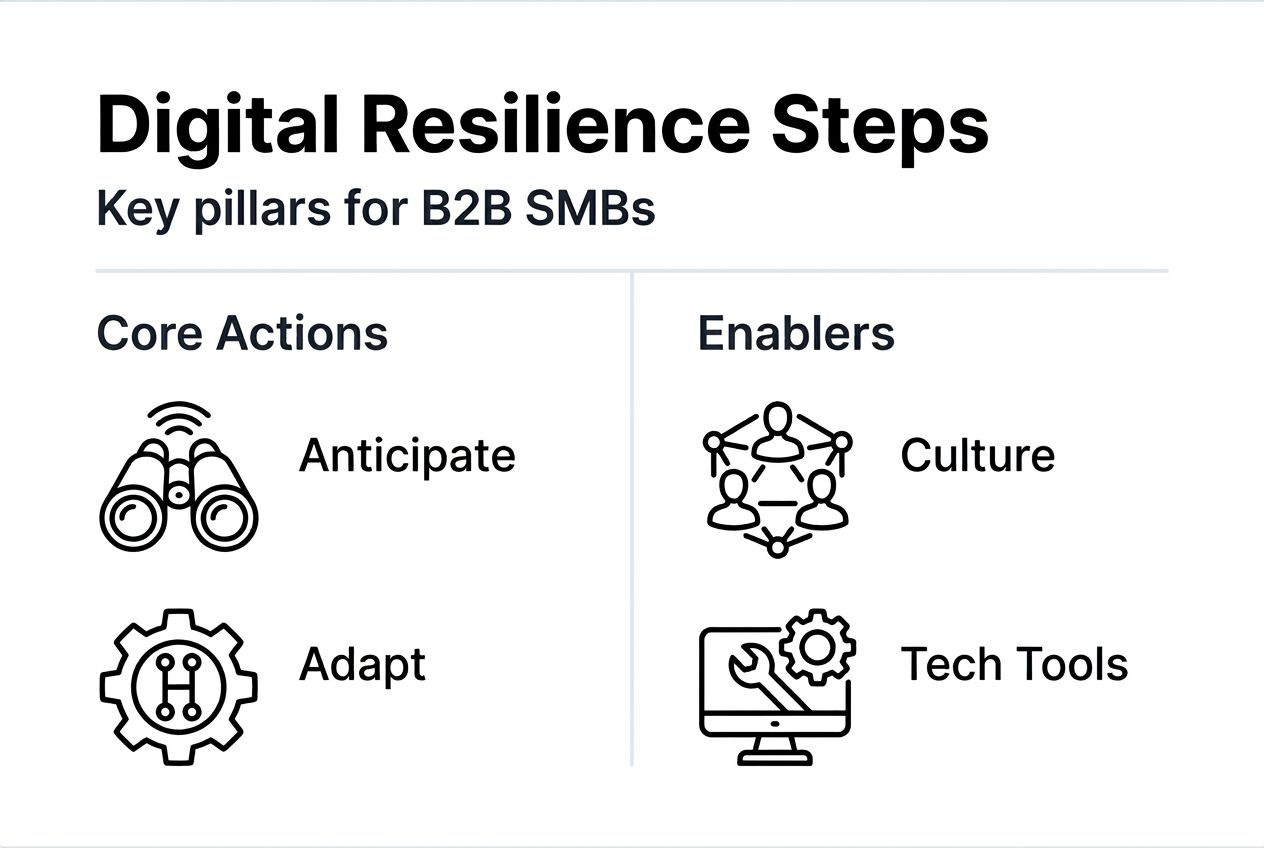
Research consistently links resilient organizational culture to superior financial performance. Companies cultivating adaptability, psychological safety, and continuous learning report revenue growth rates 15-20% higher than industry peers with traditional command-and-control cultures. This advantage compounds over time as resilient cultures attract talent, retain customers, and capture opportunities faster.
Continuous digital skills development forms the practical foundation of resilient culture. Your team’s collective digital literacy determines how effectively you leverage technology during disruptions. Organizations investing in ongoing training create deeper capability reserves that activate during crises.
Key elements of a resilient culture include:
- Psychological safety where team members raise concerns without fear of blame
- Distributed decision authority enabling rapid responses without approval chains
- Experimentation mindsets that treat failures as valuable data
- Cross-functional collaboration breaking down departmental silos
- Customer-centric orientation keeping external value creation as the north star
Pro Tip: Implement monthly learning hours where every team member dedicates 60 minutes to developing one new digital skill. Track completion rates as a leading indicator of cultural adaptability.
Coordination between culture initiatives and technology adoption determines implementation success. Roll out new digital tools alongside training programs, change management support, and leadership modeling. When executives visibly use new platforms and share their learning experiences, adoption accelerates throughout the organization.
Building this foundation supports broader initiatives detailed in integrated digital marketing strategies.
Practical steps and case studies for implementation
Transforming resilience concepts into operational reality requires systematic implementation following proven approaches. These practical steps guide SMB B2B companies through building measurable resilience capabilities.
Start by conducting a resilience baseline assessment using the frameworks discussed earlier. Document your current maturity level, identify the three most critical capability gaps, and establish specific metrics you’ll track monthly. This foundation ensures subsequent investments target actual weaknesses rather than perceived problems.
Follow this implementation sequence:
- Establish executive sponsorship with clear accountability for resilience outcomes
- Form a cross-functional resilience team representing all key departments
- Select one high-impact digital tool addressing your most critical gap
- Implement comprehensive training ensuring 80%+ team proficiency
- Run a realistic disruption simulation testing your response protocols
- Document lessons learned and refine procedures based on actual performance
- Expand to additional capabilities once the first delivers measurable results
Real SMB examples illustrate these principles in action. A 45-person manufacturing equipment distributor adopted integrated digital marketing strategies including SEO, PPC, and social media, achieving 20% faster recovery when supply chain disruptions hit their sector. Their diversified digital presence maintained customer engagement while competitors relying on trade shows and field sales went dark for months.
Another case involved a B2B software services firm that implemented real-time analytics dashboards tracking customer health scores. When usage patterns flagged early warning signs, account teams intervened proactively, reducing churn by 30% during an economic downturn that devastated competitors.
| Company Type | Primary Resilience Investment | Measurable Outcome | Timeline |
|---|---|---|---|
| Equipment distributor | Integrated digital marketing | 20% faster disruption recovery | 8 months |
| Software services | Customer analytics platform | 30% churn reduction | 6 months |
| Professional services | Cross-training program | 40% reduction in key-person risk | 12 months |
| Manufacturing | Agile planning process | 25% faster strategic adaptation | 10 months |
Best practices for sustained success include quarterly resilience reviews, ongoing skills development, regular stress testing of response protocols, and celebrating adaptation wins as prominently as revenue achievements. Track your progress against industry benchmarks and adjust strategies based on performance data rather than assumptions.
Explore comprehensive approaches in integrated digital marketing strategies for coordinated implementation across channels.
Summary and next steps for building resilient SMB B2B organizations
Building organizational resilience through adaptive digital strategies represents a strategic imperative for SMB B2B companies competing in volatile markets. The organizations thriving through 2026’s uncertainty combine digital transformation, data-driven decision-making, agile marketing practices, and resilient cultures into integrated systems greater than their individual components.
Key insights to remember:
- Resilience requires anticipation, coping capabilities, and continuous adaptation
- Digital strategies provide the agility and intelligence SMBs need to compete effectively
- Culture and measurement sustain resilience efforts beyond initial enthusiasm
- Proven frameworks and metrics enable systematic capability development
- Real SMB case studies demonstrate measurable benefits including faster recovery and reduced volatility
Start your resilience journey today by assessing your current maturity level, identifying your most critical capability gap, and implementing one high-impact digital solution. Focus on measurable outcomes, invest in both technology and culture, and track progress systematically.
Explore Web Spider Solutions for digital resilience support
Building resilient organizations requires expertise, experience, and proven strategies tailored to your competitive sector. Web Spider Solutions specializes in helping SMB B2B companies strengthen resilience through expert digital marketing services that drive measurable growth.
Our comprehensive SEO strategy guide builds organic visibility that sustains performance through market shifts. Professional social media management maintains customer engagement across disruptions. Strategic understanding PPC advertising delivers immediate results while you build long-term capabilities.
We design customized strategies that align with your specific market challenges, competitive position, and growth objectives. Contact us to explore how integrated digital marketing builds the resilience your organization needs to thrive through uncertainty.
FAQ
What are the key components of organizational resilience?
Organizational resilience combines three essential components: anticipation of emerging threats and opportunities, coping mechanisms that maintain operations during active disruptions, and adaptation capabilities that transform your business in response to permanent changes. Together, these dimensions enable organizations to not just survive challenges but emerge stronger and more competitive.
How can digital marketing improve resilience in SMBs?
Digital marketing enhances resilience by diversifying customer acquisition channels, enabling real-time performance monitoring, and supporting rapid strategy adjustments when market conditions shift. SMBs using integrated digital approaches maintain customer engagement during disruptions that silence competitors relying on traditional channels. Automated workflows and digital assets provide operational continuity even when team capacity drops unexpectedly.
What common mistakes should SMBs avoid when building resilience?
Avoid treating resilience as pure risk avoidance rather than adaptation capability. Don’t implement digital tools without corresponding cultural changes that enable effective use. Never neglect measurement and tracking of resilience KPIs. Resist the temptation to create rigid procedures that prevent flexible responses. Finally, don’t underinvest in continuous skills development that builds your team’s adaptive capacity.
Which metrics best track organizational resilience progress?
Track disruption recovery time measuring how quickly you restore normal operations after incidents. Monitor customer retention rates during and after challenges. Measure employee digital skills proficiency across critical platforms. Track cross-functional collaboration frequency showing how often departments work together. Review strategic plan revision cycles indicating how quickly leadership adapts to market changes.
Recommended