







Did you know that websites with strong backlink profiles can receive up to three times more organic search traffic than those without? Building credible links remains one of the most reliable ways to earn trust from search engines and improve the visibility of your pages. Yet, common misconceptions often lead website owners astray. Gaining a clearer understanding of link building can mean the difference between a steady climb up the rankings and missing out on valuable search traffic.
Table of Contents
- Defining Link Building And Common Myths
- Types Of Link Building Methods Explained
- How Link Building Influences SEO Rankings
- Best Practices For Safe Link Acquisition
- Risks, Costs, And Common Mistakes To Avoid
- Comparing Link Building With Other SEO Tactics
Key Takeaways
| Point | Details |
|---|---|
| Link Building Importance | Essential for improving search engine rankings and online visibility. |
| Quality Over Quantity | High-quality, relevant backlinks are prioritized over sheer numbers. |
| Continuous Effort Required | Link building is an ongoing process and not a one-time task. |
| Risks of Poor Practices | Engaging in unethical link building can lead to severe search engine penalties. |
Defining Link Building and Common Myths
Link building is a strategic digital marketing technique focused on acquiring hyperlinks from external websites to your own web pages. According to rankmarket.org, this process is crucial for improving search engine rankings and website visibility.
At its core, link building involves creating connections between different websites through hyperlinks. These connections serve multiple purposes: they help search engines understand the relationship between web pages, establish site authority, and improve overall search ranking potential. As ijert.org explains, link building isn’t just about quantity—it’s about obtaining high-quality, relevant links that genuinely enhance a site’s credibility.
Common Link Building Myths
Several persistent myths can misguide digital marketers and website owners:
- Myth 1: More Links Always Mean Better Rankings
Contrary to popular belief, simply accumulating numerous backlinks won’t automatically boost your search performance. Search engines like Google prioritize link quality over quantity. - Myth 2: Any Link Is a Good Link
This dangerous misconception can harm your website’s SEO. Low-quality or irrelevant links from spammy websites can actually penalize your search rankings. - Myth 3: Link Building Is a One-Time Task
Successful link building is an ongoing process requiring consistent effort, strategic planning, and continuous relationship building with other websites.
Understanding these nuances is critical for developing an effective link building strategy that genuinely improves your online visibility. Learn more about crafting high-quality backlinks in our comprehensive guide on what makes a high-quality backlink.
Types of Link Building Methods Explained
Link building encompasses various strategic methods for acquiring valuable hyperlinks. According to ijert.org, these methods can be broadly categorized into three primary types: natural (editorial) links, manual (outreach) links, and self-promotional (non-editorial) links.
Natural Link Building Methods
Natural links represent the gold standard of link acquisition. These are hyperlinks earned organically when other websites find your content valuable and choose to reference it voluntarily. Typically, natural links emerge from:
- High-quality, original research
- Comprehensive industry guides
- Innovative infographics
- Groundbreaking data studies
Manual Link Building Techniques
Manual link building involves proactive outreach and relationship building. As rankmarket.org highlights, this approach requires direct communication with potential linking websites. Common manual link building strategies include:

- Guest blogging on relevant industry websites
- Conducting expert interviews
- Participating in industry forums and discussions
- Reaching out to websites for collaborative content
Self-Promotional Link Building
Self-promotional methods involve creating opportunities to place your links, though these require careful execution to avoid potential search engine penalties. These techniques include:
- Submitting to reputable web directories
- Creating business profiles on industry platforms
- Participating in relevant online communities
- Leveraging social media platforms for link visibility
For a comprehensive approach to implementing these strategies effectively, check out our guide on natural link building strategies that can help you rank among the top results.
Here’s a comparison of the main link building methods:
| Link Building Method | Key Characteristics | Typical Techniques |
|---|---|---|
| Natural (Editorial) | Earned organically High trust |
Original research Industry guides |
| Manual (Outreach) | Requires direct effort Relationship-driven |
Guest blogging Expert interviews |
| Self-Promotional | Proactive submission May risk penalties |
Directory listings Business profiles |
How Link Building Influences SEO Rankings
Link building serves as a critical mechanism for improving search engine rankings by establishing website credibility and authority. According to ijert.org, search engines interpret quality backlinks as powerful endorsements, which can significantly enhance a website’s positioning in search results.
The Authority Signal
Search engine algorithms treat backlinks as votes of confidence from other websites. When reputable, relevant sites link to your content, it signals to search engines that your website offers valuable, trustworthy information. This digital recommendation system helps determine your site’s domain authority – a key metric in search ranking algorithms.
Quality Over Quantity
As rankmarket.org highlights, not all links are created equal. Search engines have sophisticated mechanisms to differentiate between high-quality, contextually relevant links and low-value, spammy connections. Factors that determine link quality include:
- Relevance of the linking website’s content
- Domain authority of the linking site
- Contextual placement of the link
- Diversity of linking domains
Ranking Impact Mechanics
Effective link building influences SEO rankings through several sophisticated mechanisms:
- Increased Crawl Frequency: More quality links encourage search engine bots to crawl your site more often
- Broader Indexing: Links help search engines discover and index more of your content
- Improved Page Authority: Each quality backlink can boost individual page rankings
- Enhanced Domain Reputation: Consistent high-quality linking builds overall website credibility
To maximize your link building strategy and understand critical ranking factors, explore our guide on SEO ranking factors that can transform your online visibility.
Best Practices for Safe Link Acquisition
Safe link acquisition requires a strategic and ethical approach that prioritizes quality over quantity. According to ijert.org, white-hat link building techniques are essential for maintaining a website’s integrity and avoiding potential search engine penalties.
Foundational Content Strategy
Content quality forms the cornerstone of safe link acquisition. Creating original, valuable content that genuinely helps your target audience naturally attracts high-quality backlinks. This means developing:
- Comprehensive industry research
- In-depth analytical reports
- Original data visualizations
- Expert-level instructional guides
Relationship-Driven Link Building
As seolinkbuilding.org highlights, building relationships with reputable websites is crucial for sustainable link acquisition. This involves:
- Networking with industry thought leaders
- Collaborating on joint content projects
- Participating in relevant online communities
- Offering genuine value before requesting links
Critical Compliance Guidelines
To maintain link building safety, avoid these dangerous practices:
- Purchasing links from link farms
- Using automated link generation tools
- Spamming comments sections
- Creating low-quality guest posts
- Participating in link exchange schemes
To streamline your link building efforts while maintaining ethical standards, explore our guide on simplifying link building with AI tools that can help you navigate this complex landscape more effectively.
Risks, Costs, and Common Mistakes to Avoid
Link building is a nuanced strategy that requires careful navigation to avoid potential pitfalls. According to ijert.org, the risks of improper link building can include severe penalties from search engines that may dramatically impact your website’s visibility and ranking.
Financial and Resource Investment
Link building costs can quickly escalate depending on your approach. The investment typically involves:
- Time-intensive research and outreach
- Potential expenses for content creation
- Tools and software for link tracking
- Professional services or consultant fees
- Opportunity costs of manual link building efforts
Significant Search Engine Risks
As rankmarket.org highlights, the consequences of poor link building strategies can be devastating. Potential risks include:
- Search Engine Penalties: Immediate ranking drops
- Domain Reputation Damage: Long-term credibility loss
- Manual Actions: Potential complete site deindexing
- Algorithmic Suppression: Reduced search visibility
Common Link Building Mistakes to Avoid
Critical errors that can sabotage your link building efforts include:
- Purchasing links from low-quality websites
- Ignoring link relevance and context
- Overusing exact match anchor text
- Neglecting link profile diversity
- Failing to conduct regular link audits
- Prioritizing quantity over link quality
To protect your website and develop a robust link building strategy, explore our guide on link building best practices that can help you navigate these complex challenges effectively.
Comparing Link Building With Other SEO Tactics
Link building represents a unique and critical component of comprehensive search engine optimization strategies. According to ijert.org, while other SEO tactics focus on internal website elements, link building distinguishes itself by leveraging external factors to enhance site authority.
Strategic Differences in SEO Approaches
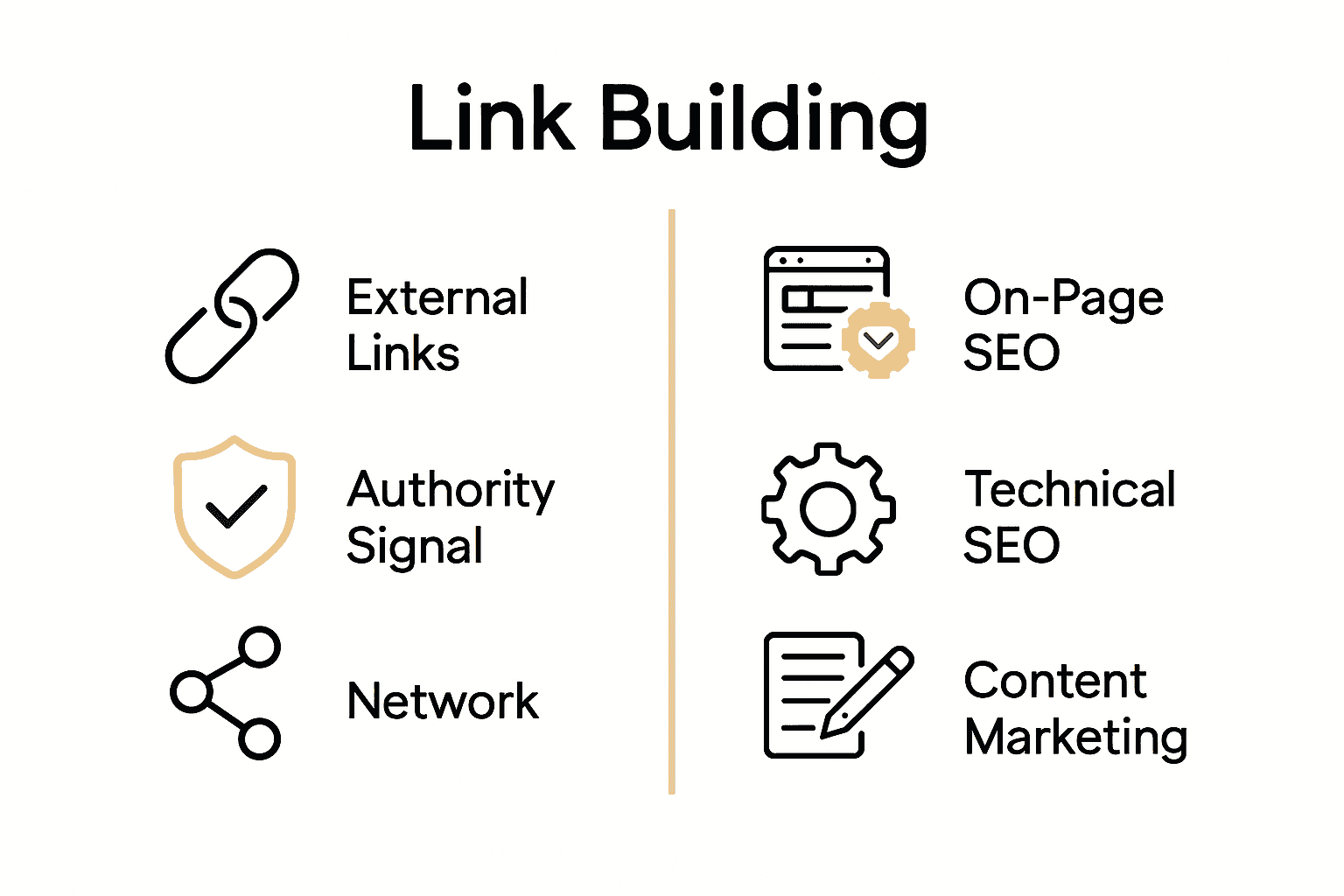
Each SEO tactic brings distinct advantages to the digital marketing ecosystem:
- On-Page SEO: Optimizes internal content, metadata, and site structure
- Technical SEO: Improves website performance, crawlability, and indexing
- Content Marketing: Creates valuable, engaging content
- Link Building: Acquires external endorsements and credibility signals
Comparative Impact and Functionality
As rankmarket.org highlights, link building uniquely focuses on external validation through backlinks.
 Unlike other tactics that operate within your website’s ecosystem, link building actively seeks recognition from other digital platforms.
Key Differentiating Characteristics
Link building stands apart through several critical mechanisms:
- External Validation: Relies on third-party endorsements
- Authority Building: Increases domain credibility through quality connections
- Network Expansion: Creates interconnected digital relationships
- Ranking Signal Generation: Provides powerful external recommendation metrics
To understand how to strategically integrate link building with other SEO techniques, explore our guide on avoiding ineffective SEO techniques that can help refine your digital marketing approach.
Elevate Your SEO with Expert Link Building Strategies
Are you struggling to gain high-quality backlinks that truly improve your search rankings and online authority? Many businesses face challenges in building relevant, trusted links that align with search engine algorithms and avoid penalties. This article breaks down common misconceptions like the myth that more links always mean better rankings. It highlights the importance of strategic, relationship-driven, and natural link building techniques to boost your website’s credibility safely.
At Web Spider Solutions, we understand the critical role of effective link building as part of a comprehensive digital marketing plan. Our services are tailored to enhance your organic visibility through ethical SEO practices, targeted content marketing, and expert outreach programs. Explore how our approach stands out by visiting our Uncategorized Archives for insights and practical advice. Ready to optimize your digital presence and avoid costly mistakes? Visit our homepage Web Spider Solutions now and take advantage of a free consultation to develop a safe, customized link building strategy designed for your business growth.
Don’t wait to transform your online visibility. Connect with us today to turn link building challenges into opportunities for lasting SEO success.
Frequently Asked Questions
What is link building?
Link building is a strategic digital marketing technique focused on acquiring hyperlinks from external websites to your own, aimed at improving search engine rankings and website visibility.
Why is link quality more important than link quantity?
Search engines prioritize high-quality, relevant backlinks over the sheer number of links. Quality links serve as endorsements from reputable sites, enhancing your website’s authority.
What are the different methods of link building?
Link building methods can be categorized into natural links, which are earned organically; manual links, which involve outreach and relationship building; and self-promotional links, which are created through strategic submissions but require careful execution.
How does link building influence SEO rankings?
Link building improves SEO rankings by establishing a website’s credibility and authority through high-quality backlinks, which search engines interpret as votes of confidence for your content.
Recommended