







Did you know that over 70 percent of consumers trust insights from recognized industry experts more than basic brand messaging? In a crowded market, being seen as a true authority matters more than ever, setting top professionals apart from the competition. Discover what transforms a marketer from just another voice into a trusted thought leader with real influence and lasting impact.
Key Takeaways
| Point | Details |
|---|---|
| Defining Thought Leadership | Thought leadership is about establishing expertise and providing genuine insights that address industry challenges rather than mere product promotion. |
| Effective Strategies | Successful thought leadership involves a mix of content-driven, engagement-based, and digital positioning strategies that resonate with target audiences. |
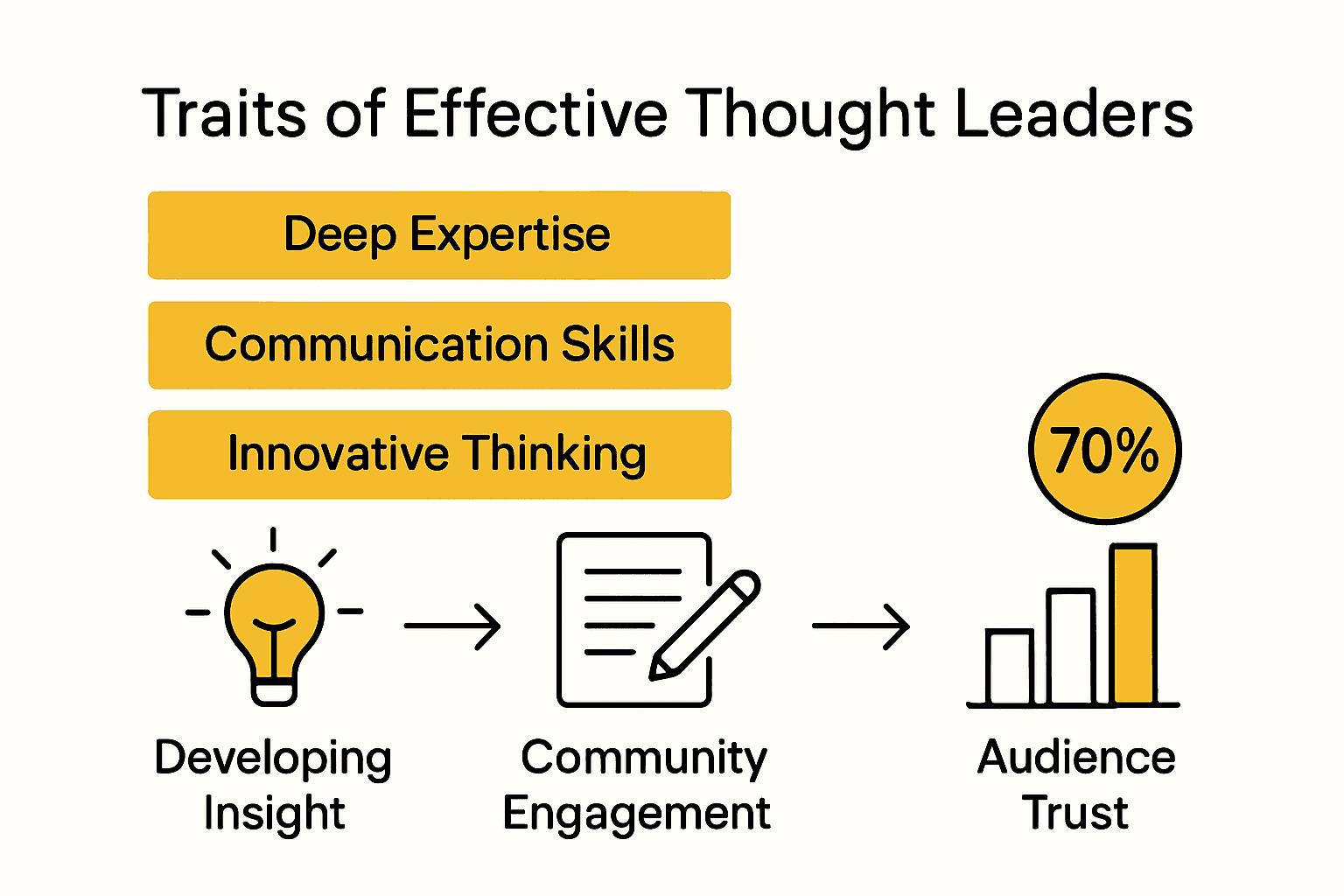
| Core Traits | Genuine thought leaders possess deep expertise, strong communication skills, and innovative thinking, which enable them to provide valuable insights. |
| Avoiding Pitfalls | To maintain credibility, thought leaders should prioritize high-quality content and authentic engagement while avoiding self-promotion and surface-level insights. |
Table of Contents
- Defining Thought Leadership In Marketing
- Types Of Thought Leadership Strategies
- Core Traits Of Effective Thought Leaders
- Real-World Applications And Industry Examples
- Mistakes To Avoid And Best Practices
Defining Thought Leadership in Marketing
A thought leader is more than just a buzzword in the marketing world – it’s a strategic position of expertise and influence. According to Wikipedia, a thought leader is recognized as a foremost authority in a specific field, consistently answering major audience questions and addressing emerging challenges through authoritative insights.
Thought leadership transcends traditional marketing approaches by positioning professionals and brands as genuine experts who provide unique perspectives. This means going beyond selling products or services and instead offering deep, meaningful insights that demonstrate profound understanding of industry trends, challenges, and innovative solutions. Successful thought leaders don’t just talk about what’s happening – they analyze why it matters and predict future developments.
Key characteristics of effective thought leadership in marketing include:
- Consistently producing high-quality, original content
- Demonstrating deep industry knowledge and expertise
- Offering forward-thinking perspectives on complex challenges
- Engaging directly with professional communities
- Building credibility through research, data, and proven insights
Thought leadership isn’t about self-promotion, but about genuinely contributing valuable knowledge that helps professionals and businesses solve real-world problems. By sharing authentic, substantive insights, marketers can establish themselves as trusted advisors rather than simply service providers.
Types of Thought Leadership Strategies
Thought leadership strategies are diverse approaches that professionals and brands can leverage to establish their expertise and influence. Each strategy serves a unique purpose in building credibility and engaging target audiences through different channels and formats.
The primary types of thought leadership strategies include industry insight approaches, where experts share deep analysis of emerging trends, educational content strategies that provide actionable knowledge, problem-solving perspectives that address complex challenges, and innovative research methods that introduce groundbreaking ideas. These strategies are not mutually exclusive but often work together to create a comprehensive thought leadership approach.
Key types of thought leadership strategies encompass:
- Content-Driven Strategies
- Developing in-depth whitepapers
- Publishing original research reports
- Creating comprehensive blog series
- Producing educational video content
- Engagement-Based Strategies
- Speaking at industry conferences
- Hosting webinars and online workshops
- Participating in panel discussions
- Conducting interactive Q&A sessions
- Digital Positioning Strategies
- Building a robust LinkedIn presence
- Developing a consistent social media narrative
- Guest writing for respected industry publications
- Creating podcast or video interview series
Successful thought leadership requires selecting strategies that authentically represent your expertise while providing genuine value to your target audience.
 Explore our content marketing trends guide to understand how evolving digital platforms can amplify your thought leadership approach.
Core Traits of Effective Thought Leaders
Thought leadership demands more than just industry knowledge – it requires a unique combination of skills, perspectives, and personal attributes that set true experts apart. Effective thought leaders are not simply information distributors, but visionary communicators who can translate complex ideas into compelling, actionable insights.
At the core of exceptional thought leadership are several critical traits that distinguish genuine experts from ordinary professionals. Intellectual curiosity drives thought leaders to continuously explore emerging trends, challenge existing paradigms, and develop innovative solutions. They possess a rare ability to synthesize information from diverse sources, connecting seemingly unrelated concepts to generate groundbreaking perspectives that move their industry forward.
Key characteristics of successful thought leaders include:
Here’s a comparison of core traits that distinguish effective thought leaders:
| Core Trait | Key Attributes | Impact on Thought Leadership |
|---|---|---|
| Deep Expertise | Industry knowledge Trend forecasting Continuous learning |
Builds credibility Enables valuable insights |
| Communication Skills | Clear storytelling Simplifies complexity Authentic style |
Engages audiences Enhances clarity and trust |
| Innovative Thinking | Challenges norms Creative solutions Adaptability |
Drives originality Fosters industry progress |
- Deep Expertise
- Comprehensive understanding of industry dynamics
- Proven track record of solving complex problems
- Ability to predict emerging trends
- Commitment to continuous learning
- Communication Skills
- Clear and engaging storytelling
- Ability to simplify complex concepts
- Authentic and genuine communication style
- Multilateral communication across different platforms
- Innovative Thinking
- Willingness to challenge conventional wisdom
- Creative problem-solving approaches
- Openness to alternative perspectives
- Adaptability in rapidly changing environments
The most impactful thought leaders demonstrate an unwavering commitment to adding genuine value.
They prioritize insights over self-promotion, using their expertise to illuminate paths forward for their audience.
 Learn more about strategic content marketing approaches to understand how thought leadership can transform your professional brand.
Real-World Applications and Industry Examples
Thought leadership is not a theoretical concept, but a practical approach that transforms how professionals and organizations communicate their expertise across various industries. Industry-specific applications demonstrate how thought leadership can drive meaningful engagement, build credibility, and create tangible business value.
In the technology sector, companies like Google and Microsoft consistently showcase thought leadership by publishing comprehensive research papers, hosting innovation conferences, and sharing cutting-edge insights about emerging technologies. Similarly, professional services firms such as McKinsey and Deloitte leverage in-depth industry reports and expert analysis to position themselves as strategic advisors rather than mere service providers.
Key industry examples of thought leadership include:
- Technology Sector
- Publishing original research on AI and machine learning
- Hosting developer conferences and innovation summits
- Creating educational content about emerging tech trends
- Developing open-source platforms and frameworks
- Consulting and Professional Services
- Producing annual industry trend reports
- Conducting original research on business challenges
- Sharing expert perspectives through multimedia content
- Offering free webinars and professional development resources
- Healthcare and Biotechnology
- Presenting groundbreaking medical research
- Developing educational resources for healthcare professionals
- Sharing insights on medical innovations
- Creating platforms for knowledge exchange
Thought leadership transcends traditional marketing by offering genuine value and demonstrating deep industry understanding. Explore strategic content marketing approaches to understand how targeted insights can elevate your professional brand.
Mistakes to Avoid and Best Practices
Thought leadership is a delicate balance between showcasing expertise and maintaining authentic credibility. Common pitfalls can quickly undermine even the most well-intentioned thought leadership efforts, transforming potential influence into perceived self-promotion or shallow content marketing.
One of the most significant mistakes professionals make is prioritizing quantity over quality. Thought leaders must resist the urge to constantly produce content and instead focus on creating genuinely insightful, well-researched perspectives that provide real value to their audience. Superficial content, frequent repetition, and recycling existing ideas can rapidly erode professional reputation and audience trust.
Key mistakes to avoid and best practices include:
- Content Creation Mistakes
- Producing generic, surface-level content
- Oversharing without adding unique insights
- Neglecting original research and perspectives
- Failing to fact-check and validate information
- Engagement and Authenticity Challenges
- Being overly self-promotional
- Ignoring audience feedback and interactions
- Lacking consistency in messaging
- Presenting information without practical applications
- Strategic Best Practices
- Develop a consistent, genuine voice
- Prioritize depth over frequency
- Continuously learn and adapt
- Engage authentically with your professional community
- Maintain intellectual humility
Successful thought leadership requires a strategic, thoughtful approach that balances expertise with genuine value creation. Explore our guide on personal branding strategies to understand how to effectively position yourself as a trusted industry voice.
Accelerate Your Thought Leadership With Proven Digital Marketing Solutions
The journey to becoming a recognized thought leader is full of challenges, from creating truly original content to earning authentic credibility in a crowded market. If you struggle to consistently produce high-quality, impactful content or find it difficult to stand out as an expert in your industry, you are not alone. Many professionals and brands face these same pain points highlighted in our article, including building authority through insightful perspectives and aligning digital strategies with real audience needs. Discover how real-world applications and strategic best practices can elevate your reputation and unlock lasting influence. For more inspiration, see industry successes in our Stories Archives.
Ready to turn your expertise into a powerful digital presence that drives measurable results? Partner with Web Spider Solutions for a tailored approach that amplifies your voice through intelligent content marketing, robust SEO, and targeted engagement strategies. Visit Web Spider Solutions now to unleash your thought leadership potential. Your next breakthrough in marketing leadership starts today.
Frequently Asked Questions
What is thought leadership in marketing?
Thought leadership in marketing refers to a strategy that positions professionals and brands as experts in their field by providing unique, valuable insights and addressing industry challenges. It goes beyond mere promotion, focusing on genuine contributions that help audiences solve real problems.
What are the key characteristics of effective thought leaders?
Effective thought leaders consistently produce high-quality, original content, demonstrate deep industry knowledge, offer forward-thinking perspectives, engage with professional communities, and build credibility through research and data.
What are some common mistakes in thought leadership?
Common mistakes include producing superficial content, prioritizing quantity over quality, being overly self-promotional, neglecting audience feedback, and lacking consistency in messaging. Thought leaders should strive for depth and authenticity in their contributions.
How can I develop a thought leadership strategy?
To develop a thought leadership strategy, focus on creating valuable and insightful content, engage authentically with your audience, participate in industry discussions, and leverage various platforms for sharing your expertise. Continuous learning and adapting your approach are also crucial.
Recommended