


TL;DR:
- Digital marketing budgets for SMBs can range from $2,500 to $12,000 monthly, depending on market competition and channels. Using revenue-backed models like percentage of revenue helps set strategic, measurable budgets that promote growth rather than overspend. Focusing on revenue-linked KPIs and balancing performance with strategic experimentation ensures sustainable marketing success.
Digital marketing budgets can spiral out of control before most SMB leaders even realize it. You add a paid search campaign here, a social media retainer there, a new automation tool, and suddenly your monthly spend has tripled with no clear picture of what’s working. The challenge isn’t just overspending. It’s making decisions without a reliable framework for what you should be spending, on which channels, and how to measure whether that money is actually driving business growth. This guide cuts through the noise with benchmarks, proven budgeting models, and practical optimization strategies built specifically for small and mid-sized businesses.
Key Takeaways
| Point | Details |
|---|---|
| SMB budget benchmarks | Small businesses often spend $2,500 to $12,000 monthly on digital marketing. |
| Revenue-based budgets | A typical allocation is 8–11% of revenue, aligning spend with business growth. |
| Major cost drivers | Agency fees, paid ad channels, and marketing automation tools are primary expense categories. |
| Optimization best practice | Track KPIs directly linked to revenue for smarter budgeting and higher returns. |
| Avoiding overspending | Beware of chasing vanity metrics and instead focus on measurable business outcomes. |
What do digital marketing costs really cover?
Before you can optimize anything, you need a clear picture of where the money actually goes. Digital marketing costs fall into several distinct buckets, and confusing them is one of the most common mistakes SMB leaders make when reviewing their monthly invoices.
The main cost categories are:
- Paid media spend: The actual dollars that go directly to platforms like Google Ads, Meta, or LinkedIn. This is separate from the agency fee that manages those campaigns.
- Agency and freelancer fees: Strategy, execution, reporting, and creative work managed by external partners.
- SEO and content production: Keyword research, technical audits, on-page optimization, blog writing, and link building.
- Software and tools: Marketing automation platforms, CRM integrations, analytics dashboards, and social scheduling tools.
- Creative assets: Design, video production, landing page development, and ad creative refreshes.
- Email marketing: Platform fees, list management, and campaign design.
The range in monthly spend across these categories is enormous. A local service business running basic Google Ads and maintaining a simple website might spend around $417 per month on digital marketing. An SMB in a competitive sector with multi-channel ambitions sits in a very different bracket. According to a practical SMB benchmark, all-in digital marketing budgets for small to mid-sized businesses typically range from $2,500 to $12,000 per month, depending on scope, competition intensity, and growth goals.
That’s a wide range, and the difference comes down to three core variables: how many channels you’re active on, how competitive your market is, and whether you’re focused on maintaining current traffic or aggressively growing market share.
To make that comparison clearer, here’s a quick snapshot of what different budget tiers typically include:
| Budget tier | Monthly spend | Typical inclusions |
|---|---|---|
| Micro/local | $500–$1,500 | Basic SEO, 1 paid channel, minimal content |
| Growth-stage SMB | $2,500–$5,000 | SEO, PPC, social media, email, basic automation |
| Competitive SMB | $5,000–$12,000 | Full multi-channel, automation, content, retargeting |
| Aggressive growth | $12,000+ | All of the above plus video, influencer, advanced analytics |
For SMBs in sectors like legal services, financial advising, or home improvement, even the “growth-stage” tier often requires careful prioritization to avoid spreading resources too thin. You can explore channel-by-channel breakdowns in this digital marketing cost guide to see how specific services stack up against your current allocation.
A simple, well-executed single-channel strategy almost always outperforms a fragmented multi-channel program that lacks budget depth. Understanding your digital advertising strategies before committing spend is critical to avoiding that fragmentation trap.
How to set your digital marketing budget: Revenue-backed models
There’s no single correct way to set a digital marketing budget, but revenue-based models give you the most defensible starting point. These frameworks remove the guesswork and anchor your spending to business reality rather than gut feeling or competitor comparison.
The most widely used models for SMBs are:
- Percentage of annual revenue: The most common approach. You allocate a fixed percentage of your total revenue to marketing each year, then divide it into monthly budgets.
- Percentage of projected revenue: Useful for growth-stage SMBs that want to invest ahead of expected revenue increases. Slightly riskier but often necessary in competitive sectors.
- Customer acquisition cost (CAC) model: You work backwards from how much a new customer is worth and how many you need, then calculate the spend required to hit that acquisition target.
- Competitor spend benchmarking: You estimate what competitors spend on digital channels and position your budget relative to their activity. Works best when combined with a revenue model.
On the revenue percentage model specifically, the data is clear. Expert guidance from HubSpot indicates that companies should spend approximately 9.4% of revenue on marketing overall, with B2B companies typically falling in the 8% to 11% range.
“The companies that consistently outperform their competitors on growth tend to treat marketing spend as a revenue driver, not a cost line. The budget conversation changes entirely when you shift that framing.” — Common insight from high-growth B2B brands
Here’s how that translates into real numbers for SMBs at different revenue levels:
| Annual revenue | 8% allocation | 10% allocation | Monthly budget range |
|---|---|---|---|
| $500,000 | $40,000 | $50,000 | $3,300–$4,200/mo |
| $1,000,000 | $80,000 | $100,000 | $6,700–$8,300/mo |
| $2,000,000 | $160,000 | $200,000 | $13,300–$16,700/mo |
| $5,000,000 | $400,000 | $500,000 | $33,000–$41,700/mo |
One of the most important things these numbers reveal is that many SMBs are significantly underspending relative to their revenue and growth ambitions. A $1 million business spending $1,500 per month on digital marketing is investing only 1.8% of revenue, which is unlikely to generate meaningful competitive traction in most sectors.
Underspending is just as dangerous as overspending. When your budget is too thin, you can’t generate enough data to optimize campaigns, your content doesn’t achieve enough reach to build authority, and your competitors gradually absorb the market attention you’re leaving on the table.
For a step-by-step framework on translating these models into an actual monthly allocation, the budget planning guide walks through how to tier spend across channels based on your growth stage.
Major cost drivers: Services, tools, and automation fees
With a budget framework in place, the next question is: why do costs vary so dramatically between businesses at similar revenue levels? The answer usually comes down to three primary drivers.

Agency and management fees are often the largest variable. A full-service digital agency managing SEO, PPC, content, and social media for a competitive SMB might charge $3,000 to $7,000 per month in management fees alone, before a single dollar goes to ad spend. Boutique specialists or freelancers cost less but cover narrower scope. The tradeoff between breadth and depth is real.
Paid media ad spend is a direct pass-through cost. In highly competitive sectors like insurance, home services, or SaaS, cost-per-click (CPC) rates on Google Search can range from $15 to $50 or more per click. If you’re targeting high-intent keywords and running campaigns at competitive budgets, ad spend alone can consume $2,000 to $5,000 per month before any management fee.
Marketing software and automation is often the hidden cost that SMBs underestimate when building their initial budget. The reality is that HubSpot Marketing Hub pricing for Professional and Enterprise tiers includes both per-seat fees and mandatory onboarding costs, which can add several thousand dollars to your first-year investment. Other tools like SEMrush, Salesforce, and Hootsuite carry recurring subscription fees that stack up quickly.
Here are the most common software cost categories SMBs should factor into their planning:
- CRM and marketing automation: $400–$3,000/month depending on contacts and features
- SEO and analytics platforms: $100–$500/month for tools like Ahrefs or SEMrush
- Social media scheduling and listening: $50–$300/month
- Email marketing platforms: $50–$500/month based on list size
- Landing page and conversion tools: $50–$250/month
- Reporting and attribution dashboards: $100–$500/month
Pro Tip: Before adding a new SaaS tool to your stack, calculate whether you’d get equivalent or better results by adding that budget to a managed service. A $300/month analytics tool only adds value if someone on your team has the time and skill to actually use it. Many SMBs overpay for software they underuse while underpaying for the strategic services that would actually move the needle.
Evaluating whether tools or managed services offer better ROI for your digital investment should be a quarterly exercise, not a one-time setup decision. And grounding those decisions in a clear digital strategy ensures each tool has a defined role rather than becoming shelfware.
Pitfalls, optimization, and how to track ROI
Even the most carefully designed budget can underperform if you’re measuring the wrong things or falling into common behavioral traps. This section addresses where well-intentioned SMB marketing spend most often breaks down.
The biggest overspending traps to avoid:
- Channel stacking without depth: Adding new channels before existing ones are fully optimized. Running thin campaigns across five channels is almost always worse than running strong campaigns on two or three.
- Chasing vanity metrics: Optimizing for impressions, follower counts, or raw traffic instead of conversion rate, lead quality, and revenue generated.
- Neglecting attribution: Not knowing which channels actually drove a sale, which leads to overinvesting in channels that look good on surface metrics but convert poorly.
- Reactive spending: Increasing budgets during slow periods out of panic rather than based on campaign data and forecasted returns.
- Set-and-forget campaigns: Paid media especially requires ongoing optimization. Campaigns that ran well six months ago may be bleeding budget today due to auction changes, competitor shifts, or audience fatigue.
The smarter approach is grounding every spend decision in revenue-linked KPIs, specifically lead quality, conversion rates, return on marketing investment (ROMI), and customer acquisition cost (CAC). These metrics connect marketing activity directly to business outcomes rather than platform-level activity.
“Rather than maximizing spend, focus on tracking revenue-linked KPIs. This protects your budget when CPCs rise or organic click-through rates drop due to competitive changes.” — Optimizing for business outcomes, not platform metrics
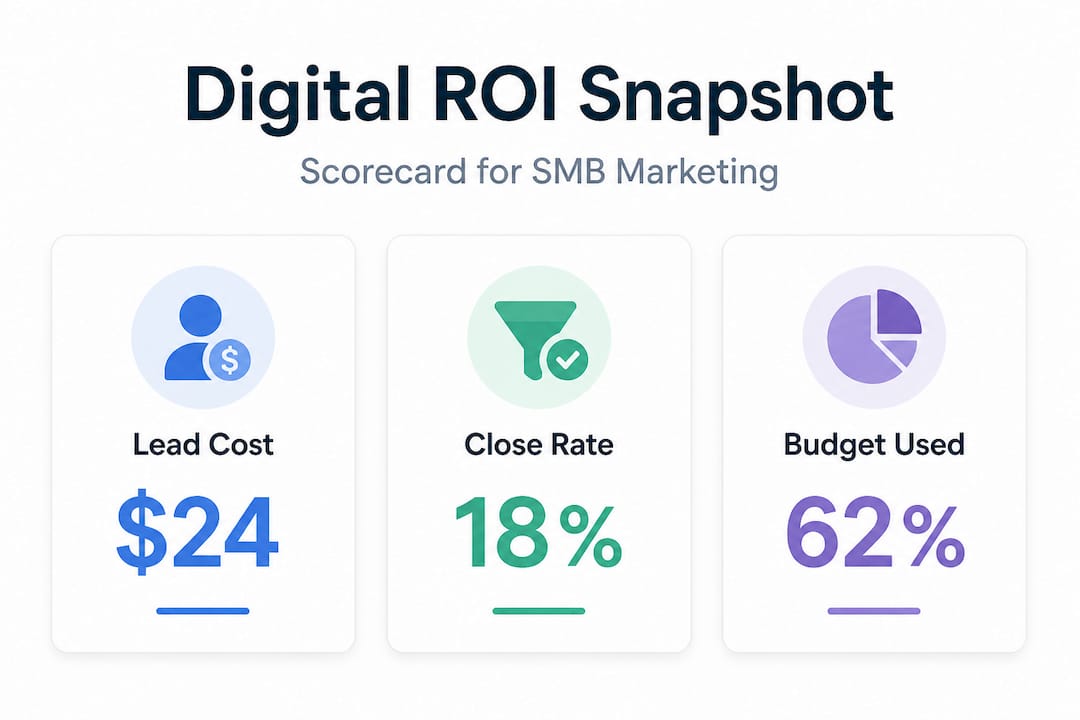
Pro Tip: Build a simple monthly scorecard that shows three numbers: cost per qualified lead, lead-to-close rate, and blended CAC across all channels. If those three numbers are trending in the right direction, your marketing is working. If they’re not, you have a specific problem to solve rather than a vague feeling that “marketing isn’t performing.”
For SMBs starting to build this measurement discipline, the tracking digital ROI guide provides a practical framework for connecting campaign data to revenue outcomes. Pairing that with a clear SMB strategy roadmap ensures you’re measuring performance against a coherent growth plan rather than in isolation.
A fresh perspective: The ROI trap and how SMBs can escape it
Here’s a view you won’t find in most budgeting guides. Obsessively chasing ROI benchmarks can actually hold your business back.
When every marketing decision gets filtered through a strict ROI lens before execution, you systematically eliminate the investments most likely to generate outsized future returns. Brand building, content authority, audience development, and channel experimentation rarely show strong short-term ROI. They’re often the exact initiatives that separate category leaders from followers three years down the road.
We’ve seen this pattern play out repeatedly with SMBs in competitive sectors. A company meticulously optimizes its Google Ads ROI for 18 months, squeezing efficiency from a mature campaign, while a newer competitor builds an organic content presence and a retargeting audience that eventually dominates the same market at a fraction of the cost per acquisition.
The uncomfortable truth is that the best ROI often comes from campaigns that looked risky at the start. A YouTube pre-roll campaign targeting early-funnel awareness, a content series targeting informational search queries, or a LinkedIn thought leadership program may show weak returns in month two or three and deliver compounding returns in month eight or twelve.
The sustainable approach isn’t to ignore ROI. It’s to segment your budget into two distinct pools. Allocate roughly 70% to proven, measurable performance channels where you track CAC and ROMI tightly. Reserve 30% for strategic experimentation where you define success in terms of learning and audience building rather than immediate conversion. Review the experimental pool quarterly and graduate successful experiments into the performance pool when the data supports it.
This framework keeps your business grounded in performance accountability while creating the space to discover your next high-performing channel before your competitors do. SMBs that never experiment don’t fail dramatically. They fade slowly as their reliable channels mature, CPCs rise, and they have no pipeline of new acquisition strategies to replace them.
Where to go next: Proven digital marketing solutions for SMBs
Now that you have a clear picture of what digital marketing costs, how to build a revenue-backed budget, and how to track what actually matters, the logical next step is putting those frameworks into practice. Start by reviewing your current channel mix and asking honestly whether each channel is funded at a level where it can realistically perform. Underfunded campaigns don’t just underperform. They mislead you into thinking a channel doesn’t work when it actually just needed more runway.
If paid search is part of your growth plan, our team specializes in PPC advertising for SMBs in competitive sectors, building campaigns that prioritize qualified lead volume over raw click metrics. For businesses looking to build audience and community value alongside performance campaigns, our social media management solutions are designed to create consistent brand presence without the overhead of managing multiple platforms in-house. Reach out to us at Web Spider Solutions to discuss a budget strategy aligned with your specific revenue goals.
Frequently asked questions
How much should a small business spend monthly on digital marketing?
Typical SMB monthly budgets range from $2,500 to $12,000 per month, with the exact figure depending on industry competitiveness, the number of active channels, and whether the business is maintaining or aggressively growing its market share.
What percentage of revenue is best for digital marketing?
Most experts recommend around 9.4% of annual revenue for total marketing spend, with B2B companies typically investing between 8% and 11%. Earlier stage companies focused on growth often need to invest at the higher end or beyond that range to gain traction.
Which digital marketing channels cost the most?
Paid search campaigns in competitive sectors, enterprise-tier SEO engagements, and marketing automation platforms like HubSpot’s Professional tier tend to be the highest-cost line items for SMBs, especially when onboarding and per-seat fees are factored in alongside management costs.
How can I avoid overspending in digital marketing?
Track revenue-linked KPIs like customer acquisition cost and lead-to-close rate rather than surface metrics like impressions or clicks. When those core numbers are moving in the right direction, your spend is justified. When they’re not, you have a specific optimization problem to address rather than a budget that simply needs cutting.



 Top-rated