






Most businesses waste thousands on digital marketing without knowing what works. You run campaigns across multiple channels, invest in content and ads, yet struggle to pinpoint which efforts drive real results. A structured digital marketing audit cuts through this confusion by systematically evaluating every aspect of your online presence. This guide reveals exactly how to conduct a comprehensive audit in 2026, uncovering hidden opportunities and eliminating wasted spend to maximize your marketing ROI.
Table of Contents
- Preparing For Your Digital Marketing Audit
- Executing The Digital Marketing Audit Step-By-Step
- Verifying Audit Findings And Common Mistakes To Avoid
- Interpreting Audit Results And Next Steps For Business Growth
- Optimize Your Digital Marketing With Expert Help
- What Is A Digital Marketing Audit?
Key takeaways
| Point | Details |
|---|---|
| Digital marketing audits assess strategy effectiveness | A comprehensive audit identifies gaps and opportunities across all your marketing channels |
| Thorough audits analyze multiple components | Review SEO performance, PPC campaigns, content quality, social media engagement, and analytics data |
| Step-by-step processes improve decision-making | Systematic audits reveal actionable insights that directly enhance campaign performance and ROI |
| Common pitfalls reduce audit value | Neglecting data verification, skipping competitor analysis, and ignoring small discrepancies lead to flawed conclusions |
| Regular audits maintain strategic alignment | Frequent reviews keep your marketing efforts synchronized with evolving market trends and business goals |
Preparing for your digital marketing audit
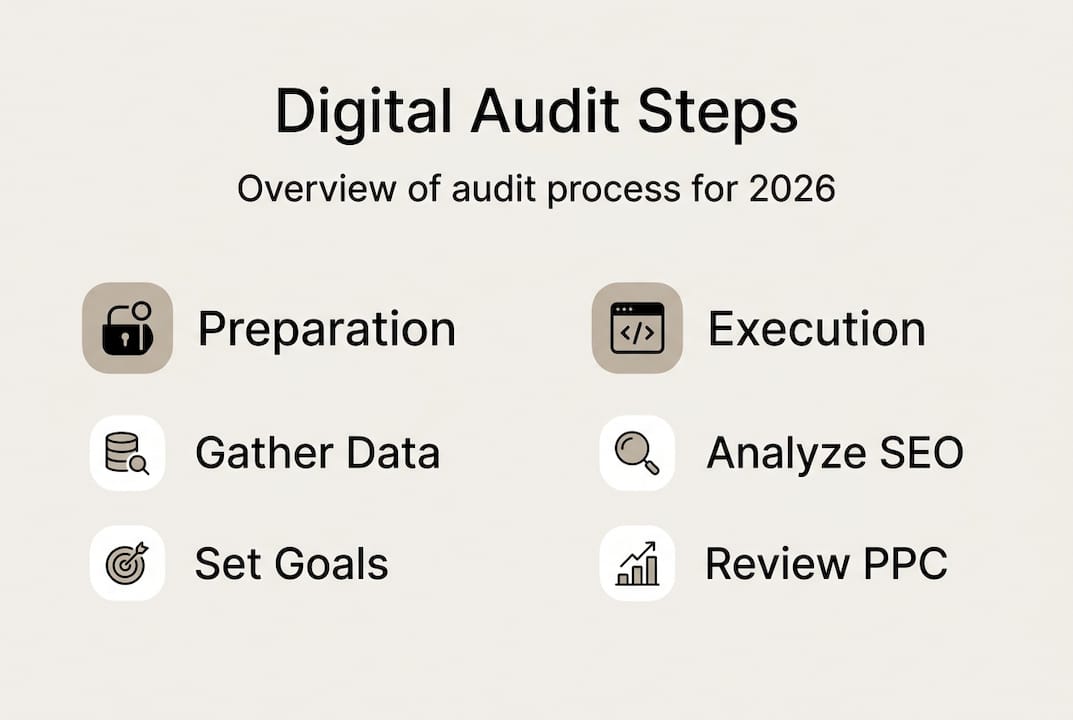
Before diving into analysis, you need a solid foundation. Start by gathering every digital marketing data source you use: Google Analytics, Google Ads accounts, Facebook Business Manager, email marketing platforms, and SEO tools like SEMrush or Ahrefs. Consolidating these resources upfront saves hours of backtracking later.
Define your audit scope clearly. Will you examine all channels or focus on specific areas like SEO and PPC? Small businesses often benefit from comprehensive audits, while larger organizations might conduct channel-specific reviews quarterly. Your scope determines the depth and duration of your audit.
Set concrete business goals that align with your audit. Are you pursuing 50% traffic growth, doubling conversion rates, or expanding brand awareness? Clear objectives transform raw data into meaningful insights. Without defined goals, you’ll collect information but struggle to prioritize improvements.
Identify the key performance indicators that matter most. Traffic volume, bounce rate, conversion rate, cost per acquisition, and customer lifetime value all tell different stories. Select KPIs that directly connect to your business objectives rather than vanity metrics that look impressive but lack actionable value.
Assign specific team responsibilities for data collection and analysis. Designate who will pull analytics reports, who reviews SEO performance, and who analyzes social media metrics. Proper preparation greatly enhances audit accuracy by ensuring nothing falls through the cracks.
Pro Tip: Create a shared spreadsheet where team members log their findings in real time. This collaborative approach prevents duplicate work and reveals patterns faster than isolated analysis.
Establish a realistic timeline based on your scope. A full audit typically requires two to four weeks, depending on your digital footprint size. Rushing produces superficial insights, while excessive delays cause you to miss timely optimization opportunities. Balance thoroughness with efficiency.
Executing the digital marketing audit step-by-step
Step one involves auditing your website’s SEO performance comprehensively. Check your keyword rankings for target terms, analyze backlink quality and quantity, and examine technical SEO elements like site speed, mobile responsiveness, and crawl errors. Use Google Search Console to identify indexing issues and Search Analytics to understand which queries drive traffic.

Step two focuses on reviewing PPC campaign effectiveness across all platforms. Examine your advertising spend distribution, click-through rates, quality scores, and conversion rates for each campaign. Identify which ad groups deliver positive ROI and which drain budget without results. Compare performance across different platforms like Google Ads, Facebook Ads, and LinkedIn to allocate resources optimally.
Step three evaluates social media activity and engagement metrics. Review posting frequency, content types, audience growth rates, and engagement rates across Facebook, Instagram, LinkedIn, and Twitter. Determine which platforms generate meaningful business outcomes versus those consuming time without returns. Analyze competitor social presence to benchmark your performance.
Step four analyzes content quality, relevance, and consistency. Use a content audit checklist to systematically review blog posts, landing pages, and resource materials. Identify outdated content requiring updates, gaps in your content strategy, and high-performing pieces worth expanding or repurposing.
Step five examines web analytics data to understand visitor behavior patterns. Study traffic sources, user flow through your site, conversion funnels, and exit pages. Identify where visitors drop off and which pages convert effectively. This website audit guide ensures no critical area gets overlooked.
| Audit Step | Recommended Tools | Expected Outcomes |
|---|---|---|
| SEO Performance | Google Search Console, SEMrush, Ahrefs | Keyword opportunities, technical fixes, backlink strategy |
| PPC Campaigns | Google Ads, Facebook Ads Manager | Budget reallocation, improved targeting, higher ROI |
| Social Media | Native platform analytics, Hootsuite | Content strategy refinement, platform prioritization |
| Content Quality | Screaming Frog, content inventory spreadsheet | Content gaps, update priorities, repurposing opportunities |
| Web Analytics | Google Analytics, Hotjar | User experience improvements, conversion optimization |
Pro Tip: Schedule all five steps sequentially rather than simultaneously. Completing one step before starting the next maintains focus and produces more thorough insights than juggling multiple analyses.
Verifying audit findings and common mistakes to avoid
Cross-check data from multiple tools to catch inconsistencies. Google Analytics might show different traffic numbers than your CRM system due to tracking differences. Reconcile these discrepancies before drawing conclusions, as they often reveal tracking implementation problems worth fixing.
Avoid dismissing small data inconsistencies as insignificant. A 5% discrepancy in conversion tracking might seem minor but could represent thousands in revenue when scaled across your entire funnel. Investigate anomalies systematically rather than assuming they’re rounding errors or acceptable variances.
Never skip competitor analysis during your audit. Understanding how your performance stacks up against industry benchmarks provides essential context. Your 3% conversion rate might seem disappointing until you discover competitors average 2%. Conversely, celebrating 1,000 monthly visitors loses meaning when competitors attract 10,000.
Beware of confirmation bias when interpreting audit data. You might want to believe your new content strategy works brilliantly, but let the numbers speak objectively. Verification of audit findings prevents costly errors by ensuring improvements rest on factual evidence rather than wishful thinking.
Ensure every finding aligns clearly with your defined business goals and KPIs. Discovering that Instagram engagement increased 40% matters only if Instagram drives meaningful business outcomes. Don’t get distracted by impressive-sounding metrics that fail to advance your core objectives.
Document your verification process thoroughly. Record which tools you used, when you pulled data, and how you resolved discrepancies. This documentation proves invaluable when comparing future audits or explaining recommendations to stakeholders who question your conclusions.
Pro Tip: Have someone outside your marketing team review your findings. Fresh eyes catch assumptions and biases that seem invisible when you’re deep in the data.
Watch for seasonal variations that skew comparisons. Comparing December performance to January rarely yields meaningful insights for most businesses due to holiday shopping patterns. Use year-over-year comparisons or account for known seasonal trends when analyzing performance changes.
Interpreting audit results and next steps for business growth
Compare pre-audit and post-implementation metrics to measure actual impact. Establish baseline measurements before making changes, then track the same KPIs monthly. This approach definitively shows whether your audit-driven improvements deliver promised results or require further adjustment.
Prioritize audit-identified issues based on potential ROI and implementation effort. Quick wins like fixing broken links or improving meta descriptions require minimal effort but often produce measurable improvements. Tackle these first to build momentum before addressing complex challenges like site architecture overhauls.
Create an actionable plan addressing SEO, content, PPC, and social channels systematically. Break large projects into specific tasks with assigned owners and deadlines. “Improve SEO” remains vague and unactionable, while “optimize 20 high-traffic pages for featured snippets by month-end” drives concrete progress.
Implement continuous monitoring to assess ongoing performance improvements. Set up automated reports tracking your priority KPIs weekly or monthly. Regular monitoring catches emerging problems early and confirms whether implemented changes produce sustained improvements or temporary spikes.
Use audit insights to inform future digital marketing strategy and budget allocation. If your audit reveals organic search drives 60% of conversions at one-third the cost of paid ads, shift resources accordingly. Proper interpretation and application of audit results significantly boosts marketing performance and efficiency.
| Metric | Before Audit | After Optimization | Improvement |
|---|---|---|---|
| Organic Traffic | 5,000 monthly visits | 8,500 monthly visits | 70% increase |
| Conversion Rate | 2.1% | 3.4% | 62% increase |
| Cost Per Acquisition | $85 | $52 | 39% decrease |
| Social Engagement Rate | 1.8% | 3.2% | 78% increase |
Schedule follow-up audits to maintain momentum. Conduct comprehensive annual audits with quarterly mini-audits focusing on high-priority channels. This rhythm keeps your strategy responsive to market changes without overwhelming your team with constant analysis.
Pro Tip: Create a one-page audit summary for executives highlighting three key findings, recommended actions, and projected ROI. Detailed reports matter for implementation teams, but leadership needs concise insights that inform strategic decisions.
Celebrate wins publicly while addressing weaknesses privately. Share successful optimizations with your team to build confidence in the audit process. Handle underperforming areas constructively, focusing on solutions rather than blame. This approach encourages honest future audits rather than defensive data manipulation.
Optimize your digital marketing with expert help
Conducting thorough digital marketing audits requires significant expertise and time investment. Web Spider Solutions specializes in transforming audit insights into measurable business growth through tailored strategies. Our team combines technical SEO excellence with data-driven campaign management to maximize every marketing dollar.
Professional social media management amplifies audit-driven improvements by implementing optimized content strategies across platforms. We handle everything from content creation to community engagement, freeing you to focus on core business operations while your online presence grows strategically.
Our comprehensive SEO campaign services convert audit findings into ranking improvements and organic traffic growth. Whether you need technical fixes, content optimization, or link building, our specialists deliver results that compound over time. Discover how our proven SEO strategy guide can prepare your business for sustained digital success.
What is a digital marketing audit?
A digital marketing audit is a comprehensive review of all your online marketing efforts to identify strengths, weaknesses, and opportunities. It systematically examines SEO performance, paid advertising campaigns, content effectiveness, social media engagement, and analytics data. The audit process reveals which tactics drive results and which waste resources, enabling you to optimize your strategy for maximum ROI.
How often should I perform a digital marketing audit?
Conduct a full digital marketing audit at least annually, with quarterly mini-audits for key channels like SEO and PPC. More frequent reviews become essential during major campaign shifts, significant market changes, or when launching new products. Regular audits ensure your strategy stays aligned with evolving consumer behavior and competitive dynamics rather than operating on outdated assumptions.
What key tools help with the digital marketing audit process?
Google Analytics and Google Search Console provide essential website performance data and search visibility insights. SEO-specific platforms like SEMrush or Ahrefs deliver competitive analysis, keyword research, and backlink auditing capabilities. Social media analytics platforms and PPC ad managers offer channel-specific performance metrics. Top SEO tools streamline technical audits, while content audit checklists ensure systematic content evaluation.
Can a digital marketing audit improve ROI?
Yes, digital marketing audits directly improve ROI by identifying underperforming tactics and highlighting optimization opportunities. Audits reveal where you’re overspending on low-converting channels and where increased investment could yield significant returns. Regular audits create a continuous improvement cycle, leading to progressively more efficient marketing strategies that maximize conversions while minimizing wasted spend. Businesses that audit quarterly typically see 30-50% improvements in marketing efficiency within the first year.
Recommended