








Every website audit begins with a challenge: cutting through noise to find what truly drives performance. For Digital Marketing Managers striving to lead in crowded markets, clarity counts more than ever. By defining specific performance metrics and establishing measurable goals, you create a foundation that transforms scattered data into actionable insight. This guide walks you through practical steps to help your team prioritize, track, and improve—giving you a proven path toward stronger digital outcomes.
Table of Contents
- Step 1: Define Audit Objectives And Gather Benchmarks
- Step 2: Evaluate Technical Seo And User Experience
- Step 3: Analyze Content Quality And Relevance
- Step 4: Assess Backlink Profile And Competition
- Step 5: Test And Verify Audit Recommendations
Quick Summary
| Key Point | Explanation |
|---|---|
| 1. Define clear audit objectives | Establish specific performance metrics and goals to guide your website audit effectively. |
| 2. Evaluate technical SEO and user experience | Assess both technical aspects and user engagement to improve digital performance and rankings. |
| 3. Analyze content quality and relevance | Review your content’s effectiveness, accuracy, and engagement potential to enhance audience connections. |
| 4. Assess backlink profile thoroughly | Focus on the quality and relevance of backlinks, not just quantity, to strengthen your website’s authority. |
| 5. Test and validate audit recommendations | Implement a structured process to measure the impact of changes and ensure continuous improvement. |
Step 1: Define audit objectives and gather benchmarks
Auditing a website requires precision and strategic planning. In this critical phase, you’ll establish clear goals and collect baseline data that will guide your entire digital performance investigation.
Starting with website audits means identifying specific performance metrics that matter most to your business. Establishing clear audit objectives involves understanding your current digital landscape and pinpointing areas for potential improvement. Consider examining key performance indicators like:
- Organic search rankings
- Website loading speed
- Conversion rates
- User experience metrics
- Mobile responsiveness
- Technical SEO health
To effectively gather benchmarks, you’ll want to collect comprehensive data from multiple sources. This means pulling information from analytics platforms, running diagnostic tools, and comparing your website’s performance against industry standards. The goal is creating a 360-degree performance snapshot that reveals strengths and potential optimization opportunities.
Successful website audits start with crystal-clear objectives and robust baseline measurements.
Track your initial metrics carefully, as these will serve as your reference point for future improvements and help you measure the impact of subsequent optimization efforts.
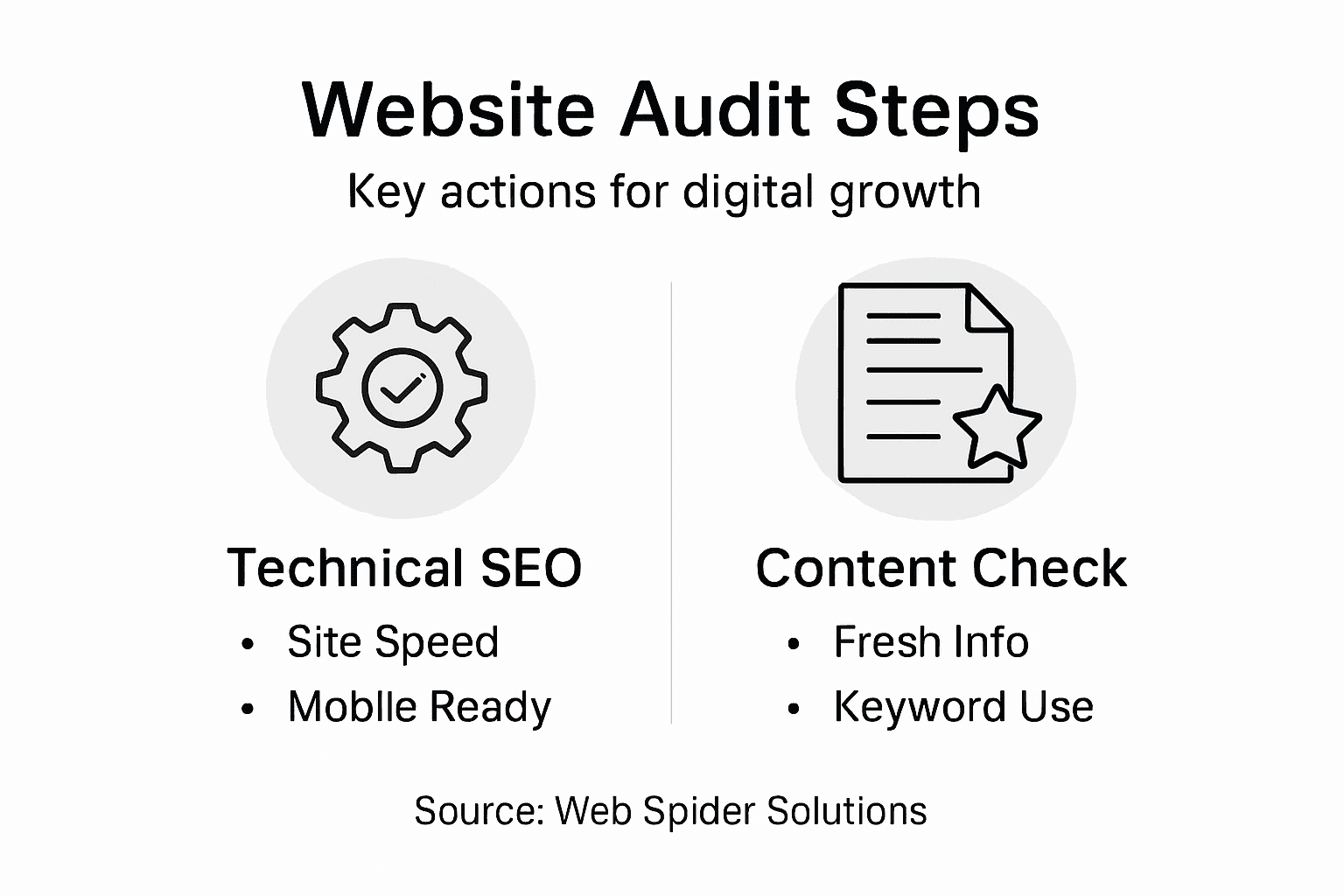
Pro tip: Use multiple analytics tools to cross-reference your benchmarks and ensure data accuracy.
Step 2: Evaluate technical SEO and user experience
In this crucial phase of your website audit, you’ll dive deep into the technical performance and user experience aspects that directly impact your digital growth strategy. Analyzing user experience and SEO interactions reveals critical insights about how your website performs and engages visitors.
To comprehensively evaluate technical SEO and user experience, you’ll need to examine multiple interconnected factors:
- Site speed and performance metrics
- Mobile responsiveness
- Navigation structure and information architecture
- Internal linking strategy
- Page load times across different devices
- Accessibility features
- Crawlability and indexing potential
Technical SEO assessment requires a systematic approach that goes beyond surface-level metrics. You’ll want to analyze how search engines perceive and interact with your website, looking for potential barriers that might prevent optimal indexing and ranking. This involves using diagnostic tools to uncover issues like broken links, redirect chains, and metadata problems.
User experience and technical SEO are not separate disciplines, but deeply interconnected elements of digital performance.
For user experience evaluation, consider both quantitative data and qualitative user feedback. Examine metrics like bounce rates, time on page, and conversion paths to understand how visitors interact with your site. Look for potential friction points that might discourage user engagement or prevent them from completing desired actions.

Pro tip: Use heatmap and session recording tools to gain visual insights into actual user behavior and interaction patterns.
Step 3: Analyze content quality and relevance
Content analysis represents a critical checkpoint in your website audit, where you’ll systematically evaluate the effectiveness and strategic alignment of your digital content. Assessing content quality and accuracy requires a comprehensive approach that goes beyond surface-level metrics.
To effectively analyze your content’s quality and relevance, you’ll want to examine several key dimensions:
- Alignment with target audience needs
- Accuracy and current information
- Depth of subject matter expertise
- Clarity of messaging
- Engagement potential
- Keyword relevance and optimization
- Unique value proposition
Content evaluation involves both quantitative and qualitative assessments. Look for indicators like reader interaction, time spent on page, and how well the content addresses specific user questions or pain points. Examine whether your content provides genuine value, answers user queries comprehensively, and stands out from competitors in your industry.
High-quality content is not just about information, but about creating meaningful connections with your audience.
Compare your existing content against current industry standards and best practices. This means checking for outdated information, reviewing the depth of your explanations, and ensuring each piece serves a clear purpose in your overall content strategy.
Pro tip: Create a content scorecard with weighted criteria to systematically and objectively evaluate each piece of content.
Step 4: Assess backlink profile and competition
Backlink analysis is a strategic deep dive into understanding your website’s digital reputation and competitive positioning. Analyzing competitor strategic environments provides critical insights that can transform your digital marketing approach.
To comprehensively assess your backlink profile, you’ll need to examine multiple critical dimensions:
- Total number of backlinks
- Domain authority of linking websites
- Relevance of linking domains
- Anchor text distribution
- Link diversity and quality
- Geographical link origins
- Toxic or potentially harmful links
Backlink evaluation requires a systematic approach that goes beyond simple quantity metrics. You’ll want to analyze not just how many links point to your site, but the strategic quality and contextual relevance of each connection. This means understanding which links genuinely contribute to your website’s authority and which might be potentially harmful.
Not all backlinks are created equal. Quality trumps quantity in modern SEO strategies.
Competitive backlink analysis involves comparing your link profile against top-performing competitors in your industry. Look for opportunities where competitors have high-quality links that you might also pursue, and identify unique linking strategies that could give you a competitive advantage.
Pro tip: Use multiple backlink analysis tools to cross-reference data and get a more comprehensive view of your link landscape.
Step 5: Test and verify audit recommendations
The final stage of your website audit transforms insights into actionable improvements. Implementing audit recommendations effectively requires a systematic approach to testing and validation that goes beyond surface-level changes.
To thoroughly test and verify your audit recommendations, you’ll need a structured verification process:
- Create a prioritized implementation roadmap
- Establish clear success metrics for each recommendation
- Develop controlled testing environments
- Measure baseline performance before changes
- Track incremental improvements
- Validate results against initial objectives
- Document unexpected outcomes
Recommendation verification involves more than simply implementing suggested changes. You’ll want to create a rigorous testing framework that allows you to measure the direct impact of each modification. This means setting up precise tracking mechanisms, comparing performance before and after changes, and being prepared to make iterative adjustments.
Not all recommendations will yield identical results. Continuous monitoring and adaptation are key to sustainable digital growth.
Plan for both short-term and long-term evaluation of your audit recommendations. Some improvements might show immediate impact, while others could require several months to demonstrate their full potential. Maintain flexibility in your approach and be ready to pivot if initial results differ from expectations.
Pro tip: Create a detailed tracking spreadsheet with columns for recommendation, implementation date, expected outcome, actual result, and necessary follow-up actions.
Here’s a quick reference to match audit tools with their main purpose:
| Tool Type | Main Use | Example Insights |
|---|---|---|
| Analytics Platform | Track user behavior | Session duration, traffic sources |
| SEO Diagnostic Tool | Identify site issues | Broken links, crawl errors |
| Heatmap/Session Tool | Visualize interactions | Click hotspots, scroll depth |
| Backlink Analyzer | Assess link quality | Referring domains, toxic links |
Here’s a summary of how each website audit step supports overall site improvement:
| Audit Step | Primary Focus | Business Benefit |
|---|---|---|
| Define Objectives & Benchmarks | Set goals and collect data | Guides optimization priorities |
| Evaluate SEO & UX | Technical health and usability | Boosts rankings and conversions |
| Analyze Content | Quality and relevance | Improves engagement and authority |
| Assess Backlinks | Link profile quality | Lifts search visibility |
| Test Recommendations | Implementation and validation | Measures progress and ROI |
Unlock Your Website’s Full Potential with Expert Audit and Optimization Support
Auditing your website for better digital growth involves tackling key challenges like technical SEO issues, user experience roadblocks, and content relevance gaps. Without clear audit objectives and reliable benchmarks, it is difficult to uncover performance barriers that limit your online visibility and conversions. The journey from identifying broken links to testing recommendations requires a strategic partner who understands how to transform audit insights into measurable results.
At Web Spider Solutions, we specialize in helping businesses overcome these exact pain points. Whether you need a comprehensive technical SEO review or assistance optimizing your content strategy, our digital marketing services deliver long-term growth by targeting your most critical performance metrics. Explore our success stories in the Stories Archives to see how we helped clients enhance organic search rankings, improve user engagement, and maximize ROI. Ready to elevate your website with tailored paid campaigns and expert implementation Find solutions in our Paid Advertising Archives that complement your audit improvements.
Don’t wait to discover opportunities you might be missing. Take the next step by visiting Web Spider Solutions today and request a free consultation. Let us guide you through effective website audits and targeted digital strategies designed to drive real business growth now.
Frequently Asked Questions
What are the key steps to audit a website for better digital growth?
To audit a website effectively, follow these steps: define your audit objectives, evaluate technical SEO and user experience, analyze content quality, assess your backlink profile, and test your audit recommendations. Start with a clear understanding of your goals and relevant performance metrics.
How do I measure the success of my website audit?
Measure the success of your audit by tracking specific performance metrics such as organic search rankings, conversion rates, and user engagement before and after implementing recommended changes. Document your initial benchmarks and look for improvements within 30 to 60 days.
What metrics should I focus on during the website audit?
Focus on metrics that impact your digital growth objectives, including website loading speed, mobile responsiveness, and technical SEO health. Prioritize these indicators to understand where enhancements will yield the most significant benefits.
How can I evaluate user experience during the audit?
Evaluate user experience by analyzing behavior data like bounce rates, time spent on page, and navigation paths. Use tools to gather qualitative feedback, and identify potential friction points where users may struggle to engage with your site effectively.
Why is content quality important in a website audit?
Content quality is crucial because it determines how effectively your content meets the needs of your audience and ranks in search engines. Ensure your content is accurate, engaging, and optimized for relevant keywords to foster better user connections and improve search visibility.
What should I look for in my backlink profile during the audit?
When assessing your backlink profile, examine the quantity and quality of backlinks, domain authority, and relevance of linking sites. Identify toxic links that could harm your SEO performance and focus on acquiring high-quality, relevant backlinks to enhance your site’s authority.