






TL;DR:
- Engagement, not just traffic, is crucial for converting B2B visitors into leads.
- Effective design includes clear value propositions, intuitive navigation, and trust signals to foster trust.
- Interactive content like calculators and chatbots significantly increase engagement and lead capture rates.
Most B2B marketing teams obsess over traffic numbers. More visitors, more budget, more ad spend. Yet a surprising number of those sites quietly bleed opportunity because the visitors who do show up leave without doing anything. The real gap is not traffic. It is engagement. When a prospect lands on your site and finds nothing that speaks to their specific pain, no clear next step, and no reason to trust you, they leave. This guide breaks down the design principles, interactive content strategies, and conversion tactics that turn passive B2B visitors into qualified leads worth pursuing.
Table of Contents
- Why engagement matters for B2B websites
- Core design principles for engaging B2B websites
- Interactive elements and content strategies that drive engagement
- Optimizing for conversion: Turning engagement into leads
- The B2B web design mistake most companies make
- Unlock better engagement and growth with expert support
- Frequently asked questions
Key Takeaways
| Point | Details |
|---|---|
| Engagement drives results | Higher website engagement leads directly to more and better B2B leads. |
| Design best practices matter | Clear structure, trust elements, and mobile-friendly design set the foundation for engagement. |
| Interactive features fuel action | Dynamic content keeps visitors invested and increases the chances they’ll convert. |
| Optimize lead capture | Smart forms and strategic calls to action help turn visitors into qualified business leads. |
| Authenticity wins long term | Websites with a strong human voice and customer focus outperform generic industry templates. |
Why engagement matters for B2B websites
Engagement in the B2B context means more than someone scrolling your homepage for 30 seconds. It means a visitor reading a case study, downloading a resource, filling out a demo request, or clicking deeper into your service pages. These behaviors signal genuine interest, and they are the behaviors that feed your sales pipeline.
Gartner research on B2B lead generation shows that most B2B websites fail at lead generation not because of poor SEO or low traffic, but because they do not give buyers a compelling reason to engage. The site exists. It loads fast. It looks fine. But it does not do anything for the visitor.
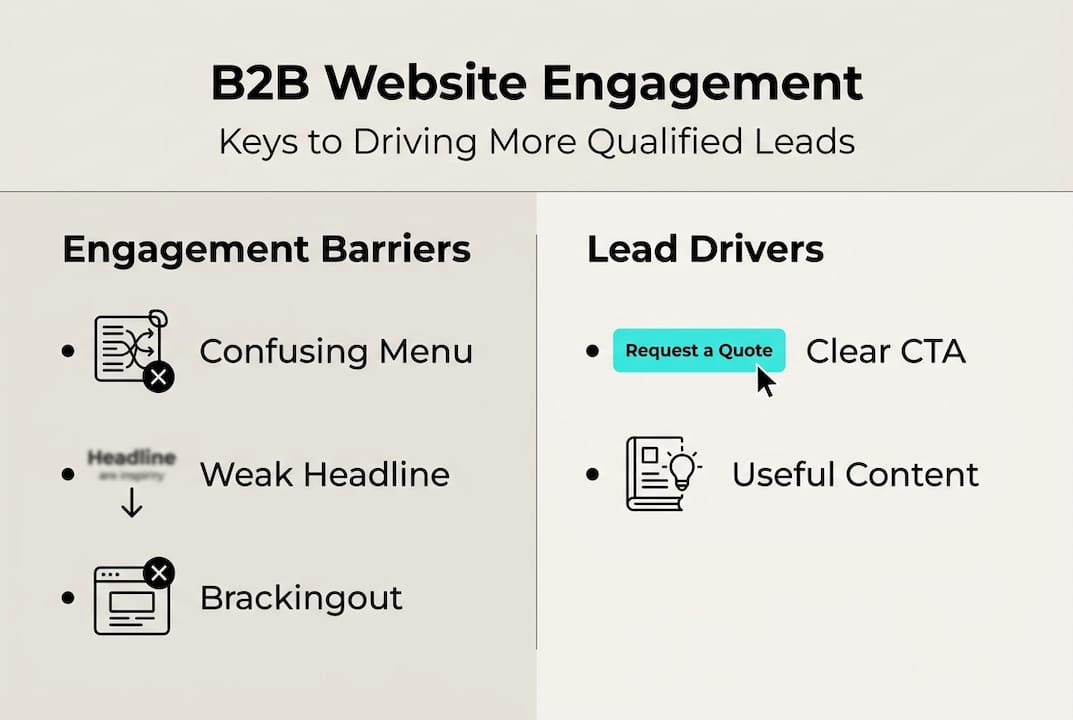
Engaged B2B website visitors are significantly more likely to become qualified leads and customers, which means the ROI of improving engagement compounds over time. You are not just getting more leads today. You are building a site that earns trust repeatedly.
So why do so many B2B sites fall short? A few common pitfalls:
- Vague value propositions that describe what you do without explaining why it matters to the buyer
- Feature-first copy that lists capabilities instead of addressing outcomes
- No clear user journey, leaving visitors to figure out where to go next
- Missing social proof, such as client logos, case studies, or third-party reviews
- Slow load times and poor mobile experience that push decision-makers away before they read a word
The benefits of fixing these issues go well beyond lead volume. Higher engagement improves your SEO rankings, reduces bounce rates, and gives your sales team warmer prospects to work with. If you want to boost B2B engagement across your site, start by understanding that every page is a conversation, and right now, most B2B sites are doing all the talking without listening. Pairing strong engagement design with B2B marketing digital strategies creates a compounding effect that outperforms either approach alone.
Core design principles for engaging B2B websites
Design is not decoration. For B2B sites, design is a decision-making tool. Every layout choice, color, and heading either moves a prospect closer to a conversion or pushes them toward the back button.
Start with navigation. Busy professionals do not have time to hunt for information. Your menu should reflect how buyers think, not how your internal org chart is structured. Group services by outcome or industry, not by department. Keep the top-level menu to five or six items maximum.
Above the fold, your value proposition must be immediate and specific. B2B design guidelines from Nielsen Norman Group confirm that B2B buyers decide within seconds whether a site is worth their time. Generic headlines like “We help businesses grow” waste that window. Specific ones like “Cut your sales cycle by 30% with automated lead qualification” earn attention.

Adhering to B2B UX best practices can significantly increase time on site and lead submissions. That means clear visual hierarchy, consistent calls to action, and trust signals placed where eyes naturally land.
Here is a quick comparison of what separates a generic homepage hero from an engaging one:
| Element | Generic hero section | Engaging hero section |
|---|---|---|
| Headline | “Your trusted partner” | “Generate 3x more qualified leads in 90 days” |
| Subheadline | “We offer full-service solutions” | “Built for B2B teams tired of chasing cold prospects” |
| CTA | “Learn more” | “See how it works” or “Get a free audit” |
| Visual | Stock photo of handshake | Real client dashboard or product screenshot |
| Trust signal | None | Client logos, review score, or media mention |
For the B2B digital marketing overview perspective, design and messaging must work together. Great design with weak copy still fails. Strong copy on a cluttered layout still fails.
Pro Tip: Over 60% of B2B researchers use mobile devices during their buying journey. Test your site on a real phone, not just a browser simulator. If your forms are hard to complete or your CTAs are too small to tap, you are losing decision-makers before they ever reach your sales team.
Interactive elements and content strategies that drive engagement
Design lays the groundwork, but it takes powerful content and interactive features to sustain engagement long-term. Static pages with blocks of text do not hold attention. Interactive experiences do.
Interactive content like configurators and quizzes increases B2B website engagement by double-digit percentages, and the logic is straightforward. When a visitor actively participates, they invest time and attention. That investment makes them more likely to convert.
Here are the most effective interactive content types for B2B sites:
- ROI calculators that let prospects input their own numbers and see projected savings or revenue gains
- Chatbots that qualify leads in real time and route them to the right resource or sales rep
- Interactive case studies where users can filter by industry, company size, or challenge
- Assessment tools that diagnose a prospect’s current situation and recommend solutions
According to interactive content research from Content Marketing Institute, interactive formats consistently outperform static content for engagement and lead capture.
Here is how engagement metrics typically compare by content type:
| Content type | Avg. time on page | Lead capture rate |
|---|---|---|
| Static blog post | 1.5 min | 1-2% |
| Downloadable white paper | 3 min | 5-8% |
| ROI calculator | 4.5 min | 12-18% |
| Interactive assessment | 5+ min | 15-22% |
To launch B2B interactive content effectively, follow these steps:
- Identify your top three buyer pain points through sales team interviews
- Choose one interactive format that directly addresses the most urgent pain
- Build a minimum viable version and test it with five to ten real prospects
- Track completion rates and drop-off points, then refine before scaling
- Pair the interactive tool with an email newsletter engagement sequence to nurture leads who complete it
Pro Tip: After launching any interactive feature, add a simple one-question feedback prompt at the end. Asking “Was this useful?” with a yes or no button gives you a constant signal for improvement without requiring a full survey.
Optimizing for conversion: Turning engagement into leads
Once your visitors are engaged, the next challenge is turning that attention into real business leads. Engagement without conversion is just entertainment.
Strategic placement of calls to action and forms is critical for capturing quality B2B leads. That means your CTA should appear where visitors are most likely to act, not just at the top of every page. Place CTAs after a case study conclusion, at the end of a blog post that solved a specific problem, and within interactive tools after the result is revealed.
For forms, shorter is almost always better in B2B. MarketingSherpa B2B lead gen research consistently shows that reducing form fields from ten to five can double submission rates. Ask only what your sales team genuinely needs to qualify and follow up.
Here is a practical audit process for your B2B lead funnel:
- Map every page where a visitor could convert and check whether a CTA exists
- Review form field counts on every lead capture form and cut anything non-essential
- Test CTA button copy. Replace “Submit” with action-oriented phrases like “Get my free audit”
- Add trust signals near every form, such as a privacy statement, client count, or response time guarantee
- Identify secondary conversion opportunities, including newsletter signups, resource downloads, and demo bookings, and make sure each has its own clear path
“The average B2B website conversion rate sits between 1% and 3%. Companies that invest in systematic conversion optimization regularly achieve rates two to three times higher than this baseline.”
Do not overlook secondary conversions. Not every visitor is ready to request a demo. Offering a free resource download or a newsletter signup keeps them in your orbit until they are ready. Pairing these with lead generation strategies built around nurture sequences turns a soft conversion today into a sales conversation next quarter.
The B2B web design mistake most companies make
Here is an uncomfortable truth we have seen repeatedly: many B2B sites follow every best practice on paper and still feel completely forgettable. The navigation is clean. The design is polished. The CTAs are placed correctly. But something is missing.
What is missing is humanity. B2B buyers are humans making high-stakes decisions, often with significant personal risk attached. They are not looking for the most technically correct website. They are looking for a team they can trust.
Generic B2B marketing examples show us that the brands that break through all share one trait: they communicate like real people who understand real problems. They use specific language, not corporate speak. They tell honest stories about challenges, not just polished success narratives.
Our perspective: conduct actual user interviews with five to ten of your best clients. Ask them what problem they were trying to solve when they found you, what almost stopped them from reaching out, and what made them trust you. Then embed those exact words and tensions into your site copy. This is not a minor tweak. It is the difference between a site that looks good and one that converts consistently.
Unlock better engagement and growth with expert support
Want to put these insights into action for your business? Transforming your B2B website from a digital brochure into a genuine lead-generation engine takes more than a template refresh. It requires strategic design, tested interactive features, and conversion-focused copy working together. At Web Spider Solutions, we specialize in exactly this kind of work. Explore our custom web design packages built for B2B companies ready to compete seriously online. Or start by reviewing our web design best practices to see where your current site stands. Your next qualified lead is already searching. Make sure your site is ready to earn it.
Frequently asked questions
What makes a B2B website engaging?
An engaging B2B website delivers clear value, intuitive navigation, trust signals, and interactive content that guides prospects to action. UX best practices are proven to increase both engagement and conversions for B2B brands.
How can interactive features help my B2B website generate more leads?
Interactive features like calculators, chatbots, and quizzes increase time on site and visitor participation, making lead capture opportunities more successful. Interactive features are linked to double-digit improvement in website engagement metrics.
What are the key elements of conversion optimization for B2B sites?
Clear calls to action, streamlined forms, and trust-building elements are essential for converting B2B site visitors into quality leads. Strategic CTA design is crucial for B2B conversion success.
Why do many B2B websites still fail to engage visitors?
Many B2B sites rely on generic templates or vague messaging, missing the emotional connection and clarity that truly engage business buyers. Generic B2B sites consistently underperform compared to those with a strong brand voice and authenticity.