






Marketing professionals and small business owners struggle daily with content that falls flat despite regular posting. In competitive industries, visibility and engagement often remain frustratingly low. This guide delivers a strategic, step-by-step framework emphasizing audience understanding, storytelling, SEO integration, and continuous analytics. You’ll learn actionable methods to consistently create content that captivates your target market and produces measurable business outcomes.
Table of Contents
- Prerequisites And Preparation
- Audience Analysis And Segmentation
- Crafting Compelling Narratives
- Optimizing Content Using Data Analytics
- Balancing Seo And Creativity
- Common Mistakes And How To Avoid Them
- Alternative Approaches And Trade-Offs
- Expected Results And Measurement
- Boost Your Content Strategy With Expert Seo Services
- Frequently Asked Questions
Key takeaways
| Point | Details |
|---|---|
| Define prerequisites early | Know your audience segments and have essential tools like Google Analytics and SEMrush ready before content creation. |
| Personalize with segmentation | Personalization increases engagement by 42% through tailored messaging. |
| Blend storytelling with SEO | Balance emotional narratives with search optimization to maximize visibility and resonance. |
| Track and refine continuously | Use data analytics to monitor performance, adjust strategies, and improve content effectiveness by 35%. |
| Avoid mobile and CTA mistakes | Mobile optimization and clear calls to action are critical to prevent engagement drops of 25% and 40%. |
Prerequisites and preparation
Successful content creation starts before you write a single word. You must identify and deeply understand your target audience segments. Who are they? What problems keep them awake at night? What solutions do they seek? Without this foundational knowledge, even beautifully written content misses the mark.
Essential tools streamline your workflow. Google Analytics reveals how users interact with your site. SEMrush uncovers keyword opportunities and competitor strategies. Canva enables quick, professional design without hiring a full team. These platforms form your core toolkit for data-driven creativity.
Set clear, measurable goals aligned with business outcomes. Do you want to increase newsletter signups by 20%? Drive 30% more qualified leads? Boost social shares by 50%? Specific targets keep your team focused and make success quantifiable. Vague goals like “improve engagement” produce vague results.
Establish workflows that combine creativity and data. A content marketing workflow guide helps structure your process from ideation through publication and analysis. Consider integrating insights from a video marketing checklist if visual content fits your strategy. Regular team check-ins ensure everyone stays aligned and accountable.
Pro Tip: Create audience personas with specific pain points, demographics, and content preferences. Refer to these personas before creating each piece to ensure relevance.
Here’s a simple preparation checklist:
- Conduct audience research using surveys and analytics
- Set up Google Analytics and SEMrush accounts
- Define 3 to 5 measurable content goals
- Build audience personas with detailed attributes
- Establish a content marketing strategy framework
| Tool | Primary Use | Cost |
|---|---|---|
| Google Analytics | Track user behavior and engagement | Free |
| SEMrush | Keyword research and SEO analysis | Paid plans from $119/month |
| Canva | Visual content design | Free with premium options |
| BuzzSumo | Content performance tracking | Paid plans from $99/month |
Audience analysis and segmentation
Personalization increases engagement by 42% compared to generic messaging. This dramatic lift comes from speaking directly to specific audience needs rather than broadcasting one-size-fits-all content. The investment in segmentation pays immediate dividends.

Use three data types to build segments. Demographic data includes age, location, job title, and income. Behavioral data tracks past purchases, content consumption patterns, and site navigation. Psychographic data reveals values, interests, and lifestyle choices. Combining these dimensions creates rich, actionable segments.
Balance broad targeting with niche focus. Casting a wide net increases reach but dilutes relevance. Targeting narrow niches deepens engagement but limits audience size. Most successful strategies use tiered segmentation: core content for your primary audience, specialized pieces for valuable sub-segments.
Leverage insights to tailor every element. A small business owner cares about ROI and time efficiency. A marketing director prioritizes team performance and strategic alignment. Your content marketing workflow should accommodate creating variations that speak to each segment’s priorities.
Pro Tip: Review your analytics quarterly to spot emerging segments. Markets shift, and new audience clusters appear as industries evolve.
Effective segmentation techniques:
- Map customer journey stages to content types
- Use email list segmentation for personalized campaigns
- Create landing pages tailored to specific segments
- A/B test messaging variations across segments
- Monitor which segments drive the highest ROI of content marketing
Once segments are defined, craft messages that resonate emotionally with each group’s unique challenges and aspirations.
Crafting compelling narratives
Storytelling transforms dry information into memorable experiences. Stories increase sharing rates by 300% because humans are wired to remember and relay narratives. A case study about how a client tripled revenue resonates far more than a list of service features.
Incorporate user-generated content to boost authenticity. Content that integrates user-generated content sees engagement rates 28% higher than brand-created material alone. Customer testimonials, social media mentions, and case studies build trust faster than self-promotion. They prove your value through third-party validation.
Use clear, compelling calls to action in every piece. Don’t assume readers know what to do next. Guide them explicitly: “Download our free template,” “Schedule a consultation,” or “Share this with your team.” Specificity removes friction and increases conversion rates.
Balance narrative techniques with brand voice consistency. Your stories should feel authentic to your brand personality. A playful, irreverent tone works for some brands but alienates audiences expecting professionalism. Review creative content marketing examples to see how diverse brands maintain voice while experimenting with format.
Effective storytelling elements:
- Begin with relatable conflict or challenge
- Introduce a protagonist your audience identifies with
- Show transformation through specific actions
- End with clear outcomes and next steps
- Use sensory details to make stories vivid
“The best marketing doesn’t feel like marketing. It feels like a conversation with someone who understands your struggles and offers genuine solutions.”
With storytelling mastered, shift focus to measuring and optimizing content performance through data analytics.
Optimizing content using data analytics
Data transforms guesswork into strategy. Track engagement metrics like social shares, average time on page, click-through rates, and conversion percentages. These numbers reveal what resonates and what falls flat. Without measurement, you’re creating content blindfolded.
Google Analytics and SEMrush provide the foundation for content intelligence. Google Analytics shows how users find and interact with your content. SEMrush reveals keyword performance and competitive positioning. Together, they create a complete picture of content effectiveness.
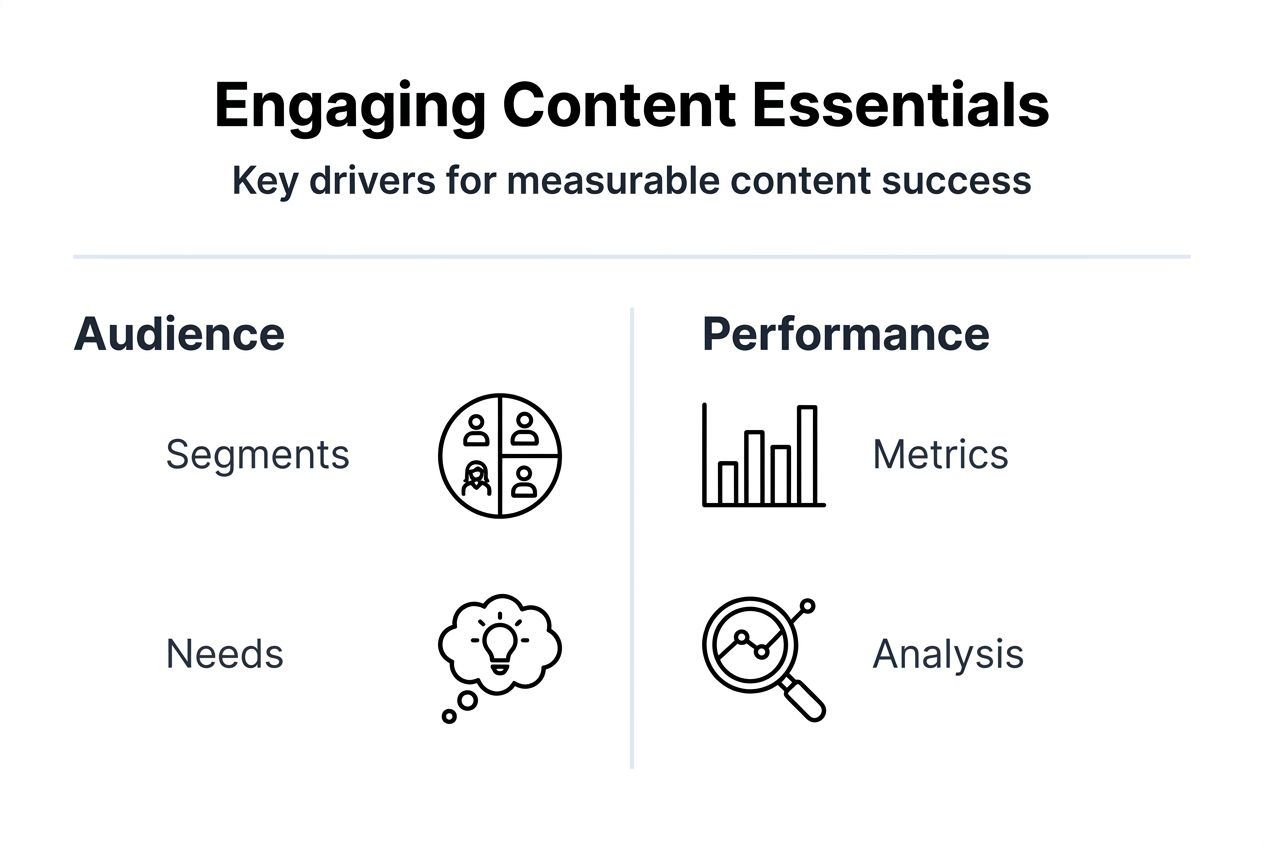
Implement a feedback loop: publish, measure, refine, republish. Review performance data weekly. Identify top performers and understand why they succeeded. Apply those lessons to underperforming content. Update old posts with fresh data and improved structure. This iterative process increases effectiveness by 35% over static publishing.
Prioritize metrics aligned with your specific goals. If lead generation drives your business, focus on form completions and email signups. If brand awareness matters most, track reach and social engagement. Don’t get distracted by vanity metrics that look impressive but don’t move business needles.
Pro Tip: Set up custom dashboards in Google Analytics to monitor your priority metrics at a glance. Automate weekly reports so your team stays informed without manual data pulls.
Optimization workflow:
- Establish baseline metrics for current content
- Set specific improvement targets (e.g., 20% increase in time on page)
- Test variations in headlines, CTAs, and content structure
- Analyze results after sufficient traffic accumulation
- Scale winning approaches across your content library
Key metrics to track:
| Metric | What It Measures | Why It Matters |
|---|---|---|
| Bounce Rate | Percentage leaving after one page | Indicates content relevance and quality |
| Time on Page | Average reading duration | Shows engagement depth |
| Social Shares | Times content is shared | Measures resonance and value |
| Conversion Rate | Percentage completing desired action | Directly ties to business goals |
| Organic Traffic | Visitors from search engines | Reflects SEO effectiveness |
Explore how analytics for digital marketing drives broader business growth. Apply data driven marketing decisions principles to content strategy. Consider how to optimize content for Google Discover to expand reach.
Balancing SEO and creativity
SEO makes content discoverable but creativity makes it memorable. Overemphasis on search optimization produces robotic, keyword-stuffed content that ranks but doesn’t engage. Pure creativity may delight readers but remain invisible in search results. The sweet spot combines both.
Use SEO best practices as a foundation, not a straitjacket. Conduct keyword research to understand search intent. Craft compelling meta descriptions and title tags. Structure content with clear headings. These technical elements support your narrative rather than constraining it.
Ignoring narratives reduces engagement by 28% even when content ranks well. Readers arrive via search but leave quickly if content feels lifeless. They share, link to, and return for content that connects emotionally and provides genuine value.
Know when to prioritize creativity over strict optimization. In saturated markets, differentiation through unique voice and perspective matters more than ranking for the same keywords as 50 competitors. Sometimes being the most helpful, entertaining, or insightful beats being the most optimized.
Integrate SEO and creativity simultaneously from the start. Don’t write first then “SEO it” later. Build keyword research into your ideation process. Let search data inform topic selection while creative instincts guide execution. Review SEO content development considerations for practical guidance.
Balancing strategies:
- Use primary keywords naturally in the first 100 words
- Structure content to answer specific search queries
- Add personality through examples, analogies, and voice
- Include semantic keywords that support context without stuffing
- Write for humans first, search engines second
| Approach | Advantages | Disadvantages |
|---|---|---|
| SEO-focused | High search visibility, predictable traffic | May feel formulaic, lower emotional engagement |
| Creativity-focused | Strong brand differentiation, high shares | Slower organic growth, limited discoverability |
| Balanced integration | Sustainable growth, audience loyalty | Requires more skill and planning |
Common mistakes and how to avoid them
Neglecting mobile optimization costs you 25% of potential engagement. Over 60% of web traffic comes from mobile devices. Content that looks beautiful on desktop but loads slowly or displays poorly on phones frustrates users. They bounce immediately and rarely return.
Omitting clear calls to action reduces interaction by 40%. Readers may love your content but have no idea what to do next. Every piece needs an explicit next step matched to content type and audience stage. Blog posts might encourage newsletter signups while product guides push demo requests.
Over-relying on SEO without creativity alienates audiences. Keywords matter, but humans crave connection. If your content reads like it was written for robots, people won’t engage regardless of ranking. Balance optimization with genuine value and personality.
Pro Tip: Run monthly content audits using mobile devices. Experience your content as users do. Slow load times and formatting issues become immediately obvious.
Practical fixes:
- Test all content on multiple mobile devices before publishing
- Compress images and enable browser caching for faster load times
- Place at least one clear CTA in every content piece
- Write naturally first, then optimize for keywords
- Use responsive design templates that adapt to screen sizes
- Gather user feedback through surveys and comments
- Review analytics to spot patterns in bounce rates and exits
Regular audits catch problems before they compound. Schedule quarterly reviews of your top-performing and most important content. Update outdated information, refresh examples, and improve structure based on current best practices.
Alternative approaches and trade-offs
Repurposing content increases engagement by 50% by reaching audiences across multiple channels. Turn a comprehensive guide into social media posts, infographics, podcast episodes, and video summaries. Each format attracts different audience segments and reinforces your message through repetition.
Consider audience preferences for content length and format. Some readers want quick tips in 500 words while others seek deep dives exceeding 3,000 words. Video learners prefer tutorials over text. Audio consumers favor podcasts during commutes. Diversifying format maximizes reach.
Resource constraints impact multi-channel feasibility. Creating high-quality content in multiple formats demands time, skills, and budget. Start with one or two channels you can execute well rather than spreading thin across many. Master those before expanding.
Trade-offs exist between content depth and breadth. Comprehensive guides establish authority but take weeks to produce. Quick tips maintain publishing frequency but may lack differentiation. Your strategy should include both: pillar content for authority, frequent updates for visibility.
Choose strategies aligned with brand voice and audience. A B2B software company might prioritize in-depth whitepapers and case studies. A consumer brand could focus on visual social content and user-generated campaigns. Let your audience’s preferences and your strengths guide format decisions.
| Strategy | Pros | Cons | Best For |
|---|---|---|---|
| Long-form content | Deep authority, strong SEO | Time-intensive, requires expertise | Thought leadership, competitive niches |
| Short-form social | High frequency, quick engagement | Limited depth, fleeting impact | Brand awareness, community building |
| Repurposed content | Efficient resource use, wide reach | Risk of repetition fatigue | Extending content lifespan |
| Video content | High engagement, shareability | Production costs, skill requirements | Product demos, storytelling |
Content repurposing tactics:
- Extract key statistics into social media graphics
- Convert blog posts into LinkedIn articles
- Create slide decks from comprehensive guides
- Develop email series from pillar content
- Turn customer interviews into case study videos
Expected results and measurement
Measurable engagement growth typically appears within 3 to 6 months of consistently applying strategic content practices. Early wins may surface sooner, but sustainable improvement requires patience and ongoing optimization. Markets need time to discover, share, and respond to your content.
Look for 30% or higher increases in shares, likes, comments, and organic traffic. These benchmarks indicate genuine audience resonance. Smaller improvements suggest incremental progress while dramatic spikes might signal viral success or seasonal factors.
Alignment of content outcomes with business KPIs validates success. Engagement metrics matter only if they connect to revenue, leads, or brand goals. Track how content engagement correlates with sales pipeline growth, customer acquisition costs, and lifetime value. This proves ROI of content marketing to stakeholders.
Use analytics regularly to track progress and adjust strategies. Monthly reviews identify trends and opportunities. Quarterly deep dives reassess overall direction. Annual evaluations inform strategic planning and budget allocation. Consistent measurement prevents costly drift from objectives.
Set realistic goals that maintain team motivation. Unrealistic targets demoralize teams while easy wins breed complacency. Stretch goals balanced with achievable milestones create healthy tension that drives performance. Celebrate wins publicly to reinforce behaviors that produce results.
Timeline expectations:
- Month 1-2: Baseline establishment and initial optimizations
- Month 3-4: Early engagement signals and pattern identification
- Month 5-6: Measurable improvements in key metrics
- Month 7-12: Sustained growth and strategy refinement
Understand core principles of content marketing to set appropriate expectations and maintain long-term focus.
Boost your content strategy with expert SEO services
Creating engaging content requires both art and science. While this guide provides the strategic framework, executing consistently at scale challenges even experienced teams. Professional SEO services complement your content creation efforts by optimizing technical elements, conducting deep keyword research, and identifying competitive opportunities your team might miss. Web Spider Solutions offers tailored strategies that increase content visibility and drive measurable engagement growth. Integrate expert insights with your content marketing workflow to accelerate results. Even specialized fields like SEO services for lawyers benefit from strategic content optimization that balances creativity with discoverability.
Frequently asked questions
How long does it typically take to see results from engaging content?
Results usually appear within 3 to 6 months of consistently applying strategic content practices. Early signals may emerge sooner, but sustainable engagement growth requires patience and ongoing optimization. Track metrics monthly and adjust your approach based on data patterns. Understanding ROI of content marketing helps set realistic timelines and expectations.
What tools are essential for creating and optimizing engaging content?
Google Analytics provides crucial performance insights into user behavior and engagement patterns. SEMrush delivers comprehensive SEO research and competitor analysis capabilities. Canva enables quick creation of visually appealing graphics without extensive design skills. These three tools form the foundation of an effective content marketing workflow that balances creativity with data-driven optimization.
What are the most common mistakes to avoid when creating engaging content?
Neglecting mobile optimization leads to 25% lower engagement since most users access content via phones. Skipping clear calls to action reduces user interaction by 40% because readers don’t know what steps to take next. Over-relying on SEO without storytelling weakens audience connection even when content ranks well. Regular audits and user feedback help identify and correct these issues before they significantly impact performance.
Recommended