






TL;DR:
- A conversion rate optimization expert systematically analyzes data and user behavior to improve website actions. They diagnose issues using tools like Google Analytics, Hotjar, and A/B testing, prioritizing data-driven hypotheses. Effective CRO is a continuous process requiring statistical discipline, realistic timelines, and focus on revenue impact.
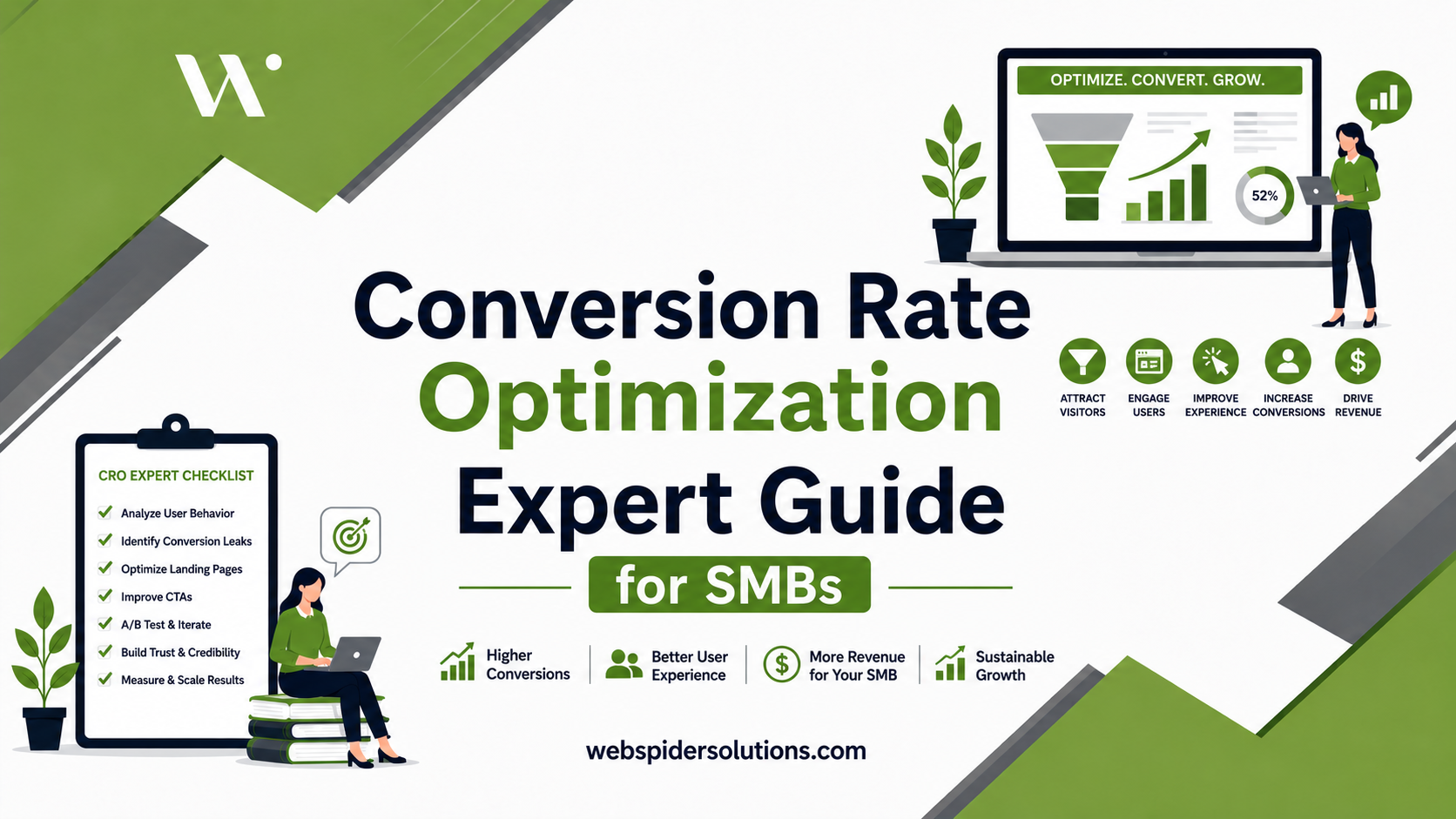
A conversion rate optimization expert is a professional who uses data analysis, user behavior research, and systematic testing to increase the percentage of website visitors who complete desired actions, whether that’s a purchase, a form submission, or a signup. Known formally as a CRO specialist, this role combines skills from analytics, UX design, copywriting, and behavioral psychology into a single, results-focused discipline. Brands like Amazon and Apple have built entire internal CRO teams around this function because even fractional improvements in conversion rates produce compounding revenue gains. For small and medium-sized businesses, hiring the right conversion optimization consultant, or knowing what to expect from one, can be the difference between a website that generates leads and one that simply generates traffic.

What does a conversion rate optimization expert actually do?
A CRO specialist’s core job is to identify why visitors leave without converting, then test solutions systematically. According to Shopify’s CRO framework, CRO is a continuous, iterative process of forming hypotheses from observed user friction and testing them against control versions. That definition matters because it rules out guesswork. A legitimate expert does not redesign your homepage because it “looks dated.” They redesign it because session recordings, heatmaps from Hotjar, and funnel data from Google Analytics 4 all point to a specific drop-off problem at a specific point in the user journey.
The tools most commonly associated with this work include Google Analytics 4, Hotjar, Optimizely, and VWO, each serving a distinct function. Google Analytics 4 surfaces quantitative patterns like bounce rates and funnel drop-offs. Hotjar provides qualitative context through session recordings and click maps. Optimizely and VWO run the actual A/B and multivariate experiments. A CRO specialist who cannot explain how they use at least three of these tools in combination is not operating at a professional level.
How do CRO experts diagnose and prioritize website issues?
Diagnosis comes before testing. Every effective conversion rate expert starts with a structured audit of existing data before recommending a single change.
The diagnostic phase typically covers four areas:
- Quantitative analysis: Reviewing Google Analytics 4 for high-exit pages, funnel abandonment points, and traffic source performance to identify where visitors are dropping off and at what rate.
- Qualitative research: Using Hotjar session recordings and heatmaps to observe actual user behavior, revealing friction points that numbers alone cannot explain, such as users repeatedly clicking a non-clickable element.
- Customer research: Conducting surveys, on-site polls, or user interviews to understand the language customers use, the objections they hold, and the information gaps that prevent them from converting.
- Competitive and copy review: Auditing landing page messaging against competitor positioning to identify whether the value proposition is clear, differentiated, and matched to visitor intent.
Once data is gathered, prioritization determines what gets tested first. A strong prioritization framework ranks test ideas by three factors: potential impact on conversion, confidence in the supporting data, and the effort required to implement. This approach, often called the ICE framework, prevents teams from spending weeks building a test that addresses a low-traffic page with minimal revenue impact.
Pro Tip: Ask any CRO specialist you’re evaluating to walk you through their last three test ideas and why they prioritized them. If they can’t explain the data behind each decision, their process is not systematic enough to trust.
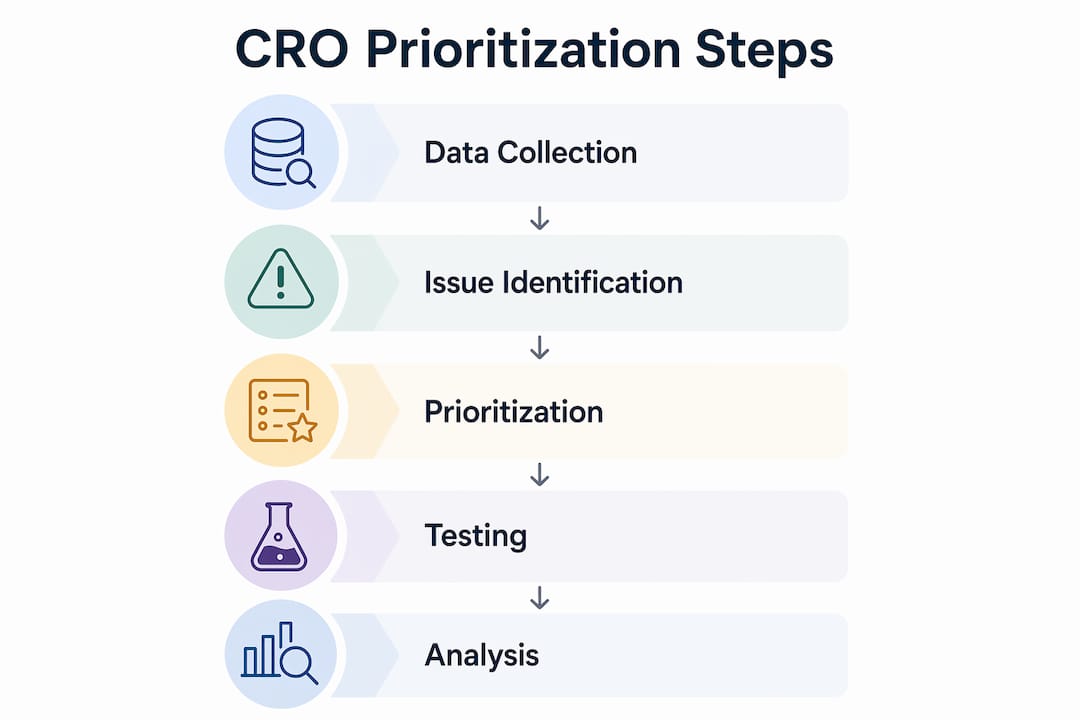
The most common mistake at this stage is skipping diagnosis entirely and jumping to surface-level fixes, such as changing button colors or headline fonts, without understanding the underlying cause of low conversion. Those changes occasionally work by accident. They never produce a repeatable, scalable improvement process.
What statistical methods do CRO experts use for reliable testing?
A/B testing is a hypothesis test, not a guessing game. Every experiment has a control version and a variant, and the goal is to determine whether the observed difference in conversion rates is real or the result of random variation.
Two statistical concepts govern every credible test. The first is significance level, set at 95% in most professional CRO work, meaning there is only a 5% chance the result is a false positive. The second is statistical power, typically set at 80%, meaning the test has an 80% chance of detecting a real effect if one exists. Both parameters directly determine how many visitors you need in each variant before a result is trustworthy.
Sample size requirements are larger than most SMBs expect. For a 2% baseline conversion rate with a 10% relative lift, each variant needs approximately 50,000 visitors to reach 95% confidence and 80% power. That figure means a site receiving 5,000 visitors per month would need nearly 20 months to complete a single reliable test on a low-converting page. Understanding this math is what separates a professional CRO specialist from someone who runs two-week tests and declares winners.
| Test parameter | What it means in practice |
|---|---|
| 95% confidence level | Only 5% chance the result is a false positive |
| 80% statistical power | 80% chance of detecting a real effect if it exists |
| Baseline conversion rate | Lower baselines require far larger sample sizes |
| Minimum detectable effect | Smaller target lifts demand exponentially more traffic |
| Test duration | Must be long enough to capture weekly behavioral cycles |
One of the most damaging habits in CRO testing is peeking. Stopping a test early after seeing a promising result inflates false positive rates significantly. Professional CRO teams define the sample size and duration before a test launches and do not adjust based on early data. Insider teams at mature organizations treat sample size calculation as a gating step before any development begins, locking in the statistical plan upfront.
Pro Tip: Avoid overly narrow audience segmentation in your experiments. Broader traffic segments produce faster, more reliable conclusions. Segment analysis is valuable post-test, not as a way to split already-thin traffic during the experiment.
When should SMBs hire a conversion rate optimization expert?
Timing matters more than most business owners realize. The single most important threshold is conversion volume. Below 500 conversions per month, A/B tests are statistically unreliable, and running them wastes both time and budget. This does not mean CRO work is off the table for lower-traffic sites. It means the approach must change.
Here is how to think about readiness in stages:
- Under 500 conversions per month: Focus on qualitative diagnostics first. Fix obvious usability problems, clarify your value proposition, and improve page load speed before investing in formal testing infrastructure.
- 500 to 2,000 conversions per month: You have enough data to run meaningful A/B tests on high-traffic pages. A freelance CRO specialist with a structured process is often the right fit at this stage.
- Over 2,000 conversions per month: You can run multiple concurrent tests and benefit from a more systematic program. A CRO agency or a dedicated internal specialist becomes cost-effective at this volume.
On timelines, meaningful CRO results typically take 60 to 120 days to materialize, depending on traffic volume and the scope of changes being tested. Any consultant promising significant conversion lifts within two weeks is either running statistically invalid tests or overstating their results. That timeline promise is the clearest red flag when evaluating providers.
Pro Tip: When comparing freelancers to agencies, freelancers often provide more direct access to the person doing the actual work, which matters for fast iteration. Agencies bring broader tool access and team depth but add coordination overhead. For most SMBs under $5M in annual revenue, a skilled freelance CRO specialist delivers better value per dollar.
What skills and tools separate effective CRO specialists from the rest?
The best conversion analytics experts combine four distinct skill sets that most marketers develop separately. Data analysis tells them where the problem is. UX design insight tells them why the experience creates friction. Copywriting determines whether the messaging resolves the objection. Behavioral psychology explains the cognitive patterns driving visitor decisions.
Copy is consistently underrated as a conversion lever. Most SMB websites fail not because of poor design but because the headline does not match what the visitor was searching for, or the call-to-action does not address the visitor’s primary concern at that moment in the funnel. A CRO specialist who focuses exclusively on design changes without auditing copy is missing the highest-leverage opportunity on most pages.
Effective specialists also avoid generic, one-size-fits-all changes. The best conversion techniques for a SaaS free trial signup page differ fundamentally from those for an e-commerce product page or a B2B lead generation form. A specialist who recommends the same set of changes regardless of business model is applying a template, not expertise. Ask them directly how their approach differs between product types and what their last three tests were for businesses similar to yours.
When evaluating tools, the standard professional stack includes Google Analytics 4 for behavioral data, Hotjar for session recordings and heatmaps, and either Optimizely or VWO for running experiments. Specialists working with tighter budgets may substitute Microsoft Clarity for Hotjar and Google Optimize alternatives for testing. What matters is not the specific tool but whether the specialist can explain what each tool reveals and how those insights connect to test hypotheses.
How do you measure whether CRO efforts are generating real business value?
Conversion rate alone is an incomplete success metric. A page that converts more visitors at a lower average order value can actually reduce revenue. Effective measurement tracks revenue per visitor and average order value alongside conversion rate to confirm that improvements translate to actual business outcomes.
Several principles guide sound measurement practice:
- Inconclusive results are not failures. A test that shows no statistically significant difference still tells you something: the change you tested did not matter to visitors. That eliminates a hypothesis and sharpens future test ideas.
- False positives are a real risk. Running multiple tests simultaneously without statistical correction, or stopping tests early, inflates the chance that a “winning” result is noise. Treat any result from an underpowered test with skepticism.
- Small lifts compound. Even a 1% improvement in conversion rate produces significant revenue impact when visitor volume is steady. HubSpot’s analysis confirms that incremental gains at scale outperform sporadic large wins.
- The testing cycle never ends. A winning test creates a new baseline. The next test builds on that baseline. Businesses that treat CRO as a one-time project rather than a continuous program capture a fraction of the available gains.
“The goal of CRO is not to find the perfect page. It’s to build an organization that gets better at converting visitors every quarter.”
Pair your CRO workflow with a consistent reporting cadence, reviewing revenue per visitor and test velocity monthly to track whether the program is accelerating or stalling.
Key takeaways
Effective CRO requires statistical discipline, qualitative diagnosis, and realistic timelines. Skipping any one of these three elements produces unreliable results regardless of how sophisticated the testing tools are.
| Point | Details |
|---|---|
| Diagnose before testing | Use Hotjar, Google Analytics 4, and customer research before writing a single test hypothesis. |
| Respect sample size math | Sites under 500 conversions per month should prioritize qualitative fixes over A/B testing. |
| Expect 60 to 120 days | Meaningful results take time; any promise of major gains in two weeks is a red flag. |
| Measure revenue, not just rate | Track revenue per visitor and average order value alongside conversion rate to confirm real gains. |
| Never stop testing | CRO is a continuous program, not a one-time project. Each winning test creates a new baseline to beat. |
What SMBs consistently get wrong about CRO engagements
Most SMBs come to CRO expecting a design refresh to solve a conversion problem. After working with dozens of businesses across different industries, the pattern at Webspidersolutions is consistent: the businesses that see the strongest results are the ones that start with a genuine diagnostic phase rather than a list of changes they already want to make.
The second mistake is underestimating copy. A landing page with a clear, specific headline that addresses the visitor’s primary concern will outperform a beautifully designed page with vague messaging almost every time. Design makes a page credible. Copy makes it convert.
The third mistake is hiring based on promises rather than process. A trustworthy CRO specialist explains their diagnostic process clearly, sets realistic timelines, and acknowledges the statistical limitations of your current traffic volume. If a provider leads with guaranteed percentage lifts before reviewing your data, that is a process problem, not a confidence signal.
The businesses that get the most from CRO investment are the ones that treat it as a learning program. Every test, whether it wins, loses, or produces no result, adds to a body of knowledge about what your specific audience responds to. That knowledge compounds. The businesses that approach CRO as a series of quick fixes never build that asset.
How Webspidersolutions helps SMBs convert more visitors
Webspidersolutions works with small and medium-sized businesses that want a structured, data-driven approach to improving conversion rates without the guesswork. The process starts with a full diagnostic audit covering analytics data, session behavior, and messaging clarity before a single test is designed. For lower-traffic sites, the focus shifts to qualitative fixes that move the needle without requiring large sample sizes. For higher-volume sites, a systematic testing program builds compounding gains over time. Explore Webspidersolutions’ CRO services for SMBs to see how a structured engagement is scoped and what realistic outcomes look like for your traffic level.
FAQ
What is a conversion rate optimization expert?
A conversion rate optimization expert is a specialist who uses data analysis, behavioral research, and structured A/B testing to increase the percentage of website visitors who complete a desired action. The role combines analytics, UX, copywriting, and psychology into a single, results-focused discipline.
How long does CRO take to show results?
Meaningful CRO results typically take 60 to 120 days depending on traffic volume and the scope of changes being tested. Any provider promising significant lifts in two weeks is running statistically invalid tests.
Do I have enough traffic to run A/B tests?
Sites with fewer than 500 conversions per month lack the volume for reliable A/B testing. The right approach at lower traffic levels is qualitative diagnostics and fixing obvious usability and messaging problems first.
What tools does a CRO specialist use?
The standard professional stack includes Google Analytics 4 for behavioral data, Hotjar for session recordings and heatmaps, and Optimizely or VWO for running experiments. The specific tools matter less than the specialist’s ability to connect insights across all three.
How do I know if a CRO consultant is credible?
Ask them to explain their diagnostic process and realistic timeframes before they recommend any changes. A credible specialist leads with data, acknowledges your traffic constraints, and avoids guaranteed percentage promises before reviewing your site.