






TL;DR:
- Keyword density does not influence Google rankings, as content is now evaluated through natural language processing.
- Filling meta keywords tags is unnecessary since Google has ignored them since 2009, and they pose operational security risks.
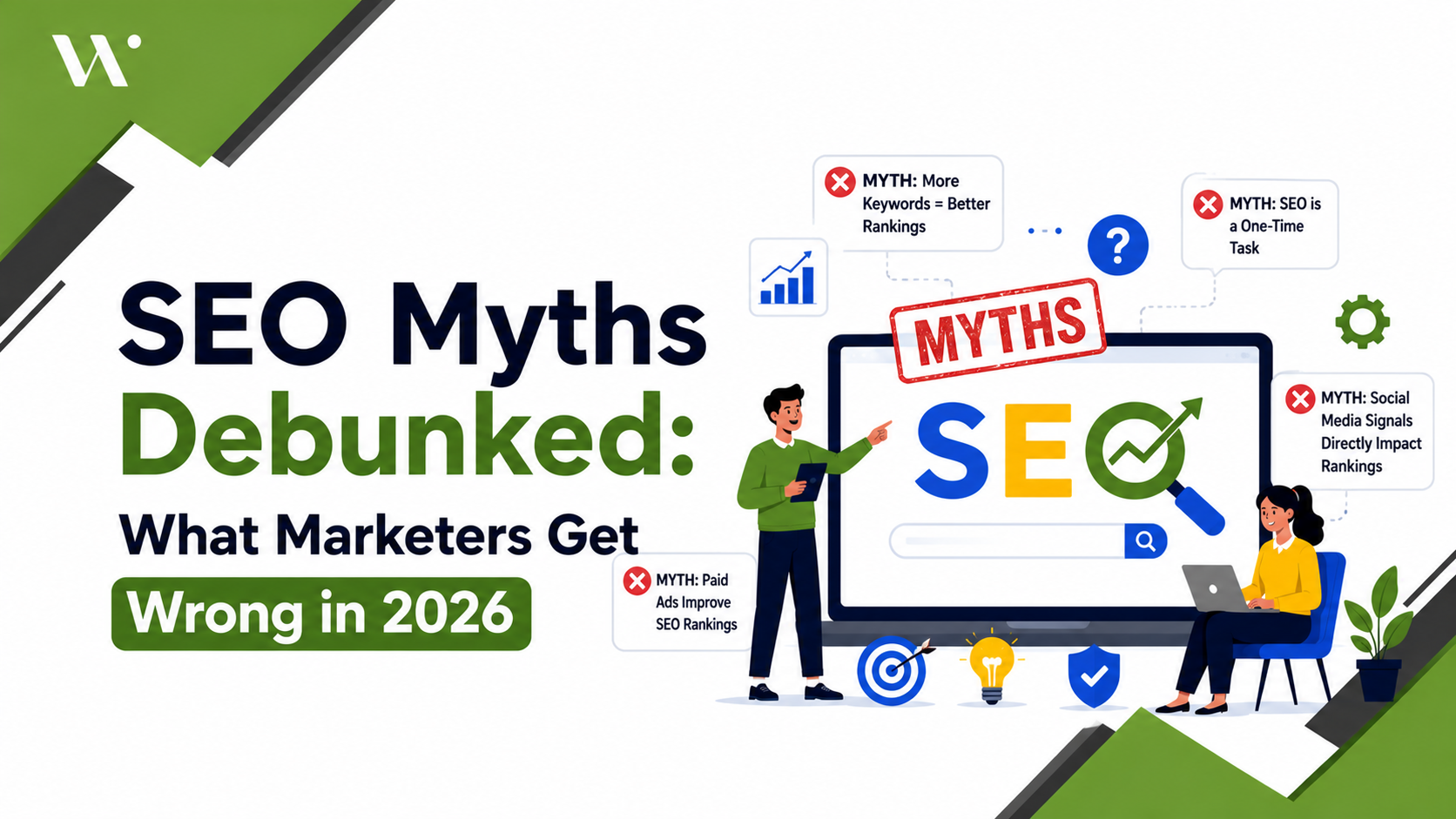
SEO myths are widespread but incorrect beliefs that push digital marketers and business owners toward tactics that waste budget and suppress rankings. Google’s John Mueller, analysis from SEOFORGE, and compliance guides from BacklinkGrid all confirm the same reality: the gap between what marketers believe about SEO and what actually drives rankings has never been wider. Getting these common SEO misconceptions right is not optional. Acting on bad information costs you traffic, authority, and revenue.
1. SEO myths debunked: keyword density does not affect rankings
Keyword density is not a ranking factor. Google does not use keyword density as a ranking signal, and any tool or consultant measuring keyword counts as a quality threshold is working from an outdated model. This is one of the most persistent myths about SEO, and it survives because density is easy to measure.

Google’s algorithm now uses natural language processing to evaluate content. It reads for meaning, context, and how well a page satisfies what the user actually wants. Stuffing a keyword 20 times into a 500-word article does not signal relevance. It signals poor writing.
Google’s John Mueller has stated clearly that Google evaluates content usefulness and alignment with user intent rather than keyword formulas. That shift happened years ago. Marketers who still chase density targets are optimizing for a search engine that no longer exists.
What actually works instead:
- Write for the question the user is asking, not the phrase you want to rank for
- Cover related subtopics that a thorough answer would naturally include
- Use tools like Clearscope or Surfer SEO to identify semantic gaps, not keyword frequency
- Prioritize readability. Google rewards pages users stay on
Pro Tip: Run your content through a tool like Hemingway Editor before publishing. If a sentence is hard to read, it is probably also hard for Google to interpret.
2. Meta keywords are dead and have been since 2009
The meta keywords tag is ignored by Google for ranking. Google stopped using the meta keywords tag in 2009 after widespread abuse made it useless as a signal. Filling it in today does nothing for your rankings. This is one of the most clear-cut seo myths explained by Google itself.
The risk of keeping meta keywords is not just wasted effort. Competitors can read your meta keywords tag in the page source and use your own keyword research against you. That is a real operational security problem.
Many content management systems still auto-insert a meta keywords field by default, including legacy WordPress plugins and older Drupal configurations. Teams fill them in out of habit, creating internal confusion during audits and wasting time that could go toward signals that actually matter.
What to focus on instead:
- Title tags: Keep them under 60 characters and front-load the primary keyword
- Meta descriptions: Write for click-through rate, not ranking. Google rewrites them anyway, but a strong description still influences clicks
- Structured data: Schema markup from Schema.org helps Google understand your content type, which does influence how your result appears in search
- Open Graph tags: These control how your pages look when shared on social platforms, which affects referral traffic
Pro Tip: Audit your CMS settings and disable any plugin that auto-populates meta keywords. Removing the field entirely prevents future confusion and keeps your codebase clean.
3. Buying links violates Google’s policies and risks real penalties
Buying or selling links to manipulate rankings violates Google’s spam policies directly. This is not a gray area. Paid links that pass PageRank without proper disclosure are a manual action risk and an algorithmic target.
Google’s 2026 Link Spam update specifically targets AI-generated link schemes and private blog networks. The update shows that Google is not getting less sophisticated about detecting manipulation. It is getting more sophisticated every year.
Here is how compliant and non-compliant link practices compare:
| Practice | Compliant? | What to do |
|---|---|---|
| Editorial link from relevant site | Yes | Earn through content quality |
| Paid link with rel=“sponsored” | Yes | Disclose properly, no PageRank passed |
| Paid link without disclosure | No | Remove or add proper rel attribute |
| Private blog network links | No | Disavow and stop building |
| Reciprocal link exchanges at scale | No | Limit to natural, relevant exchanges |
The correct approach for paid or sponsored placements is to use the rel="sponsored" or rel="nofollow" attribute. These rel attributes signal to Google that the link is not an editorial endorsement, which keeps you compliant.
Natural link building remains the most durable strategy. Publishing original research, creating tools, and earning coverage from journalists and industry publications all produce links that Google values and that no algorithm update can take away. Webspidersolutions covers this in depth in its guide to advanced link building.
- Audit your existing backlink profile using Google Search Console or Ahrefs
- Identify any links that appear paid or manipulative
- Add proper rel attributes to any sponsored placements you control
- Disavow links you cannot remove using Google’s Disavow Tool
- Build a content-first outreach program to earn editorial links
Pro Tip: A link audit is not a one-time task. Schedule a quarterly review of your backlink profile to catch new spammy links before they accumulate.
4. Social media signals do not directly influence Google rankings
Social media does not directly affect Google rankings. Most social media links carry nofollow attributes, which means they pass no ranking credit to your site. This is one of the most misunderstood myths about SEO because the correlation between social activity and rankings looks real but is not causal.
The indirect benefits of social media for SEO are real and worth pursuing. A post that goes viral on LinkedIn or X exposes your content to journalists, bloggers, and site owners who may then link to it editorially. Those editorial links do pass ranking signals. Social media is a distribution channel, not a ranking signal.
John Mueller and the broader industry consensus confirm that social signals are not ranking factors. What social platforms do provide is referral traffic, brand search volume, and content amplification. All three support SEO indirectly.
Strategic social media use for SEO looks like this:
- Share content that earns links, not just likes. Original data, research, and strong opinions get cited
- Build an audience in your niche so new content reaches people who will share it with their own audiences
- Use social platforms to test headlines and angles before committing to a full content campaign
- Monitor brand mentions to find unlinked references and request attribution
Webspidersolutions offers social media management services that align social activity with broader SEO and content goals.
5. SEO is not a one-time task. It requires ongoing work
SEO is a continuous process, not a project with a finish line. SEO success requires ongoing adaptation to algorithm changes, competitor moves, and shifts in user behavior. Setting up a site and walking away is one of the most expensive misconceptions in digital marketing.
Google updates its core algorithm multiple times per year. A page that ranked well in january may drop in march after a core update reweights quality signals. Competitors publish new content, earn new links, and improve their pages constantly. Staying still means falling behind.
Sustainable SEO workflows include:
- Monthly ranking checks using Google Search Console or a rank tracker like SEMrush
- Quarterly content audits to update outdated statistics, refresh examples, and improve thin pages
- Ongoing link building to maintain and grow domain authority
- Technical audits twice per year to catch crawl errors, page speed regressions, and indexing issues
- Monitoring Google Search Central blog and John Mueller’s public statements for algorithm guidance
The truth about SEO techniques is that the tactics that worked two years ago may actively hurt you today. Treating SEO as a living program rather than a completed checklist is what separates sites that grow from sites that plateau.
Key takeaways
Debunking SEO fallacies requires replacing formula-based thinking with a user intent focus, because Google’s algorithm rewards content that satisfies searchers, not content that hits arbitrary metric targets.
| Point | Details |
|---|---|
| Keyword density is irrelevant | Google uses natural language processing. Write for user intent, not keyword frequency. |
| Meta keywords waste time | Google has ignored the tag since 2009. Focus on title tags, meta descriptions, and structured data. |
| Link buying risks penalties | Paid links require rel=“sponsored” or rel=“nofollow” disclosure to stay compliant with Google’s policies. |
| Social media helps indirectly | Social links carry nofollow attributes. Use social platforms to earn editorial links and referral traffic. |
| SEO requires ongoing effort | Algorithm updates and competitor activity mean rankings need continuous monitoring and content updates. |
What years of client work taught me about SEO fallacies
The most damaging SEO misconceptions are not the obvious ones. They are the ones that look like discipline. I have seen marketing teams spend months perfecting keyword density targets, filling in meta keywords fields with obsessive care, and buying link packages from vendors who promise fast results. Every one of those teams believed they were doing SEO correctly. The metrics they tracked made the work feel productive.
The real problem is that most SEO misconceptions persist because marketers gravitate toward tactics with single, measurable variables. Keyword density is a number. Meta keywords is a field you can fill in. A link count is trackable. User intent satisfaction is harder to quantify, so it gets deprioritized. That is exactly backwards from how Google actually evaluates pages.
The shift I advocate for is treating SEO quality criteria the same way a good editor treats a draft. Does this page answer the question completely? Does it answer it better than the current top-ranking page? If the answer is yes, the technical signals tend to follow. If the answer is no, no amount of keyword optimization will close the gap.
The marketers who win long-term are the ones who use myth-debunking as a regular checkpoint. Every quarter, ask which tactics your team is still running on assumption rather than evidence. The answer is almost always more uncomfortable than expected. That discomfort is where the real SEO gains live.
How Webspidersolutions helps you move past outdated SEO beliefs
Knowing which SEO beliefs are wrong is only half the work. The other half is replacing them with a strategy that actually performs. Webspidersolutions has built its SEO strategy guide around the same evidence-based principles covered here: user intent, compliant link building, and continuous optimization. The guide walks through 14 specific steps for building an SEO program that holds up against algorithm updates and competitive pressure. For businesses that want managed support rather than a self-serve guide, Webspidersolutions also runs full SEO campaigns designed to drive measurable traffic growth. Both options start with a free audit that shows exactly where outdated tactics are costing you rankings.
FAQ
Does keyword density affect Google rankings?
No. Google does not use keyword density as a ranking factor. Write for user intent and topic coverage instead of hitting a keyword frequency target.
Should I still fill in the meta keywords tag?
No. Google has ignored the meta keywords tag since 2009. Time spent on it is better directed toward title tags, meta descriptions, and structured data markup.
Do social media shares improve SEO rankings?
Not directly. Most social media links carry nofollow attributes and pass no ranking credit. Social platforms help SEO indirectly by amplifying content that earns editorial links.
Is buying links safe if I use the right attributes?
Paid links require proper disclosure using rel=“sponsored” or rel=“nofollow” to comply with Google’s policies. Links that pass PageRank without disclosure risk manual penalties.
How often does SEO need to be updated?
SEO requires continuous work. Algorithm updates, competitor activity, and content decay all affect rankings, making monthly monitoring and quarterly content reviews the minimum standard.