






TL;DR:
- Digital PR is now the leading advanced link building tactic among SEO professionals.
- Building a strong backlink foundation involves auditing, cleaning, and setting clear, targeted goals.
- Combining original research, interactive content, and personalized outreach enhances the quality and authority of backlinks.
Most link building efforts hit a ceiling. You publish guest posts, chase directory listings, and swap a few links, then watch your rankings stall. The problem is not effort. It is strategy. Digital PR now ranks as the #1 tactic among nearly half of SEO professionals, signaling a massive shift away from the methods that dominated a decade ago. If you are managing SEO for a small or mid-sized business and feel like your current approach is spinning wheels, this guide breaks down the exact advanced tactics that top professionals use to earn authoritative, high-impact backlinks that actually move rankings.
Table of Contents
- Assessing your link building foundation
- Leveraging digital PR for high-authority backlinks
- Outreach at scale: Personalization, segmentation, and multi-touch tactics
- Content-driven link magnets: Interactive tools and infographics
- Evolving the skyscraper technique: Beyond generic content
- Our perspective: What most SEOs still get wrong about advanced link building
- Scale your advanced link building with expert support
- Frequently asked questions
Key Takeaways
| Point | Details |
|---|---|
| Assess your foundation | Evaluate your current backlinks and outreach approach before layering on advanced tactics. |
| Embrace digital PR | Use digital PR campaigns to earn high-authority links from media and industry sources. |
| Prioritize personalization | Segment, personalize, and follow up in your outreach for dramatically better results. |
| Develop link-worthy assets | Create interactive tools and infographics that naturally earn links by providing value. |
| Evolve classic tactics | Update approaches like the skyscraper technique with unique insights and better experience to see real gains. |
Assessing your link building foundation
Before diving into advanced strategies, it is essential to ensure your current link building foundation is strong. Think of it like renovating a house. You would not add a second story before checking if the foundation is cracked.
Start with a full backlink audit. Use tools like Ahrefs, Semrush, or Moz to pull your complete backlink profile. Look for:
- Toxic or spammy links from low-quality directories or link farms
- Irrelevant links from sites with no topical connection to your niche
- Broken backlinks pointing to pages that no longer exist
- Over-optimized anchor text that could trigger a manual penalty
- Low-authority domains dragging down your overall profile quality
Once you identify problem links, submit a disavow file through Google Search Console. But do not stop there. A cleaned-up profile is only the starting point.
Next, set clear goals for your link building program. Are you trying to build domain authority, improve rankings for specific pages, or diversify your link sources? Each goal requires a different approach. Reviewing link building best practices helps you align your tactics with measurable outcomes instead of chasing vanity metrics.
One of the most overlooked early steps is building segmented outreach lists. Generic outreach to a broad list of sites is a recipe for low response rates. Segmenting outreach targets and tailoring messages at scale is what separates amateurs from pros. Group prospects by niche, domain authority, editorial focus, and past linking behavior before you write a single email.

You should also study your competitors’ backlink profiles to find link gap opportunities. If three of your top competitors all have links from the same industry publication and you do not, that is a clear target. Understanding natural link building strategies gives you a framework to prioritize which opportunities to pursue first.
Pro Tip: Use the “Link Intersect” feature in Ahrefs to find sites that link to multiple competitors but not to you. These are warm prospects because they have already shown interest in your topic area.
Leveraging digital PR for high-authority backlinks
With your foundation in place, it is time to employ advanced tactics, starting with the new industry leader. Digital PR has changed how serious link builders operate.
Digital PR is the practice of creating genuinely newsworthy content, data studies, surveys, or stories and pitching them to journalists and editors at major publications. When it lands, you earn editorial backlinks from high-authority news sites and magazines. These are the kinds of links that move the needle.
The numbers back this up. Digital PR has overtaken guest posting, now rated by nearly half of all SEO experts as the single best advanced link building strategy. Guest posting still works, but it plays a supporting role now, not the lead.
Here is how to launch a digital PR campaign that actually earns coverage:
- Identify a compelling angle. Pick a topic that is timely, data-backed, and relevant to your industry. Survey results, proprietary data, or contrarian research angles work best.
- Produce original research or a visual asset. A survey of 500 consumers, a unique industry report, or an interactive data visualization gives journalists something worth citing.
- Build a targeted media list. Research journalists who cover your topic. Focus on those with recent relevant bylines, not just general beats.
- Write a tight, focused pitch. Lead with the news angle, not your brand. Journalists want stories, not advertisements.
- Follow up strategically. One polite follow-up three to four days after the initial pitch is standard. More than that damages your credibility.
Here is a quick comparison to help you decide when to use each tactic:
| Factor | Digital PR | Guest posting |
|---|---|---|
| Link authority | Very high (news sites, .edu) | Medium (industry blogs) |
| Reach | Broad, mass audiences | Niche, targeted audiences |
| Effort required | High (research, pitching) | Moderate (content creation) |
| Link control | Low (editorial decision) | High (you place the link) |
| Scalability | Moderate | High |
For building backlinks for visibility at scale, digital PR and guest posting vs digital PR should be seen as complementary, not competing, approaches.
Pro Tip: Pitch exclusive data to a single journalist before releasing it publicly. Exclusivity dramatically increases uptake because reporters value being first.
Outreach at scale: Personalization, segmentation, and multi-touch tactics
Once your high-level strategies are defined, successful execution relies on targeted, personalized outreach. Here is how to get it right.
Advanced outreach relies on segmented lists and personalization at scale, combined with value-first, multi-touch communication. That is a mouthful, but the concept is simple: treat every prospect like a real person, not a URL on a spreadsheet.
Start by building prospect lists segmented by:
| Segment type | What to look for | Why it matters |
|---|---|---|
| Editorial focus | Recent articles on your topic | Relevance increases response rates |
| Linking behavior | Sites that link to similar content | Shows openness to outreach |
| Domain authority | DA 40 and above | Ensures link quality |
| Recent activity | Posted in the last 30 to 60 days | Signals active editorial team |
Multi-touch outreach sequences outperform single emails by a wide margin. A basic sequence might look like this: send an initial personalized email, engage with the prospect on LinkedIn or Twitter two days later, send a brief follow-up email on day five referencing your earlier interaction, and offer a new angle or asset on day ten if there is still no response.
Tools like Lemlist allow you to personalize emails at scale using dynamic fields. Pair this with a CRM like HubSpot to track touchpoints and avoid contacting the same person twice with the same pitch.
You can also explore professional link building services if managing outreach at this level feels overwhelming for your team.
Avoid these common outreach mistakes:
- Sending identical templates to every prospect
- Pitching content that has no relevance to the recipient’s site
- Ignoring the prospect’s most recent published work
- Following up more than twice on the same pitch
- Not offering clear, specific value in the first two sentences
Content-driven link magnets: Interactive tools and infographics
To maximize the impact of your outreach, pair it with unignorable, link-worthy content assets.
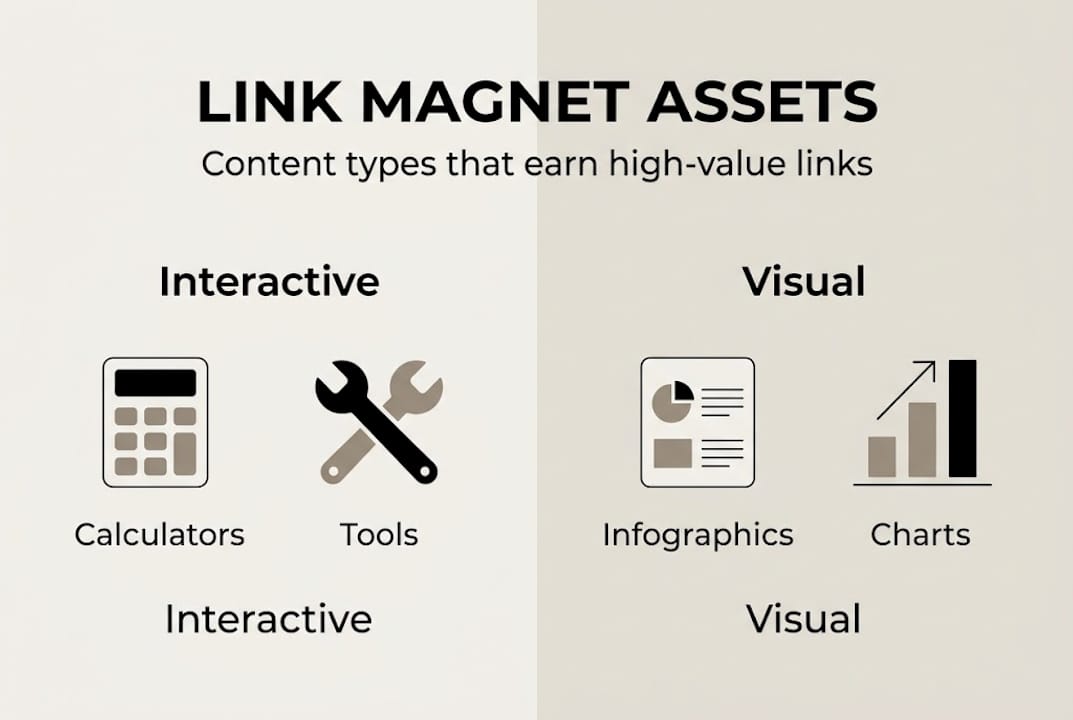
Interactive tools and visual content work because they serve a specific user need that plain text cannot. A mortgage calculator, a carbon footprint estimator, or an industry salary comparison tool earns links passively. People find it useful and cite it. No outreach required for the second and third wave of links.
Infographics and interactive tools generate ongoing backlinks, and 53% of SEOs actively use infographics as part of their link acquisition strategy. That adoption rate is high for a good reason: visual content is easier to embed, share, and reference than a wall of text.
“The best link magnets solve a problem or answer a question in a format that is impossible to ignore. Text can be paraphrased. A well-designed tool or chart gets cited directly.”
Types of link magnets worth building in 2026:
- Interactive calculators (ROI estimators, cost comparison tools)
- Original data visualizations (industry trend maps, survey result dashboards)
- Quizzes and diagnostic tools (“What SEO score does your site get?”)
- Shareable infographics (step-by-step processes, statistical breakdowns)
- Curated resource libraries (organized collections of tools or studies)
For a deeper look at how SaaS companies use this approach, see advanced SaaS link acquisition. The same principles apply across industries. Check out link building best practices to see how these assets fit into a broader strategy.
Building one strong interactive tool takes time and budget. But it can earn links for years without ongoing outreach investment. That is a compounding return most paid tactics cannot match.
Evolving the skyscraper technique: Beyond generic content
With content-driven attraction established, it is vital to evolve classic tactics like the skyscraper strategy to keep pace with the changing landscape.
The original skyscraper technique is simple: find popular content in your niche, create something better, and pitch it to everyone linking to the original. It worked brilliantly for years. Now, it is overcrowded. Skyscraper technique effectiveness dropped to 6.2% in 2024, and the reason is obvious. When everyone copies the same approach, it stops being special.
The evolved version requires three upgrades: original data, expert-driven insights, and a better user experience.
Here is a modern skyscraper approach that works:
- Find content with strong backlink counts but dated information. Identify gaps in accuracy, depth, or format.
- Conduct original research. Run a survey, analyze proprietary data, or interview five to ten industry experts. This gives your content something the original never had.
- Bring in named expert opinions. A quote from a recognized figure in your industry makes your content authoritative in a way AI-generated content cannot fake.
- Redesign for readability and interaction. Add embedded tools, comparison tables, or visual summaries that make the content genuinely more useful.
- Reach out with a specific reason. Tell linking sites exactly what is new and better, not just that you made something longer.
Pro Tip: Embed a short original survey or case study inside the content. Sites that cite primary research are far more likely to earn editorial links from journalists and academics.
For context on how AI content and SEO interact, understanding Google’s stance helps you make smarter decisions about when original human research is non-negotiable.
Our perspective: What most SEOs still get wrong about advanced link building
Having explored the top tactics, let us challenge some misconceptions.
Most SEO teams fail with advanced link building not because they lack tools or tactics, but because they treat outreach as a numbers game and content creation as a box to check. Send enough emails. Publish enough posts. Eventually something sticks. That mindset produces mediocre results at scale.
The uncomfortable truth is that the best backlinks we have ever seen earned came from genuine relationships, genuinely interesting content, or genuinely useful tools. Not from clever templates or automation sequences. Automation can support scale. It cannot replace the substance that makes someone want to link to you.
We also see teams rush to advanced tactics without fixing their foundation first. Fancy digital PR campaigns built on thin site authority rarely get the coverage they deserve. Sequence matters.
For real long-term wins, focus on creating content worth citing and being the kind of contact worth responding to. Start with building a modern backlink strategy as your operational backbone, then layer in digital PR and interactive content. Trust earns links. Tricks earn noise.
Scale your advanced link building with expert support
Ready to take action? Implementing these tactics requires time, expertise, and systems that many in-house teams struggle to maintain consistently. Our comprehensive SEO strategy guide gives you a structured roadmap for integrating advanced link building into your broader SEO program. And if you are looking for a team that manages end-to-end SEO campaigns for business growth, we work with small to mid-sized businesses to build authority, earn quality links, and drive measurable ranking improvements without shortcuts that put your site at risk.
Frequently asked questions
What is the single most effective advanced link building tactic in 2026?
Digital PR is the top strategy, with nearly half of SEO experts rating it above all other advanced link building tactics, including guest posting.
How can outreach personalization improve link building results?
Personalized, segmented outreach increases response rates significantly, especially when your first message offers something specific and valuable to the recipient rather than a generic pitch.
Do infographics and interactive tools actually help earn more links?
Yes. 53% of SEOs use infographics as active link magnets, and interactive tools generate passive backlinks over time because users embed and cite them repeatedly.
Is the skyscraper technique still effective in 2026?
Standard skyscraper methods have lost their edge, with effectiveness falling to 6.2% in 2024. Success now depends on original research, expert insights, and a stronger user experience than the content you are improving upon.
Recommended