






TL;DR:
- Startup funding provides capital for product development, hiring, and operations until businesses generate revenue. It moves through stages like pre-seed, seed, and Series A, each demanding specific proof levels to attract appropriate investors. Proper preparation, including building a detailed data room and timing funding rounds to milestones, significantly enhances the chances of success.
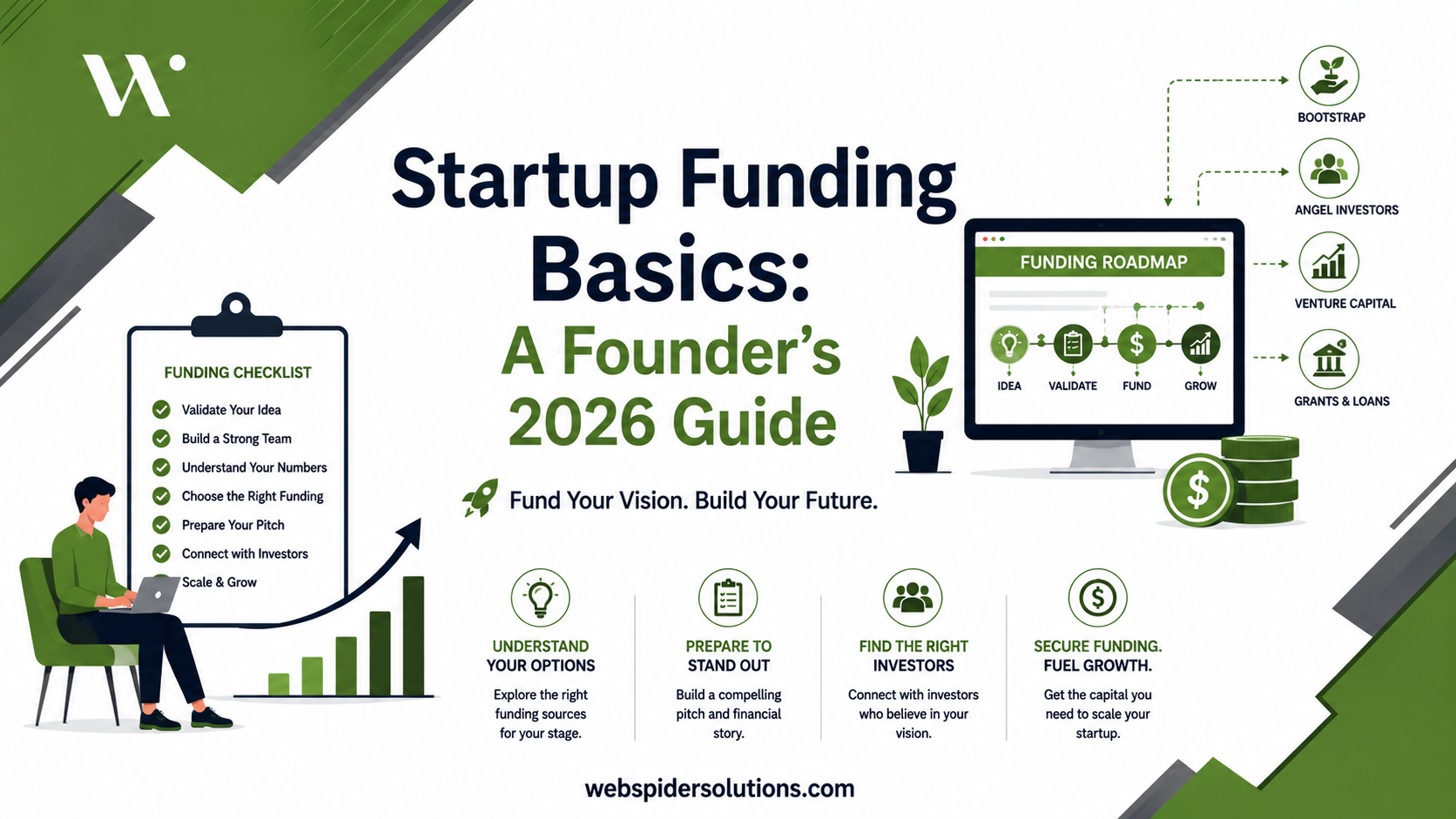
Startup funding is the capital that covers product development, hiring, and operations until your business generates its own revenue. According to Carta, startup capital turns an idea into a working business. Most founders encounter three core financing paths: bootstrapping, debt, and equity. Resources like Crunchbase, the Small Business Administration (SBA), and Carta track how billions move through these channels every year. Understanding startup funding basics before you approach a single investor separates founders who close rounds from those who stall out.
1. what are the main startup funding stages?
Startup financing follows a defined sequence, and knowing where you sit in that sequence determines how much you can raise and from whom. Funding rounds progress from pre-seed through seed and into Series A and beyond, each tied to specific proof levels.
- Pre-seed ($50K–$2M): You are validating the concept. Investors at this stage are typically friends, family, or early angel investors. The goal is building a prototype or landing your first paying users.
- Seed ($500K–$5M): You have early traction and are working toward product-market fit. Seed investors want to see real users, early revenue signals, or a clear path to both.
- Series A ($5M–$20M): You have proven the model and need capital to scale. Venture capital firms dominate this stage, and they expect repeatable growth metrics.
Fundraising timelines range from 1–6 months for pre-seed, 2–6 months for seed, and 4–8 months for Series A, with 12–24 months typically passing between rounds. That gap matters. You need enough runway from each round to hit the milestones that justify the next one.
Pro Tip: Start your next fundraise six months before you expect to run out of money. Investors take longer than founders expect, and running a process under cash pressure destroys your negotiating position.
2. bootstrapping vs. debt vs. equity financing
The three core startup financing options each carry distinct tradeoffs on ownership, control, and risk. Choosing the wrong one for your stage can cost you either your company or your momentum.
| Financing Type | Ownership Impact | Repayment Required | Best Fit |
|---|---|---|---|
| Bootstrapping | None | No | Founders with personal savings or early revenue |
| Debt Financing | None | Yes, with interest | Startups with predictable cash flow |
| Equity Financing | Dilutes ownership | No | High-growth startups needing large capital |
Bootstrapping uses your own savings or early customer revenue. You keep full control, but growth is limited by what you can generate internally. Many SaaS founders bootstrap through their first $1M in annual recurring revenue before raising outside capital.
Debt financing means borrowing money you must repay with interest. It does not dilute your ownership, but it creates fixed obligations regardless of how the business performs. This path suits startups with predictable revenue, not pre-revenue companies.

Equity financing trades a percentage of your company for capital. You give up some control, but you gain a partner with a financial incentive to help you succeed. Venture capital firms like Andreessen Horowitz and Sequoia Capital operate exclusively in this space.
Pro Tip: Equity is not free money. Every percentage point you give away in an early round compounds across future rounds. Model your cap table before you sign a term sheet.
3. how government programs and SBA loans support founders
Many founders assume federal grants exist for startups. They do not. The federal government offers no direct startup grants, but the SBA provides loan programs, free counseling, and local support networks that are genuinely useful.
The SBA 7(a) loan program is the most relevant option for early-stage founders. Here is how to approach it:
- Confirm eligibility. The SBA 7(a) program lends up to $5 million to qualifying small businesses. Lenders assess your ability to repay, your personal credit history, and whether you have invested your own equity into the business.
- Prepare your documentation. Approval is largely a packaging problem. You need financial projections, evidence of demand, collateral if available, and proof of owner equity injection. Weak documentation is the most common reason applications stall.
- Use SBA training resources. The SBA offers free online courses and connects founders with local Small Business Development Centers (SBDCs) and SCORE mentors. These resources help you build a credible loan application before you walk into a lender’s office.
- Set realistic expectations. SBA loans take weeks to process, sometimes months. Plan your timeline accordingly and do not treat an SBA loan as emergency capital.
The SBA path works best for founders who need working capital but want to avoid equity dilution. It is not a fit for pre-revenue startups with no financial history.
4. strategies that boost your fundraising success rate
Most founders treat fundraising as storytelling. Investors treat it as evidence review. Investors fund demonstrated outputs, including prototypes, active users, and early revenue. Pitching future plans without showing prior progress stalls rounds.
The most effective preparation steps before you start outreach:
- Build a data room first. A prepared data room with your financial snapshot, cap table, traction metrics, and KPIs lets you run parallel investor conversations without losing momentum. Founders who scramble to produce documents mid-process lose weeks.
- Translate milestones into investor language. “We built a product” is not a milestone. “We reached $15,000 in monthly recurring revenue with 40% month-over-month growth” is. Investors think in numbers, not narratives.
- Manage your pipeline like a sales process. Track every investor conversation in a CRM tool like Notion, Airtable, or HubSpot. Know where each conversation stands and follow up on a schedule.
- Align your ask with your stage. Raising too early or too late for your current proof level reduces your probability of closing. A pre-seed ask with no prototype signals poor judgment. A seed ask with $500K in revenue signals you waited too long.
“Fundraising is not a pitch competition. It is a due diligence process where your job is to reduce investor risk at every step.” — Startup Science
Good financial planning for startups before you raise makes every investor conversation sharper and shorter.
5. angel investors vs. venture capital: key differences
Angel investors and venture capital firms both provide equity financing, but they operate at different stages and with different expectations. Knowing which one fits your situation saves you months of misdirected outreach.
| Factor | Angel Investors | Venture Capital Firms |
|---|---|---|
| Typical Stage | Pre-seed to seed | Seed to Series A and beyond |
| Check Size | $10K–$250K | $500K–$20M+ |
| Decision Speed | Fast (weeks) | Slow (months) |
| Involvement | Varies, often advisory | Board seats, governance rights |
| Source of Capital | Personal wealth | Institutional fund |
Angel investors are individuals investing their own money. They move faster, take more risk, and often bring domain expertise or network access that matters more than the check. Networks like AngelList and platforms like Wefunder connect founders with angel investors at scale.
Venture capital firms manage pooled institutional money and answer to their own investors, called limited partners. They need larger returns, which means they favor startups with the potential to reach $100M or more in revenue. If your startup is a lifestyle business or a slow-growth service company, VC is the wrong fit.
The right choice depends on your growth ambitions, your current traction, and how much ownership you are willing to share. Most founders benefit from angel capital first, then graduate to VC once they have the metrics to justify a larger round.
6. how to choose the right funding path for your startup
The best funding path is the one that matches your current stage, your capital needs, and how much control you want to keep. There is no universal answer, but there are clear patterns.
Founders with strong personal savings and a product that can generate early revenue should bootstrap as long as possible. Every month you delay outside investment is a month you retain full ownership. Founders building capital-intensive hardware, biotech, or infrastructure products cannot bootstrap past early prototypes. They need equity capital early and should target angel investors or seed-stage VC funds.
Founders with a working product and some revenue but not enough for VC should explore SBA loans or revenue-based financing. These options provide growth capital without dilution. Explore startup funding options that match your specific stage before committing to any single path.
The most common mistake is raising equity capital too early, at too low a valuation, and giving away too much of the company before you have leverage. Validate your model first. Then raise.
Key takeaways
Successful startup fundraising requires matching your financing type and timing to your current proof level, not your future ambitions.
| Point | Details |
|---|---|
| Know your funding stage | Pre-seed, seed, and Series A each require different proof levels and attract different investors. |
| Choose financing type carefully | Bootstrapping preserves control; equity dilutes ownership; debt requires repayment regardless of performance. |
| SBA loans fill a real gap | The SBA 7(a) program lends up to $5 million but requires strong documentation and owner equity. |
| Build your data room early | Prepared financials and KPIs let you run parallel investor conversations without losing momentum. |
| Time your raise to your milestones | Raising too early or too late for your proof level reduces your probability of closing a round. |
What most funding guides get wrong
The standard advice tells founders to “tell a compelling story” and “build relationships with investors.” That advice is not wrong, but it misses the harder truth I have seen play out repeatedly when working with early-stage companies on their digital presence and growth strategy.
Investors do not fund stories. They fund evidence. The founders who close rounds fastest are the ones who show up with a data room already built, a cap table that makes sense, and traction numbers that speak for themselves. The story is just packaging around the proof.
The second thing most guides skip is the cost of premature equity. Founders who raise a $500K seed round at a $2M valuation before they have real traction often regret it by Series A. That early dilution compounds. A founder who bootstrapped to $50K in monthly recurring revenue before raising typically commands a valuation three to five times higher and gives up far less of the company.
The third overlooked step is the connection between funding and marketing. Securing capital is only half the equation. The startups that scale after funding are the ones that deploy their marketing budget with the same discipline they used to raise it. That means tracking customer acquisition cost from day one, not after you have burned through half your runway.
— webspider
Grow your startup after funding with smart digital marketing
Securing capital is the starting line, not the finish line. Once your funding is in place, your next priority is turning that capital into customers. Webspidersolutions works with funded startups and growth-stage companies to build the digital presence that converts marketing spend into measurable revenue. From SEO campaigns that drive organic traffic to paid advertising strategies that generate qualified leads, Webspidersolutions helps you deploy your marketing budget with precision. If you are ready to make your post-funding growth strategy as strong as your fundraising strategy, Webspidersolutions is the partner built for that work.
FAQ
What is startup funding, exactly?
Startup funding is capital raised to cover product development, hiring, and operations before a business generates sufficient revenue on its own. It comes from sources including personal savings, angel investors, venture capital firms, and SBA loans.
How much can i raise at the seed stage?
Seed rounds typically range from $500K to $5M, depending on your traction, market size, and investor expectations. Founders with stronger proof of product-market fit command higher valuations and raise larger amounts.
Do federal grants exist for startups?
No federal grants are specifically available for startups. The SBA offers loan programs and free counseling through SBDCs and SCORE, but direct grant funding from the federal government does not exist for most commercial startups.
When should i approach venture capital firms?
Approach VC firms when you have repeatable revenue growth and a clear path to scaling. Most VC firms focus on Series A rounds of $5M or more and expect founders to show validated product-market fit before engaging seriously.
What is a data room and why does it matter?
A data room is a collection of key documents including your financials, cap table, KPIs, and traction evidence that investors review during due diligence. Building it before outreach lets you run multiple investor conversations simultaneously and close rounds faster.