






TL;DR:
- Effective brand reputation management is an ongoing, cross-functional effort that builds stakeholder trust and protects your company before crises arise.
- Reputation reflects external perceptions influenced by interactions and external signals, while brand is the intentional identity you project; addressing only one leaves gaps.
Your brand reputation is not just a PR concern — it is a revenue driver. In competitive B2B sectors, a single procurement decision can hinge on what a prospect finds when they search your company name. Yet most marketing managers only activate their brand reputation management guide when something goes wrong, and by then the damage is already spreading. Reputation management should be ongoing and organization-wide, not a crisis-only response. This guide gives you a practical, proactive framework to assess, protect, and build your brand’s standing before the next challenge arrives.
Table of Contents
- Understanding brand reputation versus brand identity
- Preparing your organization for proactive reputation management
- Executing effective online reputation management for B2B brands
- Defending your brand against modern disinformation and AI-driven risks
- Verifying impact and continuous improvement in brand reputation management
- Why proactive, cross-functional brand reputation management is your competitive advantage
- How Web Spider Solutions supports your brand reputation management goals
- Frequently asked questions
Understanding brand reputation versus brand identity
Before you can manage something effectively, you need to know exactly what you are managing. Brand and reputation are not the same thing, and confusing them is one of the most expensive mistakes a B2B marketing manager can make.
Your brand is the identity your company intentionally projects: your messaging, visual language, positioning, and value proposition. Your reputation, on the other hand, is what stakeholders actually believe about you based on their interactions, what they read, and what colleagues tell them. As Gartner explains, brand is about identity and positioning, while reputation is the collective stakeholder perception influenced by interactions and external factors.
Here is why that distinction matters in practice. If your brand says “trusted partner for enterprise compliance,” but your clients consistently tell peers that your onboarding is chaotic, no amount of brand messaging will fix the reputational gap. You need to address the actual experience, not just the story you are telling.
The brand reputation management basics that work start with acknowledging that reputation is shaped by forces largely outside your direct control:
- Customer and partner reviews on platforms like G2, Clutch, or Trustpilot
- Media coverage, both earned and syndicated
- Word-of-mouth in industry communities and LinkedIn conversations
- Employee sentiment on Glassdoor and similar platforms
- Search engine results for your brand name, key products, and leadership
Understanding reputation management explained this way helps you see that brand image improvement alone (updating your website, refreshing your tagline) cannot substitute for reputational work. You need both, but they require different strategies and different metrics.
Preparing your organization for proactive reputation management
Most B2B companies treat reputation management as a marketing function. That is a structural mistake. One team ownership is usually the wrong model because reputation cuts across every customer touchpoint, from a sales call to a support ticket to a press release.
Effective managing online reputation requires cross-functional ownership. Here is how to build that structure without creating a bureaucratic nightmare:
- Marketing owns narrative, content, and review generation programs
- Communications handles media relationships and crisis response drafts
- Legal reviews sensitive responses and monitors for defamation or trademark issues
- Customer success surfaces feedback trends and flags emerging complaints
- Leadership provides executive visibility and buy-in to resource the program
Before any crisis emerges, build these three foundations:
- A messaging matrix that pre-approves language for common scenarios (negative review, executive scandal, product failure)
- An escalation workflow with clear decision rights: who can approve a public response, who escalates to legal, and how fast
- A monthly reputation review cadence where stakeholders share signals from their channels
The goal of getting brand reputation management services right is not perfection. It is speed and consistency. When a negative story breaks, the companies that respond within hours with a coherent, human message almost always recover faster than those waiting for a committee to draft the perfect reply.
Pro Tip: Run a tabletop simulation once a year. Pick a realistic reputation scenario, walk each function through it, and identify where your workflows break. You will find gaps before a real crisis does.

Executing effective online reputation management for B2B brands
Now comes the operational layer. A practical online audit is the first step in any online reputation management packages program. As the step-by-step online reputation guide confirms, you start with a thorough search audit, then proceed to removals, edits, SEO content, and continuous monitoring.
Here is how to execute that process:
- Run a brand audit. Search your company name, product names, key executives, and common misspellings in incognito mode. Document every result on the first two pages.
- Categorize what you find. Label each result positive, neutral, or negative. Note which ones you own and which you do not.
- Request removal where eligible. Outdated negative press releases, factually incorrect content, or fake reviews may qualify for removal under platform policies.
- Publish authoritative content. For every negative result you cannot remove, the goal is to outrank it with stronger, more relevant content: case studies, executive bylines, industry reports, and press releases.
- Set up continuous monitoring. Use Google Alerts for your brand name and key executives at minimum. More serious reputation management services include social listening dashboards that track sentiment in real time.
Quick fix vs. long-term reputation approach:
| Approach | Speed | Cost | Durability | Best used for |
|---|---|---|---|---|
| Content removal requests | Fast (days to weeks) | Low | High if successful | Fake reviews, outdated content |
| Social media response | Immediate | Low | Medium | Public complaints, real-time issues |
| Review generation program | Weeks to months | Low to medium | High | Low review volume, skewed sentiment |
| SEO content publishing | Months | Medium to high | Very high | Persistent negative rankings |
| PR and media outreach | Weeks | Medium to high | Medium to high | Brand narrative reshaping |
The most common mistake in online reputation management tips is treating SEO as a separate initiative. Positive content that ranks well IS reputation management. A thoughtfully written case study that appears on page one for your company name is doing more reputation work than any press release.
Pro Tip: When asking clients for reviews, time the request to follow a success milestone in their project, not just at contract renewal. Reviews written after a concrete win are longer, more specific, and more credible to future buyers.
Defending your brand against modern disinformation and AI-driven risks
Here is the threat that most B2B marketing managers underestimate: generative AI is making it harder for audiences to distinguish real content from fabricated content, and there is no single technology that solves this. Organizations must harden their workflows and monitor continuously for brand impersonation and misinformation.
The practical risks for B2B brands include:
- AI-generated fake reviews that mimic authentic customer language
- Deepfake executive videos used to spread false statements or scam prospects
- Brand impersonation accounts on LinkedIn and X that contact your clients or partners
- Synthetic news articles referencing your brand in false contexts
Your defense rests on three pillars:
Monitor broadly. Set up alerts not just for your brand name but for your executives’ names, your key product names, and common misspellings. Use brand reputation tools and strategies that include social listening and news monitoring.
Human-in-the-loop review. Automated monitoring flags volume anomalies and sentiment shifts, but a human must evaluate whether flagged content is genuine or synthetic. Build a weekly review process into your communications workflow.
Cross-functional incident response. When a disinformation threat is confirmed, your security team needs to know about it alongside communications and legal. The response may involve platform takedown requests, customer notifications, and coordinated media outreach simultaneously.
“The organizations that recover fastest from disinformation attacks are those that already know who does what before the incident happens.” This is the single most underinvested area in B2B reputation programs.
Pro Tip: Create a one-page “brand trust FAQ” for your sales team that addresses common false claims or misconceptions about your company. When a prospect has encountered misinformation, your rep can address it directly and confidently, turning a threat into a trust-building moment.
Verifying impact and continuous improvement in brand reputation management
Measurement is where most B2B reputation programs fall apart. Marketers default to brand awareness metrics (impressions, reach, share of voice) when the more relevant signal is stakeholder trust. As reputation success research shows, reputation is tied to stakeholder trust and sentiment analysis, not just awareness metrics.
Here is what a practical measuring brand reputation success dashboard looks like:
- Net sentiment score across review platforms (positive minus negative mentions as a percentage)
- Review platform ratings on G2, Clutch, or industry-specific directories
- Search result quality score (what percentage of page-one results are brand-owned or positive third-party)
- Stakeholder trust surveys conducted quarterly with clients, partners, and target accounts
- Share of positive earned media versus negative or neutral coverage
Brand awareness vs. reputation trust metrics:
| Metric type | Example metrics | What it tells you | Reputation relevance |
|---|---|---|---|
| Awareness | Impressions, reach, branded search volume | How many people know you exist | Low |
| Sentiment | Net sentiment score, review ratings | How people feel about you | High |
| Trust | NPS, stakeholder survey scores | Whether people recommend or rely on you | Very high |
| Search presence | Page 1 result quality, owned asset rank | What prospects see when they look | High |
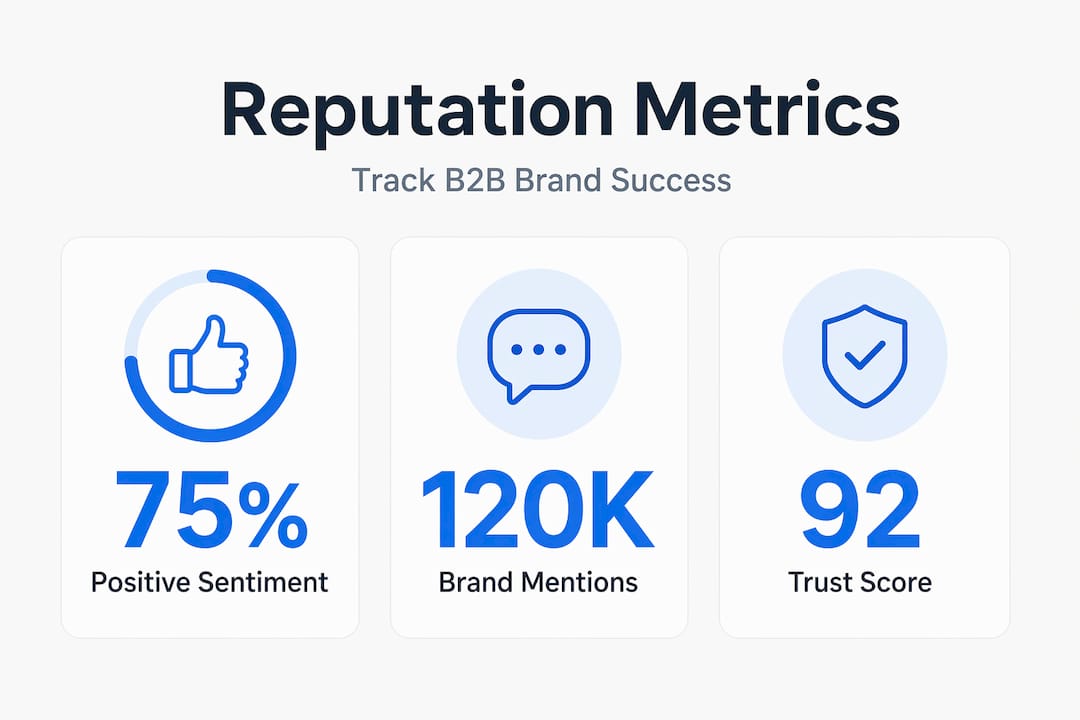
Set benchmarks aligned to your industry. A software company in a crowded SaaS vertical will have different realistic targets than a specialized logistics consultancy. The key is measuring the same metrics consistently over time and reporting on trends, not just snapshots.
Pro Tip: Include a “reputation risks” slide in your monthly marketing leadership report. List the top three emerging issues and what action is in progress. This keeps leadership engaged and creates a paper trail that demonstrates proactive management.
Why proactive, cross-functional brand reputation management is your competitive advantage
Here is the perspective most brand reputation articles skip: reputation damage is not a communications problem. It is a trust deficit that accumulated over time and finally became visible. By the time your inbox fills with alerts, you are already months behind.
The industry’s default assumption is that PR can solve reputation problems. It cannot. Confusing brand-image work with reputation work leads to misallocated resources and real gaps in stakeholder trust. Refreshing your messaging while clients are having poor experiences does not repair anything. It makes the gap more visible.
What actually works is treating brand and reputation management nuances as two distinct, parallel programs. Your brand team works on identity and positioning. Your reputation program works on stakeholder trust, external signals, and cross-functional experience delivery. They inform each other, but they do not replace each other.
The competitive advantage for B2B companies in crowded sectors is this: most of your competitors are reactive. They manage reputation when it hurts. You can build a measurable, documented, proactive reputation program that makes you structurally harder to damage. When a disgruntled ex-customer posts a negative review, you already have 40 positive ones. When a false claim circulates, you have a prepared response workflow. That kind of resilience is not visible in your marketing deck, but buyers feel it.
One more uncomfortable truth: reputation cannot be outsourced entirely. Agencies and tools help enormously, but the authentic trust signals — genuine client relationships, transparent communication, consistent follow-through — must come from inside your organization. External partners amplify what is already real. They cannot manufacture it.
How Web Spider Solutions supports your brand reputation management goals
Building and protecting your brand reputation requires consistent effort across SEO, content, social media, and monitoring — all at the same time. Web Spider Solutions’ brand reputation management service is built specifically for B2B companies in competitive sectors that need more than reactive damage control. From continuous brand audits and sentiment monitoring to online reputation management services that push authoritative content to page one, the team works across channels to protect and strengthen your standing. Paired with a tailored SEO strategy guide approach, your positive brand assets outrank the noise. If you are ready to move from reactive to proactive, this is where that work starts.
Frequently asked questions
What is the difference between brand and reputation?
Brand is how your company presents itself intentionally through identity and messaging, while reputation is the collective stakeholder perception influenced by interactions and external factors. Managing one without the other leaves significant gaps in how your market sees you.
How can a small B2B company start managing its online reputation?
Begin with a thorough online audit of your brand presence and key executive names, then systematically address negative content and build SEO-driven positive assets. The QuickSprout reputation repair playbook outlines a clear progression: audit, remove or edit, publish, and monitor continuously.
Who in the organization is responsible for reputation management?
Reputation management is genuinely organization-wide, and one-team ownership is usually ineffective. Marketing, communications, legal, customer success, and leadership all play active roles in maintaining consistent, proactive reputation strategies.
How does generative AI impact brand reputation risks?
Generative AI raises the risk of synthetic reviews, deepfake impersonations, and fabricated content that can damage your reputation before you even know it exists. Cross-functional monitoring combined with human review processes is currently the most reliable defense against these threats.
Is it possible to repair a damaged brand reputation?
Yes, but it requires transparency, consistent follow-through, and time rather than a single PR push. SEO-driven content strategies that rebuild trust through authoritative assets are among the most durable tools for long-term recovery.