






TL;DR:
- Remarketing is a comprehensive engagement system that targets prospects throughout long B2B sales cycles.
- Advanced tactics like account-based and role-specific targeting enhance remarketing effectiveness.
- Proper segmentation, content relevance, and measurement are key to maximizing ROI and overcoming common challenges.
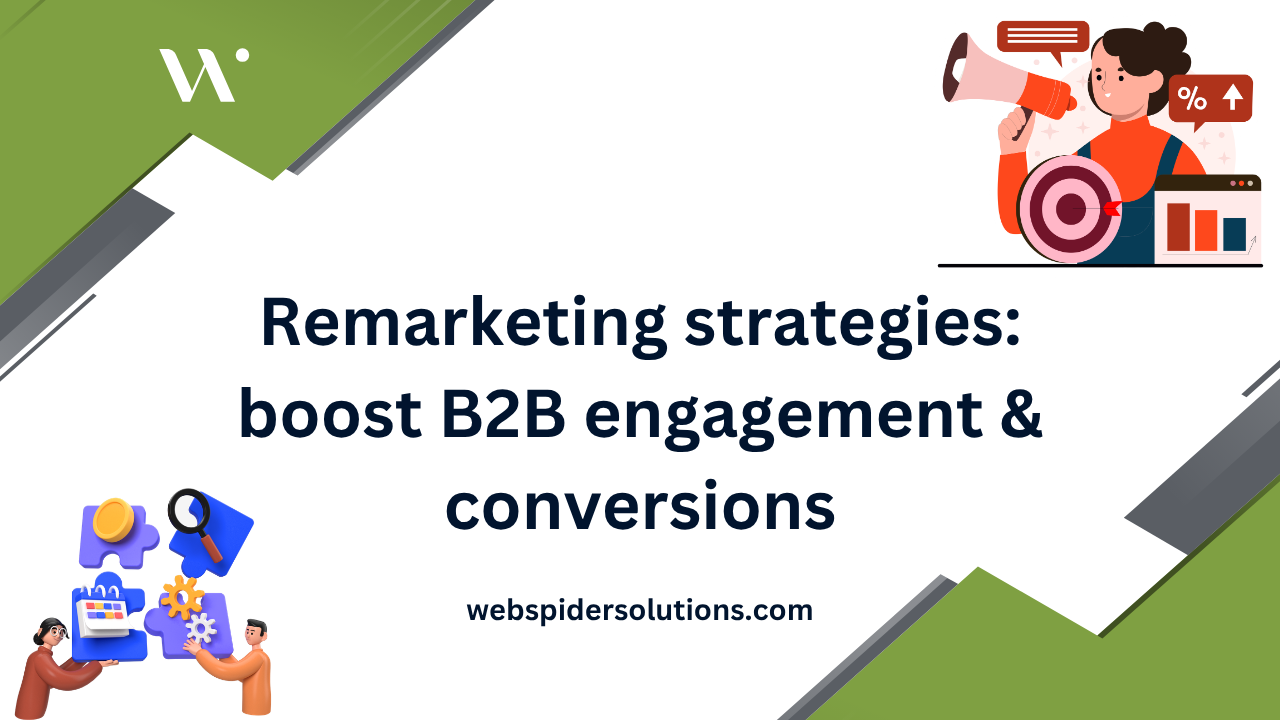
Most B2B marketers treat remarketing as a simple “show ads to past visitors” tactic. That’s a costly misunderstanding. Remarketing is a full-cycle engagement system that can re-enter conversations with prospects at every stage of a long sales cycle, not just nudge someone who browsed your pricing page. When conversion rates increase significantly through well-structured remarketing, the difference usually comes down to strategy, not budget. This article breaks down what remarketing actually is, how the mechanics work, which advanced tactics move the needle for B2B teams, and how to measure whether any of it is paying off.
Table of Contents
- What is remarketing and why does it matter?
- Core mechanics: How remarketing strategies work
- Advanced remarketing tactics for B2B success
- Navigating challenges and measuring remarketing ROI
- A fresh perspective: Moving beyond simple retargeting
- Accelerate your B2B remarketing strategy with expert support
- Frequently asked questions
Key Takeaways
| Point | Details |
|---|---|
| Remarketing defined | Remarketing is a strategic approach for re-engaging potential customers using tailored ads and content. |
| Core setup steps | Effective remarketing starts with tag installation, building audience lists, and dynamic ad feeds. |
| Advanced B2B tactics | Segmentation, cross-channel targeting, and personalized messaging drive better results in B2B remarketing. |
| Challenge navigation | Overcoming ad fatigue and privacy hurdles is key to optimizing remarketing campaigns. |
| Integrated strategies | Combining remarketing with content and sales enablement yields higher engagement and conversions. |
What is remarketing and why does it matter?
Remarketing is the practice of reconnecting with people who have already interacted with your brand, whether they visited your website, opened an email, watched a video, or used your app. It’s not a single channel or format. It’s a strategy that spans display ads, email sequences, social media, and more, all coordinated around known audience behaviors.
A lot of people use “remarketing” and “retargeting” interchangeably, but there’s a meaningful distinction. Retargeting typically refers to serving ads to users based on pixel data from website visits. Remarketing is broader. It uses tags and audience lists to re-engage potential customers across multiple touchpoints, including email, which retargeting alone doesn’t cover.
For B2B companies, this distinction matters more than it does for consumer brands. Here’s why:
- B2B sales cycles are long, often three to twelve months
- Multiple stakeholders are involved in purchase decisions
- Prospects research extensively before contacting sales
- Brand recall across channels directly influences shortlisting decisions
Remarketing gives you a structured way to stay visible and relevant throughout that entire journey. You’re not just hoping a prospect remembers you. You’re actively re-entering their consideration set with targeted, relevant content.
You can get a solid grounding in the foundational concepts through remarketing basics if you’re newer to the topic. But even experienced marketers often underestimate how much leverage proper audience segmentation adds at this stage.
“Remarketing isn’t about chasing people around the internet. It’s about being present with the right message at the right moment in a complex buying journey.”
The impact on re-engagement is measurable. Remarketed audiences consistently show higher click-through rates and lower cost-per-acquisition compared to cold audiences, because you’re not starting from zero. The relationship, however brief, already exists.
Core mechanics: How remarketing strategies work
Now that we understand what remarketing is, let’s break down how these strategies are actually implemented.
The core mechanics include installing remarketing tags, creating audience lists, and setting up dynamic feeds when relevant. Here’s how the setup process typically flows:
- Install a remarketing tag on your website. This is a small snippet of code (Google’s global site tag or a LinkedIn Insight Tag, for example) that fires when someone visits a page.
- Build audience lists based on page visits, time on site, actions taken, or CRM data. Lists can be as broad as “all visitors” or as specific as “visited pricing page but didn’t request a demo.”
- Create your ad assets, which can be static (fixed creative) or dynamic (automatically populated with product or service details based on what the user viewed).
- Set bids and frequency caps to control how often your ads appear and how much you spend per impression or click.
- Launch and monitor using conversion tracking to see which audience segments are responding.
Static remarketing works well for brand awareness and consistent messaging. Dynamic remarketing is more powerful when you have a catalog of services or products, because it personalizes the ad automatically. For most B2B companies, a hybrid approach works best.
| Feature | Static remarketing | Dynamic remarketing |
|---|---|---|
| Personalization | Low | High |
| Setup complexity | Simple | Moderate to complex |
| Best for | Brand recall | Service/product-specific follow-up |
| Creative control | Full | Partial (template-based) |
| Ideal audience size | Any | Larger lists preferred |
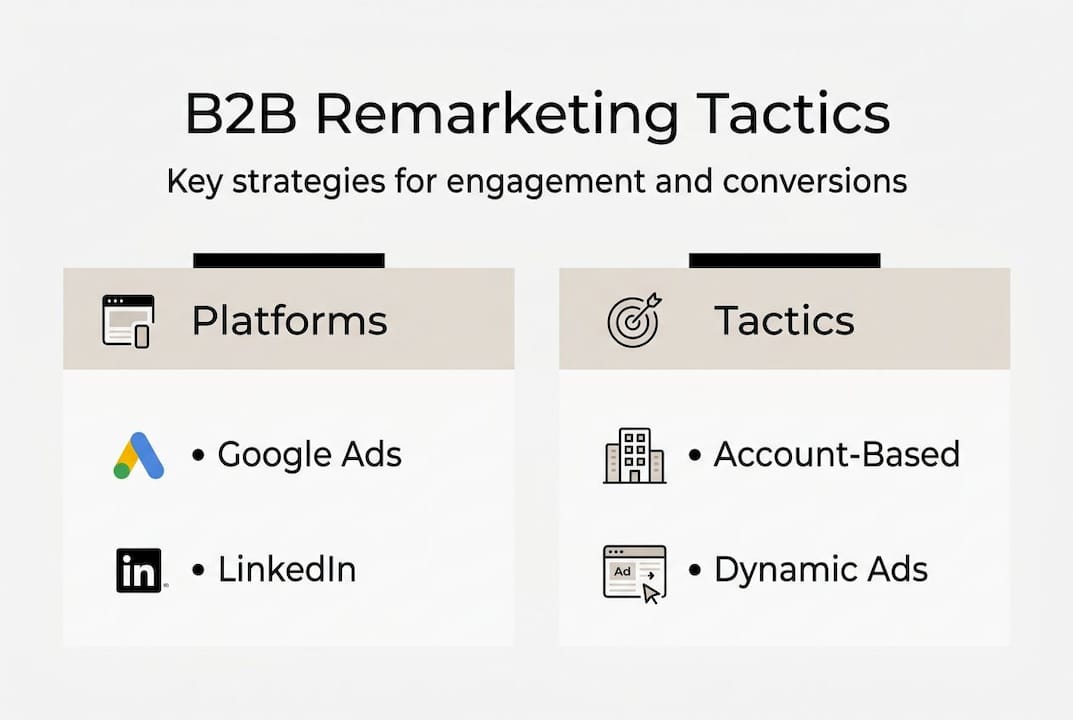
Platform choice matters too. Google Ads offers the widest reach. LinkedIn is essential for B2B because of its professional targeting filters. Amazon is increasingly relevant for B2B buyers in procurement roles. Your digital advertising strategies should dictate which platforms get priority based on where your buyers actually spend time.
Pro Tip: Segment your audience lists by funnel stage before you build a single ad. Top-funnel visitors need educational content. Bottom-funnel visitors need proof points, case studies, or direct offers. Mixing them into one list produces mediocre results across the board. Tracking performance by segment also makes tracking ROI in remarketing far more accurate.

Advanced remarketing tactics for B2B success
With the technical mechanics covered, let’s look at the tactics that actually drive B2B remarketing performance.
B2B remarketing fails when it treats all prospects the same. The most effective campaigns are built around account-level segmentation, not just individual behavior. Audience lists based on behaviors drive ad personalization, and in B2B, that means tailoring messaging to job function, company size, industry, and buying stage simultaneously.
Here are the tactics that consistently move results:
- Account-based remarketing: Upload your target account lists (from your CRM or a tool like ZoomInfo) and serve ads exclusively to people at those companies. This is high-precision and cost-efficient.
- Cross-channel sequencing: Don’t rely on a single channel. Coordinate display ads, LinkedIn sponsored content, and email nurture sequences so your prospect encounters consistent messaging across their daily digital environment.
- Role-based messaging: A CFO cares about cost justification. A VP of Operations cares about implementation risk. Serve different ad creatives to different job titles within the same target account.
- Timing alignment with sales activity: Increase ad frequency when a deal is in active negotiation. This keeps your brand top-of-mind during the final decision window.
| Tactic | Primary benefit | Expected outcome |
|---|---|---|
| Account-based remarketing | Precision targeting | Higher quality leads |
| Cross-channel sequencing | Consistent brand exposure | Shorter sales cycles |
| Role-based messaging | Relevance to decision-makers | Higher engagement rates |
| Timing alignment | Supports active deals | Improved close rates |
For companies exploring B2B remarketing on Amazon, the platform’s DSP (demand-side platform) allows you to reach procurement and operations buyers who are actively researching solutions. It’s an underused channel in B2B remarketing that deserves more attention.
Pro Tip: Build a separate audience segment for decision-makers who visited your case studies or testimonials pages. These are high-intent signals. Serve them personalized ads featuring a specific client outcome relevant to their industry. You can find real-world B2B remarketing examples that show exactly how this plays out in practice.
Navigating challenges and measuring remarketing ROI
Even effective remarketing strategies face obstacles, so understanding challenges and how to measure ROI is essential.
The three most common problems B2B marketers run into are ad fatigue, privacy compliance, and poor list quality. Each one quietly erodes campaign performance if left unaddressed.
- Ad fatigue happens when the same audience sees the same creative too often. Engagement drops, and worse, brand perception can suffer. Rotate creatives every two to three weeks and set impression frequency caps.
- Privacy compliance is a growing concern. With GDPR, CCPA, and evolving cookie deprecation timelines, your remarketing tags and audience lists must be set up with proper consent mechanisms. First-party data strategies are now essential, not optional.
- List quality is often overlooked. A list full of one-time visitors who bounced in three seconds isn’t worth targeting. Filter for minimum time-on-site or specific page visits to ensure your lists reflect genuine interest.
Addressing these issues is part of managing digital marketing challenges that every B2B team faces as campaigns scale.
Measuring ROI accurately requires more than just click-through rates. Focus on these metrics:
- Conversion rate by audience segment
- Cost per acquisition compared to non-remarketed campaigns
- View-through conversions (prospects who saw your ad and later converted without clicking)
- Incremental lift (the additional conversions directly attributable to remarketing exposure)
Incrementality testing is the gold standard. Run a holdout group that doesn’t see your remarketing ads, then compare conversion rates between the exposed and holdout groups. The difference is your true lift. This approach to measuring digital ROI removes attribution bias that inflates results in standard last-click models.
Stat callout: B2B companies that implement structured remarketing with proper audience segmentation report up to 70% lower cost-per-lead compared to cold acquisition campaigns, according to industry benchmarks.
Pro Tip: Don’t ignore view-through conversions in your reporting. B2B buyers rarely click ads during active research. They see your ad, remember your brand, and convert later through a direct visit or organic search. Excluding view-through data significantly undervalues your remarketing investment.
A fresh perspective: Moving beyond simple retargeting
Here’s what most B2B marketers miss: remarketing only works as well as the content and conversations surrounding it. Running ads at people who visited your website is not a strategy. It’s a tactic without a foundation.
The companies getting the highest lifetime value from remarketing are the ones treating it as one layer of an integrated digital advertising system. Their ads connect to relevant content. Their email sequences reinforce the same message. Their sales team follows up with context about what the prospect engaged with. Everything is coordinated.
B2B audiences are sophisticated. They don’t want reminders. They want relevance. A decision-maker who read your whitepaper on supply chain risk doesn’t need a generic “Learn more about us” banner. They need a case study from a company in their industry that solved the exact problem they’re researching.
The shift from repetition to relevance is where most B2B remarketing programs leave serious revenue on the table. Invest in the content and segmentation infrastructure first. The ads will perform dramatically better as a result.
Accelerate your B2B remarketing strategy with expert support
Ready to take your remarketing strategy further? Here’s how Web Spider Solutions can help.
If this article clarified the gap between where your remarketing program is and where it could be, the next step is getting the right support in place. Our team works with B2B companies to build paid advertising systems that combine precise audience segmentation, multi-channel coordination, and ROI-focused measurement. Start by exploring our PPC advertising guide to see how paid channels fit into a broader strategy, then review the PPC benefits that apply directly to B2B remarketing goals. When you’re ready to talk specifics, our digital marketing support team is available for a tailored consultation that maps your current setup to a higher-performance outcome.
Frequently asked questions
How does remarketing differ from retargeting?
Remarketing re-engages customers across multiple channels including email and display using audience lists and behavioral data, while retargeting typically focuses on serving ads based on website pixel data alone. The tags and audience lists used in remarketing enable broader, more flexible engagement.
Which platforms are best for B2B remarketing?
Google Ads, LinkedIn, and Amazon are the strongest platforms for B2B remarketing because they offer professional targeting filters and robust audience tools. The remarketing tags and dynamic feeds available on these platforms support both awareness and conversion goals.
What metrics should I track to measure remarketing ROI?
Conversion rate by segment, cost per acquisition, view-through conversions, and incremental lift give the most accurate picture of remarketing ROI. Accurate measurement depends on properly configured tags and audience lists from the start.
How can I reduce ad fatigue in remarketing?
Rotate ad creatives every two to three weeks and set impression frequency caps to limit overexposure. Behavior-based audience lists also allow you to serve fresher, more relevant ads as prospects move through the buying cycle.
Recommended