






Most marketing budgets carry a quiet fear: you spend, you wait, and you hope. Traditional display advertising charges you for impressions whether anyone clicks, converts, or even notices your ad. For small and medium-sized businesses operating in competitive industries, that uncertainty is not just frustrating—it’s a real financial risk. Performance marketing flips that dynamic entirely. Instead of paying for exposure, you pay only when something measurable happens. That shift in accountability changes everything about how you plan, spend, and grow.
Table of Contents
- Defining performance marketing
- How performance marketing works
- Major channels for performance marketing
- Performance marketing metrics and industry benchmarks
- Performance vs brand marketing: Which drives real growth?
- Action plan: Getting started with performance marketing
- Drive business growth with expert performance marketing solutions
- Frequently asked questions
Key Takeaways
| Point | Details |
|---|---|
| Results-focused approach | Performance marketing lets you pay only for actions that matter, making each dollar count toward leads or sales. |
| Trackable and measurable | You can monitor every campaign in real time, so you always know your ROI and can optimize quickly. |
| Choose the right channels | Paid search and social ads deliver fast results for SMBs—start with these before expanding. |
| Combine brand and performance | Balanced marketing strategies outperform pure performance by building both trust and immediate results. |
| Begin with smart setup | Fix tracking and analytics first to avoid common mistakes and get more from your ad spend. |
Defining performance marketing
At its core, performance marketing is a results-driven digital advertising model where advertisers pay only for specific, measurable actions. Those actions can be clicks (cost per click, or CPC), leads (cost per lead, or CPL), sales (cost per acquisition, or CPA), or app installs (cost per install, or CPI). You define the outcome you want, and you only pay when that outcome is delivered.
This is fundamentally different from traditional digital advertising, where you buy impressions or reach and hope the audience responds. With performance marketing, the financial risk shifts from you to the publisher or partner running the ad. If the ad does not produce the agreed action, you do not pay.
For SMBs with tight budgets and real pressure to show direct business value, this model is a natural fit. Every dollar spent is tied to a real outcome. That makes tracking ROI far more straightforward than trying to attribute brand awareness campaigns to actual revenue.
“Performance marketing ensures that every dollar you spend is accountable to a specific business result—not just visibility.”
The key principles are simple: set a measurable goal, run targeted campaigns, pay only for results, and optimize based on data. That loop is what separates performance marketing from guesswork.
How performance marketing works
Understanding the mechanics helps you run better campaigns. The performance marketing lifecycle involves setting clear goals, launching targeted campaigns with tracking, real-time monitoring of KPIs, and continuous optimization. Here is how that plays out in practice:
- Set your goal. Decide what action matters most—a form submission, a phone call, a product purchase, or a free trial signup. This single decision shapes every other choice in your campaign.
- Build your tracking infrastructure. Install conversion pixels on your website, set up UTM parameters on all ad URLs, and connect your CRM if you are tracking leads. Without clean tracking, you are flying blind.
- Launch targeted campaigns. Use audience data, keyword intent, and demographic filters to reach people most likely to take your desired action. Broad targeting wastes budget fast.
- Monitor KPIs in real time. Watch conversion rate, cost per lead, return on ad spend (ROAS), and click-through rate (CTR) daily, especially in the first two weeks.
- Optimize continuously. Run A/B tests on ad copy and landing pages, adjust bids based on performance data, and cut underperforming audience segments quickly.
Pro Tip: Before you spend a single dollar on ads, test your landing page conversion rate with organic or direct traffic. If your page converts below 2%, fix it first. Sending paid traffic to a weak page is the fastest way to burn budget.
When creating effective ad campaigns, the setup phase is where most SMBs either win or lose. Campaigns built on solid tracking and clear goals outperform rushed launches every time.
Major channels for performance marketing
Not every channel works equally well for every business. The right mix depends on your industry, audience, and budget. Key channels include paid search (Google Ads/SEM), social media ads (Meta/Facebook), affiliate marketing, display and native advertising, and programmatic buying.
Here is a quick breakdown of what each channel does best for SMBs:
- Paid search (Google Ads): Captures high-intent buyers actively searching for your product or service. Best for competitive industries where purchase intent is clear.
- Social media ads (Meta, LinkedIn, TikTok): Builds brand visibility and drives direct response. Strong for B2C and B2B lead generation.
- Affiliate marketing: Partners promote your offer and earn a commission per sale or lead. Low upfront risk, but requires strong offer economics.
- Native advertising: Ads that match the look and feel of editorial content. Works well for content-driven funnels and awareness at scale.
- Programmatic buying: Automated, data-driven ad placement across thousands of sites. Adds scale and precision but requires more budget to optimize effectively.
| Channel | Best for | Avg. cost model | SMB fit |
|---|---|---|---|
| Paid search | High-intent buyers | CPC | Excellent |
| Social ads | Awareness + leads | CPM/CPC | Strong |
| Affiliate | Sales at scale | CPA | Moderate |
| Native ads | Content funnels | CPM/CPC | Moderate |
| Programmatic | Scale + targeting | CPM | Advanced |
For most SMBs starting out, paid search delivers the fastest measurable results. Reviewing PPC best practices before launching helps you avoid the most common budget mistakes. Once you understand how PPC advertising works, you can layer in social ads to build a full-funnel approach. The PPC benefits for growth are well-documented, especially for businesses in competitive local or national markets.

Performance marketing metrics and industry benchmarks
Knowing what good looks like is half the battle. Without benchmarks, you cannot tell if your campaigns are performing or just spending. SMB paid search benchmarks for 2026 show an average CPC of $5.25 across industries, with legal and home services pushing $8.50 or higher. Average CTR sits at 6.7%, conversion rate at 7.5%, and CPL averages $70 overall, rising to $120 to $150 in legal services. For social ads, CPC runs $0.80 to $1.50 with CTR between 1% and 1.5%.
| Metric | Paid search avg. | Social ads avg. | Legal/home services |
|---|---|---|---|
| CPC | $5.25 | $0.80 to $1.50 | $8.50+ |
| CTR | 6.7% | 1% to 1.5% | Varies |
| Conversion rate | 7.5% | 2% to 4% | 5% to 8% |
| CPL | $70 | $30 to $60 | $120 to $150 |
| ROAS target | 3x+ | 2x to 3x | 2.5x to 3.8x |
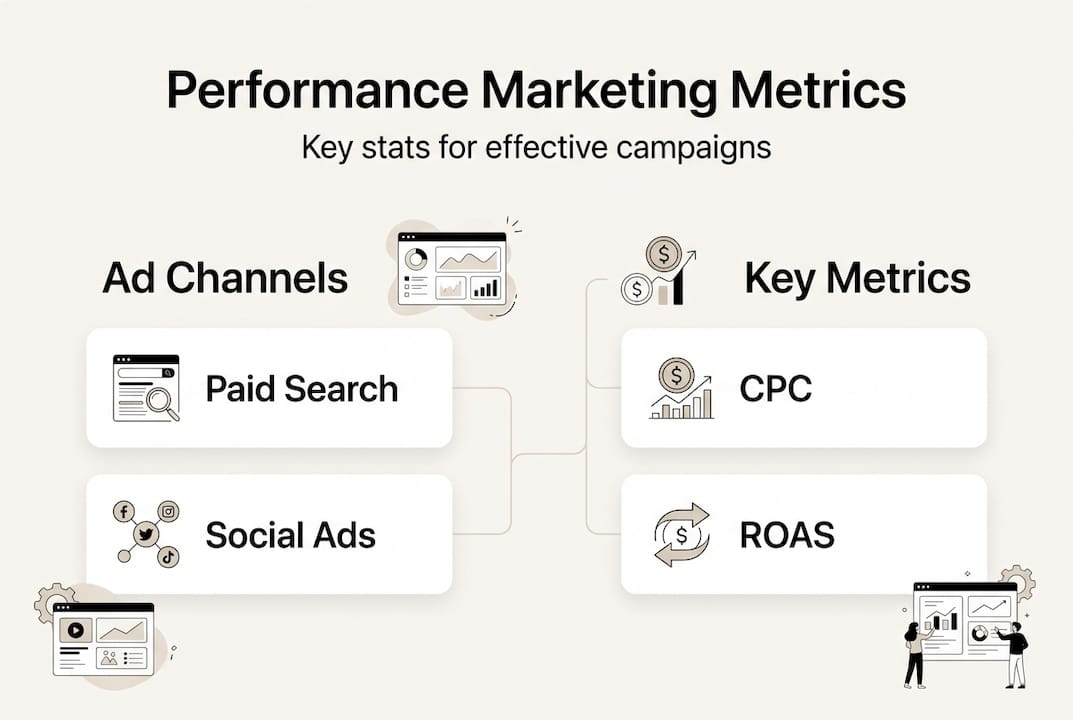
A good ROAS target for most SMBs is 3x or higher on Google Ads. If you are running low-budget campaigns, aim for 2.5x to 3.8x as a realistic starting range.
Pro Tip: Do not benchmark your campaigns against industry averages alone. Calculate your own break-even ROAS based on your margins. A 3x ROAS might be profitable for one business and a loss for another.
For a deeper look at how to interpret these numbers, explore measuring marketing ROI and strategies to boost digital marketing ROI over time.
Performance vs brand marketing: Which drives real growth?
This is one of the most debated questions in digital marketing, and the answer is not either/or. Pure performance marketing focuses on short-term, bottom-funnel, paid-focused activity with immediate ROI. Brand marketing builds long-term awareness across the full funnel through content, community, and experimentation. The risk of going all-in on performance is real: ad fatigue sets in, customer acquisition costs (CAC) rise, and without brand equity, you are always paying full price for attention.
Here is how the two approaches compare:
- Performance marketing strengths: Fast results, clear attribution, budget control, scalable with data
- Performance marketing weaknesses: Ad fatigue, rising CAC over time, no residual value when you stop spending
- Brand marketing strengths: Builds trust, improves all channel performance, sustains growth without constant ad spend
- Brand marketing weaknesses: Slow to show ROI, harder to attribute directly to revenue
“The businesses that win long-term combine performance tactics for immediate revenue with brand activity that lowers acquisition costs over time.”
For SMBs, the smartest approach is to run performance campaigns to generate revenue now while investing a portion of budget in content, SEO, and social presence to build brand equity. Understanding why use PPC advertising as part of a broader strategy, rather than a standalone solution, is what separates businesses that scale from those that plateau.
Action plan: Getting started with performance marketing
Ready to launch or improve your campaigns? Follow this sequence to avoid the most common and costly mistakes SMBs make.
- Audit your tracking first. Check that Google Analytics, your conversion pixel, and your CRM are all connected and firing correctly. Prioritize tracking fixes before spending, including CRM integration for accurate customer lifetime value (LTV) data.
- Pick one channel to start. Google Ads for high-intent search traffic or Meta Ads for audience-based targeting. Do not spread budget across five channels before you have proven one.
- Set a realistic test budget. Run campaigns for at least four weeks before drawing conclusions. Algorithms need data to optimize, and you need enough volume to see patterns.
- Review performance weekly. Check CTR, conversion rate, CPL, and ROAS every week. Kill underperforming ad sets fast and reinvest in what works.
- Refresh creative regularly. Ad fatigue is real. Rotate new images, headlines, and offers every three to four weeks to maintain performance.
- Think in LTV, not just CPA. A lead that costs $150 might be worth $3,000 over two years. Factor customer lifetime value into your bidding strategy from day one.
Pro Tip: Test incrementality by pausing campaigns in one region or audience segment for two weeks. Compare results to active regions. This tells you the true lift your ads are generating, rather than relying on platform-reported conversions that may include organic activity.
Drive business growth with expert performance marketing solutions
If you have worked through this guide and feel ready to act, the next step is deciding whether to build in-house or bring in specialists. At Web Spider Solutions, we run paid search advertising and social media advertising campaigns built around your specific revenue goals, not vanity metrics. Every campaign we manage is tied to measurable outcomes: leads, sales, and ROAS targets that make sense for your margins. We also integrate performance campaigns with a broader SEO strategy to reduce your long-term dependence on paid traffic. If you want campaigns that pay for themselves, let’s talk.
Frequently asked questions
What makes performance marketing different from traditional digital advertising?
Performance marketing only charges advertisers for specific actions like clicks or sales, instead of just displaying ads, making your budget go further with clear accountability for every dollar spent.
Which performance marketing channel is best for small businesses?
For most SMBs, paid search like Google Ads delivers the fastest and most measurable results, especially in competitive spaces where buyers are actively searching for your solution.
What are realistic performance benchmarks for SMBs?
Typical paid search benchmarks show a CPC of $5.25, CTR of 6.7%, and CPL averaging $70; for social ads, expect CPC of $0.80 to $1.50 and CTR between 1% and 1.5%.
Can I use performance marketing for both sales and leads?
Yes. Setting clear campaign goals at the start lets you optimize for sales, leads, phone calls, or any other measurable action that matters to your business.
What’s the top mistake SMBs make with performance marketing?
Most businesses rush to launch ads without fixing tracking first. Prioritizing tracking fixes before spending, including CRM integration, prevents wasted budget and gives you accurate data to optimize from.