






Nearly 92 percent of all online searches are long-tail queries, yet many American SaaS marketers still rely on broad, generic keywords that rarely convert. For any Digital marketing manager aiming to attract organic traffic and qualified leads, a practical approach to SEO content makes all the difference. This guide breaks down each proven step for targeting profitable keywords, matching user intent, and optimizing every page for measurable growth.
Table of Contents
- Step 1: Research Profitable Keywords And Audience Intent
- Step 2: Structure Content For Maximum SEO Impact
- Step 3: Write Engaging And Optimized Content
- Step 4: Optimize On-Page SEO Elements
- Step 5: Review And Measure Content Performance
Quick Summary
| Key Insight | Explanation |
|---|---|
| 1. Conduct Keyword Research | Identify the right keywords using tools to understand user intentions and improve content targeting. |
| 2. Structure Content Effectively | Organize your content with headings and short paragraphs to enhance readability for both users and search engines. |
| 3. Optimize for On-Page SEO | Focus on title tags, meta descriptions, and header tags to improve rankings and clarity of your content. |
| 4. Measure Performance Regularly | Track metrics like organic traffic and conversion rates to understand content effectiveness and areas for improvement. |
| 5. Use Engaging Writing Style | Write in a conversational tone and use subheadings and bullet points to keep readers engaged and improve readability. |
Step 1: Research profitable keywords and audience intent
Successful SEO content begins with strategic keyword research that reveals what your target audience actually wants. Uncovering the right keywords means understanding search volume, competition levels, and the specific intent behind user queries.
To start your research, leverage powerful keyword tools that help identify buyer-focused search terms. Long-tail keywords represent nearly 92% of searches and often provide higher conversion potential because they target more specific user needs. Professional tools like Google Keyword Planner, SEMrush, and Ahrefs can help you discover these valuable terms by analyzing search volume, difficulty scores, and potential traffic.
Begin by brainstorming seed keywords related to your topic, then expand using these tools to uncover related long-tail variations. Look for keywords with moderate search volume (around 1000-10000 monthly searches) and lower competition. Pay attention to search intent signals like informational, navigational, commercial, and transactional queries to match your content precisely with user expectations.
Here’s a comparison of common search intent types and how to address them with SEO content:
| Intent Type | User Goal | SEO Content Approach |
|---|---|---|
| Informational | Learn or research a topic | Detailed explanations and guides |
| Navigational | Find a specific website or page | Clear brand mentions, direct links |
| Transactional | Complete a purchase or sign up | Product pages, strong CTAs |
| Commercial | Compare products or explore options | In-depth reviews, comparison pages |
Pro tip: Create a spreadsheet to track your keyword research, including metrics like search volume, difficulty, and potential relevance to help you systematically evaluate and prioritize your keyword strategy.
Step 2: Structure content for maximum SEO impact
Content structure plays a critical role in how search engines understand and rank your web pages. Your goal is to create a clear, logical framework that helps both search algorithms and human readers navigate your content smoothly.

Start by creating a robust content outline that follows a logical hierarchy. Use on-page SEO techniques to organize your content with clear headings H1 through H3. Your primary H1 heading should include your main target keyword, while subsequent headings should incorporate related semantic keywords. Break your content into digestible sections that answer specific user questions, ensuring each paragraph focuses on a single core idea.
Pay special attention to your content’s readability and structure. Use short paragraphs (2-3 sentences), include bullet points for easy scanning, and maintain a natural flow that guides readers through your information. Strategically place keywords throughout your content, but prioritize natural language over keyword stuffing. Include internal links to related content on your website, and use descriptive anchor text that provides context about the linked page.
Pro tip: Create a content template with predefined heading structures and keyword placement guidelines to maintain consistency across your SEO writing projects.
Step 3: Write engaging and optimized content
Creating compelling SEO content requires a strategic approach that balances user engagement with search engine optimization. Your ultimate goal is to produce content that not only ranks well but genuinely helps your target audience find the information they need.
Start by deeply understanding search intent and content optimization strategies. This means crafting content that precisely matches different types of user queries whether they are informational, navigational, transactional, or investigative. Focus on providing clear, valuable answers to user questions while naturally incorporating relevant keywords. Avoid keyword stuffing and instead use semantic variations that enrich your content’s quality and readability. Structure your writing to meet Google’s E-E-A-T standards by demonstrating expertise, experience, authoritativeness, and trustworthiness through well-researched and thoughtfully presented information.
Ensure your content remains engaging by using conversational language, breaking up text with subheadings, short paragraphs, and bullet points. Include relevant internal and external links that provide additional context, and optimize your meta descriptions and title tags to improve click-through rates. Remember that high-quality content is about creating a genuine connection with your readers while strategically addressing their search needs.
Pro tip: Read your content out loud to check for natural flow and readability before publishing, ensuring it sounds like a helpful conversation rather than a robotic keyword list.
Step 4: Optimize on-page SEO elements
Optimizing your webpage’s on-page SEO elements is crucial for improving search engine rankings and attracting targeted organic traffic. This strategic process involves carefully fine tuning multiple technical and content related components to signal relevance and quality to search algorithms.
Begin by addressing critical on-page elements like title tags, meta descriptions, and header tags. Your page title should include the primary target keyword and compellingly describe the content in under 60 characters. Meta descriptions need to be engaging summaries that include relevant keywords and motivate users to click. Use technical SEO best practices to ensure your header structure follows a logical hierarchy with H1, H2, and H3 tags that incorporate semantic keywords naturally. Focus on creating descriptive, concise headers that accurately reflect the content of each section.
Implement schema markup to help search engines understand your content context, and ensure your URLs are clean, readable, and include relevant keywords. Optimize image alt texts by describing images precisely and incorporating target keywords when appropriate. Include internal links that guide users to related content on your website, using descriptive anchor text that provides clear context about the linked page. Continuously monitor your page performance using tools like Google Search Console to identify and address any technical SEO issues that might impact your search rankings.
Pro tip: Create a checklist of on-page SEO optimization tasks to systematically review and improve each page before publishing.
Step 5: Review and measure content performance
Tracking your content’s performance is essential for understanding its impact and making data driven improvements to your SEO strategy. Effective measurement helps you identify what works, what needs adjustment, and how your content contributes to overall business goals.
Start by tracking organic traffic trends using tools like Google Search Console and Google Analytics. Focus on key metrics that reveal your content’s true performance beyond surface level numbers. Analyze organic traffic volume, comparing year over year data to understand growth patterns. Pay special attention to keyword rankings, tracking how your content performs for target search terms and identifying opportunities for optimization. Segment your data to filter out branded traffic and get a more accurate picture of your content’s real reach.
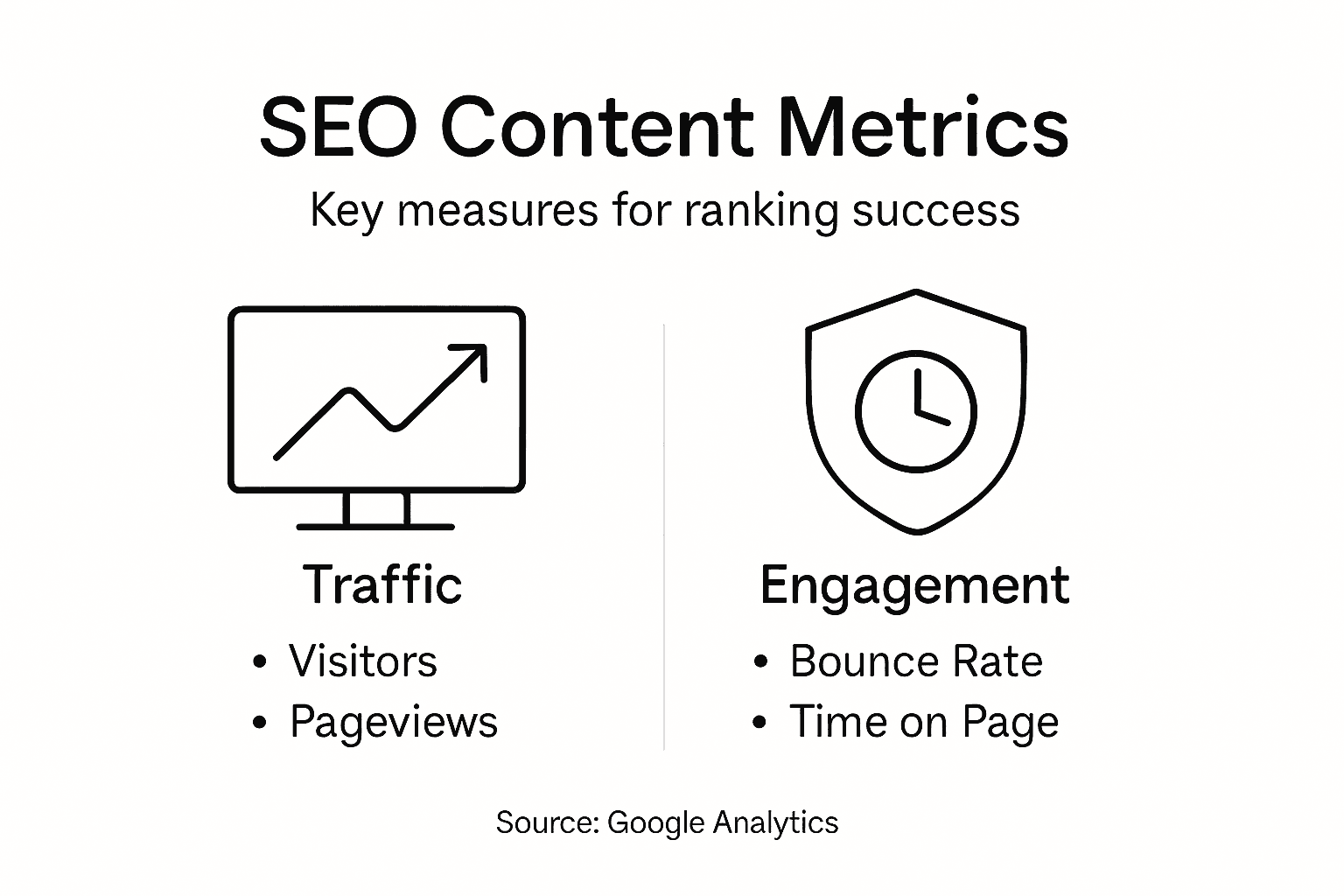
Dive deeper by examining user engagement metrics such as time on page, bounce rate, and conversion rates. These indicators provide insights into how well your content resonates with your target audience. Use content marketing metrics to connect your SEO efforts with broader marketing objectives. Create a regular reporting schedule to monitor performance consistently, looking for trends that indicate content success or areas needing improvement. Consider using A/B testing to experiment with different content approaches and validate your optimization strategies.
Below is a summary of key metrics for measuring SEO content performance:
| Metric | What It Measures | Why It Matters |
|---|---|---|
| Organic Traffic | Site visitors from search | Reveals SEO reach and growth |
| Keyword Rankings | Position in search results | Tracks keyword optimization |
| Bounce Rate | Single-page visits ratio | Shows content engagement |
| Conversion Rate | Actions completed by users | Measures business value |
| Time on Page | Average time spent reading | Indicates audience interest |
Pro tip: Develop a quarterly content performance dashboard that aggregates key metrics, allowing you to quickly visualize and communicate your content marketing impact.
Elevate Your SEO Content and Boost Your Google Rankings Today
Writing SEO content that truly ranks higher on Google can feel overwhelming when facing challenges like pinpointing the right keywords, structuring content perfectly, and optimizing on-page elements. This article breaks down essential strategies such as understanding search intent, leveraging long-tail keywords, and aligning your content with E-E-A-T principles so you can attract more targeted traffic and engage readers effectively.
If you want to go beyond theory and get hands-on support, our team at Web Spider Solutions specializes in transforming your SEO content into a powerful growth engine. Explore our insights in the Stories Archives to see real examples and learn how we integrate cutting-edge techniques with strategic keyword research and technical SEO expertise. For forward-thinking businesses, our Artificial Intelligence Archives reveal how AI-powered tools amplify content optimization and search performance.
Don’t wait to dominate your digital market. Visit Web Spider Solutions now to request your free SEO audit or consultation and start crafting SEO content that drives measurable results.
Frequently Asked Questions
How can I identify the right keywords for my SEO content?
To identify the right keywords, start by brainstorming seed keywords relevant to your topic. Then, use keyword research tools to find long-tail variations with moderate search volume and lower competition.
What is the best way to structure my SEO content?
Structure your SEO content using clear headings and a logical hierarchy. Begin with an H1 heading that includes your main target keyword, followed by H2 and H3 headings that incorporate related keywords for better organization.
How do I ensure my content matches user search intent?
To ensure your content matches user search intent, categorize keywords into informational, navigational, transactional, or commercial types. Tailor your content to directly answer the specific questions or needs associated with these categories.
What on-page SEO elements should I optimize?
Optimize critical on-page SEO elements such as title tags, meta descriptions, and header tags. Ensure your titles are engaging and include target keywords while keeping them under 60 characters for maximum impact.
How can I track the performance of my SEO content?
To track your content’s performance, monitor key metrics like organic traffic, keyword rankings, and bounce rate using analytics tools. Set a regular review schedule, such as monthly, to analyze trends and adjust your strategy accordingly.
What role does readability play in SEO content?
Readability is crucial as it affects user engagement and retention on your page. Use short paragraphs, bullet points, and headings to enhance clarity, aiming for an easy-to-read format that keeps users engaged for longer periods.