






Most small and medium-sized business owners assume paid advertising is a game reserved for companies with massive marketing budgets. That assumption costs them real revenue. PPC (Pay-Per-Click) advertising averages 200% ROI, and some well-optimized campaigns have pushed returns far beyond that. The truth is, PPC is one of the most budget-flexible, measurable, and fast-acting lead generation tools available to businesses of any size. This article breaks down exactly how PPC works, why it delivers results for SMBs, and how to make every dollar count.
Table of Contents
- What is PPC and how does it work?
- Top business benefits of investing in PPC
- How small businesses can compete with big brands in PPC
- Maximizing ROI: Best practices and pitfalls for PPC success
- Is PPC right for your business? Key considerations
- Take the next step toward PPC success
- Frequently asked questions
Key Takeaways
| Point | Details |
|---|---|
| Fast, high-intent traffic | PPC lets your business reach ready-to-buy customers instantly over organic competition. |
| Control and flexibility | You set the budget, choose targets, and can tweak campaigns for performance in real time. |
| Compete with big brands | Niche targeting and smart optimization help SMBs win leads without outspending larger rivals. |
| Measurable ROI | PPC’s transparency allows you to track every dollar, proving its impact quickly. |
| Avoid common pitfalls | Success hinges on best practices like landing page alignment and avoiding frequent campaign changes. |
What is PPC and how does it work?
PPC stands for Pay-Per-Click. It is a form of digital advertising where you only pay when someone actually clicks your ad. No click, no charge. That model alone makes it fundamentally different from traditional advertising, where you pay for exposure regardless of whether anyone responds.
Your ads can appear across several platforms: Google Search, Google Display Network, Microsoft Bing, YouTube, LinkedIn, Facebook, and Instagram. Each platform uses an auction system to determine which ads appear and in what order. Your bid, your ad quality score, and the relevance of your landing page all factor into your ad rank. You do not need the highest bid to win. A highly relevant, well-structured ad can outrank a competitor spending twice as much.
For understanding PPC advertising at a foundational level, here are the key terms you need to know:
- Keyword: The search term that triggers your ad
- CPC (Cost Per Click): The amount you pay each time someone clicks
- Ad rank: The position your ad earns based on bid and quality
- Quality score: Google’s rating of your ad relevance and landing page experience
- ROI (Return on Investment): Revenue generated relative to what you spent
What makes PPC especially powerful for SMBs is the intent behind the traffic. Someone searching “emergency plumber near me” or “best CRM for small business” is not browsing. They are ready to act. How PPC advertising works in practice means your ad reaches people at the exact moment they are looking for what you offer. That is a level of precision that most other marketing channels simply cannot match.
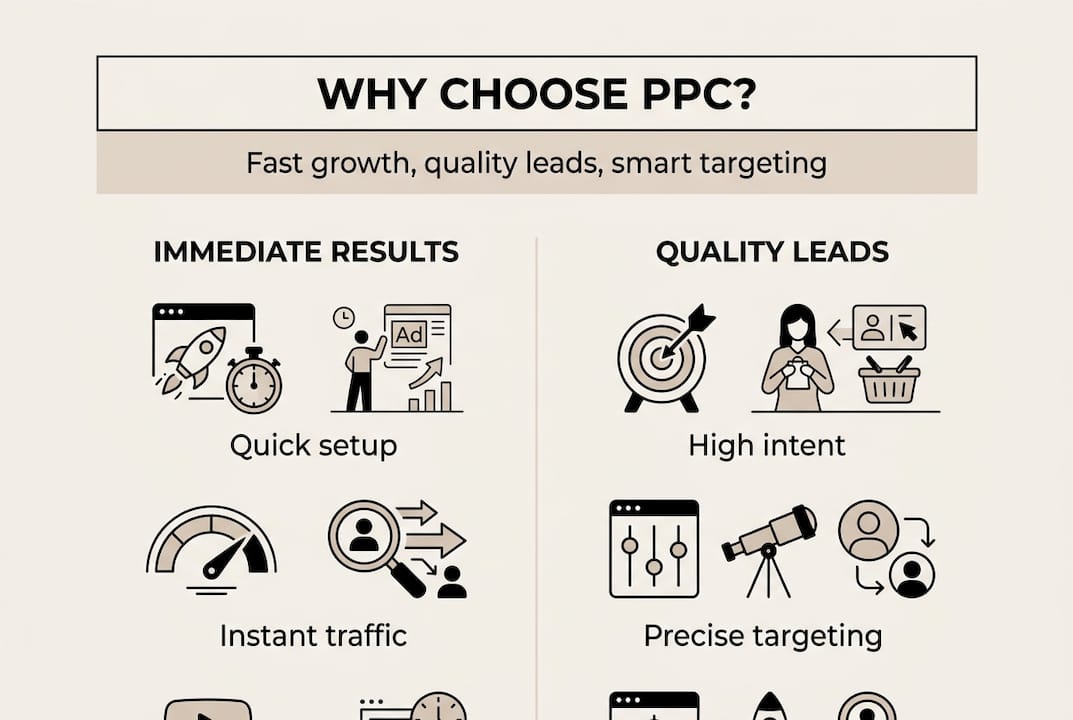
Unlike SEO, which can take months to build momentum, PPC delivers immediate visibility and high-intent traffic from day one. For businesses that need leads now, that speed is invaluable.
Top business benefits of investing in PPC
Now that the basics are clear, let’s look at what makes PPC investment especially appealing for small and mid-sized businesses in competitive spaces.

PPC puts your brand at the top of search results instantly, even if your website is brand new. You do not need years of domain authority to appear above established competitors. That visibility alone can shift how potential customers perceive your business.
Here is what makes PPC stand out as a lead generation tool:
- High purchase intent: Users clicking PPC ads are actively searching for solutions, not passively scrolling
- Full budget control: Set daily and monthly caps so you never overspend
- Precise targeting: Reach users by location, device, time of day, demographics, and search behavior
- Measurable results: Track every click, conversion, and dollar spent in real time
- Instant scalability: Increase spend on campaigns that perform, pause ones that do not
For SMBs in competitive industries, PPC provides immediate visibility above organic results, targeting users who are actively searching for your services. That is not a small advantage. That is the difference between being found and being invisible.
The numbers speak clearly. PPC ROI averages 200% across campaigns, with some case studies reporting 790% ROAS (Return on Ad Spend). Even conservative, well-managed campaigns consistently outperform most traditional advertising channels.
Explore the top PPC benefits and the broader benefits of PPC advertising to see how these advantages translate across different industries.
Pro Tip: Add negative keywords before you launch, not after. Negative keywords tell Google which searches should not trigger your ad. Without them, you will pay for irrelevant clicks that drain your budget and skew your data.
How small businesses can compete with big brands in PPC
While PPC might seem like a pay-to-win space, smart businesses can outmaneuver even the largest competitors by playing to their strengths.
Big brands have big budgets, but they also have big blind spots. They target broad, high-volume keywords. They move slowly. They cannot pivot a campaign overnight. You can. That agility is your competitive edge, and it is more valuable than most SMB owners realize.
SMBs can compete through agility, niche targeting with long-tail keywords, and lower CPCs. A long-tail keyword like “affordable HR software for construction companies” costs far less per click than “HR software” and attracts a buyer who is much closer to making a decision.
| Tactic | Big brands | SMBs |
|---|---|---|
| Keyword strategy | Broad, high-volume terms | Long-tail, niche-specific terms |
| Budget flexibility | Large, often rigid | Lean, highly adjustable |
| Campaign speed | Slow approval chains | Fast pivots and real-time changes |
| Local targeting | Often national or global | Hyper-local, community-focused |
| Personalization | Generic messaging | Specific, relatable ad copy |
Here are practical ways to run budget-smart PPC campaigns as an SMB:
- Focus on one geographic area before expanding
- Target a single product or service niche per campaign
- Use exact match and phrase match keywords to control spend
- Write ad copy that speaks directly to a specific customer problem
- Schedule ads to run only during your highest-converting hours
The PPC advantages for SMBs are real, but they require consistent attention. A campaign set up once and left alone will underperform. The businesses that win in PPC are the ones reviewing data weekly, testing new ad variations, and adjusting bids based on what the numbers actually show.
Maximizing ROI: Best practices and pitfalls for PPC success
Success in PPC comes from not just starting campaigns, but also consistently refining your approach and avoiding costly errors.
The single biggest mistake SMBs make is treating PPC like a light switch. They turn it on, expect instant results, and turn it off when the first week looks slow. PPC needs time to gather data, especially when AI-powered bidding strategies like Target CPA or Maximize Conversions are involved. Frequent campaign changes disrupt AI learning and prevent the algorithm from optimizing effectively.
Here are the steps to maximize your PPC ROI:
- Define your goal first. Are you generating leads, driving calls, or pushing e-commerce sales? Your goal shapes every other decision.
- Choose keywords with intent. Focus on terms that signal a buyer is ready to act, not just browsing.
- Set a realistic budget. Spreading $300 across ten campaigns starves each one of data. Concentrate spend where it matters.
- Align your landing page. If your ad promises a free consultation, your landing page must deliver exactly that, immediately.
- Analyze weekly. Look at search term reports, click-through rates, and conversion data every week without fail.
- Test incrementally. Change one element at a time so you know what actually moved the needle.
Prioritize landing page alignment and negative keywords to prevent budget bleed. A mismatched landing page is one of the fastest ways to waste ad spend. If a user clicks an ad for “commercial cleaning services” and lands on your homepage, they will leave. That click still costs you money.
| Common pitfall | Why it hurts | How to fix it |
|---|---|---|
| Poor landing page match | High bounce rate, wasted spend | Create dedicated landing pages per ad group |
| Skipping negative keywords | Irrelevant clicks drain budget | Build a negative keyword list before launch |
| Frequent campaign changes | Disrupts AI bidding optimization | Allow 2 to 4 weeks before making major changes |
| Click fraud exposure | Inflated costs, false data | Use click fraud protection tools |
| Data starvation on small budgets | Algorithm cannot optimize | Consolidate campaigns, focus on one niche |
For PPC best practices and guidance on landing page optimization, these resources will help you build campaigns that convert rather than just spend.
Pro Tip: If your monthly budget is under $1,000, run one tightly focused campaign rather than spreading across multiple. Small budgets need hyper-niche focus to avoid data starvation, where the algorithm does not get enough clicks to learn and improve.
Is PPC right for your business? Key considerations
With a firm grasp on how to optimize, it is time to decide whether PPC aligns with your current business goals and capacity.
PPC is not a universal solution. It works exceptionally well in specific situations, and understanding those situations helps you invest wisely rather than impulsively.
PPC works best for businesses that:
- Operate in competitive markets where organic rankings take too long to build
- Have a clear, specific offer that solves a defined problem
- Can follow up on leads quickly (within minutes, not days)
- Have measurable conversion goals like form fills, calls, or purchases
- Are willing to review and optimize campaigns on an ongoing basis
- Want to test a new market or product before committing to long-term SEO
Before launching, assess your readiness honestly. Do you have a landing page that converts? Is your sales team ready to handle inbound inquiries? Can you commit to at least 90 days of consistent spend and optimization? These questions matter more than your budget size.
For competitive industries, PPC excels in lead generation through high-intent targeting, with benchmarks showing viable ROI even for modest SMB budgets when campaigns are optimized for niches.
That said, PPC may not be the right fit if you have no unique offer to differentiate from competitors, if your budget is so limited that you cannot sustain at least 30 to 60 days of data collection, or if your business model relies on very long sales cycles with no clear conversion point online. In those cases, starting with SEO or content marketing may build a stronger foundation first.
The PPC advertising guide can help you evaluate your specific situation and determine the right entry point for paid search.
Take the next step toward PPC success
PPC gives SMBs something rare in marketing: speed, precision, and measurable results from day one. You control the budget, the targeting, and the message. You see exactly what works and what does not. For businesses in competitive industries, that level of control is not just useful, it is a genuine advantage over slower-moving competitors. If you are ready to put these strategies into practice, explore understanding PPC advertising for your business to build your foundation, review the benefits of PPC advertising to align your goals, and dig into how PPC advertising works for a step-by-step breakdown. Our team at Web Spider Solutions is ready to help you build campaigns that generate real leads, not just clicks.
Frequently asked questions
How quickly can I see results from a PPC campaign?
PPC delivers immediate visibility and measurable traffic within days of launch, making it far faster than SEO for generating early leads. Most campaigns begin showing meaningful data within the first one to two weeks.
What kind of ROI can SMBs expect from PPC?
On average, SMBs see ROI around 200% from PPC, with well-optimized campaigns in specific niches reporting significantly higher returns. Results depend heavily on targeting quality and landing page performance.
Is PPC too expensive for businesses with small budgets?
Not if you focus tightly. Small budgets need hyper-niche focus to avoid spreading spend too thin, but even campaigns under $1,000 per month can generate strong ROI when structured correctly.
What are some common PPC pitfalls for small businesses?
Prioritize landing page alignment and negative keywords from the start, and avoid making frequent campaign changes that disrupt AI bidding. Click fraud and poor keyword match types are also common budget drains for SMBs.
How does PPC compare to SEO for lead generation?
PPC delivers fast, targeted traffic from day one, while SEO builds authority and organic visibility over months or years. Running both together typically produces the strongest long-term lead generation results for SMBs.