






Businesses that actively invest in digital campaigns see faster growth compared to those relying solely on traditional marketing. Yet many small and medium-sized business owners hesitate, uncertain whether digital spending will deliver measurable returns. This article breaks down the benefits, ROI potential, and practical steps to launch campaigns that drive real revenue growth. You’ll discover why digital investment is no longer optional for competitive businesses and how to maximize every dollar spent.
Table of Contents
- What are digital campaigns and why do they matter?
- The business case for investing in digital campaigns
- Key benefits of digital campaigns for SMBs
- Emerging trends making digital investment critical in 2026
- How to maximize your ROI from digital campaigns
- Take the next step: Launching digital campaigns for real growth
- Frequently asked questions
Key Takeaways
| Point | Details |
|---|---|
| Digital campaigns drive measurable growth | Online campaigns are proven to deliver faster, trackable ROI compared to traditional marketing. |
| SMBs benefit from targeting and analytics | Digital strategies enable small businesses to reach the right customers and adjust tactics in real time for better results. |
| Stay ahead with new trends | Adopting current digital trends and tools keeps your business competitive and maximizes returns. |
| Start small and scale | Begin with a modest investment, analyze performance, and grow your campaigns for optimal outcomes. |
What are digital campaigns and why do they matter?
A digital campaign is a coordinated series of online marketing activities designed to achieve specific business goals. Unlike traditional print or broadcast advertising, digital campaigns include paid ads, SEO, content marketing, and social engagement working together to drive conversions.
Traditional marketing casts a wide net with limited targeting. You place an ad in a magazine or on a billboard and hope the right people see it. Digital campaigns flip this model entirely. You reach specific audiences based on demographics, interests, search behavior, and online activity.
Major digital channels include:
- Search advertising: Ads appear when prospects search for your products or services
- Display networks: Visual ads across websites your audience visits
- Social platforms: Targeted campaigns on Facebook, LinkedIn, Instagram, and emerging networks
- Email marketing: Direct communication with prospects and customers
- Content marketing: Educational resources that attract and convert qualified leads
The game changer? Real-time insights. You see exactly how many people clicked your ad, visited your site, and completed a purchase. This transparency lets you adjust messaging, reallocate budget, and improve results while campaigns run.
“Digital campaigns enable businesses to track every interaction, measure precise ROI, and optimize for better performance continuously.”
For small businesses competing in crowded markets, this precision targeting and measurement capability levels the playing field. You’re not outspending competitors, you’re outsmarting them with data-driven decisions.
The shift toward digital isn’t just about technology. It’s about meeting customers where they spend time. Your prospects research solutions online, compare options through search, and make decisions based on what they find. Balancing brand awareness with performance ensures you’re visible at every stage of their journey.
The business case for investing in digital campaigns
The numbers tell a compelling story. Digital campaigns deliver stronger ROI than traditional media because every dollar spent is trackable and optimizable.
Consider this comparison:
| Marketing Channel | Average ROI | Time to Results | Targeting Precision |
|---|---|---|---|
| Digital campaigns | $5.20 per $1 spent | 2-4 weeks | High (demographic, behavioral) |
| Print advertising | $2.80 per $1 spent | 8-12 weeks | Low (geographic only) |
| Broadcast media | $3.10 per $1 spent | 6-10 weeks | Medium (time slots, programs) |
Search and social campaigns consistently outperform traditional channels for small and medium businesses. Why? You’re reaching people actively looking for solutions, not interrupting them during unrelated activities.
A manufacturing company we tracked increased qualified leads by 340% within six months of shifting 60% of their marketing budget to digital campaigns. They used search ads to capture high-intent prospects and retargeting to convert website visitors who didn’t purchase immediately.
The key advantage is measuring and optimizing ROI in real time. Traditional campaigns require weeks or months to assess performance. Digital platforms show results within hours. You see which ads drive conversions, which keywords attract qualified traffic, and which audiences respond best.
Pro Tip: Set up conversion tracking before launching any campaign. Install tracking pixels, configure Google Analytics goals, and establish clear attribution models. Without proper tracking from day one, you’re flying blind and can’t optimize for better results.
This measurability transforms marketing from a cost center into a revenue driver. You’re not guessing which tactics work. You’re making data-backed decisions that boost ROI systematically.
Key benefits of digital campaigns for SMBs
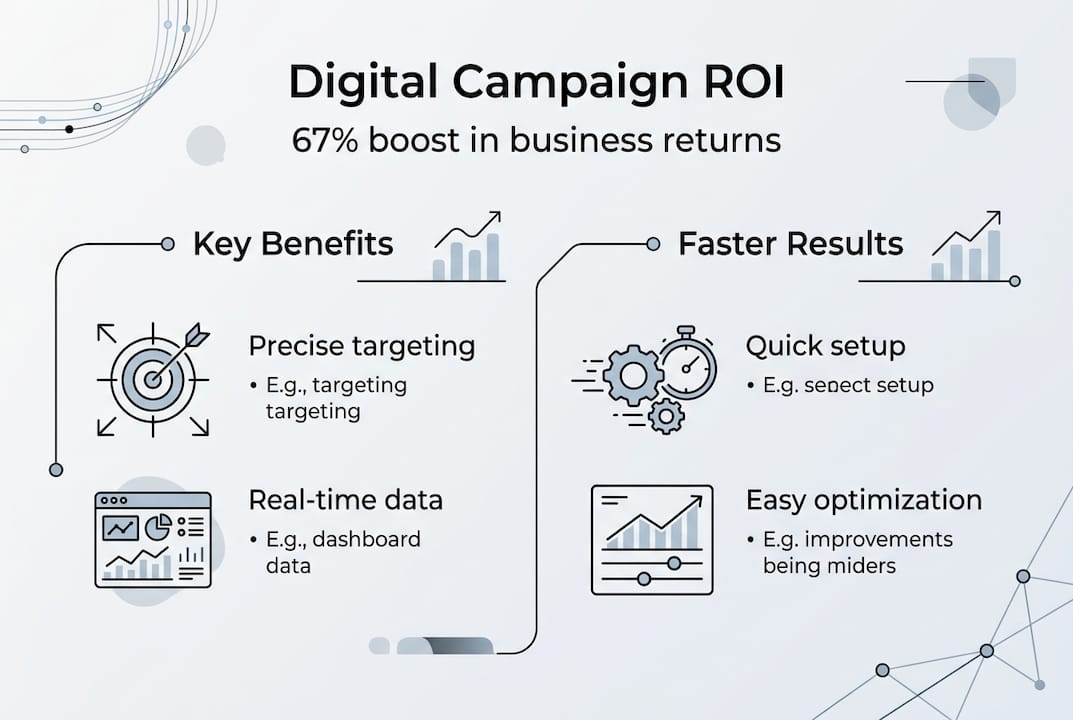
Beyond ROI, digital campaigns offer specific advantages that matter most to growing businesses.
Visibility where it counts: Your prospects spend hours daily on search engines, social platforms, and industry websites. Digital campaigns put your brand in front of them at the exact moment they’re researching solutions. You’re not hoping they see your billboard during their commute. You’re appearing in their search results when they type “best solution for [problem].”
Pinpoint targeting: Digital campaigns enable segmented outreach that improves conversion rates dramatically. You can target:
- Decision makers at companies with specific revenue ranges
- People who visited your website but didn’t purchase
- Audiences similar to your best customers
- Prospects searching for competitor brands
- Users in specific geographic areas during business hours
This precision eliminates wasted spend on unqualified audiences. Every dollar reaches someone likely to become a customer.
Flexibility and speed: Launch a campaign Monday morning and see results by Wednesday. Something not working? Pause it immediately and reallocate budget to better-performing tactics. Traditional campaigns lock you into multi-month commitments with no ability to adjust mid-flight.

Data-driven optimization: Digital platforms provide detailed performance data:
| Metric | What It Reveals | How to Use It |
|---|---|---|
| Click-through rate | Ad relevance and appeal | Test different headlines and offers |
| Conversion rate | Landing page effectiveness | Optimize page design and copy |
| Cost per acquisition | Campaign efficiency | Shift budget to best-performing channels |
| Return on ad spend | Overall profitability | Scale winners, cut losers |
You’re not making decisions based on hunches. You’re using concrete data to improve results continuously.
Pro Tip: Run A/B tests on every campaign element. Test two different headlines, images, or calls to action simultaneously. Even small improvements compound over time. A 15% better conversion rate can double your ROI within months.
These benefits combine to create a marketing approach that’s more effective, efficient, and accountable than traditional methods. You’re building a digital strategy that scales with your business and adapts to market changes.
Emerging trends making digital investment critical in 2026
The digital landscape evolves rapidly, and 2026 brings changes that make strategic investment more important than ever.
AI and automation revolutionize targeting: Machine learning algorithms now optimize campaigns automatically, adjusting bids, targeting, and creative elements based on performance data. Adopting AI-powered targeting is mainstream among growing businesses. These tools identify patterns humans miss and improve results faster than manual optimization.
New ad formats and platforms: Social and search platforms continuously launch innovative ad types. Video ads, interactive experiences, and shoppable posts create engagement opportunities that didn’t exist two years ago. Businesses that experiment with these formats gain competitive advantages before markets saturate.
Personalization meets privacy: Users expect personalized experiences but demand data privacy. Successful campaigns balance these priorities through first-party data strategies, contextual targeting, and value-exchange models where users willingly share information for better experiences.
“The businesses winning in 2026 are those that adapt quickly to platform changes while maintaining focus on customer value and measurable outcomes.”
Key trends to watch:
- Voice search optimization: More searches happen through voice assistants, requiring different keyword strategies and content approaches
- Short-form video dominance: Platforms prioritize video content, making it essential for visibility and engagement
- Predictive analytics: Advanced tools forecast campaign performance and customer behavior with increasing accuracy
- Cross-channel attribution: Better tracking shows how multiple touchpoints work together to drive conversions
- Sustainability messaging: Audiences increasingly favor brands demonstrating environmental and social responsibility
Staying updated on digital trends isn’t optional anymore. The gap between businesses leveraging new capabilities and those stuck with outdated approaches widens monthly. Your competitors are testing these innovations. Falling behind means losing market share to more agile rivals.
The good news? You don’t need to master every trend immediately. Focus on the innovations most relevant to your audience and business model. Test systematically, measure results, and scale what works.
How to maximize your ROI from digital campaigns
Knowing digital campaigns work is one thing. Making them work for your business requires a systematic approach.
Step 1: Set clear, measurable goals. Vague objectives like “increase awareness” don’t drive results. Define specific targets: generate 50 qualified leads monthly, achieve $10,000 in sales from digital channels, or reduce cost per acquisition by 25%.
Step 2: Choose the right platforms. Don’t spread budget across every channel. Research where your target audience spends time and which platforms align with your goals. B2B companies often succeed with LinkedIn and search ads. Consumer brands might prioritize Instagram and Facebook.
Step 3: Implement comprehensive tracking. Successful SMBs track every campaign and adjust spend for best results. Use UTM parameters, conversion pixels, and call tracking to attribute revenue to specific campaigns.
Step 4: Analyze performance weekly. Review metrics every seven days minimum. Identify what’s working and what’s not. Look for patterns in high-performing ads, audiences, and times of day.
Step 5: Optimize continuously. Use insights to improve campaigns. Pause underperforming ads, increase budget for winners, test new variations, and refine targeting based on conversion data.
Common mistakes that kill ROI:
- Underfunded campaigns: Spreading $500 across five platforms generates no meaningful results. Concentrate budget on one or two channels until you achieve profitability
- Weak targeting: Broad audiences waste money on unqualified clicks. Narrow your focus to ideal customer profiles
- Ignoring analytics: Running campaigns without reviewing data is like driving blindfolded. You’ll crash eventually
- Impatience: Stopping campaigns after one week doesn’t allow time for optimization. Give strategies at least 30 days to gather meaningful data
- Set and forget: Digital campaigns require active management. Check performance regularly and make adjustments
Pro Tip: Start with a small test budget on one platform. Master that channel before expanding. A $1,000 monthly budget on Google Ads, optimized properly, outperforms $5,000 spread thinly across multiple platforms with no optimization.
Follow proven digital planning steps and focus on boosting campaign results through systematic testing and refinement. The businesses seeing exceptional returns aren’t lucky. They’re disciplined about measurement and optimization.
Take the next step: Launching digital campaigns for real growth
You now understand why digital campaigns deliver superior results, which benefits matter most, and how to maximize ROI. The question becomes: how do you move from knowledge to implementation?
Many SMBs struggle with the technical complexity of campaign setup, platform selection, and ongoing optimization. You’re running a business, not becoming a digital marketing expert. That’s where strategic guidance makes the difference between mediocre results and exceptional growth.
A comprehensive digital campaign management approach addresses every element: strategy development, platform selection, creative development, tracking implementation, and continuous optimization. You get the benefits of digital campaigns without the learning curve and time investment.
For businesses focused on organic visibility alongside paid campaigns, SEO campaign services build long-term traffic that compounds over time. Paid ads drive immediate results while SEO creates sustainable growth.
Looking for inspiration? Review B2B digital campaign examples showing how companies in competitive industries achieved breakthrough results through strategic digital investment.
The businesses dominating their markets in 2026 aren’t necessarily the largest or best funded. They’re the ones that recognized digital campaigns as essential growth drivers and implemented them strategically. Your competitors are investing in digital. The question isn’t whether to join them, but how quickly you can catch up and pull ahead.
Frequently asked questions
What types of businesses benefit most from digital campaigns?
Small and midsize businesses in competitive industries see the highest impact from digital campaigns due to targeted reach and measurable ROI. Companies with clear customer profiles and specific geographic or demographic targets achieve exceptional results.
How quickly can I see results from digital campaign investments?
Results appear within weeks for paid campaigns, but full impact takes several months depending on campaign type and budget. PPC and social ads yield fast feedback compared to traditional tactics, while SEO builds momentum over time.
Is it possible to track the ROI of a digital campaign accurately?
Yes, measuring and optimizing ROI is straightforward with digital campaigns. Platforms provide detailed analytics showing exactly which ads, keywords, and audiences drive conversions, making ROI tracking more accurate than any traditional marketing method.
What is the minimum budget recommended for digital campaigns?
Budgets vary by industry and goals, but starting small and scaling is best practice. Begin with $1,000 to $2,000 monthly on one platform, optimize for profitability, then expand budget and channels based on proven results.