






Most American marketers still believe keyword stuffing guarantees higher rankings, yet search engines now reward real relevance and intent matching. This common myth leads to wasted efforts and disappointing results. Understanding what users truly want is the key to creating content that actually connects and converts. Here you will find clear insights that separate outdated assumptions from what actually drives genuine user engagement in today’s world.
Table of Contents
- Defining Search Intent And Common Myths
- Types Of Search Intent And Key Differences
- How User Intent Influences Seo Strategy
- Recognizing User Journey And Business Value
- Avoiding Search Intent Mistakes In Content
Key Takeaways
| Point | Details |
|---|---|
| Understanding Search Intent is Essential | Recognizing the underlying motivations behind user queries shapes effective content strategies. Each type of intent demands a tailored approach to meet specific user needs. |
| Content Must Align with User Journey | Different stages of the user journey require distinct content that addresses unique user concerns and goals, enhancing engagement and conversion rates. |
| Avoid Common Content Mistakes | Failing to align content with search intent can lead to generic output that disengages users and undermines search engine rankings. Regular analysis is necessary for maintaining content relevance. |
| Implement Actionable Strategies | Utilize tools like intent mapping and journey mapping to create highly targeted content that meets user needs and boosts overall business value. |
Defining Search Intent and Common Myths
Search intent represents the underlying purpose behind a user’s online query, revealing what information or outcome they truly seek when typing words into a search engine. Understanding this concept goes beyond simple keyword matching, requiring a nuanced approach to interpreting user search behaviors.
Traditionally, search intent falls into four primary categories: informational (seeking knowledge), navigational (finding a specific website), commercial (researching products before purchase), and transactional (ready to complete an action or purchase). Each category demands a unique content strategy that precisely matches user expectations. For instance, an informational query about “how to fix a leaky faucet” requires step-by-step tutorial content, while a transactional query like “buy plumbing wrench” needs product-focused information.
Common myths about search intent often mislead marketers and content creators. Some believe keyword density alone drives rankings, but modern search algorithms prioritize relevance and user satisfaction. Another prevalent misconception is that all searchers want the same thing, when in reality, intent can vary dramatically even for seemingly identical search phrases. Advanced search task classifications demonstrate the complex nature of user search goals, highlighting the need for sophisticated content strategies.
Pro Tip: Content Precision Strategy: Analyze the top-ranking pages for your target keywords and deconstruct their approach to matching user intent, then create content that provides even more comprehensive and targeted information to outperform competitors.
Types of Search Intent and Key Differences
Search intent represents a complex ecosystem of user motivations, expanding far beyond simple keyword matches. Modern search intent classifications reveal intricate patterns of online user behavior, demonstrating that not all searches are created equal. Understanding these nuanced categories helps marketers and content creators develop more targeted and effective strategies.
Traditionally, search intent falls into five primary categories, each representing a distinct user motivation:
- Informational Intent: Users seeking knowledge, answers, or explanations
- Navigational Intent: Users trying to locate a specific website or webpage
- Commercial Intent: Users researching products or services before making a purchase
- Transactional Intent: Users ready to buy or complete a specific action
- Local Intent: Users searching for location-specific information or nearby services
Advanced search intent research suggests that these categories are not rigid containers but fluid frameworks that often overlap. For example, a search for “best smartphones” might simultaneously represent commercial and informational intent, as the user seeks both product recommendations and detailed information about potential purchases. This complexity means content creators must develop sophisticated, multi-dimensional strategies that address various potential user motivations simultaneously.
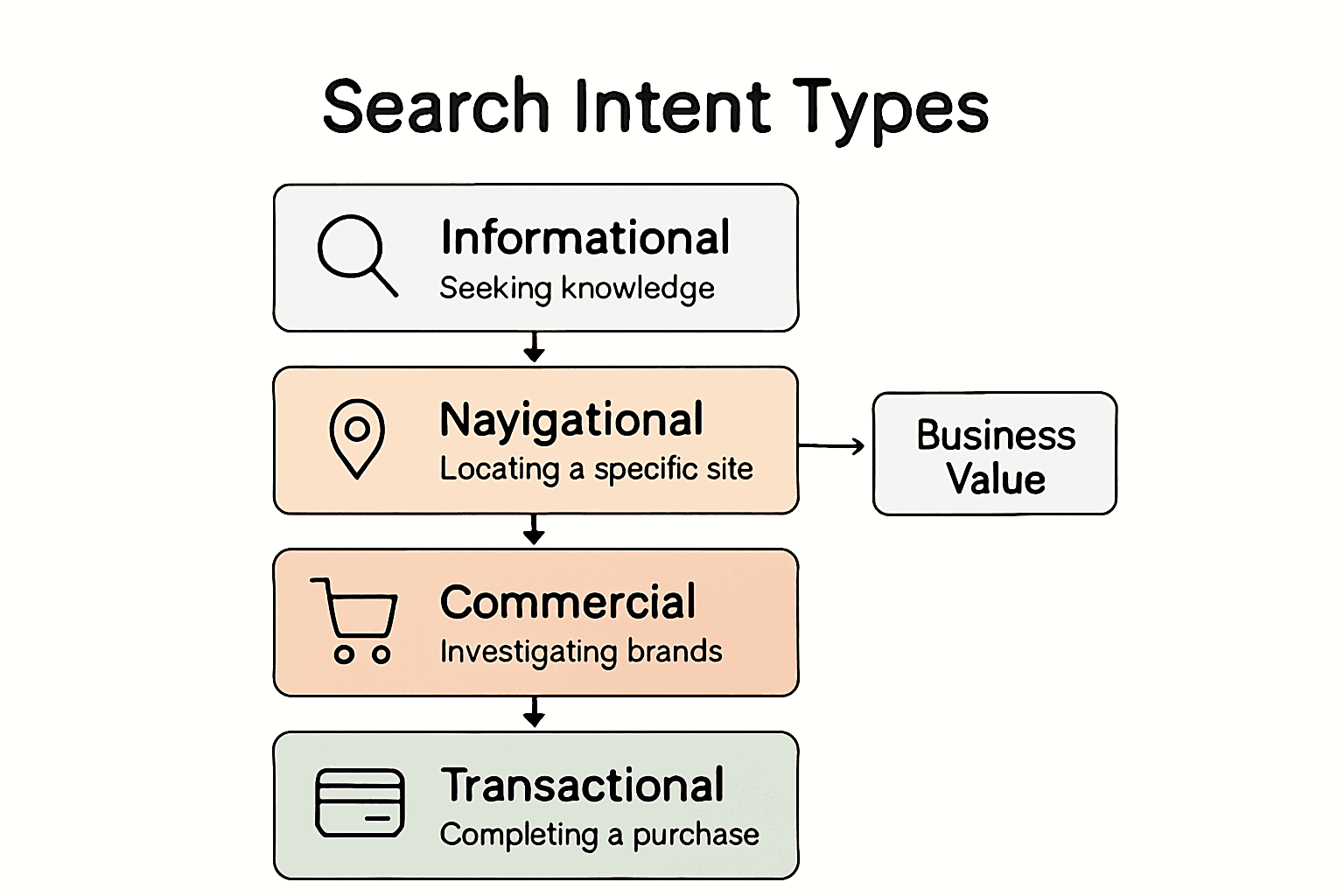
Pro Tip: Intent Mapping Strategy: Conduct thorough keyword research and analyze search results for your target keywords, paying close attention to the type of content ranking highest for each query to understand the predominant search intent.
Here’s a summary of how different search intent types influence content strategy:
| Search Intent Type | Recommended Content Format | User Goal Example | Business Value |
|---|---|---|---|
| Informational | How-to guides, articles | Learn to fix an issue | Build authority, educate |
| Navigational | Landing pages, site directories | Find official website | Direct traffic, brand recall |
| Commercial | Comparison charts, reviews | Research best products | Influence buying decisions |
| Transactional | Product pages, checkout flows | Make a purchase | Drive conversions, sales |
| Local | Maps, location pages | Find nearby service | Attract local customers |
How User Intent Influences SEO Strategy
Search engine optimization has fundamentally transformed from keyword-centric approaches to a sophisticated understanding of user search behaviors and content relevance. Modern SEO strategies recognize that simply matching keywords is insufficient; instead, content must precisely align with the underlying user intent behind each search query.
Understanding search intent directly impacts several critical SEO elements:
- Ranking Potential: Search engines prioritize content that best satisfies user intent
- User Engagement: Matching intent increases time spent on page and reduces bounce rates
- Conversion Optimization: Content aligned with intent drives more meaningful user actions
- Long-Term Authority: Consistently meeting user needs builds domain credibility
Local search optimization strategies demonstrate how intent-driven content can dramatically improve visibility. For instance, a local restaurant searching for “best pizza near me” requires completely different content approach compared to a user researching pizza-making techniques. This nuanced understanding means marketers must develop hyper-specific content strategies that go beyond generic keyword targeting.

Pro Tip: Intent Deconstruction Method: Analyze the top 10 search results for your target keywords, identifying the specific type of content (video, long-form article, product page) that currently ranks highest to understand the precise intent Google associates with those search terms.
Recognizing User Journey and Business Value
Understanding the intricate landscape of user information behavior represents a critical strategic advantage for businesses seeking to optimize their digital presence. The user journey is not a linear path but a complex network of interactions, decisions, and micro-moments that collectively shape how potential customers engage with online content and make purchasing decisions.
The user journey typically encompasses several key stages:
- Awareness: Initial discovery of a potential solution or need
- Consideration: Researching and evaluating different options
- Decision: Selecting a specific product, service, or solution
- Retention: Ongoing engagement and potential repeat interactions
- Advocacy: Sharing experiences and recommending to others
Information retrieval strategies reveal that each stage requires a unique content approach tailored to the user’s specific intent and emotional state. For businesses, this means developing a nuanced content ecosystem that addresses different user needs simultaneously. A software company, for instance, must create content that educates potential customers during the awareness stage, provides detailed comparisons during consideration, and offers clear value propositions during the decision stage.
Pro Tip: Journey Mapping Technique: Create detailed user personas representing different customer segments, then systematically audit your existing content to identify gaps in addressing each stage of their decision-making process.
To clarify the business impact of aligning content with user journey stages, see the table below:
| User Journey Stage | Content Focus | User Need | Impact on Business |
|---|---|---|---|
| Awareness | Educational content | Basic information | Increase brand visibility |
| Consideration | Comparisons | Weigh alternatives | Guide choice toward offer |
| Decision | Persuasive message | Final reassurance | Boost conversion rate |
| Retention | Support resources | Continued value | Improve loyalty, upsell |
| Advocacy | Shareable stories | Share experience | Drive referrals, new leads |
Avoiding Search Intent Mistakes in Content
Diverse search intent strategies reveal that content creators frequently underestimate the complexity of user search behaviors. The most common mistake is producing generic, one-size-fits-all content that fails to address the specific nuanced needs behind different search queries. This approach not only diminishes user engagement but also signals to search engines that the content lacks genuine relevance.
Key search intent mistakes to avoid include:
- Keyword Stuffing: Cramming keywords without providing meaningful context
- Mismatched Content Format: Creating blog posts when users want videos or infographics
- Ignoring User Depth: Providing overly basic or unnecessarily complex information
- Neglecting User Questions: Failing to answer the underlying queries behind search terms
- Inconsistent Messaging: Producing content that doesn’t align with user expectations
Comprehensive search intent analysis demonstrates that successful content strategies require deep empathy with user motivations. For example, a search for “smartphone repair” could indicate multiple intents: someone wanting DIY fixing instructions, seeking professional repair services, or comparing repair costs. Recognizing these subtle distinctions allows content creators to develop targeted, precise materials that directly address specific user needs.
Pro Tip: Intent Verification Method: Regularly review your top-performing content’s search analytics, identifying the actual search queries driving traffic and comparing them against your original content intent to ensure continued alignment.
Unlock the Power of True Search Intent to Boost Your SEO Results
Understanding the nuances of search intent is critical for creating content that truly resonates with your target audience. As the article explains, ignoring the specific user motivations behind queries can lead to generic content that fails to engage, convert, or build authority. Key challenges include interpreting complex intent types such as commercial, transactional, and local intent and aligning your content to meet these needs precisely.
At Web Spider Solutions, we specialize in transforming your SEO strategy by deeply analyzing user intent and tailoring your digital marketing efforts accordingly. Our expert team focuses on delivering customized content marketing and SEO services that increase relevance, enhance user engagement, and drive conversions. Don’t let your website miss out on valuable traffic because your content does not speak directly to your customers’ true needs.
Ready to take your SEO to the next level with intent-driven strategies that deliver measurable growth now Visit Web Spider Solutions for a free consultation and start crafting content that wins in search engines and converts visitors into loyal customers.
Frequently Asked Questions
What is search intent?
Search intent refers to the underlying purpose behind a user’s online query, indicating what information or outcome the user is seeking when they enter search terms into a search engine.
Why is understanding search intent important for SEO?
Understanding search intent is crucial for SEO because it allows content creators to develop strategies that align with users’ needs, leading to higher engagement, better ranking potential, and improved conversion rates.
What are the primary types of search intent?
The primary types of search intent are informational, navigational, commercial, transactional, and local intent. Each type requires a specific content strategy to effectively address users’ different motivations and goals.
How can I align my content with user search intent?
To align your content with user search intent, conduct thorough keyword research, analyze top-ranking pages for your target keywords, and create content that provides comprehensive information tailored to the specific needs and questions of your audience.