






Over 60 percent of American businesses report that their success depends on understanding how customers move from curiosity to purchase. For any organization aiming to compete, mastering the marketing funnel framework is not just helpful, it is essential. This guide breaks down each funnel stage, highlights proven strategies, and reveals ways American brands transform broad awareness into lasting customer loyalty.
Table of Contents
- Defining The Marketing Funnel Framework
- Key Stages Of A Marketing Funnel
- Different Types Of Marketing Funnels
- How Businesses Use Funnels Strategically
- Common Mistakes And Optimization Tips
Key Takeaways
| Point | Details |
|---|---|
| Understand the Marketing Funnel Stages | Familiarize yourself with the five key stages: Awareness, Interest, Consideration, Decision, and Post-Purchase to strategically guide potential customers. |
| Optimize Each Funnel Stage | Continuously analyze conversion rates and adjust strategies to reduce drop-off points and enhance customer progression through the funnel. |
| Segment and Target Audiences | Develop detailed customer profiles to create tailored messaging that resonates with specific audience segments at different funnel stages. |
| Leverage Data-Driven Insights | Use analytics to track performance metrics, enabling informed decisions that improve funnel efficiency and maximize return on investment. |
Defining the Marketing Funnel Framework
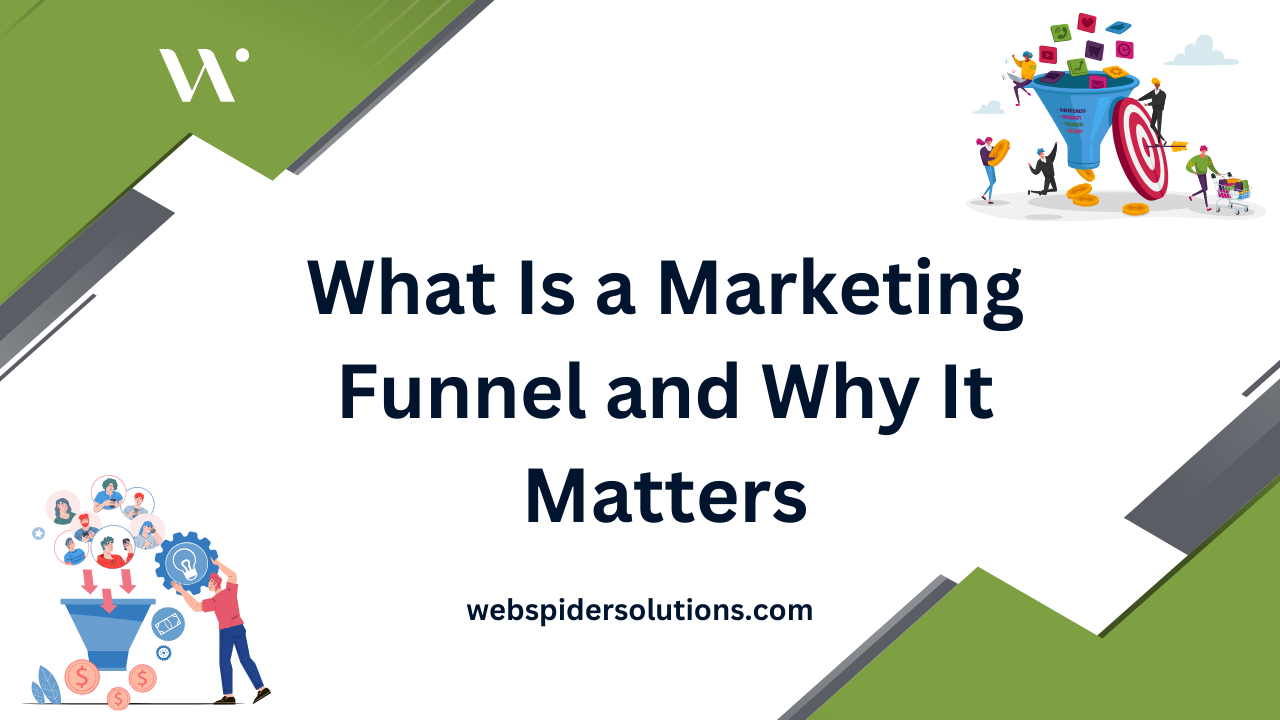
A marketing funnel represents a strategic framework that visually maps how potential customers move through different stages of engagement and purchasing decisions. This systematic model guides businesses in understanding consumer progression from initial brand awareness to final purchase, helping organizations craft targeted messaging at each critical touchpoint.
The marketing funnel essentially functions like a filtering mechanism. Imagine a literal funnel where numerous potential customers enter at the top, but only a select few make it through to the bottom as actual paying customers. At each stage, businesses strategically narrow their audience by providing increasingly specific and relevant information designed to move prospects closer to conversion.
Key Components of a Marketing Funnel typically include:
- Awareness Stage: Where potential customers first discover your brand
- Interest Stage: Prospects begin researching and evaluating your offerings
- Consideration Stage: Potential buyers compare your solution against alternatives
- Conversion Stage: Where interested prospects become actual customers
Pro Tip – Funnel Optimization: Continuously analyze and refine your marketing funnel by tracking conversion rates at each stage, identifying potential drop-off points, and developing targeted strategies to improve customer progression through the purchasing journey.
Conversion Rate Optimization (CRO) plays a crucial role in understanding and improving how effectively your marketing funnel transforms interested prospects into committed customers.
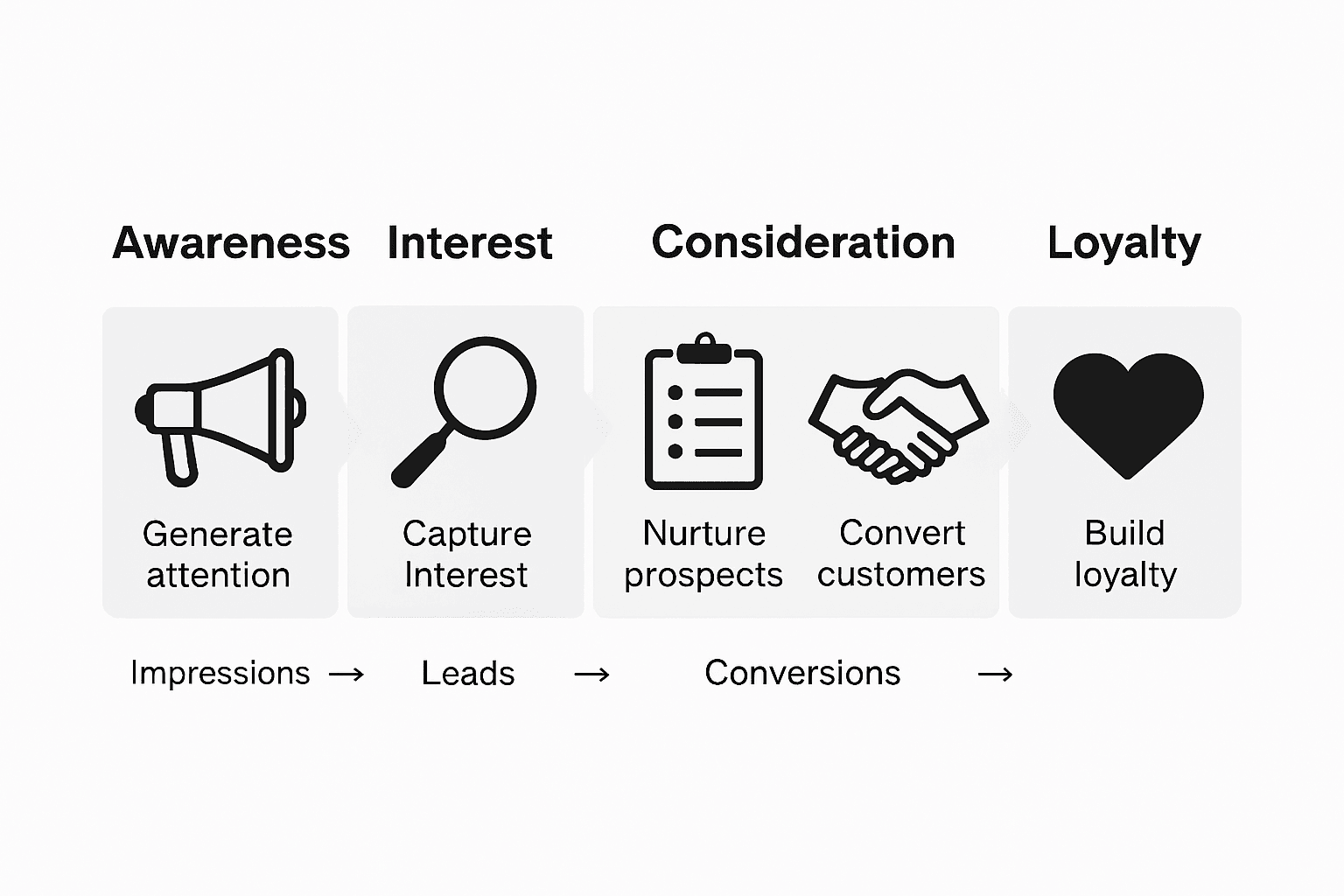
Key Stages of a Marketing Funnel
Marketing funnels are typically structured around several critical stages that systematically guide potential customers from initial awareness to final purchase. Digital marketing experts outline a comprehensive progression through strategic engagement phases, each designed to incrementally move prospects closer to conversion.
The standard marketing funnel generally encompasses five primary stages:
- Awareness Stage: This initial phase focuses on attracting a broad audience and introducing your brand or product. Businesses use strategies like social media marketing, content creation, advertising, and search engine optimization to generate initial interest and visibility.
- Interest Stage: Once potential customers become aware of your brand, they enter the interest phase. Here, prospects actively seek more information, researching your offerings and comparing them against alternatives. Targeted content, educational materials, and engaging storytelling become crucial in maintaining their attention.
- Consideration Stage: At this point, potential customers are seriously evaluating your solution. They’re comparing features, reading reviews, and assessing how your product or service might solve their specific problems. Detailed case studies, product demonstrations, and comparative analyses help prospects make informed decisions.
- Decision Stage: Prospects are now ready to make a purchase but might need a final nudge. Strategies like limited-time offers, testimonials, free trials, and personalized consultations can help convert interested leads into actual customers.
- Post-Purchase/Loyalty Stage: The funnel doesn’t end with a sale. This critical stage focuses on customer retention, satisfaction, and potential future purchases. Lead nurturing strategies play a vital role in transforming one-time buyers into long-term brand advocates.
Pro Tip – Funnel Stage Optimization: Continuously track conversion rates between each funnel stage, identify potential bottlenecks, and develop targeted interventions to improve prospect progression and minimize drop-offs.
This table summarizes key business benefits of optimizing each stage of the marketing funnel:
| Funnel Stage | Optimization Focus | Benefit to Business |
|---|---|---|
| Awareness | Better targeting, visibility | Lower acquisition costs |
| Interest | Engage and educate prospects | Higher lead quality |
| Consideration | Remove friction, provide proof | Faster decision-making |
| Decision | Incentivize purchase | Increased conversion rates |
| Post-Purchase/Loyalty | Nurture relationships | Improved retention and referrals |
Different Types of Marketing Funnels
Marketing funnel strategies vary significantly across different business models and industries, with each type carefully designed to address unique organizational objectives and target audience behaviors. Understanding these variations allows businesses to craft more precise and effective customer acquisition approaches.

Types of Marketing Funnels include:
Here’s a comparison of common marketing funnel types and their best-fit scenarios:
| Funnel Type | Best For | Typical Channels | Sales Cycle |
|---|---|---|---|
| Traditional Sales Funnel | High-touch sales, complex products | In-person, phone, events | Long |
| Digital Marketing Funnel | Broad digital audiences | Social media, email, web | Medium |
| Content Marketing Funnel | Educating or nurturing leads | Blogs, webinars, guides | Medium to Long |
| B2B Marketing Funnel | Multi-stakeholder decision-making | Account-based marketing, LinkedIn | Long |
| E-commerce Marketing Funnel | Fast online conversions | Online ads, retargeting, website | Short |
- Traditional Sales Funnel: Follows a linear progression from awareness to purchase, focusing on direct sales techniques and personal interactions. This model works exceptionally well for high-ticket items or services requiring substantial customer education and relationship building.
- Digital Marketing Funnel: Leverages online channels and digital platforms to guide potential customers through the purchasing journey. Digital marketing strategies utilize tools like social media, email marketing, content marketing, and targeted advertising to create seamless, data-driven customer experiences.
- Content Marketing Funnel: Emphasizes providing valuable, educational content at each stage of the customer journey. This approach focuses on building trust, establishing thought leadership, and nurturing leads through informative resources like blog posts, videos, webinars, and downloadable guides.
- B2B Marketing Funnel: Specifically designed for business-to-business interactions, this funnel typically involves longer sales cycles, multiple decision-makers, and more complex evaluation processes. It requires highly targeted, relationship-driven approaches that address specific organizational challenges.
- E-commerce Marketing Funnel: Optimized for online retail environments, this funnel concentrates on quick conversions, cart abandonment strategies, retargeting, and creating frictionless purchasing experiences through user-friendly interfaces and personalized recommendations.
Pro Tip – Funnel Customization: Continuously analyze your specific business model, target audience characteristics, and conversion metrics to develop a hybrid marketing funnel that combines the most effective elements from different approaches.
How Businesses Use Funnels Strategically
Businesses leverage marketing funnels as strategic frameworks to systematically transform potential customers into loyal brand advocates, utilizing targeted approaches that guide consumers through increasingly focused stages of engagement and decision-making.
Strategic funnel implementation involves several critical methodologies:
Segmentation and Targeting
Companies develop granular customer profiles to create hyper-personalized marketing experiences. By understanding demographic, psychographic, and behavioral characteristics, businesses can craft messaging that resonates precisely with specific audience segments, dramatically improving conversion potential.
Touchpoint Optimization
Conversion rate optimization strategies play a crucial role in refining each interaction point within the marketing funnel. Businesses meticulously analyze customer interactions, identifying potential friction points and developing solutions that smooth the path from initial awareness to final purchase.
Data-Driven Decision Making
Modern marketing funnels rely heavily on analytics and performance metrics. Organizations continuously track key performance indicators like conversion rates, customer acquisition costs, and lifetime value to dynamically adjust their strategies, ensuring maximum efficiency and return on marketing investments.
Customer Journey Mapping
Businesses create comprehensive journey maps that outline every potential interaction and emotional state a customer might experience. This approach allows for anticipatory marketing, where companies proactively address potential concerns and motivations before they become barriers to conversion.
Pro Tip – Funnel Refinement: Regularly conduct customer feedback surveys and analyze drop-off points to continuously optimize your marketing funnel, treating it as a living strategy that evolves with your audience’s changing preferences and behaviors.
Common Mistakes and Optimization Tips
Marketing funnel strategies require continuous refinement to prevent common performance pitfalls, with businesses needing to proactively identify and address potential weaknesses in their customer acquisition processes.
Top Marketing Funnel Mistakes:
- Ignoring Stage-Specific Targeting
Many businesses create generic messaging that fails to resonate at specific funnel stages. Effective marketing requires tailored communication that speaks directly to a prospect’s current mindset and needs. - Insufficient Data Analysis
Technical SEO issues can significantly impact funnel performance, making comprehensive data tracking essential. Organizations must continuously monitor conversion rates, customer behavior, and engagement metrics to identify optimization opportunities. - Poor Lead Nurturing
Businesses often neglect leads by failing to provide consistent, valuable engagement between initial contact and final conversion. This results in prospect disengagement and missed opportunities.
Optimization Strategies:
- Develop hyper-targeted content for each funnel stage
- Implement advanced analytics tracking
- Create personalized follow-up sequences
- Use progressive profiling to gather deeper customer insights
- Regularly test and refine funnel elements
Pro Tip – Funnel Health Check: Conduct quarterly comprehensive audits of your marketing funnel, analyzing conversion rates, drop-off points, and customer feedback to systematically improve performance and reduce acquisition costs.
Transform Your Marketing Funnel Into a Powerful Growth Engine
Struggling to convert prospects effectively at every stage of your marketing funnel? This article highlights common challenges like poor stage-specific targeting, insufficient data analysis, and weak lead nurturing—all critical factors that slow down your customer journey and reduce conversion rates. Understanding the marketing funnel framework is just the first step. To truly optimize your funnel, you need tailored strategies that improve awareness, engagement, and finally, conversion with measurable results.
At Web Spider Solutions, we specialize in elevating your entire funnel. From enhancing your paid campaigns with precise audience targeting in our Paid Advertising Archives to crafting B2B marketing approaches that address complex buyer journeys found in our B2B Marketing Archives, our digital marketing agency delivers comprehensive solutions focused on increasing targeted leads and maximizing revenue. Don’t let drop-offs hold your business back—take control of your customer journey today.
Ready to optimize your marketing funnel for lasting growth? Visit Web Spider Solutions now to request a free SEO audit and learn how our expert strategies can drive your business forward.
Frequently Asked Questions
What is a marketing funnel?
A marketing funnel is a strategic framework that visually represents the stages potential customers go through from initial awareness of a brand to the final purchase. It helps businesses understand and optimize consumer engagement.
What are the key stages of a marketing funnel?
The key stages of a marketing funnel typically include Awareness, Interest, Consideration, Decision, and Post-Purchase/Loyalty. Each stage focuses on different customer needs and interactions to guide them toward conversion.
Why is optimizing a marketing funnel important?
Optimizing a marketing funnel is important because it directly impacts conversion rates. By improving each stage, businesses can maximize customer progression, reduce drop-offs, and ultimately increase sales.
How can businesses track performance in their marketing funnel?
Businesses can track performance in their marketing funnel by analyzing key performance indicators such as conversion rates, customer acquisition costs, and engagement metrics. This data-driven approach helps in refining marketing strategies and improving overall effectiveness.