






Publishing more blog posts without a clear structure is one of the fastest ways to stall your organic growth. Many B2B marketing teams fall into this trap, producing content at volume while watching rankings plateau or drop. The reality is that neglecting pillar strategies can cost you 20 to 50 percent of your organic traffic. SEO content pillars give your content a logical architecture that search engines reward and buyers actually navigate. This article walks you through what content pillars are, how to choose the right topics, how to build clusters, and how to keep the whole system running without losing ground.
Table of Contents
- What are SEO content pillars and why do they matter?
- How to identify pillar topics for your B2B business
- Building your content clusters and linking structure
- Maintenance, updates, and common mistakes to avoid
- What most B2B brands miss about content pillars
- Put SEO content pillars to work for your business
- Frequently asked questions
Key Takeaways
| Point | Details |
|---|---|
| Content pillar basics | Building pillar pages with organized clusters drives sustainable SEO growth. |
| Choosing the right topics | Prioritize topics with both SEO value and business alignment to maximize impact. |
| Smart linking | Every cluster should link back to its pillar and other clusters for optimal authority. |
| Ongoing maintenance | Regular updates and audits can help prevent traffic loss from outdated or poorly linked content. |
| Avoid common pitfalls | Address keyword cannibalization and keep all links and content fresh to protect rankings. |
What are SEO content pillars and why do they matter?
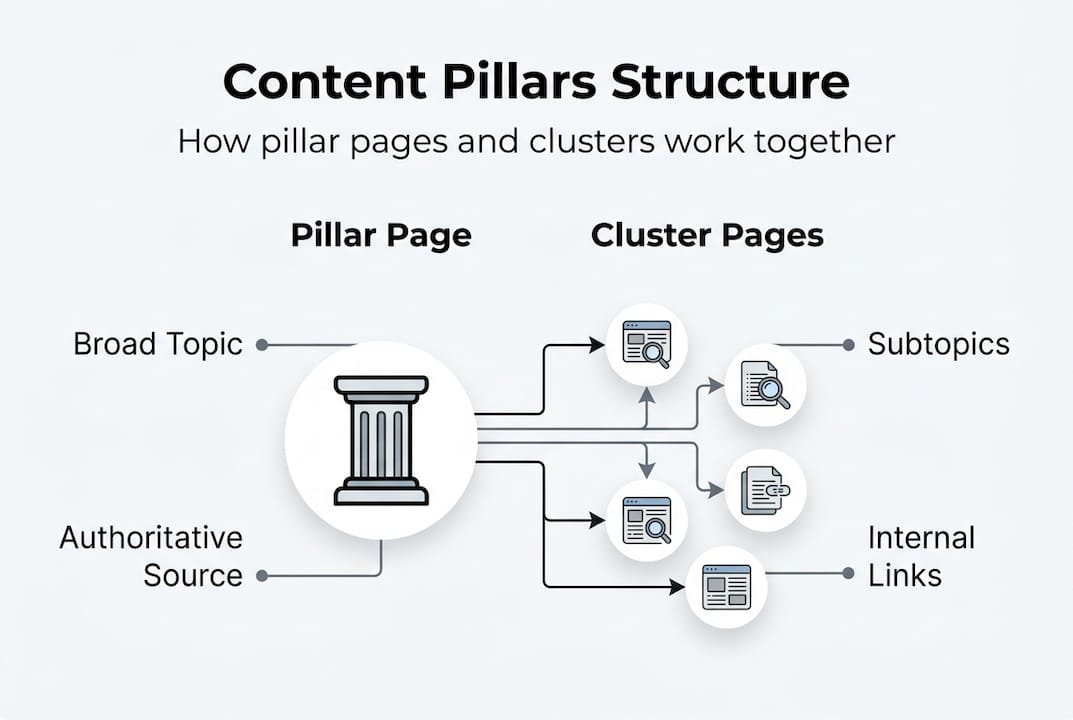
A content pillar is a long-form, authoritative page that covers a broad topic in depth. Around it, you build cluster pages, each one targeting a specific subtopic that links back to the pillar and to each other. This structure is called the pillar-cluster model, and it tells search engines that your site has genuine expertise on a subject rather than scattered opinions.
Traditional blogging treats every post as its own island. You write about a topic, publish it, and move on. The pillar-cluster model is fundamentally different. Every piece of content has a role. The pillar page acts as the hub. Cluster pages act as spokes. Together, they build topical authority, which is the signal search engines use to decide which sites deserve to rank for competitive queries.
For B2B marketers, this matters more than it does for consumer brands. Your buyers are researchers. They read multiple pages before they ever fill out a contact form. A well-structured pillar strategy keeps them on your site longer, answers their questions at every stage of the funnel, and builds the kind of trust that converts.
Here is a quick comparison of the two approaches:
| Approach | Structure | SEO impact | User experience |
|---|---|---|---|
| Traditional blogging | Isolated posts | Fragmented authority | Disjointed navigation |
| Pillar-cluster model | Hub and spoke | Concentrated authority | Guided journey |
The benefits go beyond rankings. A strong content pillars and SEO strategy also improves crawl efficiency, reduces bounce rates, and gives your sales team pages they can actually share with prospects.
As the Guide to Topic Clusters explains, SEO pillars use broad keywords with strong business alignment, not just high search volume. That distinction is critical for B2B, where a keyword with 2,000 monthly searches from decision-makers is worth far more than one with 50,000 searches from students.
Key structural elements of a well-built pillar page include:
- A table of contents with anchor links to each major section
- H2 and H3 headings that map to cluster topics
- Embedded statistics and data points that establish credibility
- FAQ sections that capture featured snippet opportunities
- Internal links to every cluster page in the group
This is why content is king only when it is organized. Raw volume without structure delivers diminishing returns.
“A pillar page should answer every major question a buyer has about a topic, while cluster pages go deeper on each specific question.” This is the editorial standard that separates high-performing pillar strategies from content that just fills up a blog.
How to identify pillar topics for your B2B business
Choosing the right pillar topic is the most important decision in this entire process. Get it wrong and you spend months building content that never gains traction. Get it right and a single pillar can drive qualified traffic for years.
A strong pillar topic meets three criteria. First, it is broad enough to support at least 20 distinct subtopics. Second, it aligns with a core service or solution your business offers. Third, it reflects how your buyers actually search, not just internal jargon.
Here is a simple prioritization framework you can use right now:
- List your top five to seven service areas or product categories.
- For each one, brainstorm 20 questions your buyers ask during the research phase.
- Check search volume using a tool like Ahrefs or Semrush. According to topic cluster research, broad pillar topics should have search volume between 1,000 and 10,000 and support 20 or more subtopics.
- Score each candidate on business fit, search potential, and competitive gap.
- Start with the topic that scores highest on business fit, not search volume.
This last point is where most teams go wrong. They chase volume and end up with pillars that attract the wrong audience. A marketing manager at a cybersecurity firm does not need a pillar about “what is cybersecurity.” They need one about “enterprise cybersecurity compliance strategies” because that is what their buyers are actually researching.
Here is a scoring table to help you evaluate candidates:
| Pillar topic candidate | Business fit (1-5) | Search volume | Subtopic depth | Priority score |
|---|---|---|---|---|
| Enterprise compliance strategies | 5 | 3,200/mo | 25+ subtopics | High |
| What is cybersecurity | 2 | 40,000/mo | 30+ subtopics | Low |
| B2B security audit checklist | 4 | 1,800/mo | 20 subtopics | High |
Pro Tip: Before committing to a pillar topic, ask your sales team what questions prospects ask most in discovery calls. Those questions are your cluster topics, and the theme connecting them is your pillar.
Once you have your shortlist, look at writing SEO content that matches search intent at each stage of the buyer journey. Your pillar should target informational intent, while clusters can mix informational, navigational, and commercial intent. For real-world examples of how this looks in practice, review pillar page examples that show different formats and structures.
Building your content clusters and linking structure
With your pillar topics selected, the next job is to build the cluster content and connect everything with a clean internal linking structure. This is where the strategy becomes tangible and where most of the SEO value is actually created.
Follow these steps to build your clusters systematically:
- Brainstorm cluster topics. For each pillar, list 10 to 15 specific questions or subtopics. Each one becomes a dedicated cluster article.
- Create outlines before you write. Each cluster article should have a clear angle, a target keyword, and a defined link to the pillar page.
- Draft cluster content at depth. Shallow cluster articles undermine the whole structure. Each one should fully answer its specific question.
- Add internal links immediately. Every cluster must link to the pillar page. The pillar must link back to every cluster. This bidirectional structure is non-negotiable.
- Use contextual anchor text. Link on phrases that describe the destination, not generic phrases like “click here.”
According to topic cluster research, the recommended cluster count is 8 to 12 per pillar, with HubSpot advising a minimum of 6 to 10. Fewer than six clusters and the pillar lacks the depth search engines expect. More than 15 and you risk diluting focus.
For a B2B marketing pillar, your clusters might include:
- How to measure content marketing ROI
- B2B content distribution channels compared
- Content marketing KPIs for lead generation
- How to repurpose long-form content for social media
- Building a B2B editorial calendar
Each of these links back to the pillar and to at least two or three other clusters in the group. This creates a web of relevance that search engines can follow and reward. Review the pillar and cluster guidelines for structural best practices that apply to different industries.
Pro Tip: Run an internal link audit every six months. Broken links, orphaned cluster pages, and missing pillar references are silent ranking killers. Tools like Screaming Frog can identify these gaps in under an hour.
Pay close attention to bidirectional linking between your pillar and clusters. One-way links leave authority stranded. Also apply link building best practices to earn external links pointing to your pillar pages, which amplifies the entire cluster’s authority.
Maintenance, updates, and common mistakes to avoid
Building a pillar strategy is not a one-time project. It is an ongoing system. The teams that treat it as a launch-and-forget exercise are the ones who call us six months later wondering why their traffic dropped.

According to topic cluster research, clusters and pillars need quarterly updates to stay competitive, and neglect or keyword cannibalization can cause traffic losses of 20 to 50 percent. That is a significant number for any marketing budget to absorb.
Here is your quarterly maintenance checklist:
- Update statistics, case studies, and data points that have aged out
- Add new FAQ entries based on recent sales conversations or search queries
- Check all internal links and fix any that are broken or redirected
- Review cluster rankings and identify pages that have slipped
- Add new cluster articles if your topic has expanded
- Consolidate or redirect cluster pages that overlap too closely
“Content decay is not dramatic. It is slow, quiet, and expensive. A page that ranked on page one in January can be on page three by October if no one tends to it.”
The most common mistakes we see B2B teams make include:
- Keyword cannibalization: Two or more pages targeting the same keyword compete against each other and split authority. Audit your keyword map regularly to prevent this. Learn how to spot and fix SEO mistakes to avoid before they compound.
- Broken internal links: A cluster page that links to a deleted or redirected pillar loses its authority transfer entirely.
- Outdated cluster content: A cluster article with 2022 statistics signals to both readers and search engines that your site is not actively maintained.
- Missing on-page optimization: Even great cluster content underperforms without proper title tags, meta descriptions, and heading structure. Apply on-page SEO for clusters to every piece in your system.
Pro Tip: Set a recurring calendar reminder for the first week of each quarter labeled “pillar audit.” Assign one team member ownership of each pillar. Accountability prevents the slow drift that causes ranking declines.
What most B2B brands miss about content pillars
After working with B2B companies across multiple industries, one pattern stands out clearly. Most brands focus on building the pillar structure and then stop thinking strategically. They treat the model as a template to fill rather than a living system to develop.
The biggest misconception is that depth means length. A 5,000-word pillar page stuffed with loosely related information is not deep. It is just long. Real depth means answering every meaningful question your buyer has at that stage of their journey, with specificity and evidence. Automation tools can generate volume, but they cannot replace the strategic judgment that decides which questions actually matter to your specific audience.
What experienced marketers call “pillar decay” is the gradual erosion of rankings when content stops being maintained and clusters stop being expanded. You can spot it early by monitoring impressions in Google Search Console. A slow drop in impressions before rankings fall is the warning sign most teams miss.
For real-world pillar examples that show how depth and relevance drive results, the pattern is consistent: the brands that win are the ones treating their pillars as product lines, not publishing projects.
Put SEO content pillars to work for your business
If you have read this far, you understand that a strong pillar strategy requires the right topic selection, disciplined cluster development, clean linking, and consistent maintenance. That is a lot to manage alongside everything else on a marketing manager’s plate.
At Web Spider Solutions, we help B2B companies build and scale pillar-driven SEO strategies that generate compounding organic growth. From our step-by-step SEO strategy guide to fully managed SEO campaigns for business growth, we handle the architecture, content, and ongoing optimization. Understanding SEO search term insights is where every strong pillar strategy starts. Reach out for a free consultation and let us show you what a structured pillar strategy can do for your pipeline.
Frequently asked questions
What is the ideal number of clusters for each SEO content pillar?
Aim for 8 to 12 high-quality cluster articles per pillar. A minimum of 6 can still produce results if each article is thorough, well-linked, and directly relevant to the pillar topic.
How often should pillar pages and clusters be updated?
Review and update your pillar pages and clusters at least once per quarter. Keeping statistics, examples, and internal links current is what separates stable rankings from slow declines.
What is the biggest mistake to avoid with SEO content pillars?
Keyword cannibalization is the most damaging mistake. When multiple pages compete for the same query, they split authority and confuse search engines, which can trigger ranking drops of 20 to 50 percent.
How do I know if a topic is suitable for a pillar?
A topic is ready to become a pillar if it is broad enough to support 20 or more specific subtopics and maps directly to a core service or solution your business provides to buyers.