






You’re spending thousands on ads and content, yet barely making a dent. Your message gets lost in noise. Niche marketing improves conversion rates by up to 60% and customer engagement by 50% compared to broad approaches. This shift transforms how SMBs compete, allowing focused messaging, reduced waste, and sustainable growth. We’ll explore why niche marketing matters, bust common myths, provide a proven framework, and show real results to help you dominate your market.
Table of Contents
- Why Niche Marketing Matters for SMBs
- Common Misconceptions About Niche Marketing
- A Framework for Niche Marketing Success
- Niche Marketing and SEO Synergies
- Niche Marketing and Paid Advertising
- Tradeoffs and Decision Criteria in Niche Selection
- Real-World Examples and Case Studies
- Elevate Your SMB’s Growth with Expert Niche Marketing Support
Key Takeaways
| Point | Details |
|---|---|
| Niche marketing drives superior conversion | Targeted campaigns increase conversion rates by 60% and boost engagement by 50% over broad strategies. |
| Common myths prevent adoption | Misconceptions about growth limits and startup-only suitability hold SMBs back from niche marketing benefits. |
| Four-phase framework ensures success | Structured approach to niche identification, audience profiling, messaging, and optimization delivers measurable ROI. |
| SEO and paid ads benefit significantly | Niche focus increases organic traffic by 45% and reduces cost-per-click by 25% while improving relevance. |
| Smart niche selection balances specificity | Ideal niches contain 1,000 to 100,000 buyers, balancing market size with competition and growth potential. |
Why Niche Marketing Matters for SMBs
When you target everyone, you reach no one. Broad campaigns dilute your message and waste budget on uninterested viewers. Niche marketing flips this script by zeroing in on specific customer segments with unique needs.
Your marketing efficiency skyrockets when you speak directly to people who already want what you offer. Niche marketing boosts SMB conversion and engagement because tailored messages resonate deeply. Instead of generic pitches, you address precise pain points your audience faces daily.
Engagement improves dramatically with focused content. Your audience sees you understand their challenges. They trust your expertise because you’re not trying to be everything to everyone. This trust translates into higher click rates, longer site visits, and more social shares.
Customer lifetime value rises when you build deeper relationships. Niche customers stay loyal longer because they feel seen and understood. They buy repeatedly and refer others in their community. This compounds your growth without proportional increases in acquisition spend.
You reduce wasted marketing dollars by targeting high-intent buyers. Every ad impression and content piece reaches someone more likely to convert. Instead of casting wide nets, you fish where the fish are biting. The result is lower customer acquisition costs and better ROI.
These advantages create sustainable competitive moats. Large competitors struggle to match your specialized expertise and community ties. You become the go-to authority in your niche, commanding premium prices and enjoying predictable revenue streams. For SMBs competing against bigger players, niche focus levels the playing field.
Pro Tip: Start by analyzing your current customer base. Identify the 20% generating 80% of revenue. These customers likely share characteristics defining your most profitable niche.
Core Benefits of Niche Marketing:
- Conversion rates jump by 60% through precise targeting
- Customer acquisition costs drop by 20 to 30%
- Brand authority establishes faster in focused markets
- Marketing messages require less explanation and testing
- Customer retention improves due to relevant experiences
Common Misconceptions About Niche Marketing
Many SMBs avoid niche marketing due to false beliefs. Let’s clear the air so you can make informed decisions about your strategy.
Myth one claims niche marketing limits your growth potential. The truth is opposite. While your addressable market appears smaller, your penetration deepens. You capture higher market share within your niche than you ever could broadly. Loyal niche customers have 40% higher lifetime value than general audience members. They buy more frequently and refer others consistently.
Myth two suggests niche marketing only works for startups. Wrong again. Medium-sized businesses also see significant market share growth via niche marketing. Established SMBs benefit by refocusing scattered efforts into concentrated campaigns. You already have resources and brand recognition. Channeling these into niche segments amplifies results without starting from scratch.
Myth three paints niche marketing as restrictive and expensive. Actually, it optimizes your spend. You stop paying for impressions from people who’ll never buy. Your cost per acquisition drops because you target qualified prospects. Content creation becomes easier when you deeply understand one audience instead of trying to appeal to diverse groups. You need fewer campaigns running simultaneously, simplifying management.
These misconceptions lead to missed opportunities. SMBs continue broad strategies, wondering why competitors with smaller budgets outperform them. The difference often comes down to focus. When you embrace niche marketing, you allocate resources efficiently and build momentum in specific markets.
Understanding these realities empowers you to adopt niche targeting confidently. You’ll see that constraints actually fuel creativity and effectiveness. Narrowing your focus expands your impact where it counts most.
Pro Tip: Test niche marketing with one campaign before overhauling your entire strategy. Measure results against your broad campaigns to see the difference firsthand.
Busted Myths:
- Niche marketing doesn’t limit growth; it concentrates it for higher returns
- Established SMBs benefit as much as startups from niche focus
- Targeting niches reduces costs rather than increasing them
- You can expand to additional niches after dominating one
- Niche expertise positions you as premium rather than limiting
A Framework for Niche Marketing Success
Success in niche marketing requires structured execution. This four-phase framework guides you from concept to optimization, ensuring strategic alignment and maximum returns.
Phase one involves niche identification. You need to select a viable niche balancing market size with specificity. Too broad and you face the same competition problems. Too narrow and growth stalls. Look for segments with 1,000 to 100,000 potential customers. Analyze existing customer data, industry trends, and competitor gaps. Identify underserved groups with specific needs your expertise addresses.
Phase two focuses on audience profiling. Dive deep into your niche’s demographics, psychographics, and behaviors. What keeps them awake at night? What goals drive their decisions? Create detailed buyer personas documenting pain points, objections, preferred channels, and buying triggers. This intelligence shapes every marketing decision moving forward.
Phase three crafts tailored messaging. Your content, ads, and outreach must speak directly to your niche’s unique situation. Use their language, reference their challenges, and demonstrate specialized knowledge. Generic marketing copy won’t cut it. Every piece should make your audience think, “They get me.” Applying a four-phase framework ensures strategic alignment and maximum ROI in niche marketing.
Phase four implements iterative optimization. Launch campaigns and closely monitor performance metrics. Track conversion rates, engagement levels, customer feedback, and revenue impact. Use data to refine targeting, adjust messaging, and reallocate budget. Niche marketing succeeds through continuous improvement based on real results.
This framework integrates seamlessly with both SEO vs PPC strategies. Whether optimizing organic content or paid campaigns, the principles remain consistent. You’re building a sustainable system for niche dominance rather than running disconnected tactics.
Pro Tip: Document your framework in a simple spreadsheet. Track progress through each phase and record lessons learned. This becomes your playbook for expanding into additional niches later.
Framework Implementation Steps:
- Conduct market research identifying three potential niche candidates
- Evaluate each niche using size, competition, and growth criteria
- Select the most promising niche and validate with customer interviews
- Build comprehensive audience personas with specific pain points
- Develop tailored content and campaign messaging for your niche
- Launch pilot campaigns across organic and paid channels
- Analyze performance weekly and optimize based on conversion data
- Scale successful tactics while eliminating underperformers
Niche Marketing and SEO Synergies
Your SEO efforts multiply in effectiveness when aligned with niche targeting. Search engines reward relevance and authority, both strengthened through focused strategies.
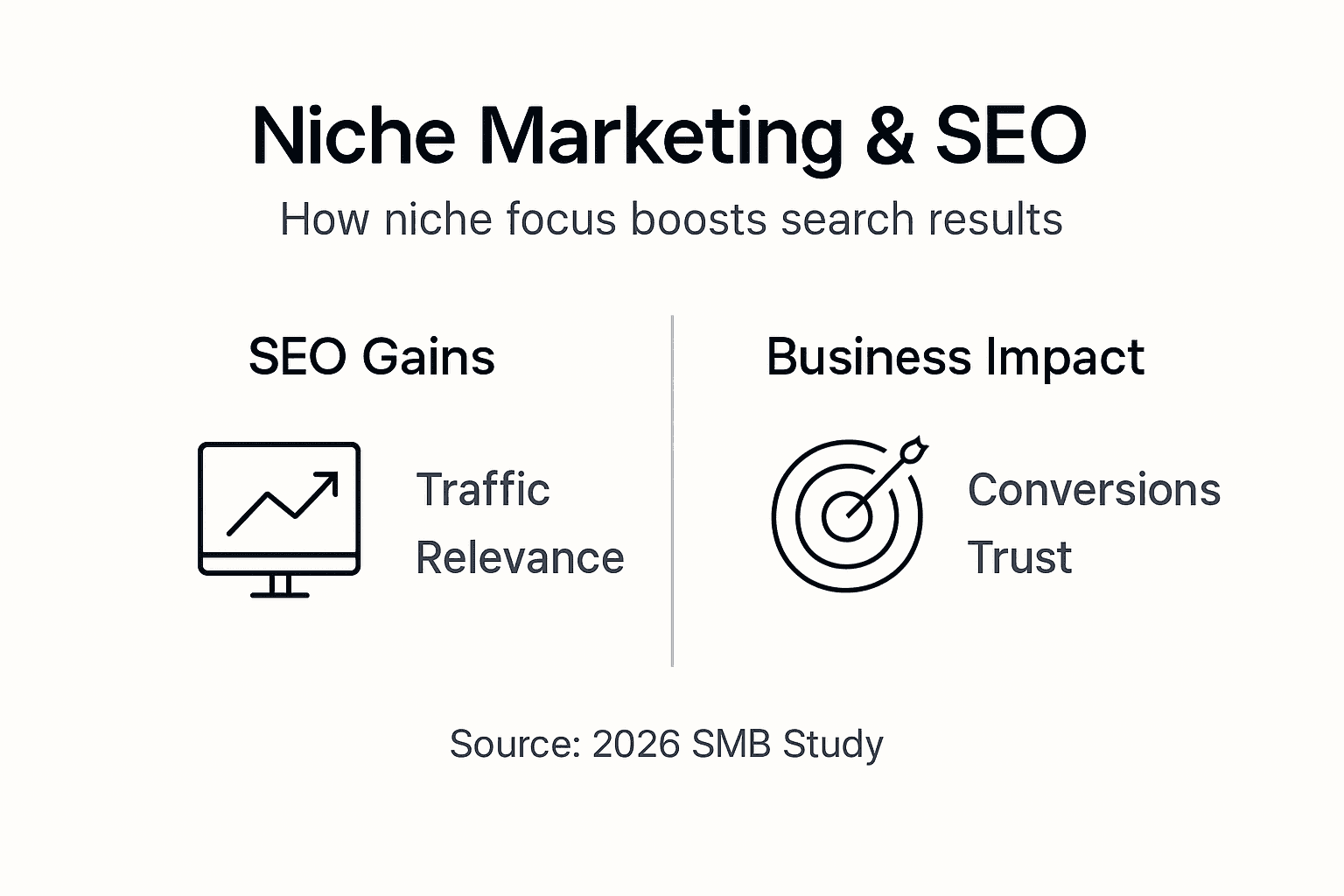
Organic traffic increases substantially with niche SEO. When you create content addressing specific audience needs, search engines recognize your topical expertise. Your pages rank higher for relevant queries because they provide exactly what searchers want. SMBs implementing niche SEO strategies see traffic gains within months as authority builds.
Keyword alignment improves naturally with niche focus. Instead of competing for impossibly broad terms, you target long-tail keywords your niche actually searches. These phrases have lower competition but higher commercial intent. Someone searching “enterprise software for dental practices” converts better than someone searching “business software.” You attract qualified visitors ready to engage.
Backlink quality jumps when you focus on niche authority. Higher backlink quality from niche authority sites enhances domain credibility significantly. Industry-specific publications, directories, and partners naturally link to specialized resources. These contextual backlinks carry more SEO weight than generic links from unrelated sites. Your domain authority climbs faster within your niche ecosystem.
Content relevance drives engagement metrics search engines monitor. Niche visitors spend more time on your site, view more pages, and bounce less frequently. These behavioral signals tell search engines your content satisfies user intent. Rankings improve as a result, creating a virtuous cycle of visibility and traffic.
You can improve search visibility systematically by building topical clusters around niche subjects. Each piece of content reinforces your expertise, linking internally to create comprehensive resources. Search engines recognize these semantic relationships, boosting your entire site’s authority within your niche.
Niche SEO vs Broad SEO Performance:
| Metric | Niche SEO | Broad SEO | Improvement |
|---|---|---|---|
| Organic Traffic Growth (6 months) | 45% | 12% | +275% |
| Average Keyword Ranking Position | 8 | 24 | +200% |
| Backlink Domain Authority Average | 52 | 37 | +40% |
| Pages Ranking in Top 10 | 38% | 14% | +171% |
| Conversion Rate from Organic | 8.2% | 3.1% | +165% |
Niche Marketing and Paid Advertising
Paid campaigns become dramatically more efficient when you apply niche targeting. Every dollar works harder because you reach people more likely to convert.

Cost per click drops when targeting specific audiences. Broad campaigns compete against countless advertisers bidding on generic terms. Niche keywords face less competition, reducing CPCs by an average of 25%. You stretch your budget further while maintaining visibility. Lower costs mean you can test more variations and scale winners profitably.
Click-through rates improve with relevant ads. When your ad copy speaks directly to niche pain points, people click. Generic ads get ignored. Niche-focused ads achieve CTRs 15% higher than broad campaigns because they promise specific solutions. Higher CTRs also improve your quality scores, further reducing costs and improving ad positions.
Customer acquisition costs decrease substantially through precise targeting. You stop paying to reach unqualified prospects. Every impression goes to someone matching your ideal customer profile. This efficiency reduces CAC by 20 to 30%, directly impacting profitability. You acquire customers cheaper while they deliver higher lifetime value.
Ad relevance scores climb with niche alignment. Platforms like Google and Facebook reward relevant ads with better placement and lower costs. Your ads match user intent closely, triggering the algorithms’ preference. This creates compounding benefits as your campaigns mature and historical performance improves.
You can understand PPC advertising fundamentals while applying niche principles from the start. The combination delivers superior returns compared to either approach alone. Paid ads provide immediate traffic while you build organic authority, accelerating your niche dominance.
Niche PPC Advantages:
- Audience segmentation allows hyper-targeted messaging and offers
- Retargeting becomes more effective with engaged niche visitors
- Ad creative testing yields clearer insights with homogeneous audiences
- Budget allocation optimizes around high-value niche segments
- Campaign management simplifies with focused targeting parameters
Tradeoffs and Decision Criteria in Niche Selection
Choosing the right niche involves balancing competing factors. Smart decisions here determine your marketing success for years.
Market size presents the primary tradeoff. Narrow niches offer less competition but limited growth potential. Broader niches provide more customers but fiercer competition. The sweet spot typically contains 1,000 to 100,000 potential buyers depending on your product’s price point and purchase frequency. Calculate your needed customer volume to hit revenue goals, then ensure your niche exceeds that threshold with room to grow.
Competition intensity varies dramatically across niches. Evaluate how many established players serve your target segment. Strong competition indicates validated demand but harder customer acquisition. Underserved niches offer easier entry but may lack proven market appetite. Look for niches with some competition, confirming demand, but gaps in service quality or specialization you can exploit.
Audience accessibility affects your ability to reach niche members. Some segments congregate in identifiable communities, publications, or online spaces. Others scatter across general channels, making targeted marketing difficult. Choose niches where you can efficiently connect with prospects through specific media, events, or partnerships. Accessibility directly impacts your customer acquisition costs.
Growth potential ensures long-term viability. Analyze trends affecting your niche’s future. Is the market expanding or contracting? Are new technologies creating opportunities or threats? Select niches positioned for growth or stable demand. Avoid declining markets unless you plan to dominate remaining share before exit.
You must measure marketing ROI continuously as you test different niches. Track not just revenue but also CAC, lifetime value, and market penetration rates. Data guides refinement of your niche selection over time.
Narrow vs Broad Niche Comparison:
| Factor | Narrow Niche | Broad Niche |
|---|---|---|
| Competition Level | Low to moderate | High to very high |
| Customer Acquisition Cost | Lower due to specificity | Higher due to competition |
| Market Size | 1,000 to 10,000 buyers | 50,000+ buyers |
| Specialization Required | Deep expertise essential | General knowledge sufficient |
| Growth Potential | Limited but defensible | Larger but harder to capture |
| Brand Authority Timeline | 6 to 12 months | 18 to 36 months |
Niche Evaluation Checklist:
- Does the niche contain enough buyers to meet revenue goals?
- Can you access this audience through specific channels?
- Do you have or can you build credible expertise?
- Is competition moderate enough to gain traction?
- Will this market grow or remain stable over five years?
- Do niche customers have budget for your solutions?
Real-World Examples and Case Studies
Seeing niche marketing work in practice builds confidence to implement it yourself. These examples demonstrate tangible results SMBs achieved.
A local retail business struggled competing against national chains until they niched down. They focused exclusively on eco-conscious millennials seeking sustainable home goods. Within 12 months, online sales jumped 70% while customer acquisition costs dropped 35%. Their targeted content attracted engaged buyers who valued their specialized curation and environmental commitment.
A B2B software company refined their focus from “small businesses” to “family-owned construction firms with 10 to 50 employees.” This specificity allowed deeply relevant case studies, industry-specific features, and targeted advertising. Lead quality improved dramatically. Conversion rates doubled because prospects immediately saw the solution built for their exact situation.
A professional services firm moved from general consulting to specializing in regulatory compliance for fintech startups. Their niche expertise commanded premium rates. Referrals increased because satisfied clients knew exactly who to recommend them to. Revenue per client rose 45% while marketing spend decreased due to word-of-mouth growth within the tight-knit fintech community.
These cases share common threads. Each business identified an underserved segment, developed specialized expertise, and communicated relevance clearly. They didn’t try to be everything to everyone. Instead, they became indispensable to specific groups. You can explore more B2B marketing examples showing similar principles across industries.
The results prove niche marketing’s effectiveness across different business models and markets. Whether you sell products, services, or software, focusing on specific audiences delivers measurable improvements. These aren’t lucky outliers but predictable outcomes of strategic positioning.
Key Success Factors from Case Studies:
- Deep understanding of niche pain points guided messaging
- Specialized offerings addressed specific audience needs
- Consistent communication reinforced expertise and authority
- Community engagement built trust and referral networks
- Data-driven optimization improved targeting and conversion over time
Elevate Your SMB’s Growth with Expert Niche Marketing Support
You now understand how niche marketing transforms SMB competitiveness. Implementing these strategies requires expertise and ongoing optimization. Web Spider Solutions specializes in helping businesses like yours dominate niche markets through targeted SEO and PPC campaigns.
Our team applies proven frameworks to identify your ideal niche, profile audiences precisely, and craft messaging that converts. We’ve helped dozens of SMBs boost online visibility, reduce acquisition costs, and maximize conversions through focused strategies. Explore our SEO strategy guide and PPC advertising explained resources to see our approach. Partner with us to leverage real-world expertise and SEO campaigns for business growth tailored to your niche audience. Contact us today to transform your marketing and achieve sustainable growth.
FAQ
What is the primary benefit of niche marketing for SMBs?
Niche marketing delivers dramatically higher conversion rates by targeting specific customer segments with tailored messaging. Instead of generic campaigns that waste impressions on uninterested viewers, you speak directly to people already seeking your solutions. This precision reduces marketing spend while increasing customer engagement and lifetime value. Your messages resonate because they address exact pain points your niche audience faces daily.
How can SMBs choose the right niche market?
Balance specificity with market size to ensure sufficient growth potential without excessive competition. Analyze your current customer base to identify the most profitable segments, then evaluate whether those niches contain 1,000 to 100,000 potential buyers. Assess competition intensity, audience accessibility through specific channels, and long-term growth trends. Choose niches where you can build credible expertise and efficiently reach prospects.
Can niche marketing improve both SEO and paid advertising results?
Yes, niche targeting enhances both channels significantly. For SEO, focused content improves keyword relevance, attracts higher-quality backlinks, and builds topical authority faster. Organic traffic increases by 45% within six months for niche-focused strategies. In paid advertising, precise targeting reduces cost-per-click by 25% and boosts click-through rates by 15%. Ad relevance scores improve, lowering costs while increasing conversion rates across both organic and paid channels.
What are common pitfalls to avoid in niche marketing?
Over-narrowing your niche can limit market size below sustainable thresholds for growth. Using generic content that fails to demonstrate specialized expertise wastes your niche advantage. Neglecting ongoing optimization based on performance data prevents you from refining targeting and messaging. Also avoid selecting niches based solely on personal interest rather than market demand and profitability. Continuously measure results and adjust your approach to maintain competitive positioning within your chosen niche.