






Every digital marketing manager knows the challenge of turning website visits into meaningful interactions, especially in sectors like SaaS and healthcare where expectations run high. Understanding what drives engagement and crafting a seamless user experience is not just a technical goal but a competitive necessity. This guide brings together actionable steps grounded in proven segmentation tactics, data-driven insights, and UX design strategies to help you position your B2B website for measurable impact.
Table of Contents
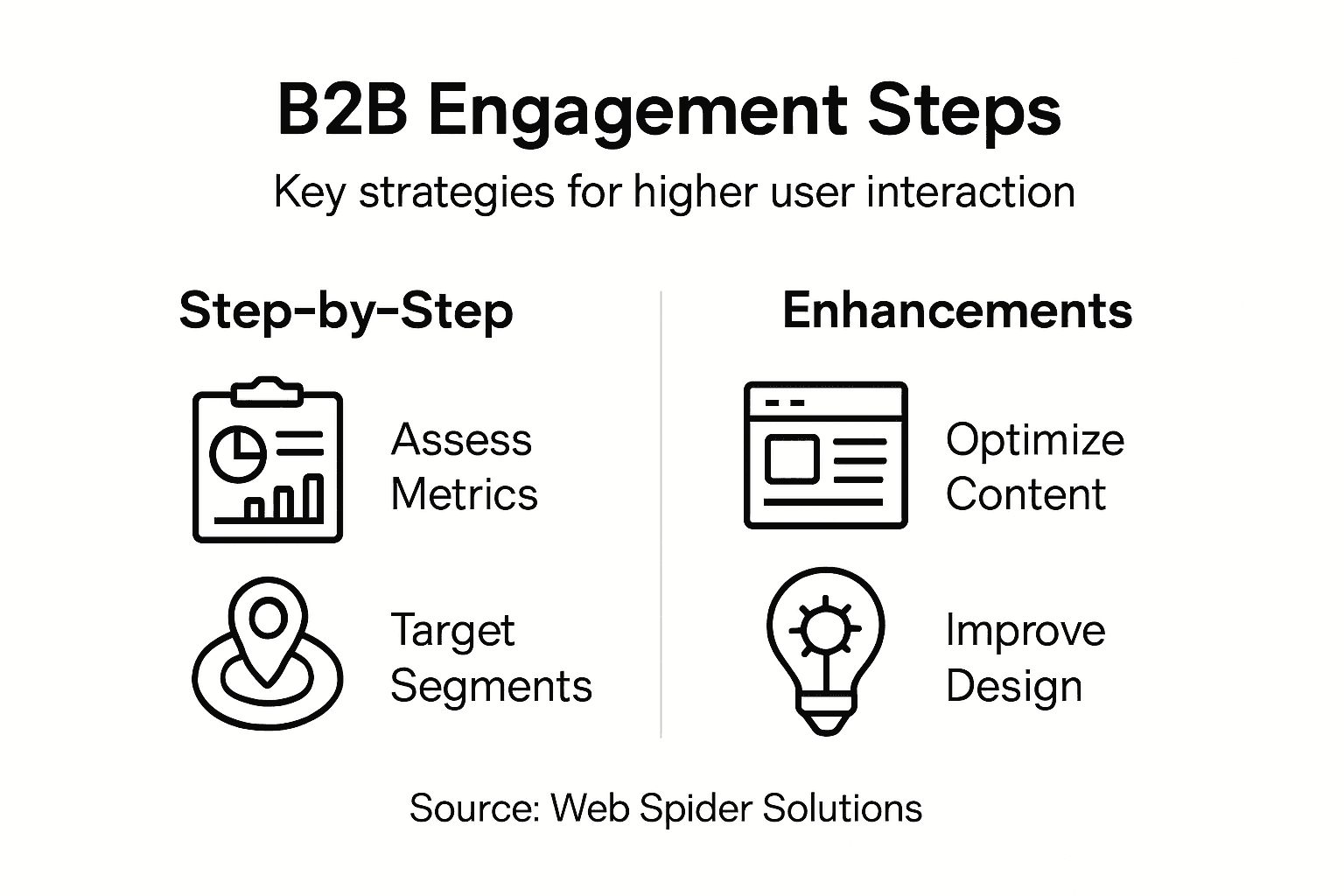
- Step 1: Assess Current Engagement Metrics And User Behavior
- Step 2: Identify And Target High-Value Audience Segments
- Step 3: Optimize Website Content For Interaction And Value
- Step 4: Enhance User Experience Through Design Improvements
- Step 5: Test Engagement Strategies And Analyze Results
Quick Summary
| Key Insight | Explanation |
|---|---|
| 1. Analyze Engagement Metrics | Track your website’s bounce rate, average time on page, pages per session, and conversion rate for insights on user behavior. |
| 2. Target Valuable Audience Segments | Segment your audience based on firmographics, technographics, behaviors, and needs to focus marketing efforts effectively. |
| 3. Enhance Content Engagement | Create interactive and valuable content by addressing audience challenges and including rich media to encourage participation. |
| 4. Optimize User Experience Design | Improve website navigation, mobile responsiveness, and visual hierarchy to create seamless user experiences that drive engagement. |
| 5. Implement Systematic Testing | Use A/B testing to evaluate different content, design, and user flow strategies, ensuring data-driven decisions for web improvements. |
Step 1: Assess Current Engagement Metrics and User Behavior
Before diving into website engagement improvement strategies, you need a comprehensive understanding of your current performance. This means systematically analyzing how users interact with your B2B website and identifying potential areas of optimization.
To start, focus on critical website performance metrics that reveal user behavior. These metrics provide actionable insights into how visitors navigate and engage with your digital platform:
- Bounce Rate: Percentage of visitors leaving after viewing only one page
- Average Time on Page: How long users spend consuming your content
- Pages per Session: Number of pages viewed during a single visit
- Conversion Rate: Percentage of visitors completing desired actions
Utilize web analytics tools to track these metrics consistently. Google Analytics offers robust tracking capabilities that allow you to monitor user interactions in real-time. Pay special attention to pages with high bounce rates or low engagement, as these indicate potential content or design issues.
Understanding user behavior isn’t just about numbers – it’s about discovering why visitors stay or leave.
Compare your metrics against industry benchmarks to contextualize your performance. B2B websites typically aim for bounce rates under 55% and average session durations of 2-3 minutes.
Here is a quick reference for common website engagement metrics and their business implications:
| Metric | What It Measures | Business Value |
|---|---|---|
| Bounce Rate | Single-page visits | Identifies content or UX issues |
| Avg. Time on Page | Duration visitors spend | Indicates content relevance |
| Pages per Session | Site navigation depth | Reveals user interest level |
| Conversion Rate | Desired actions completed | Tracks lead and sales generation |
Pro tip: Segment your website analytics by traffic source, device type, and user demographics to uncover more nuanced engagement insights.
Step 2: Identify and Target High-Value Audience Segments
Successful B2B marketing hinges on understanding and precisely targeting your most valuable audience segments. B2B market segmentation strategies enable you to develop laser-focused marketing approaches that resonate with specific business personas and decision-makers.
To effectively segment your audience, consider these critical dimensions:
- Firmographic Segmentation: Company size, industry, revenue, location
- Technographic Segmentation: Technology stack, software usage, digital maturity
- Behavioral Segmentation: Purchase history, engagement patterns, interaction frequency
- Needs-Based Segmentation: Specific business challenges, strategic objectives
Develop detailed buyer personas by analyzing these segmentation criteria. Use data analytics tools to map out the characteristics of your most profitable clients. Look for common patterns in:
- Demographic information
- Professional roles
- Pain points
- Purchasing behaviors
- Decision-making processes
Not all potential customers are equally valuable – focus your resources on segments with the highest conversion potential.
Utilize intent data and behavioral intelligence to refine your targeting. This means tracking digital signals that indicate a prospect’s readiness to engage or purchase, such as content consumption, search behaviors, and interaction with relevant industry resources.
Pro tip: Continuously update your audience segments by regularly analyzing performance data and tracking shifts in market dynamics.
This summary table highlights key segmentation approaches and their strategic benefits:
| Segmentation Type | Focus Area | Marketing Impact |
|---|---|---|
| Firmographic | Company traits | Enables targeted messaging |
| Technographic | Technology adoption | Tailors product solutions |
| Behavioral | User actions | Optimizes engagement tactics |
| Needs-Based | Business challenges | Increases personalization |
Step 3: Optimize Website Content for Interaction and Value
Creating engaging B2B website content requires a strategic approach that transforms passive visitors into active participants. Website content development involves crafting materials that not only inform but also inspire meaningful interaction with your brand.
Focus on developing content that addresses your audience’s specific needs and challenges:
- Interactive Elements: Embed calculators, assessment tools, and dynamic quizzes
- Rich Media: Include videos, infographics, and animated explainers
- Downloadable Resources: Create whitepapers, case studies, and comprehensive guides
- Expert Insights: Develop thought leadership content with actionable strategies
Ensure your content follows these critical engagement principles:
- Address specific pain points
- Provide clear, actionable solutions
- Use data-driven insights
- Demonstrate tangible business value
- Maintain professional yet conversational tone
Engagement isn’t about volume of content – it’s about delivering precise, compelling value that resonates with your target audience.
Structure your content with clear hierarchies, compelling headlines, and scannable formats. Break complex information into digestible sections, use bullet points, and highlight key insights to maintain reader interest.

Pro tip: Continuously A/B test your content formats and track engagement metrics to understand what truly captures your audience’s attention.
Step 4: Enhance User Experience Through Design Improvements
Designing a B2B website that captivates and converts requires a meticulous approach to user experience. UX design principles are critical in creating intuitive navigation that guides potential clients through their decision-making journey.
Implement these key design strategies to elevate user engagement:
- Intuitive Navigation: Create clear, logical menu structures
- Responsive Design: Ensure seamless experience across all devices
- Visual Hierarchy: Guide users’ attention with strategic layout
- Performance Optimization: Minimize loading times and reduce friction
Focus on these critical design elements that directly impact user experience:
- Simplify complex information
- Use consistent color and typography
- Implement clear call-to-action buttons
- Reduce cognitive load
- Provide immediate value
Great design isn’t just about looking good – it’s about creating effortless paths to information and action.
Pay special attention to your website’s information architecture. Organize content logically, use clear headings, and create smooth transitions between sections. Your goal is to make every interaction intuitive and valuable for B2B decision-makers.
Pro tip: Conduct regular user testing and heatmap analyses to continuously refine your website’s design and user experience.
Step 5: Test Engagement Strategies and Analyze Results
Systematic testing is the cornerstone of continuously improving your B2B website’s engagement performance. A/B testing strategies provide a scientific approach to understanding what truly resonates with your target audience.
Develop a comprehensive testing framework that covers multiple engagement dimensions:
- Conversion Elements: Test headlines, call-to-action buttons, form designs
- Content Variations: Compare different content formats, lengths, and styles
- Visual Design: Experiment with color schemes, layouts, and visual hierarchies
- Navigation Paths: Analyze user flow and interaction patterns
Implement your testing strategy through these structured steps:
- Define clear, measurable hypotheses
- Select specific metrics for evaluation
- Create controlled test variations
- Run tests with statistical significance
- Document and interpret results
Effective testing is about quality of insights, not just quantity of experiments.
Utilize analytics tools to track granular performance metrics. Look beyond surface-level data to understand the deeper behavioral signals that indicate genuine engagement and potential conversion.
Pro tip: Combine quantitative test results with qualitative user feedback to develop a more nuanced understanding of your audience’s preferences.
Boost Your B2B Website Engagement with Expert Digital Solutions
Increasing website engagement starts with understanding your audience and delivering targeted, value-driven content that speaks directly to their needs. This article highlights the challenges of analyzing key metrics like bounce rates, conversion rates, and visitor behavior to optimize engagement. At Web Spider Solutions, we specialize in addressing these pain points through tailored strategies that combine technical SEO, creative content marketing, and user experience enhancements. Our approach helps you transform passive visits into meaningful interactions that support lead generation and sustained growth.
Ready to take your engagement efforts further Explore our Stories Archives – Web Spider Solutions to discover real-world success examples and insights. Don’t let high bounce rates or low session times hold your business back Take the next step now by visiting Web Spider Solutions for a personalized consultation and find out how you can turn your website into a powerful asset that captivates and converts your target B2B audience.
Frequently Asked Questions
How can I analyze current engagement metrics for my B2B website?
Start by using web analytics tools to track key performance metrics like bounce rate, average time on page, and conversion rate. Regularly monitor these metrics to identify patterns and areas for improvement within 30 days.
What are effective audience segmentation strategies to increase engagement?
Focus on firmographic, technographic, and behavioral segmentation to understand your audience better. Create detailed buyer personas that reflect these segments and refine your marketing strategies based on the insights gained.
How can I optimize website content to boost user engagement?
Develop interactive content, such as quizzes and tools, that addresses your audience’s specific pain points. Adjust your content strategy to ensure it’s data-driven and clearly demonstrates tangible business value within a few weeks.
What design improvements can enhance user experience on my B2B website?
Implement intuitive navigation and a responsive design to ensure a seamless user experience. Regularly test loading times and reduce friction points to enhance overall usability in less than two months.
How should I structure my A/B testing for engagement strategies?
Define clear hypotheses and select specific metrics to evaluate during your tests. Test different variations systematically, and analyze results every 2-4 weeks to optimize your website’s engagement tactics effectively.
Recommended