






Small businesses in competitive sectors often invest heavily in their websites yet struggle to rank on search engines. The challenge intensifies as algorithms evolve and competitors adopt sophisticated strategies. This guide delivers practical, actionable methods to boost your website ranking in 2026. You will learn essential technical optimizations, content strategies, link building tactics, and monitoring frameworks that drive measurable improvements. Whether you are fighting for local visibility or national market share, these proven steps help you climb search results and capture more qualified traffic.
Table of Contents
- Understanding The Website Ranking Problem And Preparation Steps
- Executing On-Page And Content Strategies To Boost Ranking
- Building Quality Backlinks And Improving Off-Page Seo Signals
- Monitoring Performance And Adapting Seo Strategies For Lasting Improvement
- Let Web Spider Solutions Help You Improve Your Website Ranking
Key takeaways
| Point | Details |
|---|---|
| Technical foundation matters | Fix site speed, mobile responsiveness, and crawlability before pursuing other SEO tactics. |
| Quality content drives rankings | Create user-focused content that matches search intent and incorporates strategic keywords naturally. |
| Backlinks build authority | Earn high-quality backlinks through outreach, partnerships, and valuable content marketing. |
| Monitor and adapt continuously | Track rankings, traffic, and user behavior to refine strategies and maintain long-term growth. |
| Local SEO amplifies visibility | Optimize for geographic searches to attract nearby customers in competitive markets. |
Understanding the website ranking problem and preparation steps
Website ranking determines how easily potential customers find your business online. In competitive sectors, higher rankings translate directly to increased visibility, traffic, and revenue. Small and medium-sized businesses face unique barriers that prevent them from reaching top positions. Limited budgets restrict advertising spend. Smaller teams lack specialized SEO expertise. Established competitors dominate search results with years of accumulated authority.
Three common obstacles block ranking progress. Technical problems like slow load times and broken pages prevent search engines from properly indexing your site. Weak content fails to satisfy user intent or incorporate relevant keywords effectively. Poor backlink profiles lack the authority signals that search algorithms prioritize. Technical SEO is crucial for site crawlability and ranking. Understanding these fundamentals helps you address root causes rather than symptoms.
Technical SEO encompasses the infrastructure elements that enable search engines to access, crawl, and index your website efficiently. Site speed affects both user experience and search rankings. Mobile friendliness ensures your site performs well on smartphones and tablets. Proper indexing allows search engines to discover and catalog your pages. Core Web Vitals measure loading performance, interactivity, and visual stability.
Before implementing improvement strategies, gather essential tools and establish baselines. Google Search Console monitors site health, indexing status, and search performance. Google Analytics tracks visitor behavior, traffic sources, and conversion patterns. SEO audit software identifies technical errors, broken links, and optimization opportunities. These platforms provide the data foundation for informed decision making.
Complete this preparation checklist before advancing to optimization work:
- Fix critical errors identified in Search Console including 404 pages and server errors
- Improve website speed optimization to achieve load times under three seconds
- Ensure mobile responsiveness across all device types and screen sizes
- Verify that search engines can crawl and index your important pages
- Create an XML sitemap and submit it through Search Console
Pro Tip: Run a comprehensive technical audit quarterly to catch issues before they impact rankings. Small problems compound quickly in competitive markets.
Executing on-page and content strategies to boost ranking
On-page SEO optimizes individual pages to rank higher and earn more relevant traffic. Each element sends signals to search engines about your content’s topic, quality, and relevance. Strategic optimization transforms ordinary pages into ranking assets that attract and convert visitors.
Follow this on-page SEO checklist systematically:
- Craft compelling title tags that include your target keyword and stay within 60 characters
- Write meta descriptions that summarize page content and encourage clicks in 155 characters
- Structure content with H1, H2, and H3 headings that organize information logically
- Optimize images with descriptive file names and alt text that explains visual content
- Create clean URLs that include relevant keywords and avoid unnecessary parameters
- Add schema markup to help search engines understand your content type and context
Content quality and keyword optimization are essential ranking factors. Develop content that directly addresses what users search for when they enter specific queries. Match search intent by understanding whether visitors want information, products, or local services. Incorporate keywords naturally within the first 100 words, headings, and throughout body text. Avoid forcing keywords where they disrupt readability or sound unnatural.

User experience significantly influences rankings as search engines prioritize sites that satisfy visitors. Clear navigation helps users find information quickly without confusion. Mobile responsiveness ensures content displays properly on all devices. Fast loading speeds prevent frustration and abandonment. Readable formatting with short paragraphs, bullet points, and white space improves comprehension.
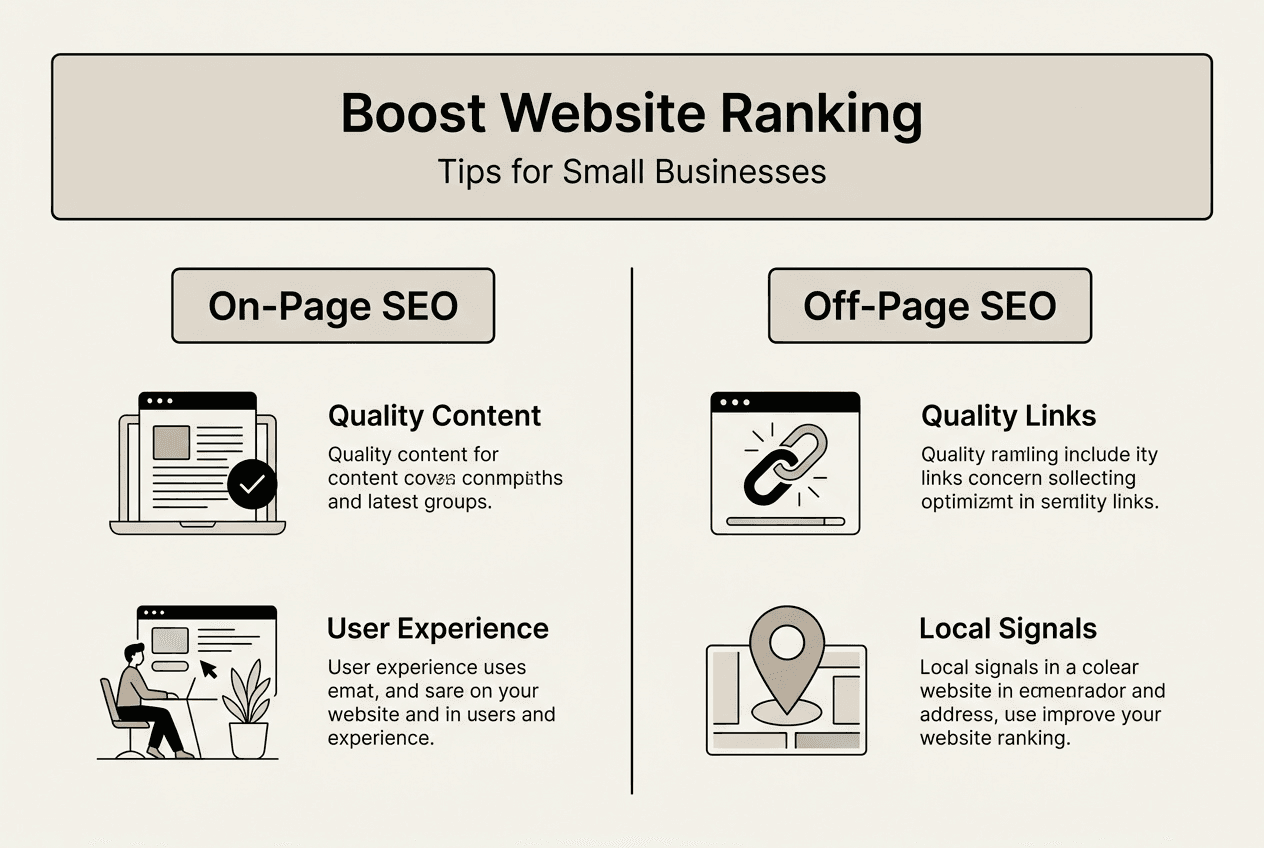
Internal linking strengthens site architecture and distributes authority across pages. Link to related content using descriptive anchor text that tells users and search engines what they will find. Create topic clusters by connecting supporting articles to comprehensive pillar pages. This structure demonstrates topical expertise and keeps visitors engaged longer.
Pro Tip: Update existing content regularly with fresh information, new statistics, and current examples. Search engines favor recently updated pages that maintain relevance over time.
Keyword stuffing damages rankings and creates poor user experiences. Write for humans first, then optimize for search engines. Natural language that flows conversationally outperforms robotic repetition. Focus on covering topics comprehensively rather than hitting arbitrary keyword density targets. Quality signals like time on page and engagement matter more than keyword frequency.
Building quality backlinks and improving off-page SEO signals
Backlinks function as votes of confidence from other websites. When reputable sites link to your content, search engines interpret this as validation of your expertise and authority. High-quality backlinks significantly impact search rankings. The quantity, quality, and relevance of links pointing to your site collectively determine your domain authority.
Three main backlink types serve different purposes:
- Natural backlinks occur when other sites link to your content without prompting because they find it valuable
- Manual outreach backlinks result from deliberate relationship building and content promotion efforts
- Self-created backlinks come from directory submissions, forum signatures, and blog comments
Natural backlinks carry the most weight because they represent genuine endorsements. Manual outreach requires more effort but produces reliable results when done ethically. Self-created links provide minimal value and risk penalties if overused or manipulative.
Implement these strategies to acquire high-quality backlinks systematically:
- Create exceptional content that naturally attracts links through original research, data visualization, or comprehensive guides
- Guest post on industry publications and relevant blogs that serve your target audience
- Build partnerships with complementary businesses for mutual linking opportunities
- Leverage content marketing by promoting valuable resources to journalists and influencers
- Participate authentically in industry communities and forums where links add genuine value
| Backlink Quality | Characteristics | Impact on Rankings |
|---|---|---|
| High quality | Relevant industry sites, strong domain authority, editorial context | Significant positive impact, builds lasting authority |
| Medium quality | Related topics, moderate authority, some editorial value | Modest positive impact, supports overall profile |
| Low quality | Unrelated sites, weak authority, spammy context | Minimal or negative impact, risks penalties |
Avoid low-quality or spammy links that trigger algorithmic penalties or manual actions. Link farms, paid link schemes, and automated link building violate search engine guidelines. These tactics may produce short-term gains but cause long-term damage that takes months to recover from. Search engines have become sophisticated at detecting manipulative link patterns.
Pro Tip: Personalize outreach messages by referencing specific content on the target site and explaining how your resource adds value for their audience. Generic templates get ignored while thoughtful messages build relationships.
Successful building backlinks effectively requires patience and relationship focus. Start conversations rather than immediately requesting links. Provide value first through helpful comments, social shares, or collaborative content. Build genuine connections with industry peers who may naturally link to your work over time. This foundation supports sustainable link acquisition that compounds as your network expands.
Monitoring performance and adapting SEO strategies for lasting improvement
Tracking SEO progress reveals what works, what needs adjustment, and where opportunities exist. Without measurement, you operate blindly and waste resources on ineffective tactics. Strategic monitoring transforms raw data into actionable insights that guide continuous improvement.
Monitor these key metrics consistently:
- Keyword rankings for target terms across search engines and locations
- Organic traffic volume and trends over weekly and monthly periods
- Bounce rate indicating whether visitors find content relevant and engaging
- Conversion rate showing how effectively traffic turns into leads or sales
- Page load speed and Core Web Vitals affecting user experience
- Backlink acquisition rate and profile quality over time
Google Analytics provides comprehensive traffic data including sources, behavior flows, and conversion paths. Search Console reveals search performance, indexing status, and technical issues. SEO platforms like SEMrush or Ahrefs offer competitive analysis, keyword tracking, and backlink monitoring. Combining these tools creates a complete picture of SEO health.
Read data by correlating SEO actions with observable results. When you publish new content, track ranking improvements for target keywords within four to eight weeks. After fixing technical issues, monitor crawl statistics and indexing rates in Search Console. Following link building campaigns, watch for authority score increases and referral traffic growth. Establish cause and effect relationships between your efforts and outcomes.
| Metric | Target Range | Action if Below Target |
|---|---|---|
| Organic traffic growth | 10-20% monthly | Audit content quality, expand keyword targeting, improve technical SEO |
| Average session duration | 2-4 minutes | Enhance content depth, improve internal linking, reduce page load times |
| Conversion rate | 2-5% | Optimize calls to action, improve page relevance, simplify conversion paths |
Common SEO mistakes undermine ranking progress. Neglecting mobile optimization alienates the majority of searchers who use smartphones. Ignoring technical errors allows problems to accumulate and harm visibility. Publishing thin content fails to satisfy user intent or compete with comprehensive competitors. Buying links violates guidelines and invites penalties.
Troubleshoot ranking drops by identifying the timing and scope of changes. Sudden drops across all keywords suggest technical issues or penalties. Gradual declines indicate increasing competition or content staleness. Drops for specific keywords may reflect algorithm updates prioritizing different ranking factors. Regular monitoring and adaptation drive SEO success over time.
Pro Tip: Set realistic expectations by understanding that competitive keywords take six to twelve months to rank. Focus on quick wins with long-tail keywords while building authority for broader terms. This balanced approach maintains momentum while pursuing ambitious goals.
Update your SEO guide for small businesses quarterly based on performance data and industry changes. Refresh underperforming content with new information and better optimization. Double down on strategies producing strong results. Abandon tactics that consume resources without delivering returns. Continuous adaptation keeps your approach aligned with evolving algorithms and competitive dynamics.
Let Web Spider Solutions help you improve your website ranking
Improving website ranking requires expertise, time, and consistent effort that many small business owners struggle to maintain alongside operational demands. Web Spider Solutions specializes in delivering proven SEO strategies tailored specifically for competitive business sectors. Our comprehensive SEO strategy guide outlines essential preparation steps that position your site for sustainable growth.
Our SEO campaigns combine technical optimization, content development, and strategic link building to drive measurable traffic increases. We leverage advanced analytics and competitor research to identify opportunities your competitors miss. Our AI SEO services case studies demonstrate how cutting-edge technology accelerates ranking improvements and delivers exceptional ROI. Partner with our team to transform your website into a powerful lead generation asset that dominates search results in your market.
FAQ
How long does it typically take to see improvements in website ranking?
SEO improvements typically require three to six months before producing noticeable ranking gains. Competitive keywords and saturated markets extend this timeline while less competitive niches may show faster results. Consistent optimization work and strategic adaptation accelerate progress by compounding small improvements over time.
What are the most important SEO ranking factors small businesses should focus on?
Prioritize technical SEO fundamentals including site speed, mobile responsiveness, and proper indexing. Quality content that matches user intent and incorporates relevant keywords naturally drives organic traffic. High-quality backlinks from authoritative sites build domain authority. Mobile user experience affects both rankings and conversion rates significantly.
How can I avoid common SEO mistakes that hurt my rankings?
Avoid keyword stuffing by writing naturally for human readers rather than search engines. Eliminate duplicate content across your site that confuses search engines and dilutes authority. Reject low-quality backlinks from spammy sites that trigger algorithmic penalties. Regularly audit site health using Search Console and address technical errors promptly before they compound.
Is local SEO important for competitive small businesses?
Local SEO dramatically improves visibility for businesses serving specific geographic areas by optimizing for location-based searches. It drives qualified foot traffic from nearby customers actively searching for your services. Critical elements include Google Business Profile optimization, local citations, and location-specific content. Competitive sectors benefit especially from local SEO for businesses strategies that capture high-intent local searchers.