





TL;DR:
- PPC provides immediate visibility and lead generation for small businesses.
- Combining PPC and SEO creates a powerful hybrid strategy for long-term growth.
- Proper campaign structure and automation maximize ROI and competitive advantage.
Smaller businesses often assume that landing at the top of Google search results is a game reserved for companies with massive budgets. That assumption is wrong. Pay-per-click (PPC) advertising gives you a seat at that table from day one, and unlike search engine optimization (SEO), it does not make you wait months for traction. Immediate top-of-page visibility for high-intent buyers is one of PPC’s most powerful advantages. This article breaks down exactly what PPC is, how it works, and how you can structure it to generate real leads and revenue, even in the most competitive markets.
Table of Contents
- Understanding PPC: What it is and how it works
- Immediate visibility and lead generation: Why PPC matters for SMBs
- How to structure winning PPC campaigns for maximum ROI
- How PPC and SEO work together: A hybrid strategy for long-term growth
- Why most SMBs still overlook PPC’s true potential
- Level up your growth with expert PPC strategies
- Frequently asked questions
Key Takeaways
| Point | Details |
|---|---|
| PPC delivers instant results | Well-run PPC campaigns can drive qualified traffic and leads for SMBs within days instead of months. |
| Targeting is precise and scalable | PPC empowers businesses to target by intent, location, and behavior for better return on investment. |
| Best outcomes blend PPC and SEO | A hybrid digital marketing approach leverages PPC for fast wins and SEO for long-term growth. |
| Smart automation maximizes efficiency | AI-powered bidding and audience segmentation help SMBs compete and optimize campaigns at scale. |
Understanding PPC: What it is and how it works
PPC, short for pay-per-click, is an online advertising model where you pay only when someone clicks your ad. No click, no charge. That alone makes it fundamentally different from traditional media buys where you pay for exposure whether or not anyone acts. You can learn more about how PPC advertising works and why it appeals to budget-conscious business owners.
The two dominant platforms are Google Ads and Microsoft Advertising (formerly Bing Ads). Google commands the lion’s share of search volume, but Microsoft’s platform often delivers lower cost-per-click with a slightly older, higher-income user base. Many SMBs run both.
When someone types a search query, an auction fires in milliseconds. Your ad rank is shaped by three factors: your bid amount, your Quality Score (a composite of ad relevance, expected click-through rate, and landing page experience), and your ad extensions. Winning the auction does not always mean bidding the highest. A tightly written, highly relevant ad can outrank a bigger spender.
Key targeting options available to you:
- Location targeting: Show ads only to users in your city, region, or radius
- Device targeting: Adjust bids for mobile vs. desktop based on where your buyers convert
- Demographic targeting: Filter by age, income level, or household size
- Intent targeting: Reach users actively searching for what you sell
- Remarketing: Re-engage past website visitors who did not convert
AI-powered smart bidding has largely replaced manual bid management. Tools like Google’s Target CPA (cost per acquisition) or Target ROAS (return on ad spend) analyze thousands of real-time signals, device, time of day, search history, and adjust bids automatically. For SMBs without dedicated PPC analysts, this automation closes a major gap.
| Targeting type | Best use case | Control level |
|---|---|---|
| Keyword match types | Reach buyers by search intent | High |
| Location radius | Drive local foot traffic or leads | High |
| Demographic filters | Focus spend on ideal customers | Medium |
| Smart bidding | Optimize for conversions at scale | Automated |
| Remarketing lists | Re-engage warm audiences | Medium |
Pro Tip: Before turning on any campaign, verify that your landing page directly matches the promise in your ad. A mismatch between your ad and the page destroys your Quality Score and wastes every dollar you spend.
Getting familiar with PPC basics early on saves you from costly mistakes that most first-time advertisers make.
Immediate visibility and lead generation: Why PPC matters for SMBs
Once you know the PPC basics, the next question is: why should a smaller business prioritize PPC, especially when budgets are tight?
The answer is speed. A brand new business with zero domain authority and no organic rankings can launch a Google Ads campaign on a Monday and appear at the top of page one by Tuesday morning. Top-of-SERP placement instantly is achievable for any business, regardless of how long its website has been live. SEO, in contrast, often takes six to twelve months to show meaningful movement.
PPC’s advantages go beyond just showing up fast. Consider a local law firm entering a competitive metro market. They cannot wait a year for SEO to kick in. A well-structured PPC campaign targeting high-intent keywords like “personal injury lawyer near me” puts them in front of buyers ready to call right now. That is the difference between a lead and a missed opportunity.
“Paid search gives small businesses the ability to look just as credible and visible as national brands, the moment a potential customer starts searching.”
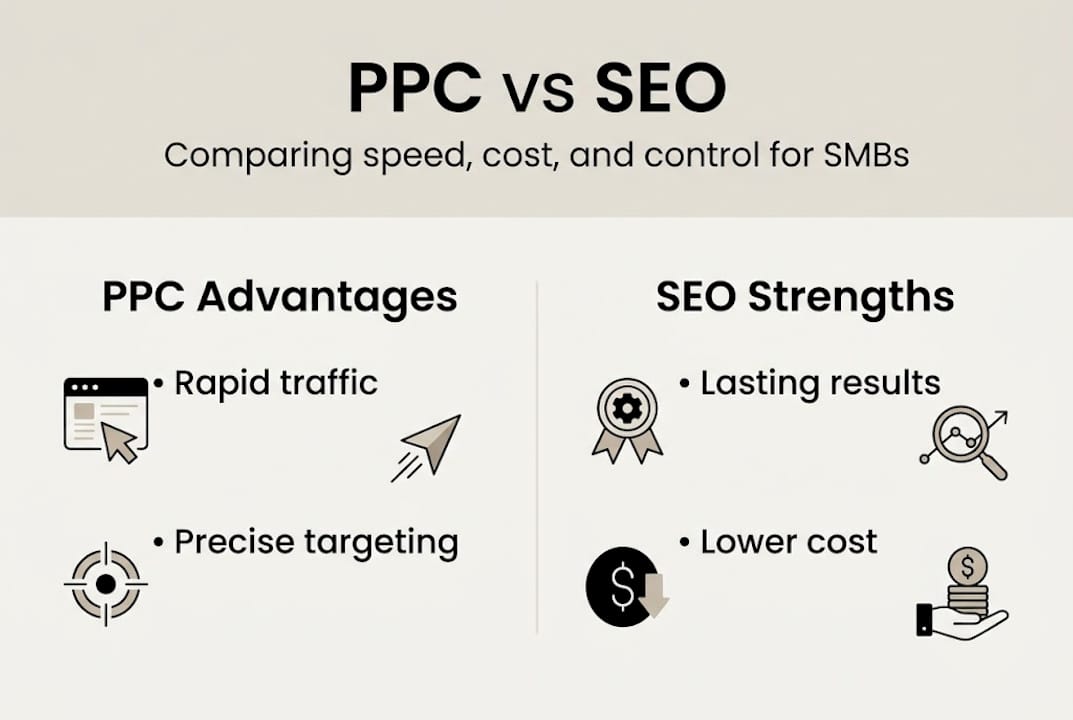
Here is a direct comparison between PPC and SEO so you can see when each channel fits:
| Factor | PPC | SEO |
|---|---|---|
| Time to visibility | Hours to days | Months to years |
| Cost structure | Pay per click | Time and resource investment |
| Scalability | Instant budget scaling | Gradual compounding |
| Data feedback | Real-time | Slower trend data |
| Market testing | Rapid message testing | Hard to test quickly |
PPC also functions as a low-risk market research tool. You can test a new service offering, a different geographic market, or a messaging angle in days, not quarters. If the numbers do not work, you pause the campaign and lose nothing more than a modest test budget.
The PPC advantages for business growth extend across virtually every industry, from professional services to e-commerce. You are not buying eyeballs. You are buying intent.
Why SMBs specifically benefit from PPC:
- Compete directly with larger, established brands on the same search results page
- Generate leads before organic presence is built
- Control exactly how much you spend each day
- Target hyper-local buyers with precise geographic filters
- Pause, adjust, or scale campaigns instantly based on performance
Understanding the full PPC benefits for SMBs helps you see why this channel belongs in your growth plan from the start, not as an afterthought.
How to structure winning PPC campaigns for maximum ROI
Seeing the power of PPC is motivating, but structuring it right is what produces real returns. Most wasted ad spend comes not from the platform itself, but from campaigns built without a clear framework.

Start with revenue goals, not keywords. Know exactly how much a new customer is worth to your business. That number determines your maximum allowable cost per lead and guides every bidding decision you make. Starting with revenue goals and buyer intent segmentation, not keyword lists, is the foundation that separates profitable campaigns from money pits.
Follow this sequence to build campaigns that convert:
- Define your revenue target and acceptable cost per acquisition (CPA) before touching the platform
- Segment your audience by intent (ready to buy vs. researching) and build separate ad groups for each
- Write ad copy that speaks directly to the buyer’s pain point, not your product’s features
- Build dedicated landing pages that mirror the ad’s promise, eliminating any friction between click and conversion
- Install clean conversion tracking so you measure real business outcomes, not just clicks
- Activate smart bidding once your campaign has at least 30 to 50 conversions, giving the algorithm enough data to optimize effectively
- Add negative keywords weekly to prevent wasted spend on irrelevant searches
Pro Tip: Consolidate your campaigns rather than fragmenting them into dozens of tiny ad groups. Smart bidding algorithms need volume to learn. Too many small campaigns starve the algorithm of data and reduce efficiency.
PPC best practices tell you what to do. But regular testing tells you what actually works for your specific audience. Test one variable at a time, headline, call to action, or landing page layout, so you know exactly what moved the needle.
Also review the PPC campaign benefits and consider how the PPC strategies for SMBs can be adapted to your specific industry context. Tactics that work for a SaaS company differ meaningfully from those that work for a regional contractor.
For a practical reference on structuring PPC campaigns, the core principle stays consistent: align every element of your campaign from ad copy to landing page to the exact moment your buyer is experiencing.
How PPC and SEO work together: A hybrid strategy for long-term growth
Of course, paid visibility is just part of the puzzle. Let’s see why PPC and SEO are even stronger together.
Thinking of PPC and SEO as competing priorities is one of the most common mistakes SMBs make. They are not rivals. They are partners. SEO builds a long-term foundation of organic authority and traffic. PPC delivers immediate wins for new product launches, seasonal campaigns, or markets you are just entering. Running both at once gives you coverage across the full timeline.
Here is what a hybrid strategy actually looks like in practice:
- Use PPC to test keywords before investing SEO resources into content creation
- Apply PPC conversion data to identify which keywords signal buyer intent, then build organic content around those topics
- Maintain PPC on competitive keywords where SEO alone cannot guarantee top placement
- Pull back PPC spend on keywords where you already rank organically in positions one or two
- Track attribution across both channels to understand how they work together in your buyer’s journey
“PPC data is arguably your best keyword research tool. Real click and conversion data tells you what your buyers actually respond to, which no third-party keyword tool can replicate.”
The smartest hybrid PPC and SEO approach also includes unified conversion tracking. Many SMBs track online form fills but ignore phone calls, in-store visits, or offline sales that originated from a paid click. Enhanced conversion tracking closes that gap by connecting ad spend to real business revenue, not just digital micro-conversions.
For a clear breakdown of when to lean on each channel, the SEO vs PPC comparison breaks down the tradeoffs in practical terms. The SEO and PPC comparison goes further, showing how blending both produces compounding returns that neither channel achieves alone.
The bottom line: an SMB relying entirely on organic search is gambling on an algorithm. An SMB relying entirely on paid search is bleeding money the moment budgets tighten. The hybrid model gives you speed now and stability over time.
Why most SMBs still overlook PPC’s true potential
Here is something most marketing blogs will not say plainly: the biggest barrier to PPC success for small business owners is not budget. It is confidence.
Many owners write off PPC as something only large brands with dedicated teams can afford to run profitably. That thinking cost them real revenue. The platforms have changed dramatically. Smart bidding, automated creative testing, and audience signals have leveled the playing field significantly. A $1,500 monthly budget, managed well, can outperform a $15,000 budget managed poorly.
The real risk is not spending money on PPC. It is the opportunity cost of ignoring it while competitors use it to dominate your market. Every search query your ideal customer runs, and clicks a competitor’s ad, is a lead you did not get. Understanding PPC’s ROI potential reframes it from a cost to an investment with measurable returns.
SMBs that commit to learning the mechanics, or partner with people who already know them, consistently outpace those that default to “let’s just do SEO.” The data, testing speed, and targeting precision that PPC provides also make your entire marketing operation smarter, including your organic strategy.
Level up your growth with expert PPC strategies
If you are ready to use PPC’s full potential, expert help can bridge the gap between learning and winning. At Web Spider Solutions, we build custom PPC campaigns designed around your revenue goals, not just clicks. We work with SMBs in competitive industries to structure ad spend that converts, from search and display to remarketing campaigns that bring warm leads back. Explore how PPC can transform your business and learn how our team approaches PPC ROI for SMBs. If you want to see the benefits of PPC applied to your specific market, reach out for a consultation and let’s build a strategy that wins.
Frequently asked questions
What is PPC and how does it work for businesses?
PPC, or pay-per-click, is an online advertising model where you pay only when someone clicks your ad. Your ad rank is determined by your bid, Quality Score, and ad extensions, which together decide where and when your ads appear in search results.
How quickly can PPC generate results for small businesses?
PPC campaigns can drive targeted traffic and top search visibility within hours to days of launch, making it far faster than SEO for generating early-stage leads and exposure.
Is PPC more expensive than SEO?
PPC requires ongoing spend for every click, while SEO demands time and content investment but compounds over time. Short term, PPC costs more per lead; long term, a hybrid PPC and SEO approach typically delivers the strongest overall ROI.
Can PPC and SEO work together to grow my business?
Absolutely. PPC complements SEO by delivering fast wins and keyword data while organic rankings build, and together they maximize reach, conversion data, and long-term authority for most SMBs.