

TL;DR:
- Content marketing generates three times more leads at 62% lower cost, yet many B2B organizations lack strategic focus. It builds authority, nurtures the buyer journey, and offers long-term value by leveraging insights, formats, and emerging technologies like AI and video. High-performing teams optimize measurement, repurpose content strategically, and balance demand capture with thought leadership to sustain growth.
Content marketing generates 3x more leads than outbound marketing at 62% lower cost, yet most B2B organizations still treat it like a side project. If you’re a marketing manager or business owner wrestling with tight budgets, scattered efforts, and unclear ROI, you’re not alone. This guide cuts through the noise and walks you through the strategies, tools, and frameworks that actually move the needle, from building your foundational content engine to leveraging AI and video for outsized results in 2026.
Key Takeaways
| Point | Details |
|---|---|
| Content marketing scales B2B growth | It generates three times more leads at a much lower cost than outbound marketing. |
| Effective strategies combine formats | Success relies on blending SEO, thought leadership, video, and email for full-funnel results. |
| Overcoming challenges yields better ROI | Tackling resource, measurement, and conversion issues sets top performers apart. |
| AI and video transform results | Adopting AI tools and leveraging video unlock next-level marketing efficiency and ROI. |
| Continuous measurement drives improvement | Tracking and optimizing metrics ensures your content engine performs consistently. |
Why content marketing matters for B2B growth
B2B buying cycles are long, complex, and involve multiple decision-makers who do significant research before ever speaking to a salesperson. Traditional outbound tactics like cold calls and display ads interrupt that process. Content marketing works with it.
When your target buyers search for solutions, they find your blog post, your case study, your comparison guide. You’ve already built trust before the first conversation. That trust compounds over time, making content marketing one of the few strategies that gets more cost-effective the longer you run it.
The numbers back this up. Content marketing generates 3x more leads than outbound marketing at 62% lower cost. And adoption is nearly universal: 97% of B2B marketers have a content strategy, with 61% reporting improvement in effectiveness year over year.
“Content marketing is the only marketing left.” That quote, often attributed to Seth Godin, reflects a simple reality: buyers tune out ads, but they actively seek out helpful content.
Still, widespread adoption doesn’t mean widespread success. Many B2B teams publish content without a clear strategy, buyer focus, or distribution plan. The gap between having a content strategy and having an effective one is exactly where competitive advantage lives.
Here’s what effective B2B content marketing actually does:
- Builds authority in your niche, so buyers trust you before they’ve spoken to your sales team
- Reduces customer acquisition cost over time by generating organic traffic and inbound leads
- Supports the full buyer journey, from awareness through decision, with content mapped to each stage
- Creates compounding value, since a well-optimized blog post published today can generate leads for years
Understanding why content works is the foundation you need before diving into the specific strategies and channels that best support B2B marketing strategies for sustainable growth.
Core pillars of an effective content marketing strategy
Building a content marketing engine that actually drives results requires more than publishing articles. You need a structured framework that connects audience research, content creation, distribution, and measurement into one coherent system.
Here are the foundational pillars, in the order you should build them:
- Define your ideal customer profile and buyer journey stages. Map the awareness, consideration, and decision stages for each persona. A CFO and a procurement manager have very different content needs even when buying the same product.
- Conduct keyword and topic research. Identify what your buyers are searching for and align content topics to those queries. SEO-driven content is the backbone of organic discovery.
- Create content across formats. Core mechanics include SEO-optimized blogs, case studies, ebooks, email nurturing sequences, video, and multi-channel distribution across social platforms and podcasts, all tracked with analytics tied to conversions.
- Build a distribution and promotion strategy. Publishing is not distributing. Each piece of content should have a deliberate plan for email, LinkedIn, organic search, and paid amplification.
- Track, analyze, and iterate. Use conversion data, not just traffic, to judge what’s working. Staying current with content marketing trends ensures your strategy evolves with buyer behavior.
Here’s a quick comparison of the most common B2B content formats and how they perform across key objectives:
| Content type | Best for | Buyer stage | Distribution channel |
|---|---|---|---|
| SEO blog posts | Organic traffic, brand awareness | Awareness | Search, social |
| Case studies | Trust-building, proof of results | Consideration/Decision | Email, sales, website |
| Ebooks/whitepapers | Lead generation, gating | Awareness/Consideration | Paid, email, SEO |
| Video (explainer, testimonial) | Engagement, product clarity | All stages | YouTube, LinkedIn, web |
| Email newsletters | Nurturing, retention | Consideration/Decision | Owned list |
| Thought leadership articles | Authority, differentiation | Awareness/Consideration | LinkedIn, PR, SEO |
Pro Tip: Don’t try to dominate every channel at once. Pick two or three formats based on your team’s strengths and your audience’s preferences. Master those before expanding. A tight, well-distributed email newsletter consistently outperforms a scattered 10-channel strategy every time.
Following solid email marketing best practices in particular can turn your newsletter from a low-priority send into one of your highest-converting content assets.

Top challenges and how high-performers overcome them
Building a plan is one thing. Knowing what hurdles to anticipate and how top teams clear them is just as critical to long-term success.
The most common pain points are well-documented. Top challenges include creating content that actually converts (cited by 40% of marketers), resource constraints (39%), and measuring effectiveness (33%). These aren’t small problems. They explain why only 29% of B2B marketers rate their content efforts as extremely or very effective.
Here’s how high-performers approach each challenge differently:
- Creating content that converts: Top teams tie every content piece to a specific conversion goal, whether that’s a whitepaper download, demo request, or newsletter sign-up. They use strong calls to action, internal linking to conversion pages, and A/B testing on headlines and formats.
- Resource constraints: Instead of producing more content, they repurpose strategically. One long-form article becomes a LinkedIn post series, an email digest, a short-form video script, and an infographic. This multiplies output without multiplying effort.
- Measuring effectiveness: They go beyond traffic and vanity metrics. They track content-attributed pipeline, lead quality by content source, and assisted conversions in their CRM.
A real-world example worth studying: Quali’s content program achieved a 3.4% LinkedIn click-through rate (that’s six times the B2B average) and a 121% increase in reposts, driven entirely by organic, subject-matter-expert content. No massive budget. Just strategic focus, authentic voices, and consistent distribution.
Pro Tip: If you can’t measure content effectiveness cleanly, start with just one metric tied to revenue, such as leads from organic search. Get that number right before adding complexity. Trying to measure everything at once usually means measuring nothing well.
To see how these strategies translate into tangible outcomes, exploring real B2B results from actual campaigns gives you a practical benchmark for what’s achievable.
How AI, video, and new formats drive next-level results
Knowing the challenges, what are the practical levers that set next-generation content programs apart from average ones?
Two trends dominate: AI adoption and video performance. Both are dramatically reshaping what’s possible for lean B2B marketing teams.
AI is now the default tool for content creation. 95% of B2B marketers now use AI, primarily for content creation (89%). That’s not a future trend. It’s the current state of the market. AI tools help teams brainstorm faster, repurpose content across formats, write first drafts, personalize emails at scale, and analyze content performance. Teams that use AI strategically, rather than just running bulk content through it, see significant productivity gains.
Video is the highest-performing content format by ROI. Video delivers positive ROI for 93% of marketers and consistently ranks as the top format for B2B engagement and results. Short explainer videos, customer testimonials, and thought leadership clips on LinkedIn are converting at rates that text-only content simply can’t match.
Budget signals point to where the market is heading. 46% of marketers expect content budgets to increase in 2026, with video investments rising for 61% of respondents and thought leadership prioritized by 52%.
Here are four quick wins B2B teams can implement right now:
- Use AI for content briefs and first drafts, then add expert voice and specific company data to differentiate. AI sets the structure; your expertise sets the value.
- Film short LinkedIn videos (60 to 90 seconds) featuring real team members answering common buyer questions. These outperform stock-photo graphics by wide margins.
- Repurpose your best-performing blog posts into video scripts to extract maximum value from proven topics without starting from scratch.
- Test interactive content like ROI calculators, assessments, or quizzes to increase engagement time and lead quality simultaneously.
Exploring video marketing strategies and interactive content ideas will help you prioritize which new formats fit your audience and goals.
Pro Tip: Don’t wait for a “perfect” video setup. A well-lit, clear-audio clip filmed on a smartphone by a genuine expert consistently outperforms a polished, generic corporate video. Authenticity is the differentiator in B2B video content right now.
How to measure success and optimize your content engine
With new technologies and formats available, ongoing measurement and adjustment is critical to sustained B2B marketing success. Without a clear measurement framework, even great content becomes an expensive guessing game.
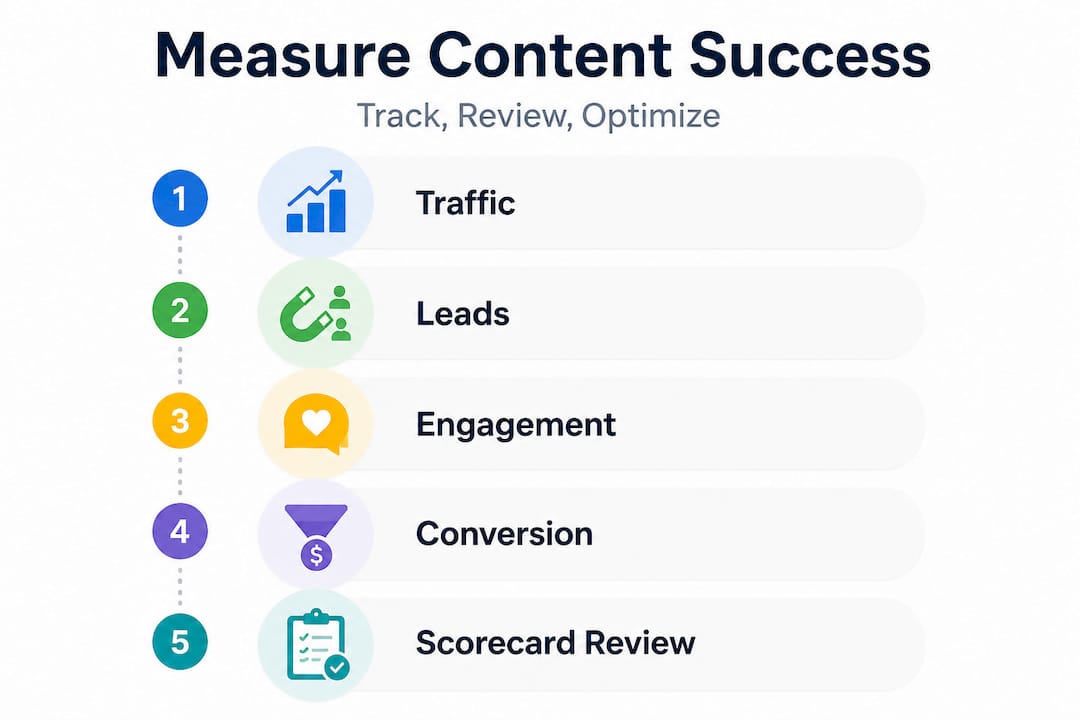
Start with the metrics that connect directly to business outcomes:
- Organic traffic: Are more qualified visitors finding your content through search?
- Lead volume and quality: Are content-driven leads converting to sales opportunities at acceptable rates?
- Conversion rate by content type: Which formats (blog, video, case study) generate the most pipeline?
- Engagement metrics: Time on page, scroll depth, and video completion rates reveal whether content resonates or loses readers mid-way.
- Assisted conversions: Many content pieces don’t convert directly, but they influence deals. Track this in your CRM or analytics platform.
Analytics tracking conversions is not optional. It’s the only way to distinguish content that looks successful (high traffic) from content that actually is successful (high leads or revenue).
If results are lagging, run a content audit every quarter. Identify your top 20% of performers by traffic and conversion, then ask: what do they have in common? Topic depth, format, search intent match? Then replicate those characteristics across new content.
Pro Tip: Use a simple content performance scorecard. Rate each piece monthly on traffic, leads generated, and engagement. Content that scores low on all three gets updated or consolidated. This keeps your library lean and high-performing rather than bloated with outdated posts that dilute site authority. Our full guide to content marketing metrics walks through exactly how to build this system.
Managing expectations is equally important. Organic content typically takes three to six months to gain traction in search. Paid distribution can accelerate early results, but the long-term compounding value comes from organic reach. Set realistic timelines with stakeholders so content doesn’t get defunded before it hits its performance peak.
A fresh perspective: What most B2B marketers get wrong about content marketing
Here’s the uncomfortable reality: most B2B content marketing programs produce a lot of content that goes nowhere. Not because the content is bad, but because teams confuse activity with strategy.
The most pervasive mistake is building a program entirely around SEO and demand capture, which means creating content to rank for search terms buyers already use, without investing in thought leadership that shapes what buyers think in the first place. Thought leadership is POV and story-driven, while standard content is topic-driven. AI boosts productivity, but strategy refinement (cited by 74% of top performers) drives success over technology alone. That’s not a small distinction. It’s the difference between being found and being trusted.
There’s also a growing split in how AI is being used. The teams pulling ahead aren’t just using AI to write faster. They’re using it to structure content for AEO and AI overviews, which means leading with direct answers, using structured schema markup, and sourcing expert statistics, all of which produce 22 to 37% higher visibility in AI-generated results. This is a competitive edge most teams haven’t tapped yet.
Our perspective: the smartest B2B marketers in 2026 are building two parallel content tracks. One track captures existing demand through SEO. The other shapes future demand through original research, bold opinions, and executive-level thought leadership. The best place to see how this is evolving is in content marketing trends that show exactly where investment is shifting and why.
The teams that treat content as a long-term brand asset, not a short-term traffic tactic, are the ones that compound advantage year after year.
Level up your content marketing with expert support
The strategies in this article work. But executing them well, from keyword research and video marketing experts to conversion tracking and thought leadership development, takes time, expertise, and consistent focus that most internal teams simply don’t have at scale. At Web Spider Solutions, we help B2B businesses bridge that gap with specialized content strategy, fully managed content programs, and data-driven campaign execution. Whether you’re starting from scratch or optimizing an existing program, our team builds content engines designed to generate real pipeline. Stay ahead of the curve by exploring the latest content trends and see how a tailored approach can accelerate your results.
Frequently asked questions
What is a content marketing strategy, and why does my B2B business need one?
A content marketing strategy is a structured plan to produce, distribute, and measure content that attracts and engages your ideal clients. 97% of B2B marketers have one, with 61% reporting it improved effectiveness, making it essential for long-term growth.
How can I measure if my content marketing is working?
Track key metrics such as traffic, engagement, leads, and conversion rates tied to specific content pieces. Solid analytics tracking conversions will show you which content drives pipeline, not just pageviews.
What are the biggest mistakes businesses make with content marketing?
The most damaging mistakes include producing unfocused content, skipping strategy, and failing to align content with the buyer’s journey. Content strategy red flags like generic messaging and over-targeting narrow ICPs consistently underperform across all formats.
What content types work best for B2B lead generation?
SEO-optimized blogs, case studies, video, and thought leadership are the highest-performing formats. Video delivers positive ROI for 93% of marketers and consistently ranks as the top format for B2B results.
How is AI changing content marketing for small teams?
AI tools dramatically speed up content creation and allow small teams to scale high-quality output efficiently. 95% of B2B marketers now use AI, primarily for content creation, making it a core productivity driver for resource-limited teams.
 Top-rated