







Ranking above competitors in Google search can feel out of reach without a clear strategy. For many SaaS companies, Domain Authority becomes the north star for building digital credibility, measuring potential to climb in search results. By understanding which factors truly influence this score, digital marketing managers can assess their website’s strength, attract valuable backlinks, and lay the groundwork for lasting organic growth.
Table of Contents
- Defining Domain Authority In Digital Marketing
- How Domain Authority Is Measured And Scored
- Key Factors Influencing Domain Authority Growth
- Common Misconceptions About Domain Authority
- Boosting Domain Authority For SaaS Companies
Key Takeaways
| Point | Details |
|---|---|
| Importance of Domain Authority | Domain Authority is a key metric that estimates a website’s potential ranking strength in search engine results. Understanding it aids in competitive positioning for digital marketers. |
| Factors Influencing Domain Authority | High-quality backlinks, domain age, and content relevance are critical to improving Domain Authority. Technical performance also plays a significant role. |
| Common Misconceptions | Domain Authority is not a direct ranking factor used by search engines; rather, it’s a predictive metric that must be built sustainably. |
| Strategies for Improvement | Enhancing Domain Authority requires a holistic approach including effective content marketing, technical optimization, and genuine relationship-building within the industry. |
Defining Domain Authority in Digital Marketing
Domain Authority (DA) represents a critical metric in digital marketing that helps businesses understand their website’s potential search engine ranking strength. Search engine performance evaluation goes beyond simple metrics, providing a comprehensive score that predicts how well a website might rank in search results. Developed by Moz, this scoring system ranges from zero to 100, with higher numbers indicating greater potential for top search positioning.
The DA score considers multiple complex factors that contribute to a website’s overall digital credibility. These include the total number of high-quality backlinks, the domain’s age, content relevance, and technical optimization elements like site speed and mobile responsiveness. While not a direct ranking factor used by search engines like Google, Domain Authority serves as a powerful comparative tool for digital marketers to assess their website’s competitive positioning in their industry.
For SaaS companies and digital marketers, understanding Domain Authority means recognizing it as a strategic benchmarking tool. Authoritative domains build trust through consistent high-quality content, reliable external links, and positive user engagement. A strong DA indicates that a website is more likely to attract organic traffic, secure valuable backlink opportunities, and establish brand reputation in competitive digital landscapes.
Pro tip: Regularly audit your backlink profile and focus on acquiring links from high-quality, relevant websites to incrementally improve your Domain Authority score.
How Domain Authority Is Measured and Scored
Domain Authority measurement is a sophisticated process that involves complex algorithmic calculations designed to predict a website’s search ranking potential. Predictive scoring algorithms utilize advanced machine learning techniques to generate a comprehensive score ranging from zero to 100. This score represents a website’s likelihood of ranking successfully across various search engine results, taking into account multiple intricate digital performance factors.

The scoring mechanism considers several critical components that contribute to a website’s overall digital credibility. Key factors include the quantity and quality of external backlinks, domain age, content relevance, site architecture, and technical performance metrics like loading speed and mobile responsiveness. Search engine algorithms evaluate these elements to determine a website’s relative strength and potential ranking power, with higher scores indicating a more robust online presence and greater potential for organic search visibility.
Here’s a concise overview of key factors that influence Domain Authority scores:
| Factor | Description | Business Impact |
|---|---|---|
| Backlink Quality | Links from trusted industry websites | Boosts credibility and visibility |
| Domain Age | Time since domain registration | Signals reliability to algorithms |
| Content Relevance | Original and topic-focused content | Improves user engagement rates |
| Site Speed | Fast loading and responsiveness | Enhances user experience |
| Mobile Optimization | Adaptive design for mobile devices | Increases reach and engagement |
Website ranking strength emerges from a complex interplay of factors that extend beyond simple link counting. Moz’s proprietary algorithm incorporates nuanced elements such as link diversity, domain prestige, content quality, and competitive positioning within specific industry contexts. While search engines like Google do not directly use Domain Authority as a ranking factor, digital marketers and SEO professionals rely on this metric as a valuable benchmarking tool to assess and compare website performance across different digital landscapes.
Pro tip: Focus on acquiring high-quality, contextually relevant backlinks from authoritative websites in your industry to incrementally improve your Domain Authority score.
Key Factors Influencing Domain Authority Growth
Building Domain Authority requires a multifaceted approach that goes beyond simple link acquisition. Comprehensive website optimization involves strategic improvements across technical, content, and networking dimensions. SaaS companies must understand that Domain Authority growth is a nuanced process demanding consistent, targeted efforts across multiple digital performance indicators.
The most critical factors influencing Domain Authority include high-quality backlink acquisition, content relevance, and technical website performance. External link quality matters more than quantity, with links from reputable, industry-relevant websites significantly boosting credibility. Content strategy plays a pivotal role, requiring consistent production of original, in-depth material that demonstrates expertise and provides genuine value to target audiences. Technical aspects like website speed, mobile responsiveness, secure hosting, and clean site architecture also contribute substantially to overall domain strength.
Website ranking strategies extend beyond traditional SEO tactics, requiring a holistic approach to digital presence. Successful Domain Authority growth demands continuous monitoring of user engagement metrics, including bounce rates, session duration, and interaction quality. SaaS companies must develop a comprehensive strategy that integrates content marketing, technical optimization, strategic link building, and consistent brand positioning to progressively enhance their digital authority and search engine visibility.
Pro tip: Create a quarterly content and link-building audit to systematically identify and address gaps in your Domain Authority growth strategy.
Common Misconceptions About Domain Authority
Domain Authority is surrounded by numerous misunderstandings that can derail effective SEO strategies for SaaS companies. Misconceptions about ranking metrics often lead digital marketers down ineffective paths, creating unrealistic expectations about search engine performance. Many professionals mistakenly view Domain Authority as a direct ranking factor, when in reality, it is a predictive metric developed by Moz to estimate a website’s potential search performance.
One of the most prevalent myths is that Domain Authority can be rapidly increased through quick link-building tactics or purchasing backlinks. In truth, building authentic domain strength requires a sustained, strategic approach focused on creating high-quality content, developing genuine industry relationships, and consistently delivering value to target audiences. Another critical misconception is believing that a high Domain Authority automatically guarantees top search rankings. While a strong DA correlates with better search performance, it does not directly determine a website’s position in search engine results pages.
Compare common misconceptions about Domain Authority and their realities:
| Misconception | The Reality | Business Consequence |
|---|---|---|
| DA is a direct Google ranking factor | DA is only predictive, not used by Google | Misguided strategy focus |
| Buying links quickly boosts DA | Sustainable DA requires authentic relationships | Risk of penalties and waste |
| High DA guarantees top rankings | DA does not ensure top placement | False expectations |
Domain management complexities extend beyond simple numeric scores, challenging many traditional SEO assumptions. SaaS companies often misunderstand that domain ownership or registration does not equate to search engine authority. True domain strength emerges from a complex ecosystem of factors including content quality, user engagement, technical optimization, and genuine industry influence. Successful digital marketing requires a nuanced understanding that Domain Authority is a comparative tool, not an absolute measure of website performance.
Pro tip: Develop a holistic SEO strategy that focuses on comprehensive value creation rather than artificially manipulating Domain Authority scores.
Boosting Domain Authority for SaaS Companies
Domain Authority growth requires a strategic, multifaceted approach tailored specifically to SaaS business models. Link-building strategies for SaaS demand a sophisticated blend of technical optimization, content excellence, and strategic networking. SaaS companies must recognize that authentic domain strength emerges from consistent, value-driven digital marketing efforts that extend far beyond simple link acquisition.
The core pillars of Domain Authority enhancement for SaaS platforms include creating authoritative, solution-oriented content that directly addresses target audience challenges, developing robust technical infrastructure, and cultivating meaningful industry relationships. High-quality content marketing strategies such as in-depth technical guides, original research, comprehensive whitepapers, and thought leadership pieces can attract natural backlinks from reputable industry websites. Technical optimization remains crucial, encompassing elements like lightning-fast page load speeds, impeccable mobile responsiveness, secure HTTPS connections, and clean, intuitive site architecture that signals credibility to search engines.
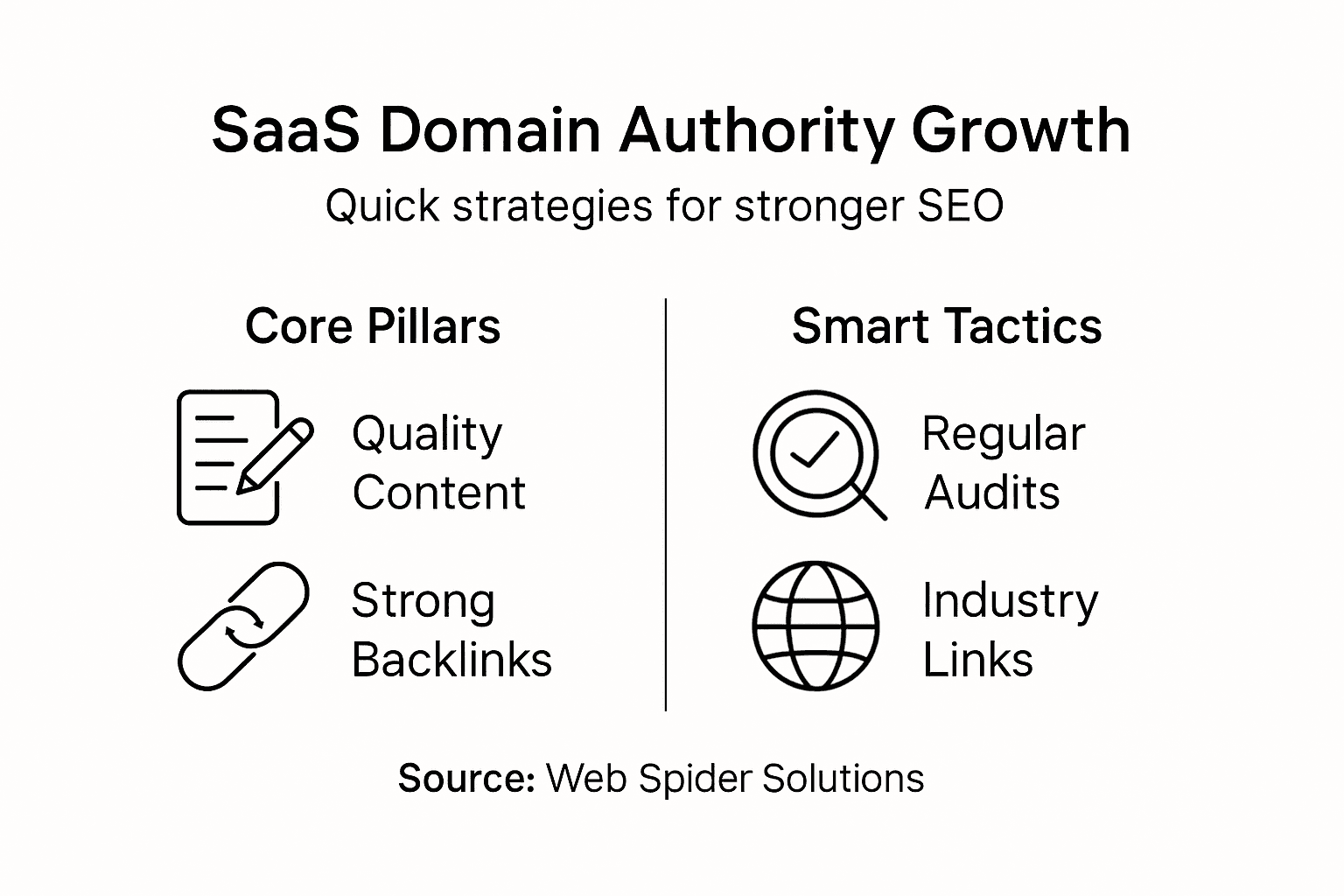
SaaS platform governance practices play a significant role in building domain trust beyond traditional SEO tactics. Implementing rigorous security protocols, transparent data management, and demonstrating consistent reliability can indirectly boost domain credibility. Proactive engagement through targeted guest posting, strategic podcast and webinar appearances, and active participation in industry forums can further amplify a SaaS company’s digital footprint and domain strength. The key is developing a holistic approach that integrates technical excellence, content innovation, and genuine industry contribution.
Pro tip: Create a quarterly content and backlink audit to systematically identify and leverage opportunities for sustainable Domain Authority growth.
Elevate Your SaaS SEO with Proven Domain Authority Strategies
Understanding Domain Authority is essential for SaaS companies aiming to improve organic search rankings and build lasting digital credibility. This article highlights the challenges of growing Domain Authority through authentic content, technical optimization, and strategic link building. We know that acquiring high-quality backlinks and maintaining a fast, mobile-optimized website can be overwhelming without expert guidance.
At Web Spider Solutions, we specialize in comprehensive digital marketing services designed to boost Domain Authority and increase your SaaS platform’s visibility. Our tailored SEO solutions focus on enhancing your backlink profile, optimizing site performance, and producing authoritative content that attracts organic traffic. Ready to leave behind common SEO misconceptions and accelerate your Domain Authority growth? Explore how our SEO services can transform your online presence and deliver measurable results.
Don’t wait to get ahead in a competitive market. Visit Web Spider Solutions now and request your free SEO audit to start building genuine digital authority today.
Frequently Asked Questions
What is Domain Authority and why is it important for SaaS companies?
Domain Authority (DA) is a metric developed by Moz that predicts how well a website may rank in search engine results. It ranges from 0 to 100, with a higher score indicating a greater potential for attracting organic traffic, which is crucial for SaaS companies looking to establish their online presence.
How is Domain Authority measured?
Domain Authority is measured through a complex algorithm that considers various factors, including the quality and quantity of backlinks, domain age, content relevance, site speed, and mobile responsiveness. These elements collectively contribute to a website’s credibility and potential ranking strength.
What strategies can SaaS companies use to improve their Domain Authority?
SaaS companies can improve their Domain Authority by focusing on creating high-quality, relevant content, optimizing their website’s technical performance, and acquiring backlinks from reputable industry sources. Continuous monitoring of user engagement metrics is also essential for driving domain growth.
What are common misconceptions about Domain Authority?
A common misconception is that Domain Authority is a direct ranking factor used by search engines like Google; it is not. DA is a predictive tool that helps assess a website’s potential performance. Additionally, fast-tracking DA through buying backlinks or using quick link-building tactics does not create sustainable domain strength. Instead, authentic quality content and genuine relationships are needed for long-term success.