

TL;DR:
- Developing leadership qualities involves intentionally practicing specific skills and behaviors through feedback and structured learning. Building and focusing on 1-3 key goals enhances sustainable growth, while regular self-reflection and 360-degree feedback increase self-awareness. Consistent daily habits and targeted development strategies enable leaders to achieve lasting organizational impact and personal growth.
Developing leadership qualities means cultivating specific, observable skills and behaviors through deliberate practice and feedback, not relying on innate traits or job titles. Leadership skills are learned behaviors that anyone can build with the right structure and consistency. According to Gallup, managers drive 70% of variance in employee engagement across business units. That number tells you one thing clearly: leadership quality is not a soft concern. It is the single most measurable driver of team performance. Organizations like Gallup, SHRM, and FranklinCovey have built entire research programs around this fact, and their findings form the foundation of every strategy in this guide.
1. What are the most valuable leadership qualities to develop?
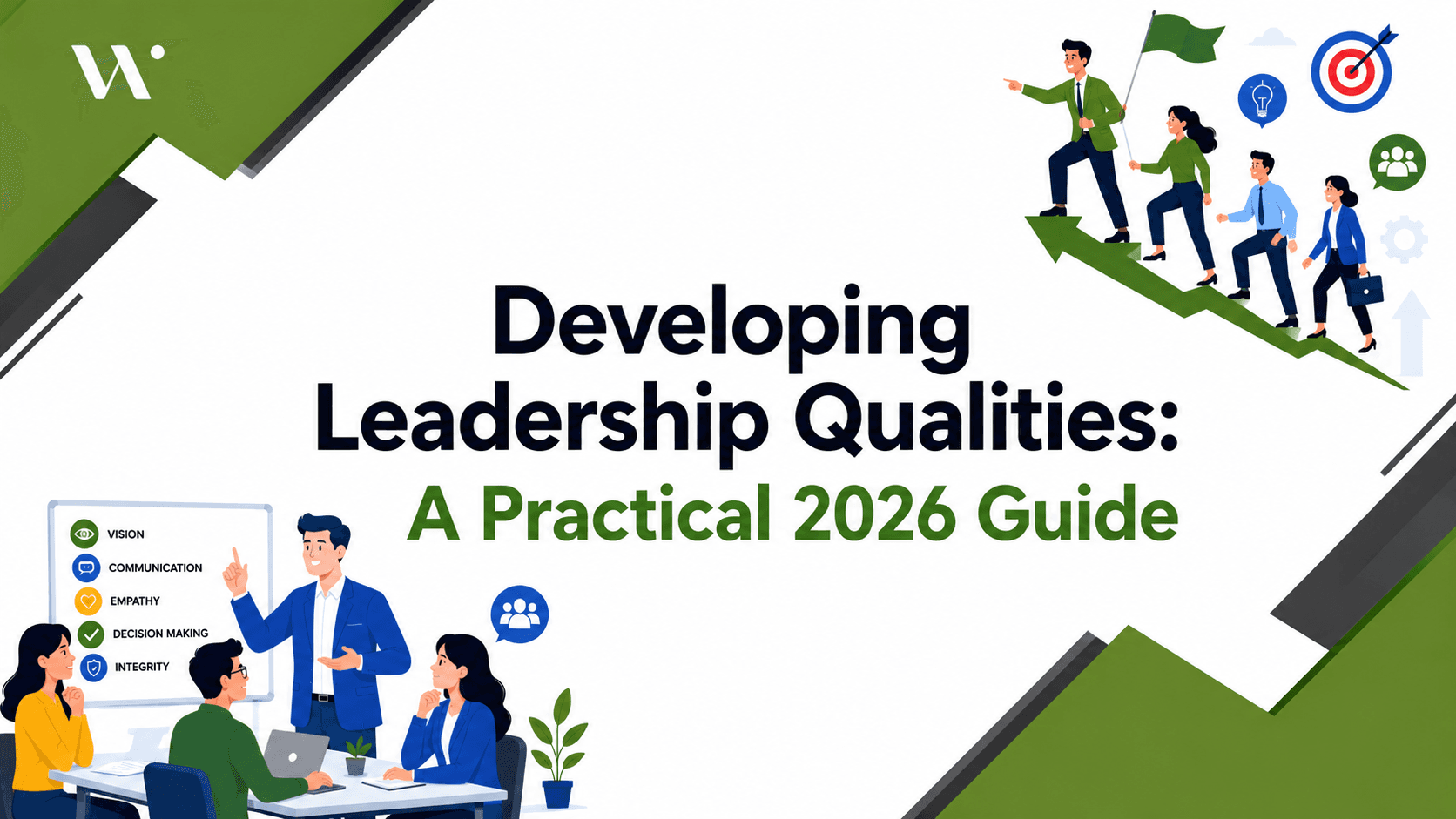
The qualities that produce the greatest organizational impact are integrity, emotional intelligence, resilience, communication, strategic thinking, and adaptability. These are not personality traits you either have or lack. They are competencies you build through practice, feedback, and reflection over time.

SHRM identifies core leader skills as communicating vision, giving feedback, decision making, and strategic thinking. Each of these maps directly to measurable team outcomes. A leader who communicates vision clearly reduces ambiguity. A leader who gives feedback consistently builds trust and accelerates performance.
Here is how each quality connects to real results:
- Integrity: Teams follow leaders they trust. When your actions consistently match your stated values, you build the credibility that makes influence possible.
- Emotional intelligence: Leaders who regulate their own emotions and read others accurately make better decisions under pressure and create psychologically safe environments.
- Resilience: Setbacks are inevitable. Leaders who model recovery and persistence set the tone for how their teams handle failure.
- Communication: Clarity in communication reduces wasted effort. FranklinCovey research links poor communication directly to execution failures at the team level.
- Strategic thinking: Leaders who connect daily decisions to long-term goals keep their teams aligned and focused on what matters most.
- Adaptability: Markets, teams, and priorities shift. Leaders who adjust quickly without losing direction are the ones organizations promote and retain.
FranklinCovey and Gallup both link these qualities to measurable organizational outcomes, including retention, productivity, and engagement scores. Start by identifying which two or three of these you most need to strengthen in your current role.
2. How to create a focused leadership development plan
A written, structured development plan is the difference between intentional growth and accidental improvement. FranklinCovey’s leadership development framework identifies five core elements every effective plan must include: assessment, competency identification, goal setting, relationship-based learning, and regular accountability.
Here is how to build yours:
- Start with a 360-degree assessment. Collect structured feedback from your manager, peers, and direct reports. This gives you a data-based picture of how others experience your leadership, not just how you see yourself.
- Identify two or three target competencies. Pick the skills with the greatest gap between your current level and what your role demands. Trying to fix everything at once produces shallow results across the board.
- Set SMART goals for each competency. Specific, measurable, achievable, relevant, and time-bound goals give you a clear target and a way to track progress. “Improve communication” is not a goal. “Deliver a structured weekly team update every Monday for 90 days and collect feedback on clarity” is a goal.
- Build in relationship-based learning. A coach, mentor, or accountability partner accelerates growth in ways that self-study cannot. SHRM confirms that leadership development includes formal courses and informal experiences like mentoring and on-the-job challenges. Both matter.
- Schedule regular reviews. Monthly check-ins against your goals keep you honest. Skipping this step is the most common reason development plans fail. FranklinCovey warns that skipping elements like assessment or accountability weakens the entire process.
Pro Tip: Limit your development plan to 1–3 Wildly Important Goals® at any given time. FranklinCovey’s research shows that concentrating on a small number of goals produces deeper skill acquisition and more sustained behavior change than spreading effort across many targets.
3. What practical steps can leaders take daily to build their skills?
Daily habits produce the behavior change that workshops alone never will. The most effective development targets measurable behavior goals and consistent feedback cycles rather than one-off training events. That means integrating growth into your actual workday, not treating it as a separate activity.
Here are the habits that produce the most consistent results:
- Read or listen for 20 minutes daily. Books like The 7 Habits of Highly Effective People by FranklinCovey’s Stephen Covey, podcasts like How I Built This, and peer forums like Chief Executive Network expose you to real leadership decisions and their consequences.
- Seek feedback after key interactions. After a difficult conversation, a presentation, or a team meeting, ask one person: “What could I have done more effectively?” This turns every interaction into a learning event.
- Align your decisions with your stated values. Before making a call on a team issue, ask whether your decision reflects the leader you are trying to become. Consistency between values and actions builds the credibility that makes influence possible.
- Practice giving feedback deliberately. Use a structured model like the Situation-Behavior-Impact (SBI) framework from the Center for Creative Leadership. Practicing a specific method builds the skill faster than improvising each time.
- Use stretch assignments as training. Volunteer to lead a cross-functional project, present to senior leadership, or manage a difficult stakeholder relationship. High-performing leadership programs link learning to real work through coaching, role-play, and action-learning methods.
Pro Tip: Block 30 minutes every Friday for self-reflection. Review one decision you made that week, identify what you would do differently, and write it down. Leaders who reflect consistently improve faster than those who only act.
4. How does 360-degree feedback fit into developing leadership qualities?
360-degree feedback is the most reliable tool for building self-awareness in leaders. It surfaces blind spots that no self-assessment can reveal, because it collects input from the people who experience your leadership directly.
360-degree feedback is most effective when used explicitly as a development tool rather than an evaluation mechanism. This distinction matters more than most leaders realize. When people believe their feedback will affect someone’s performance rating or compensation, they soften their responses. When the purpose is clearly developmental, you get honest data you can actually use.
To get the most from a 360-degree process, follow these practices:
- Tie feedback questions directly to your target competencies. Generic questions produce generic answers. Ask specifically about the behaviors you are trying to change.
- Share your development goals with respondents before they give feedback. This context helps them focus on what is most useful to you.
- Debrief with a coach or trusted mentor. Raw feedback data without interpretation can be misleading. A coach helps you separate patterns from noise.
- Avoid using 360 results for performance reviews. Blurring development with evaluation harms feedback quality and reduces the honesty of future responses.
“Strong leadership development strategies use 360-degree feedback to improve self-awareness and personalized growth plans aligned with organizational goals.” — Center for Creative Leadership
The Center for Creative Leadership recommends running a 360-degree review at the start of a development cycle and again 12–18 months later to measure behavioral change. That before-and-after comparison is one of the clearest ways to demonstrate real progress.
5. How to balance developing strengths versus fixing weaknesses
Every leader faces a choice: invest in what you already do well, or fix what holds you back. Harvard Business Review’s analysis concludes that the right answer depends on your role requirements and the potential impact of each option. There is no universal rule.
The practical framework is this: fix weaknesses that create a floor problem, and build strengths that create a ceiling opportunity. A weakness that actively damages trust, alienates your team, or blocks your promotion is a floor problem. It needs attention first. A strength that could make you exceptional in your role and differentiate you from peers is a ceiling opportunity worth investing in.
Assessment data from tools like the Hogan Assessments, Korn Ferry Leadership Architect, or a structured 360-degree review helps you make this call with evidence rather than instinct. Leaders who use assessment data to guide their development roadmaps make faster, more targeted progress than those who rely on gut feel alone.
Aligning your individual growth plan with your organization’s strategic needs also matters. If your company is scaling rapidly, adaptability and strategic thinking may be more valuable to develop than technical expertise. Talk to your manager or HR business partner about where leadership gaps exist at the organizational level. That conversation often reveals the highest-leverage development target for your specific situation.
Key takeaways
Developing leadership qualities requires a structured plan that combines honest assessment, focused goals, daily practice, and consistent feedback to produce lasting behavior change.
| Point | Details |
|---|---|
| Leadership skills are learned | Anyone can build leadership qualities through deliberate practice and structured feedback, regardless of starting point. |
| Focus beats breadth | Limiting development to 1–3 goals at a time produces deeper, more sustainable skill growth than broad improvement efforts. |
| 360-degree feedback drives self-awareness | Use multi-source feedback strictly for development, not evaluation, to get honest and useful input. |
| Daily habits compound over time | Integrating reflection, feedback-seeking, and stretch assignments into your workday builds skills faster than periodic training. |
| Strengths vs. weaknesses is a strategic choice | Fix weaknesses that create floor problems first, then invest in strengths that create ceiling opportunities in your role. |
What I have learned about sustained leadership growth
Most leadership development fails not because the content is wrong, but because the structure is missing. I have watched talented people attend excellent programs, take thorough notes, and return to work unchanged within two weeks. The reason is almost always the same: no accountability, no practice environment, and no feedback loop to reinforce what they learned.
The leaders who grow consistently share one habit. They treat development as a work process, not a personal project. They schedule it, measure it, and talk about it with someone who will hold them accountable. They do not wait for the annual review or the next training budget cycle. They build strong communication habits into their daily work and treat every difficult conversation as a practice opportunity.
My honest recommendation: pick one behavior you want to change this quarter. Just one. Tell your manager, a peer, or a mentor what you are working on. Ask them to give you specific feedback on that behavior every two weeks. Do that for 90 days before adding anything else. The results will surprise you, because focused effort on a single behavior produces visible change that broad, scattered effort never does.
— webspider
How Webspidersolutions can support your growth as a leader
Strong leaders think strategically, communicate with clarity, and execute with discipline. These are the same principles that drive high-performing digital campaigns. At Webspidersolutions, we work with B2B organizations to build the kind of structured, measurable growth strategies that leaders can learn from directly. If you want to sharpen your strategic thinking, our SEO strategy guide walks through a 14-step planning process that mirrors the goal-setting and accountability frameworks used in top leadership development programs. Explore our digital campaign management guide to see how disciplined execution translates into measurable outcomes, in marketing and in leadership.
FAQ
What does developing leadership qualities actually mean?
Developing leadership qualities means building specific, observable skills and behaviors through deliberate practice, feedback, and structured learning. It is an ongoing process, not a one-time training event.
How long does it take to develop strong leadership skills?
Meaningful behavior change typically takes 90–180 days of consistent, focused practice with regular feedback. FranklinCovey recommends working on 1–3 goals at a time to accelerate progress.
What is the most effective leadership development method?
High-performing development programs combine real work challenges, coaching, and structured feedback cycles. One-off workshops without follow-up produce little lasting change.
How do I know which leadership qualities to prioritize?
Start with a 360-degree feedback assessment to identify gaps between your current behaviors and your role requirements. Then focus on the one or two competencies with the greatest impact on your team’s performance.
Can anyone become a strong leader?
Yes. Leadership is a set of skills and habits that anyone can learn through deliberate practice and feedback. It is not a fixed trait determined by personality or position.
Recommended
- 7 Leadership Strategies for Success in the Digital Age
- Personal Branding for Executives: Complete Guide – Web Spider Solutions
- Building a Marketing Strategy for 2025: A Guide for Competitive Industries – Web Spider Solutions
- How to Build Brand Loyalty: A Step-by-Step Guide for 2025 Success – Web Spider Solutions

 Top-rated