






TL;DR:
- Most small and medium-sized businesses either underfund digital marketing or spend without a clear strategy, leading to poor results. Understanding fixed and variable costs, aligning budget with revenue, and continuously optimizing campaigns are essential for effective investment. Prioritizing quality leads, tracking performance diligently, and adjusting budgets monthly ensure sustained growth and better ROI.
Most small and medium-sized businesses either spend too little on digital marketing and wonder why nothing moves, or they spend without a clear framework and watch their budget disappear with little to show for it. The gap between these two outcomes isn’t luck. It’s clarity. Local SMB digital advertising typically starts at $1,000 to $2,000 per month as a practical baseline for lead generation, yet most business owners have no idea whether their current spend is above or below this range. This guide gives you real 2026 numbers, proven benchmarks, and a practical budgeting process so every dollar you invest earns its place.
Table of Contents
- What makes up your monthly digital marketing cost?
- Typical digital marketing budget ranges for SMBs
- How marketing channels and goals affect your monthly spend
- How to build and adjust your monthly budget for better performance
- Why ‘cost per month’ doesn’t tell the whole story
- Ready to make your digital marketing budget work smarter?
- Frequently asked questions
Key Takeaways
| Point | Details |
|---|---|
| Budget ranges clarified | Most SMBs should expect monthly digital marketing costs between $1,000 and $2,000, or 6–12% of revenue. |
| Know your cost drivers | Distinct fixed and variable components—software, ads, services—determine your unique monthly spend. |
| Channel and goals matter | Your chosen digital channels and campaign objectives have a significant impact on your overall monthly cost. |
| Iterate for ROI | Start with test budgets, monitor outcomes, and reallocate spend regularly to maximize returns. |
What makes up your monthly digital marketing cost?
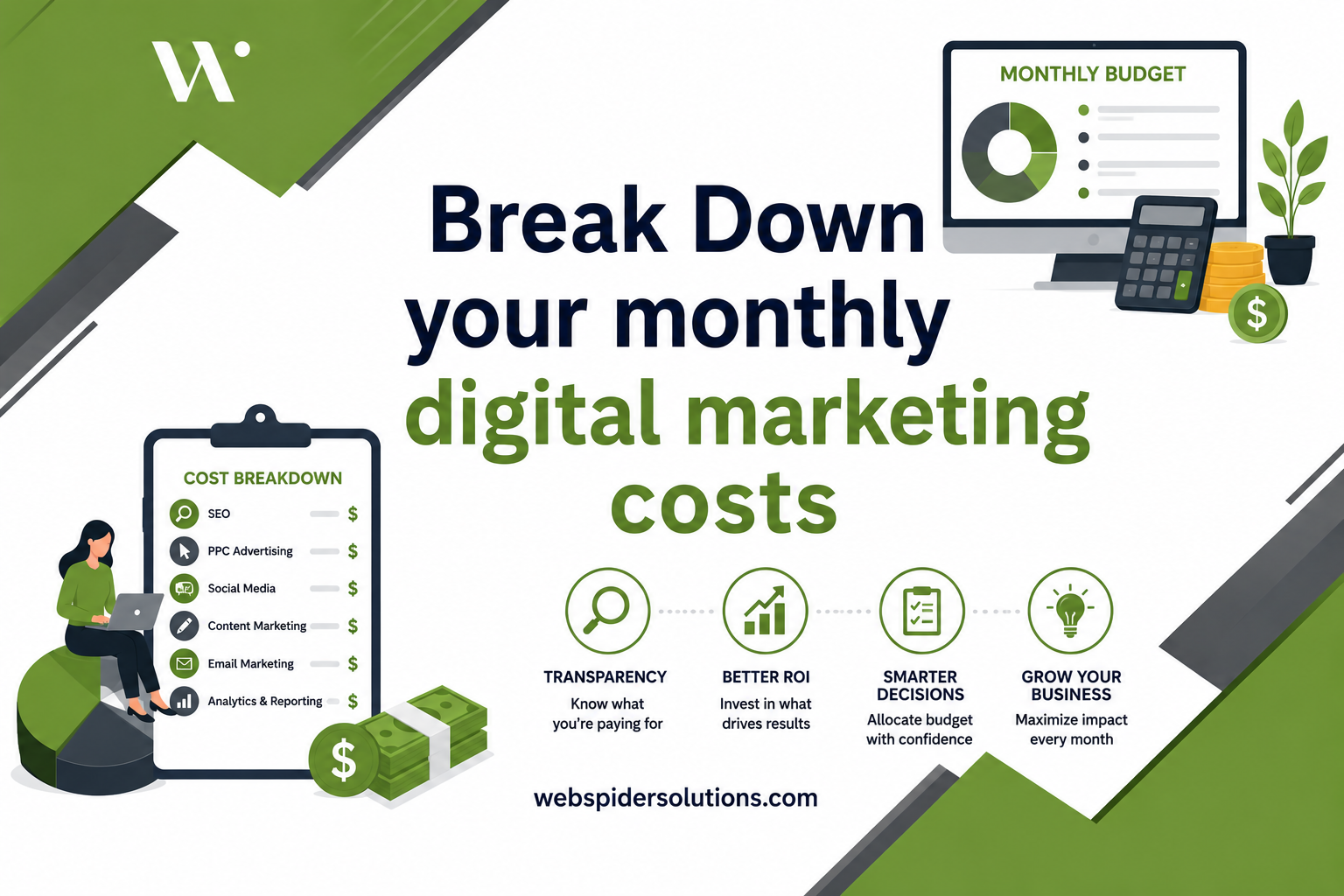
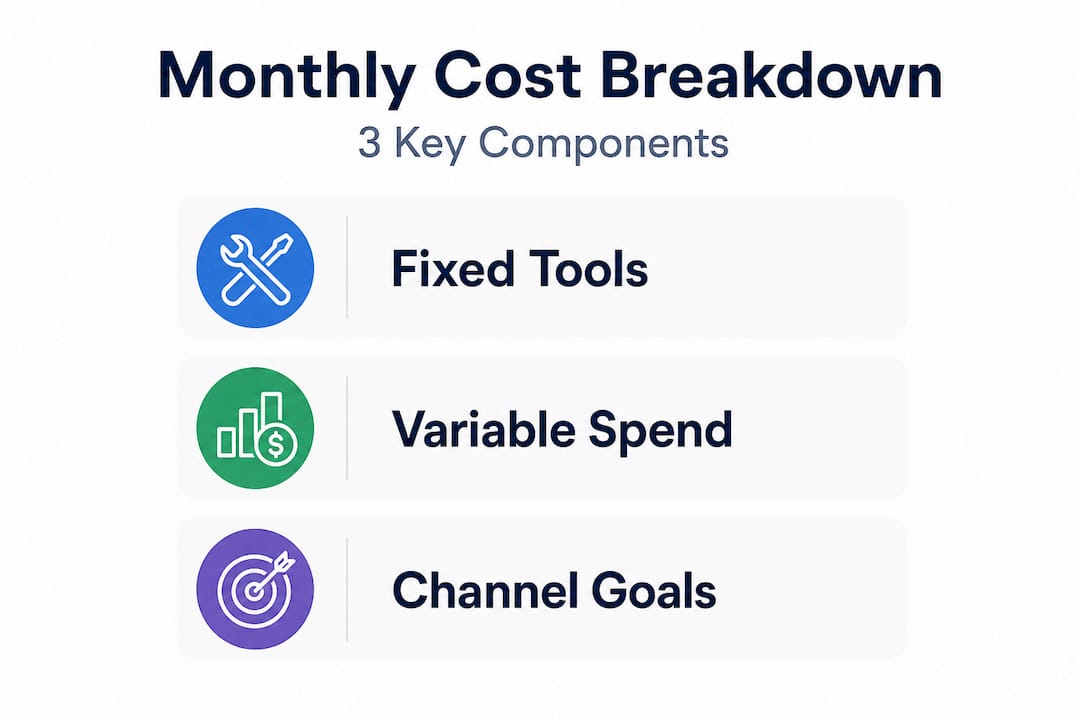
Before you can optimize your budget, you need to understand what you’re actually paying for. Monthly digital marketing costs fall into two broad categories: fixed and variable. Getting clear on both prevents the most common budgeting mistakes.
Fixed costs are predictable and recurring regardless of how much you run campaigns in a given month. These include:
- Platform and tool subscriptions: SEO tools, keyword research platforms, scheduling software, and reporting dashboards typically range from $50 to $400 per month depending on features.
- CRM and marketing automation: This is where costs can climb quickly. HubSpot Marketing Hub starts around $890 per month for 2,000 marketing contacts, which catches many SMBs off guard when they first look at enterprise-tier tools.
- Web hosting and maintenance: Depending on your setup, this can range from $20 to $300 per month, and it often gets overlooked in marketing budget discussions.
- Agency retainers: If you work with a full-service agency, monthly retainers for SEO, content, or social media management typically run between $1,000 and $5,000 per month.
Variable costs shift based on campaign activity, market conditions, and goals:
- Paid ad spend: Google Ads, Meta ads, LinkedIn ads, and display networks all bill based on actual impressions or clicks, so this number changes monthly.
- Content creation: Blog posts, video production, graphics, and copywriting vary depending on volume and quality level.
- Influencer or partnership spend: One-off campaigns for promotions or launches.
Here’s a quick look at how these components stack up for a typical SMB:
| Cost component | Monthly range (SMB) | Type |
|---|---|---|
| SEO tools | $50 to $300 | Fixed |
| CRM / automation software | $0 to $900+ | Fixed |
| Agency retainer (full service) | $1,000 to $5,000 | Fixed |
| Google Ads spend | $500 to $5,000+ | Variable |
| Social media ads | $300 to $3,000 | Variable |
| Content creation | $200 to $2,000 | Variable |
| Email marketing software | $20 to $300 | Fixed |
For a deeper understanding of what goes into pricing across services, our cost of digital marketing guide breaks down individual service costs with detailed explanations and real examples.
Pro Tip: Separate your “must have” fixed costs from your “performance-dependent” variable costs in a spreadsheet before you set your budget. This prevents you from accidentally cutting ad spend to cover a software subscription you could negotiate or replace.
One important nuance is that your business model directly affects which costs dominate. An e-commerce store may spend heavily on Google Shopping and retargeting. A local service business might invest primarily in local SEO and Google Ads for specific high-intent keywords. A B2B company often prioritizes LinkedIn ads and content marketing over social media ads.

Typical digital marketing budget ranges for SMBs
Now that you know what you’re paying for, the next question is: how much should you be paying overall? The answer depends on your revenue, industry, and growth stage, but there are credible benchmarks to guide your thinking.
For local businesses focused on lead generation, starting at $1,000 to $2,000 per month gives you enough volume to gather real data on cost per lead. This figure is often derived from a simple rule: multiply your target cost per conversion by 10. If your average customer acquisition through digital ads costs $150, your minimum test budget should be around $1,500 per month.
For businesses thinking about percentage of revenue, the research is clear. B2B small businesses spend 6 to 7% of revenue on marketing, while B2C businesses spend 9 to 12%. These numbers reflect the longer sales cycles in B2B versus the higher frequency of purchase decisions in B2C markets.
Key insight: A $1 million B2B company should expect to invest $60,000 to $70,000 per year on marketing, which works out to $5,000 to $5,800 per month. A B2C company at the same revenue level should plan for $90,000 to $120,000 per year, or $7,500 to $10,000 per month.
Here’s a side-by-side comparison to make this concrete:
| Business type | Revenue | % of revenue | Monthly budget |
|---|---|---|---|
| B2B small business | $500K | 6 to 7% | $2,500 to $2,900 |
| B2B growing company | $2M | 6 to 7% | $10,000 to $11,700 |
| B2C retail / service | $500K | 9 to 12% | $3,750 to $5,000 |
| B2C e-commerce | $2M | 9 to 12% | $15,000 to $20,000 |
Where many SMBs go wrong is treating these benchmarks as optional. Under-investing feels safe because it preserves cash, but it often results in spending just enough to generate data without generating results. You’re essentially paying for inconclusive experiments rather than actual growth.
For structured guidance on allocating these dollars, explore our digital marketing budget planning resource, which walks through prioritization frameworks for SMBs at different growth stages. If you’re focused on business-to-business marketing, our B2B marketing benchmarks page provides industry-specific context for spend decisions.
One more important benchmark worth noting: average cost per click (CPC) on Google Ads ranges from $1 to $2 for display network to $2 to $10 or more for competitive search keywords in industries like legal, insurance, and home services. Knowing your average CPC helps you calculate how many clicks your monthly budget realistically buys, which connects directly to your expected lead volume.
How marketing channels and goals affect your monthly spend
Your budget doesn’t exist in a vacuum. The channels you choose and the goals you pursue directly shape how much you’ll spend each month and what you’ll get in return.
Channel cost differences are significant. Here’s what you need to know:
- Search advertising (Google Ads): High intent, higher CPC. Ideal for capturing people actively searching for your product. Conversion volume and competition heavily influence cost per lead in any given market. A plumber in a mid-sized city might pay $15 per click. A personal injury attorney in a major metro could pay $80 or more per click.
- Social media advertising (Meta, LinkedIn, TikTok): Lower CPC on average, but lower intent. Better for awareness, retargeting, and top-of-funnel engagement. LinkedIn is the exception because it targets by job title and industry, making it valuable for B2B but expensive, often $8 to $15 per click.
- Email marketing: Extremely cost-efficient for retention and repeat purchases. Platform costs are low ($20 to $300 per month), and ROI is high when your list is well-segmented.
- Display and programmatic ads: Low CPCs, but also low conversion rates. Best for building brand recognition when paired with other channels.
Campaign goal shapes spend dramatically. An awareness campaign targeting cold audiences requires a much larger reach, meaning more impressions and therefore more budget. A conversion campaign targeting warm audiences who have already visited your site can accomplish more with less spend but needs a well-built retargeting setup first.
Here’s a step-by-step approach to choosing channels based on goals:
- Define your primary goal. Is it leads, sales, website traffic, or brand awareness? Rank these clearly.
- Match goal to channel. Leads and sales go to search and retargeting. Awareness goes to social and display.
- Set a minimum test budget per channel. Don’t spread $1,000 across five channels. Put $800 into one or two and measure results before expanding.
- Calculate expected outcomes. If your average CPC is $5 and your conversion rate is 5%, you need 20 clicks to get one lead. At $5 each, that’s $100 per lead. Is that acceptable for your business?
- Review performance weekly for the first month, then shift to biweekly once patterns stabilize.
Pro Tip: Never run a channel with less than a 90-day commitment. Most campaigns take 30 to 60 days to exit the learning phase and generate reliable data. Cutting campaigns early based on month-one results is one of the most expensive mistakes SMBs make.
For a deeper look at selecting the right mix, see our digital channel strategy guide, and if you’re building a plan from scratch, our step-by-step digital marketing strategy resource walks through the full process.
How to build and adjust your monthly budget for better performance
Setting a budget once and leaving it alone is the fastest way to waste money. The best-performing SMB marketing programs treat budgets as living documents that get reviewed and adjusted regularly.
Here’s a proven process:
- Start with your target cost per conversion. If you know a new customer is worth $500 in lifetime value, you can afford to spend up to $150 to $200 to acquire them. Set that as your ceiling for cost per lead.
- Multiply your target cost per conversion by 10. This gives you your minimum monthly test budget. If your target cost per lead is $100, start with at least $1,000 per month so you can gather 10 or more conversions to analyze.
- Allocate 70/20/10. Put 70% of your budget into proven channels. Use 20% to test new channels or ad formats. Reserve 10% for creative refreshes, landing page improvements, or technical fixes.
- Set up conversion tracking from day one. Without tracking, you’re flying blind. Google Analytics, Google Tag Manager, and your ad platform’s built-in conversion tracking should all be configured before you spend a single dollar.
- Review your budget allocation every month. Look at cost per lead by channel, conversion rates, and total leads generated. Shift money from underperformers to top performers.
- Run A/B tests on ads and landing pages. Even small improvements in click-through rate or conversion rate reduce your effective cost per lead without increasing your budget.
Common pitfalls to avoid:
- Spreading budget too thin across too many channels. This produces mediocre results everywhere and standout results nowhere.
- Ignoring attribution. Not knowing which channel or campaign generated a lead means you can’t make informed budget decisions.
- Cutting budgets during slow seasons without a strategy. Sometimes that’s the exact moment your competitors pull back, giving you an opportunity.
- Confusing spend with investment. Spend implies cost. Investment implies expected return. Measure every budget line against an expected return.
For practical tools and methods to measure what’s working, explore our guide on tracking digital marketing ROI, and for building your plan with discipline and foresight, our digital marketing strategy planning resource provides a structured framework.
Why ‘cost per month’ doesn’t tell the whole story
Here’s an opinion you won’t hear from every agency: the dollar amount you spend per month is one of the least interesting numbers in your marketing report.
We’ve worked with businesses that spent $500 per month and generated consistent, high-quality leads. We’ve also seen companies pour $10,000 per month into campaigns and come away with inflated click metrics, low-quality leads, and frustrated sales teams. The difference was never the budget. It was the thinking behind it.
The SMBs that consistently win at digital marketing do three things differently. First, they know exactly why each budget line exists. Not “we run Google Ads because everyone does,” but “we allocate $2,000 to search because our average cost per lead is $90 and we need 20 leads per month to hit revenue targets.” That level of specificity changes every decision.
Second, they treat conversion quality as seriously as conversion volume. Generating 50 leads per month sounds great until your sales team tells you 45 of them are unqualified. Chasing volume without filtering for quality destroys both your sales productivity and your marketing morale.
Third, they review and question every budget component monthly. Not quarterly. Not annually. Monthly. Markets shift, algorithms update, competitor behavior changes. A campaign that delivered a $70 cost per lead in January may be delivering $140 by April because a competitor entered your keywords. If you’re reviewing budgets quarterly, you’ve already lost 90 days to a problem that could have been corrected in 30.
The phrase “set it and forget it” is dangerous in digital marketing. The platforms are designed to spend your budget. Your job is to make sure you’re directing that spend toward outcomes that actually matter to your business. If you’re focused on low-cost digital marketing, the real question isn’t how little you can spend. It’s how intelligently you can allocate what you have.
Ready to make your digital marketing budget work smarter?
If you’ve made it through this breakdown and realized your current budget is either undefined, under-structured, or untracked, you’re not alone. Most of the SMBs we work with come to us at exactly that realization. Start by reviewing our budget planning guide to map out your monthly investment across the right channels and priorities. If paid search is part of your plan, our PPC advertising explained resource gives you a solid foundation before you spend a dollar. And when you’re ready to build sustainable organic traffic that compounds month over month, our SEO campaigns for growth show you what a structured, results-focused approach actually looks like. We offer free audits so you can see exactly where your current spend is performing and where it isn’t.
Frequently asked questions
What is a realistic monthly budget for a small local business?
For most local SMBs focused on lead generation, a practical starting range is $1,000 to $2,000 per month, which provides enough data volume to measure real cost per lead and refine campaigns over time.
How much do B2B vs B2C businesses spend on digital marketing?
B2B small businesses typically allocate 6 to 7% of revenue toward marketing, while B2C businesses commonly invest 9 to 12%, reflecting the higher frequency of purchase decisions in consumer markets.
What is the cost of digital marketing tools or software per month?
CRM and marketing automation costs vary widely, but HubSpot Marketing Hub starts at approximately $890 per month for 2,000 contacts, with costs rising as your contact list or feature needs grow.
How should I divide my budget across channels each month?
Allocate the majority of your budget to channels with proven results for your specific business, and review channel-specific performance monthly to shift spend toward what’s delivering the best cost per lead or conversion.