








TL;DR:
- Voice search now accounts for 20-27% of global queries, requiring new SEO approaches.
- Optimizing for conversational questions, structured data, and local intent boosts voice visibility.
- Voice search excels in local discovery and quick answers but faces recognition and privacy challenges.
There are more voice assistants active right now than there are people on Earth. That single fact should stop any digital marketer in their tracks. Voice search now accounts for 20-27% of all global queries, yet most SEO strategies still treat voice as a footnote. Businesses that keep optimizing only for typed queries are quietly handing visibility to competitors who understood the shift earlier. This article breaks down how voice search reached mainstream status, the real obstacles marketers face, and the practical frameworks you can apply today to show up when your audience speaks instead of types.
Table of Contents
- How voice search became mainstream in 2026
- Unique challenges and nuances of voice search
- Optimizing content for voice search: What really works
- Voice, AI, and search: Predictions and actionable strategies
- Why voice search is misunderstood—and what actually works
- Take your voice search strategy to the next level
- Frequently asked questions
Key Takeaways
| Point | Details |
|---|---|
| Voice search adoption | Voice search now accounts for over 20% of global queries, making it a critical channel for marketers. |
| Optimization strategy | Successful voice SEO relies on conversational keywords, structured answers, and local optimization. |
| Unique challenges | Zero-click answers, privacy concerns, and bias toward large brands impact how businesses benefit from voice. |
| AI integration | Voice search and AI are merging to create new opportunities—adapting early gives businesses a competitive edge. |
| Realistic expectations | Voice search will supplement traditional search but not fully replace it, requiring hybrid strategies. |
How voice search became mainstream in 2026
Voice search did not sneak up on us. It grew steadily, powered by three converging forces: smarter AI, cheaper smart speakers, and near-universal smartphone adoption. What changed in recent years is the quality of the responses. Early voice assistants were novelty tools that fumbled basic questions. Today, they parse intent, recognize context, and deliver answers with striking accuracy.
The numbers tell a clear story. 8.4 billion voice assistants are in active use worldwide, outnumbering the global population. Smart speakers sit in living rooms, cars ship with built-in voice controls, and mobile users trigger voice queries during commutes, workouts, and cooking sessions. Voice is embedded in daily life in a way that typed search never fully achieved outside of desk-based work.
This shift is already reshaping how brands think about digital marketing trends 2026. Keyword lists built around two-word phrases look increasingly outdated when users are asking full questions like “What’s the best Italian restaurant open near me right now?”
Key drivers of voice search adoption in 2026:
- Smart speaker penetration in 40%+ of connected households
- In-car voice assistant use surging with EV adoption
- Hands-free mobile use during physical activity and commuting
- Improved natural language processing reducing errors and friction
- Voice-enabled shopping queries growing year over year
| Channel | Typed search behavior | Voice search behavior |
|---|---|---|
| Query length | 2-3 words average | 7-9 words average |
| Tone | Fragmented, keyword-driven | Conversational, question-based |
| Intent | Often exploratory | Usually immediate or local |
| Result format | List of links | Single featured answer |
| Device context | Desktop or mobile | Mobile, smart speaker, car |
“Voice search is not replacing text search—it is capturing the moments text search never owned: the kitchen, the car, the gym.”
Understanding the future of search marketing means accepting that user behavior is fragmenting across devices and contexts. Marketers who anchor their content strategy to a single input mode will miss enormous segments of their audience.
Unique challenges and nuances of voice search
With adoption rising, digital marketers must navigate some unique obstacles to leverage voice search effectively. The most misunderstood one is the zero-click problem.

When a voice assistant reads a featured snippet aloud, the user gets their answer and moves on. No website visit. No conversion opportunity. Zero-click search now dominates a significant share of voice interactions, which means ranking first does not automatically translate into traffic. Your brand gets mentioned, but the visitor never lands on your site.
There is a second, less-discussed challenge. Voice assistants are designed to avoid embarrassing mistakes. They favor responses they consider safe and certain, which means established brands with high authority appear far more often than newer competitors, regardless of content quality. If your domain authority is low, your voice visibility will reflect that gap directly.
Other barriers marketers often overlook:
- Accent and dialect recognition: Assistants still struggle with regional accents, limiting reach in diverse markets.
- Noise interference: Ambient sound degrades recognition accuracy, especially in professional or public environments.
- Privacy hesitation: Many users disable always-on listening due to data concerns, reducing the total addressable audience.
- Voice fatigue: Users switch back to typing for complex searches, product comparisons, or tasks requiring visual results.
- Complexity limits: Voice is genuinely poor for searches that require scrolling, comparing multiple options, or viewing images.
| Factor | Voice search | Text search |
|---|---|---|
| Result volume | One answer | Multiple results |
| Brand bias | High (safe responses) | Moderate |
| Zero-click rate | Very high | Moderate |
| Visual content | Excluded | Included |
| Complex queries | Poorly handled | Well handled |
The AI and SEO landscape is making these dynamics more pronounced. As AI models get better at predicting user satisfaction, the preference for trusted, authoritative sources will only intensify.
Pro Tip: If you are a smaller brand, prioritize local voice queries. Assistants trust proximity and relevance for local intent, giving you a genuine shot at appearing even against larger competitors.
Optimizing content for voice search: What really works
Understanding these quirks, let’s turn to practical strategies digital marketers can use to get noticed in voice search results. The core shift is simple to state and harder to execute: stop writing for keywords and start writing for questions.
Step-by-step voice search optimization framework:
- Map conversational queries. Identify how your audience actually speaks about your product or service. Tools like AnswerThePublic or Google’s People Also Ask section surface natural phrasing you can build content around.
- Write direct answers first. Place a clear, concise answer in the first 40-60 words of any FAQ or article section. Assistants pull from the top of the content block, not the middle.
- Claim featured snippets. Structure content with question-based H2 and H3 headings followed by tight answers. Tables, ordered lists, and definition-style paragraphs perform well for snippet eligibility.
- Optimize for local intent. Ensure your Google Business Profile is complete and accurate. Local voice queries like “near me” or “open now” heavily favor businesses with verified, consistent local data.
- Implement structured data. Schema markup for FAQs, local business info, products, and reviews gives assistants clear signals about your content’s relevance and format.
- Build topical authority. Because voice assistants favor safe, certain responses, covering a topic thoroughly across multiple pages signals the kind of authority that earns voice mentions.
Pro Tip: Use semantic search principles when writing. Group related concepts together naturally. Do not just repeat a keyword—explain the idea from multiple angles. Assistants now evaluate topical depth, not keyword density.
For a deeper look at how content structure impacts discoverability, content marketing trends show that long-form, well-structured content outperforms thin articles in both traditional and voice-optimized search results.
One pitfall many marketers miss: optimizing for zero-click SEO does not mean abandoning traffic goals. Use featured snippet positions to build brand recognition, then create compelling reasons on the page itself for users who click through anyway—exclusive data, tools, calculators, or visuals that go beyond what the snippet delivers.
Quick wins for voice search readiness:
- Add FAQ sections to your top-performing pages
- Compress page load speed below 2 seconds on mobile
- Use natural, first-person language in your copy
- Audit and update all local business listings quarterly
Voice, AI, and search: Predictions and actionable strategies
Now let’s look ahead and see how AI integration will change the game further—and what strategies you can start using now. The merger between voice interfaces and generative AI is no longer theoretical. It is live, and it is reshaping what a “search result” even means.
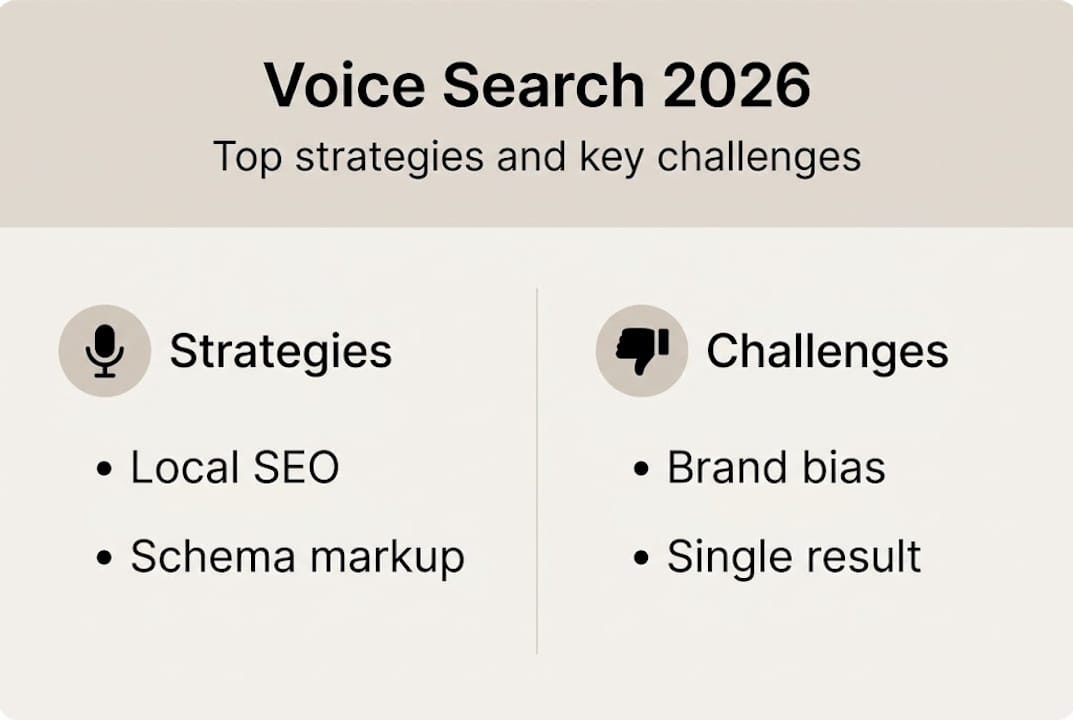
AI-powered assistants now synthesize multiple sources into a single conversational response. This changes the optimization game because you are no longer just competing for a ranking position. You are competing to be cited within an AI-generated answer. That requires a fundamentally different content strategy: one built around credibility signals, structured information, and clear sourcing.
Predictions for voice and AI search in the next 12 months:
- Multi-turn conversations with assistants will become standard, requiring content structured around dialogue-style depth
- AI will personalize voice results by user history, making brand familiarity even more valuable
- Visual-voice hybrid searches will emerge, combining image recognition with voice queries on mobile
- Voice commerce will grow, but remain concentrated in repeat purchases and low-complexity decisions
There is a real divide in how analysts view this trajectory. Optimists see voice merging with AI as a full behavioral shift toward spoken interaction, while skeptics point to persistent barriers like privacy concerns, voice fatigue, and the professional impracticality of speaking queries aloud in office environments. Both camps are partly right.
For practical strategy, the middle path wins. Invest in voice and AI optimization, but do not abandon text-first content. Integrate your work with broader AI in digital marketing frameworks that cover multiple touchpoints. Stay current with AI market trends so you can adjust as the landscape shifts faster than any annual strategy document can predict.
Actionable moves to future-proof your strategy now:
- Audit existing content for conversational query gaps
- Build an FAQ architecture across your entire site
- Prioritize E-E-A-T (experience, expertise, authority, trust) signals in all content
- Test your brand’s voice search presence monthly across Google Assistant, Siri, and Alexa
- Develop location-specific landing pages to capture local voice traffic
Why voice search is misunderstood—and what actually works
Most voice search guides sell you a version of the future that has not arrived yet. They describe a world where users speak every query and assistants handle everything from research to purchase. That world is not here. What is here is more interesting and more actionable.
Voice search works brilliantly for a narrow set of use cases: local discovery, quick factual lookups, hands-free task management, and repeat purchases. It performs poorly for everything that requires comparison, visuals, or nuance. The mistake most marketers make is treating voice optimization as a complete parallel strategy rather than a targeted extension of their existing content structure.
After running campaigns across competitive verticals, the truth we have seen repeatedly is this: businesses that win at voice search are usually the ones that have already won at featured snippets, local SEO, and structured data. Voice is not a separate channel you bolt on. It rewards the same fundamentals.
The brands that chase voice-only optimization frameworks often waste budget chasing a channel that generates brand mentions with no traffic. The smarter play, which you can read about in our work on SaaS search visibility, is to build content that performs across every surface: featured snippets, AI overviews, local packs, and voice results simultaneously. That is the hybrid approach that actually moves revenue.
Take your voice search strategy to the next level
Voice search optimization does not exist in a silo. It connects directly to your SEO architecture, content strategy, and AI readiness. At Web Spider Solutions, we help businesses build the kind of digital presence that surfaces across every search format, whether typed, clicked, or spoken. Our SEO strategy guide breaks down the foundational steps that feed directly into voice and AI search performance. If you want to understand how AI is reshaping SEO, we have covered that in depth. Ready to put it all into motion? Explore our SEO campaigns built around the real metrics that matter: traffic, leads, and revenue.
Frequently asked questions
What percentage of global searches are done via voice in 2026?
Voice search accounts for 20-27% of all global queries in 2026, making it a significant and no-longer-optional channel for any serious digital marketing strategy.
Why do voice assistants mostly recommend big brands?
Voice assistants are built to minimize bad recommendations, so they favor safe, certain responses and rely heavily on established brands with proven authority scores and consistent online signals.
How can marketers optimize content for voice search?
Marketers should structure content around conversational questions, use schema markup, target featured snippets, and build local intent-driven pages to maximize voice search visibility across assistants.
What are the biggest challenges to using voice search professionally?
Privacy concerns, voice fatigue, noise, and accent recognition gaps limit professional use significantly, and voice remains a poor fit for any task requiring visual output or complex multi-step comparisons.
Will voice search replace traditional search methods?
Voice will complement rather than replace traditional search, functioning as a side feature, not a primary UI, most valuable for local, hands-free, and quick-lookup queries rather than deep research or purchase decisions.