






TL;DR:
- Focus on the right digital channels aligned with your goals, audience, and resources.
- Regularly evaluate and adjust your channel strategy every quarter to optimize results.
- Prioritize owned channels like email and SEO for cost-effective, long-term growth amid digital shifts.
Spreading your digital marketing budget across every available channel sounds thorough. In practice, it’s one of the most expensive mistakes a small or medium-sized business can make. When you’re competing in a crowded industry, scattered effort produces scattered results. The businesses winning online aren’t doing everything — they’re doing the right things with focus and intention. This guide gives you a practical framework for identifying which digital channels actually fit your goals, your audience, and your resources, so you stop guessing and start growing.
Table of Contents
- Understanding the core digital marketing channels
- How to evaluate digital channels for your business
- Integration and measurement: Getting the most out of your channel mix
- Keeping up with digital trends: AI, economic shifts, and SMB priorities
- What most guides miss about choosing digital channels
- Ready to maximize your digital channel ROI?
- Frequently asked questions
Key Takeaways
| Point | Details |
|---|---|
| Focus on fit | Choose 1–2 digital channels that align with your goals and audience, not every available option. |
| Measure and adapt | Quarterly audits and ongoing measurement ensure your channel strategy stays effective in changing markets. |
| Prioritize owned media | Low-cost channels like email and your website often deliver ROI and resilience, especially in uncertain times. |
| Integrate for impact | Blending paid, owned, and earned media channels amplifies results and supports sustained growth. |
| Stay agile | Monitor trends like AI and adjust your channel mix proactively rather than reactively. |
Understanding the core digital marketing channels
Let’s begin by clarifying what each major digital channel actually offers your business.
Not all channels are built for the same purpose. Using the wrong one for your goal is like running a print ad to drive same-day website traffic. Before you allocate a single dollar, you need to understand what each channel does well and where it falls short for SMBs with real budget constraints.
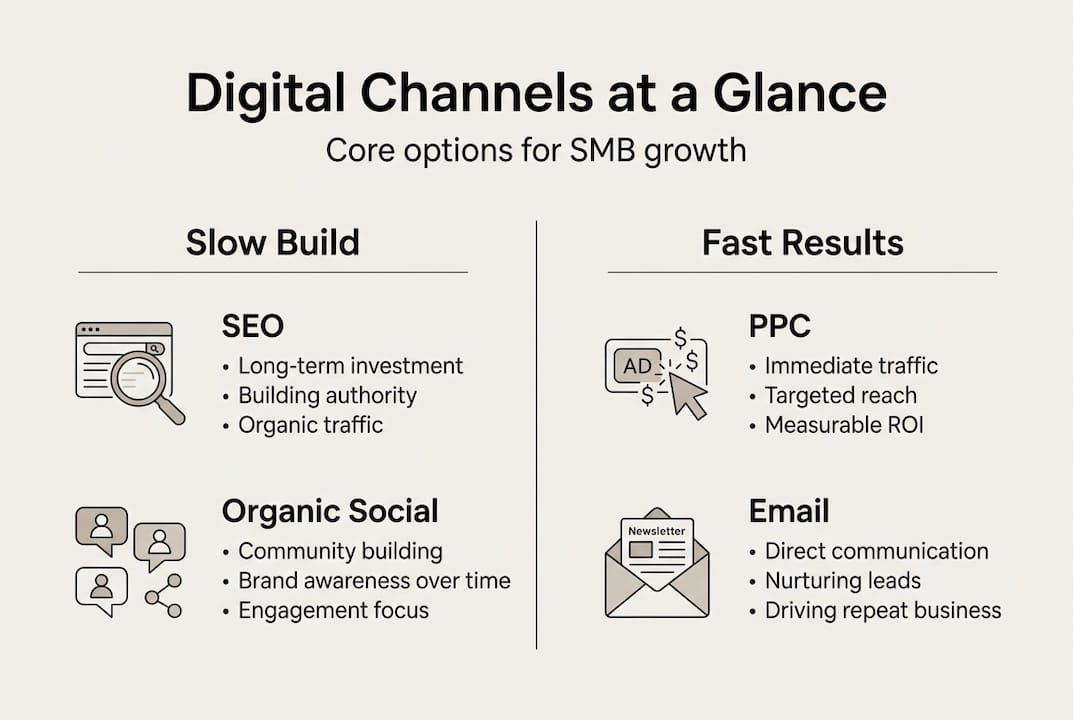
Search Engine Optimization (SEO) builds organic visibility over time. It targets users who are actively searching for what you offer, which means the intent is already there. The catch is patience: SEO typically takes 6 to 12 months to show meaningful results. It’s a long game, but the payoff is high-ROI traffic that doesn’t stop when your budget does. Explore how SEO vs PPC channel comparison can help you decide which fits your timeline.
Pay-Per-Click advertising (PPC) delivers speed. You can launch a campaign today and have leads in your inbox tomorrow. The tradeoff is cost, especially in competitive industries where cost-per-click can run high. PPC is best when you need immediate, scalable lead generation and have the budget to sustain it.
Email marketing is the quiet overachiever. It drives the highest ROI of any channel, returning $36 to $42 for every $1 spent. It’s ideal for nurturing prospects, retaining customers, and driving repeat purchases. If you’re not building an email list right now, you’re leaving money behind.
Organic social media builds community and brand personality. It’s low cost but time-intensive, and reach has declined significantly on most platforms without paid support. Paid social fills that gap, offering precise audience targeting for awareness and engagement campaigns. It’s especially strong for B2C brands, while LinkedIn holds the edge for B2B.
Here’s a quick comparison to frame your thinking:
| Channel | Primary goal | Time to results | Relative cost | Best for |
|---|---|---|---|---|
| SEO | Organic traffic | 6 to 12 months | Low to medium | Long-term lead gen |
| PPC | Immediate leads | Days | High | Fast-growth campaigns |
| Nurture and retain | Immediate | Low | Repeat business | |
| Organic social | Awareness | Weeks | Low | Brand building |
| Paid social | Engagement/reach | Days | Medium | B2C awareness |
Key takeaways before moving forward:
- No single channel does everything well
- Budget size should influence which channels you prioritize first
- Timing expectations vary dramatically between channels
- Your business model (B2B vs. B2C) should heavily influence your mix
“The most effective digital strategies don’t try to win every channel. They win the right ones.”
For a deeper look at building a full-picture approach, the digital marketing strategy frameworks on our site walk through how to structure this thinking from the ground up.
How to evaluate digital channels for your business
With the channels defined, here’s how to systematically evaluate what’s best for your business.
Channel selection isn’t a one-size-fits-all decision. It’s a structured process that starts with honest self-assessment and ends with a prioritized, budget-aligned plan. Here’s how to work through it:
- Define your primary goal. Are you trying to generate new leads, increase brand awareness, retain existing customers, or drive repeat purchases? Each goal points to different channels. Lead generation favors SEO and PPC. Retention favors email. Awareness favors social.
- Know your audience deeply. Where does your target customer spend time online? A 45-year-old B2B procurement manager behaves very differently from a 28-year-old B2C consumer. Audience behavior determines platform fit. Check the digital marketing basics guide for help profiling your audience.
- Analyze your competition. Which channels are your competitors investing in? More importantly, where are the gaps? If every competitor is running Google Ads but none are investing in email nurture sequences, that gap is your opportunity.
- Audit your internal resources. Do you have the time, skills, and budget to execute consistently? A channel you can’t sustain is worse than no channel at all. Be honest about capacity before committing.
- Allocate budget strategically. Experts recommend concentrating 70 to 80% of your budget on one or two primary channels, with the remainder supporting secondary efforts. This prevents the dilution that kills SMB campaigns.
Here’s a practical evaluation grid you can apply directly:
| Channel | Goal alignment | Audience fit | Budget required | Internal capacity | Priority |
|---|---|---|---|---|---|
| SEO | High | High | Medium | Medium | Primary |
| PPC | High | Medium | High | Low | Primary |
| Medium | High | Low | Low | Supporting | |
| Paid social | Low | Medium | Medium | Medium | Supporting |
For businesses managing B2B campaigns specifically, the process of managing digital campaigns for B2B requires an even tighter focus on website performance, SEO, and email over social platforms.
Pro Tip: Don’t treat channel selection as a one-time decision. The most effective SMBs review their channel mix every quarter. Markets shift, algorithms change, and customer behavior evolves. A quarterly micro-audit lets you reallocate budget toward what’s working before small inefficiencies become expensive habits.
Integration and measurement: Getting the most out of your channel mix
Once you’ve chosen and prioritized your channels, the next step is making sure they work together and are measured for impact.

Running channels in silos is one of the most common and costly mistakes SMBs make. When your paid ads, email campaigns, and organic content don’t talk to each other, you lose amplification and create a fragmented customer experience.
The POEM framework (Paid, Owned, and Earned Media) is a useful model here. Paid media includes PPC and paid social. Owned media includes your website, email list, and blog. Earned media covers organic mentions, shares, and press coverage. When these three work together, each channel reinforces the others.
A practical example: a PPC ad drives traffic to a landing page (owned). That page captures an email address. The email sequence nurtures the lead. A retargeting ad re-engages visitors who didn’t convert. That’s integration in action, and it consistently amplifies ROI compared to running any single channel alone.
Key metrics to track per channel:
- SEO: Organic traffic, keyword rankings, click-through rate, and domain authority
- PPC: Cost per click, conversion rate, cost per acquisition, and quality score
- Email: Open rate, click-through rate, unsubscribe rate, and revenue per email
- Social: Reach, engagement rate, follower growth, and referral traffic
- Paid social: Cost per thousand impressions, link clicks, and lead form completions
“Continuous measurement and iteration are not optional extras. They are the mechanism by which good strategies become great ones.”
Pro Tip: The most overlooked tracking failure isn’t missing data — it’s siloed data. If your PPC metrics live in Google Ads, your email stats in Mailchimp, and your SEO data in Search Console, you’re never seeing the full picture. Consolidate reporting into a single dashboard so you can spot cross-channel patterns.
A proper digital marketing audit can surface exactly where your channels are underperforming or working against each other. Running structured marketing audit steps quarterly keeps your strategy responsive rather than reactive.
Keeping up with digital trends: AI, economic shifts, and SMB priorities
In such a fast-changing digital landscape, your approach needs to keep pace with both tech shifts and business realities.
The digital marketing environment in 2026 is moving faster than it has in years. Two forces in particular are reshaping how SMBs should think about channel selection: artificial intelligence and economic pressure.
AI is fundamentally changing how search engines work. Generative AI answers are appearing directly in search results, reducing clicks to organic content. This means top-funnel organic traffic is under real pressure, and businesses that relied heavily on informational blog content for SEO are feeling it. The opportunity now lies in transactional and high-intent searches, where users are ready to act rather than just research. Learn how AI changes in SEO are forcing strategy adjustments across competitive industries.
Economic uncertainty is pushing SMBs toward owned and low-cost channels. When budgets tighten, email becomes even more valuable. Your list is an asset you own outright. No algorithm can take it away. No platform can change its rules overnight and wipe out your reach.
Key trends to monitor heading into 2026 and beyond:
- AI-generated search summaries reducing organic click-through rates
- Increased competition and cost in paid search across most industries
- Growing importance of first-party data as third-party cookies phase out
- Short-form video continuing to dominate social engagement metrics
- Voice and conversational search changing keyword strategy
- Email personalization becoming a baseline expectation, not a differentiator
The smartest pivot for most SMBs right now is doubling down on owned channels while maintaining selective paid investment. Build your email list aggressively. Optimize your website for conversion, not just traffic. Use paid channels to amplify owned assets rather than replace them. If you’re still unsure whether digital is worth the investment, the case for choosing digital marketing for growth is stronger than ever, especially as traditional channels continue to lose ground.
What most guides miss about choosing digital channels
Most channel selection guides give you a framework and call it done. What they skip is the psychological trap that derails more SMB strategies than any algorithm update ever will: channel envy.
Channel envy is what happens when you see a competitor running aggressive TikTok campaigns or a big brand dominating YouTube, and you assume you need to do the same. You don’t. Large brands have dedicated teams, massive budgets, and the ability to absorb months of zero return. You don’t have that luxury, and copying their playbook without their resources is a fast path to wasted spend.
The businesses we see succeed consistently are the ones that resist the urge to be everywhere and instead commit to being excellent in a few places. One strong SEO presence and a well-managed email list will outperform five mediocre channels every time. The SEO vs PPC best strategy decision alone is one where focus beats breadth.
Micro-audits every quarter are more practical and more powerful than sweeping annual strategy resets. Small, data-driven adjustments compound over time. That’s how real digital growth works.
Ready to maximize your digital channel ROI?
If you’re ready to put these strategies to work and boost your results, here’s where to get started.
At Webspider Solutions, we work with SMBs in competitive industries to build focused, high-performing digital channel strategies. Whether you need to sharpen your organic presence with our SEO strategy guide, launch targeted campaigns through understanding PPC advertising, or grow your audience with social media management, we have the tools and expertise to help. Stop spreading your budget thin. Let’s build a channel strategy that actually moves the needle for your business.
Frequently asked questions
Which digital channel is best for immediate leads?
PPC delivers immediate leads and is the fastest channel for scalable lead generation, particularly in competitive industries where buyers are actively searching.
How often should SMBs review their digital channel mix?
Review your channel mix every quarter to catch performance shifts early and reallocate budget before small problems become expensive ones.
Are email campaigns still effective for SMBs?
Absolutely. Email consistently delivers the highest ROI per dollar spent, ranging from $36 to $42 per $1 invested, making it one of the most reliable channels for nurturing and retention.
Should B2B and B2C businesses use the same digital channels?
No. B2B businesses should prioritize website performance, SEO, and email, while B2C brands typically see stronger returns from social media platforms.
How does AI impact digital channel selection?
AI is reducing organic click-through rates on top-funnel content, making owned channels like email more strategically important as search behavior continues to evolve.
Recommended