






TL;DR:
- Technical SEO foundation is essential before creating content or building links.
- Controlling indexation of filters and faceted navigation prevents dilute rankings and crawl waste.
- Optimizing category and product pages for revenue improves conversion and sales outcomes.
Most e-commerce startups make the same expensive mistake: they pour budget into driving traffic and assume sales will follow. They rarely do. SEO for e-commerce is not about raw visitor numbers. It is about reaching buyers at the exact moment they are ready to purchase. The search landscape in 2026 is more competitive than ever, with AI-generated results and zero-click searches reshaping how organic traffic converts. This guide cuts through the noise and focuses on what actually moves revenue, from technical foundations to category page optimization, smart indexing, and avoiding the pitfalls that quietly sink new stores before they gain momentum.
Table of Contents
- Core technical SEO foundations for e-commerce startups
- Smart indexing: Navigating categories, filters, and faceted navigation
- Maximizing category and product page SEO for sales, not just traffic
- Technical pitfalls: Out-of-stock products, inventory flux, and internal linking
- Our take: Why most e-commerce startups approach SEO backwards
- Get expert support to accelerate your e-commerce SEO
- Frequently asked questions
Key Takeaways
| Point | Details |
|---|---|
| Master technical SEO | Solid site architecture, mobile optimization, and structured data are non-negotiable for e-commerce growth. |
| Index pages strategically | Index only high-value categories and filters to avoid SEO bloat and wasted crawl budget. |
| Category pages drive revenue | Focus on optimizing category and product detail pages for commercial intent rather than generic blog content. |
| Handle inventory smartly | Never delete high-authority product pages; use clear messaging and strategic redirects for out-of-stock and discontinued products. |
Core technical SEO foundations for e-commerce startups
Before you write a single blog post or pursue a single backlink, your store needs a solid technical foundation. Search engines need to crawl your site efficiently, load your pages quickly, and understand your products clearly. Without this baseline, every other SEO effort you make is building on sand.
The technical SEO priorities that matter most for e-commerce are site architecture and crawl optimization, mobile-first indexing, Core Web Vitals performance, and structured data for product pages. Each of these affects how well search engines can discover, interpret, and rank your store.
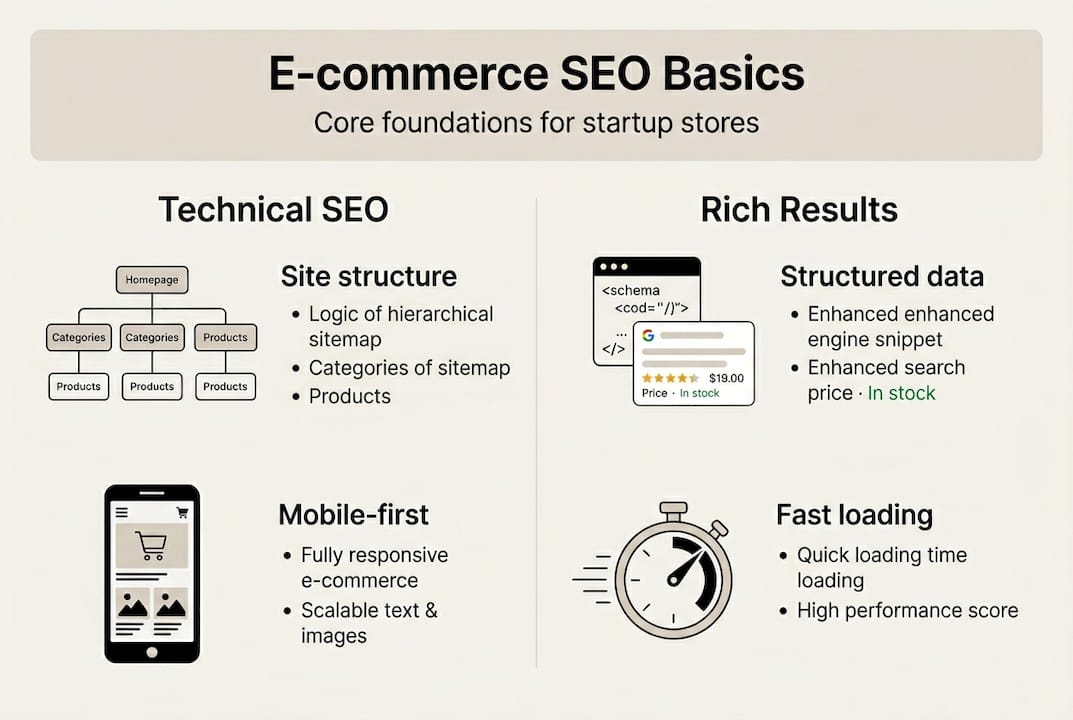
Site architecture is especially critical for SEO for ecommerce sites because a poorly organized store wastes crawl budget. Search engine bots have a limited amount of time they will spend crawling your site. If that budget gets eaten up by duplicate filter pages or orphaned product URLs, your most important category and product pages may never get indexed properly.
Core Web Vitals measure how fast and stable your pages feel to real users. Google uses these signals as a ranking factor. Specifically, Largest Contentful Paint (LCP), which measures load speed, Interaction to Next Paint (INP), which measures responsiveness, and Cumulative Layout Shift (CLS), which measures visual stability, all affect where your pages appear in search results.
Structured data for products, specifically Schema.org markup for price, availability, and reviews, enables rich results in Google Search. These enhanced listings show star ratings and pricing directly in search results, which increases click-through rates significantly.
Here is a baseline technical checklist every e-commerce startup should complete before scaling:
| Foundation | Priority | Impact |
|---|---|---|
| Flat site architecture (3 clicks max to any product) | Critical | Crawl efficiency |
| Mobile-first responsive design | Critical | Indexing and rankings |
| Core Web Vitals passing thresholds | High | User experience and rankings |
| Product schema markup | High | Rich results and CTR |
| XML sitemap submitted to Google Search Console | High | Discoverability |
| Canonical tags on duplicate URLs | High | Index cleanliness |
| HTTPS across all pages | Essential | Trust and rankings |
Pro Tip: Run a full technical audit using a tool like Screaming Frog or Sitebulb before you invest in content or link building. Fixing technical debt first means every other SEO dollar you spend works harder. You can also explore site architecture for SEO to understand how to structure your store for maximum crawl efficiency.
Smart indexing: Navigating categories, filters, and faceted navigation
Once your technical foundation is solid, the next challenge is controlling what search engines actually see and rank. For e-commerce stores, this is where many startups quietly destroy their own SEO performance without realizing it.
Faceted navigation refers to the filter systems shoppers use to sort products by size, color, brand, price range, and other attributes. These filters are essential for user experience, but they create a massive SEO problem. Each filter combination generates a unique URL, and faceted navigation best practices warn that this can produce thousands of near-duplicate pages that dilute your crawl budget and confuse search engines about which page to rank.
“Index bloat from faceted navigation is one of the most common and costly technical SEO mistakes in e-commerce. A store with 500 products can easily generate 50,000 indexable URLs from filters alone, splitting ranking signals across pages that should never compete with each other.”
The solution is selective indexing. Here is how to audit your indexation:
- Crawl your site and export all indexed URLs using Google Search Console or a crawl tool.
- Identify filter-generated URLs by pattern (e.g., URLs with query parameters like ?color=red).
- Check Google Search Console to see which filter pages actually receive organic traffic.
- Mark high-traffic, high-demand filter pages as indexable. These are filters like brand name or specific size that people genuinely search for.
- Apply noindex or canonical tags to all remaining low-value filter combinations.
- Monitor your index coverage report monthly to catch new bloat before it compounds.
Here is a comparison of the two approaches:
| Approach | Indexed pages | Crawl budget use | Ranking clarity | Risk |
|---|---|---|---|---|
| All-facet indexing | Thousands | Wasted on thin pages | Diluted | Index bloat, poor rankings |
| Selective indexing | Dozens to hundreds | Focused on value pages | Concentrated | Minimal if audited regularly |
For pagination, use numbered page URLs rather than infinite scroll where possible, and make sure deeper pages are accessible within a reasonable number of clicks. Your ecommerce SEO services strategy should include a clear policy for which pages get indexed and why, documented in an SEO strategy checklist that your team reviews quarterly.
Maximizing category and product page SEO for sales, not just traffic
With indexation under control, you can focus on what actually generates revenue: well-optimized category and product pages. This is where most startups leave serious money on the table.

Revenue-focused SEO treats category pages as the primary commercial real estate of your store. A category page for “women’s running shoes under $100” targets buyers at the decision stage, not the awareness stage. These pages convert at a much higher rate than blog posts because the intent is commercial, not informational.
Here are the tactics that actually move the needle on category and product pages:
- Write unique category descriptions that include primary and secondary keywords naturally, not stuffed
- Add buyer-focused H2 subheadings within category pages to target long-tail variations
- Include aggregate review schema on category pages to earn star ratings in search results
- Use your site’s internal search data to find what shoppers are looking for but not finding
- Add expert insights or buying guides directly on product detail pages (PDPs) to increase topical authority
- Leverage customer reviews and Q&A sections as semantic content that covers related search terms organically
For optimizing product detail pages, the biggest gains come from turning reviews and Q&A into structured content, adding expert commentary, and ensuring every PDP has a unique title tag and meta description that reflects the specific product variant.
Pro Tip: Export your internal site search queries from Google Analytics or your e-commerce platform. The terms shoppers search for on your site are a goldmine for content gaps, new category ideas, and product page optimization opportunities. These are real buyers telling you exactly what they want.
Focusing on improving ecommerce conversion rates alongside SEO means your traffic improvements translate directly into revenue. Pair this with smart optimizing landing pages practices and website design best practices to ensure your pages convert the traffic you earn.
Technical pitfalls: Out-of-stock products, inventory flux, and internal linking
Even a well-optimized store can lose significant SEO ground through poor inventory management decisions. This is one of the most overlooked areas in e-commerce SEO, and the mistakes here are often irreversible.
“Deleting a product page that has earned backlinks and ranking history is one of the fastest ways to destroy accumulated SEO authority. That page’s equity simply vanishes, taking your rankings with it.”
For out-of-stock product SEO, the right approach depends on whether the item is temporarily unavailable or permanently discontinued. Here is what smart inventory handling looks like:
- Temporarily out of stock: Keep the page live, display clear availability messaging, add a restock notification signup, and show alternative products
- Seasonal products: Keep pages live year-round with updated content and redirect seasonal traffic to relevant category pages during off-seasons
- Discontinued products: Set up a 301 redirect to the most relevant category or replacement product page
- Never delete: Do not delete any product page that has earned backlinks, organic traffic, or ranking history without first redirecting it
- Monitor regularly: Set up crawl monitoring to catch accidental page deletions before they affect rankings
Beyond inventory, graph-based internal linking is an advanced tactic that most startups ignore. Rather than relying only on breadcrumb navigation, graph-based linking connects related products, categories, and supporting content in a network that distributes authority more effectively across your entire site.
Pro Tip: Run a monthly crawl of your store and filter for pages returning 404 errors or pages with no internal links pointing to them. These orphaned pages earn no authority and often represent deleted or forgotten products that need redirects.
You can see how these principles apply in practice by reviewing a fashion brand SEO success case study, or explore ecommerce SEO packages if you want a structured approach to implementing these fixes at scale.
Our take: Why most e-commerce startups approach SEO backwards
After working with fast-growing e-commerce businesses, we have seen the same pattern repeat: founders invest in content marketing first because it feels productive. Blog posts go up, social shares happen, and traffic ticks upward. But revenue stays flat.
The uncomfortable truth is that a technically broken store with index bloat and weak category pages will not be saved by blog content. Content amplifies what is already working. It does not fix what is fundamentally broken.
“The startups that grow fastest from SEO are the ones that spend their first three months fixing technical issues and optimizing category pages, not writing blog posts.”
Measuring success by traffic instead of revenue is the other major trap. We always push clients to connect their SEO strategy guide directly to revenue metrics in Google Analytics 4. If your organic sessions are growing but your organic revenue is not, you are ranking for the wrong keywords or sending traffic to pages that do not convert. Fix the foundation first. Then scale content.
Get expert support to accelerate your e-commerce SEO
Implementing these strategies correctly takes time, technical knowledge, and ongoing monitoring. Mistakes in technical SEO or indexation can set a startup back months. If you want to move faster and avoid costly errors, working with specialists makes a measurable difference.
At Web Spider Solutions, we help e-commerce startups build the right foundation from day one. Whether you need a full ecommerce SEO services engagement, a focused landing page optimization sprint, or a complete SEO strategy guide tailored to your store, we bring the experience to get it right. Reach out for a free SEO audit and find out exactly where your biggest growth opportunities are hiding.
Frequently asked questions
What are the most important first steps in e-commerce SEO for startups?
Technical SEO priorities like site architecture, mobile optimization, and structured product data should come first, before you invest in content creation or link building. Getting these right ensures every other SEO effort you make actually sticks.
Should I index every filter or facet on my e-commerce site?
No. Only index filters with real search demand, such as specific brand names or popular size categories, and apply canonical or noindex tags to all other filter combinations to prevent index bloat from diluting your rankings.
How should I handle out-of-stock or discontinued product pages?
Keep temporarily out-of-stock pages live with clear messaging and restock alerts. Only redirect pages for permanently discontinued products, and never delete any page that has earned backlinks or organic traffic history.
What type of content should e-commerce startups prioritize for SEO?
Focus on category and product pages with unique descriptions, reviews, and schema markup before investing in blog content. These pages target commercial intent and convert at a much higher rate than informational articles.