






TL;DR:
- A unified B2B digital strategy uses integrated channels to generate and nurture leads throughout the sales cycle.
- Effective strategies leverage SEO, LinkedIn, and content marketing, focusing on personalized, multi-stage engagement.
- Human relationship-building remains essential; technology should enhance trust, not replace personal connection.
More than 70% of B2B buyers complete significant research online before ever speaking to a vendor. Yet most small and medium-sized enterprises still treat their digital presence as a collection of disconnected tactics rather than a unified strategy. A website here, a LinkedIn post there, an occasional email blast. The result is wasted budget, inconsistent messaging, and sales cycles that drag on longer than they need to. This guide cuts through the noise. We’ll define what a B2B digital strategy actually is, break down its core components, and give you a clear framework you can apply immediately, regardless of your current starting point.
Table of Contents
- Defining B2B digital strategy and why it matters
- Core components of a successful B2B digital strategy
- Proven methodologies: From account-based to inbound
- Benchmarks, budgets, and pitfalls for SMEs
- A fresh perspective: Why B2B digital strategy is about people, not just platforms
- How Web Spider Solutions can help you master B2B digital strategy
- Frequently asked questions
Key Takeaways
| Point | Details |
|---|---|
| Multi-layered approach | B2B digital strategy uses multiple channels and tactics to move buyers through a lengthy, complex funnel. |
| Personalization is critical | Account-Based Marketing and buyer journey mapping enable precision targeting and higher ROI for SMEs. |
| Benchmarks guide growth | Knowing average budgets, lead costs, and ROI metrics helps set realistic, effective goals. |
| Integration wins | A unified strategy outperforms scattered tactics by aligning touchpoints for key decision-makers. |
Defining B2B digital strategy and why it matters
Let’s be direct. A B2B digital strategy is not a social media calendar or a content plan. It is a complete, coordinated plan that uses digital channels, tools, and data to reach other businesses, generate qualified leads, nurture those relationships over time, and ultimately drive sales. The emphasis is on logic, measurable ROI, long sales cycles, and decisions made by multiple stakeholders, not a single consumer impulse.
This is what separates B2B digital marketing from its B2C counterpart. When someone buys a pair of sneakers online, the decision might take minutes and involve one person. When a company selects a new CRM platform or outsources its digital campaigns, that decision can involve six to ten people, take three to twelve months, and require multiple rounds of justification. Your digital strategy has to account for every stage of that process.
For SMEs, this distinction matters even more. Larger enterprises can afford to run disconnected experiments across dozens of channels. You probably cannot. A unified approach to digital marketing for B2B means every channel, every piece of content, and every campaign works toward the same business objectives.
Here are the most common misconceptions that hold SMEs back:
- “We just need more content.” Content without a distribution and nurturing plan rarely converts in B2B.
- “Social media doesn’t work for our industry.” LinkedIn alone generates 80% of B2B social media leads. The platform matters.
- “Our sales team handles relationships.” Digital touchpoints now influence buying decisions long before sales gets involved.
- “We’ll figure out strategy after we grow.” Waiting is expensive. Piecemeal tactics cost more per lead and deliver less predictable revenue.
“A B2B digital strategy is a comprehensive plan leveraging digital channels, tools, and data to reach businesses, generate leads, nurture relationships, and drive sales, emphasizing logic, ROI, long sales cycles, and multi-stakeholder decisions unlike B2C.”
The payoff for getting this right is significant. Businesses with a documented digital strategy consistently outperform those without one on lead quality, conversion rates, and customer retention. For SMEs competing against larger players, a sharp strategy is often the only sustainable advantage.
Core components of a successful B2B digital strategy
Now that we know what a B2B digital strategy is, it’s time to break down its core building blocks and the channels that drive results.
Every effective B2B strategy maps to a marketing funnel with three distinct stages. Understanding where your buyers are in that funnel determines which channels and messages you deploy.
- Awareness — Prospects discover you through SEO, content, and social media. They are not ready to buy; they are researching problems.
- Consideration — Prospects evaluate solutions. Lead nurturing, case studies, and educational content keep you top of mind.
- Decision — Prospects are ready to choose. Personalized outreach, demos, and account-based tactics close the gap.
The channels that power each stage are not equal. B2B marketing statistics for 2026 confirm that SEO drives 71% of B2B searches and LinkedIn accounts for 80% of social media leads. These two channels alone deserve serious investment.
| Channel | Best funnel stage | Average cost per lead |
|---|---|---|
| SEO | Awareness, Consideration | $33 |
| Awareness, Decision | $124 | |
| Email marketing | Consideration, Decision | Low |
| PPC | All stages | Variable |
| Content marketing | Awareness, Consideration | Bundled with SEO |
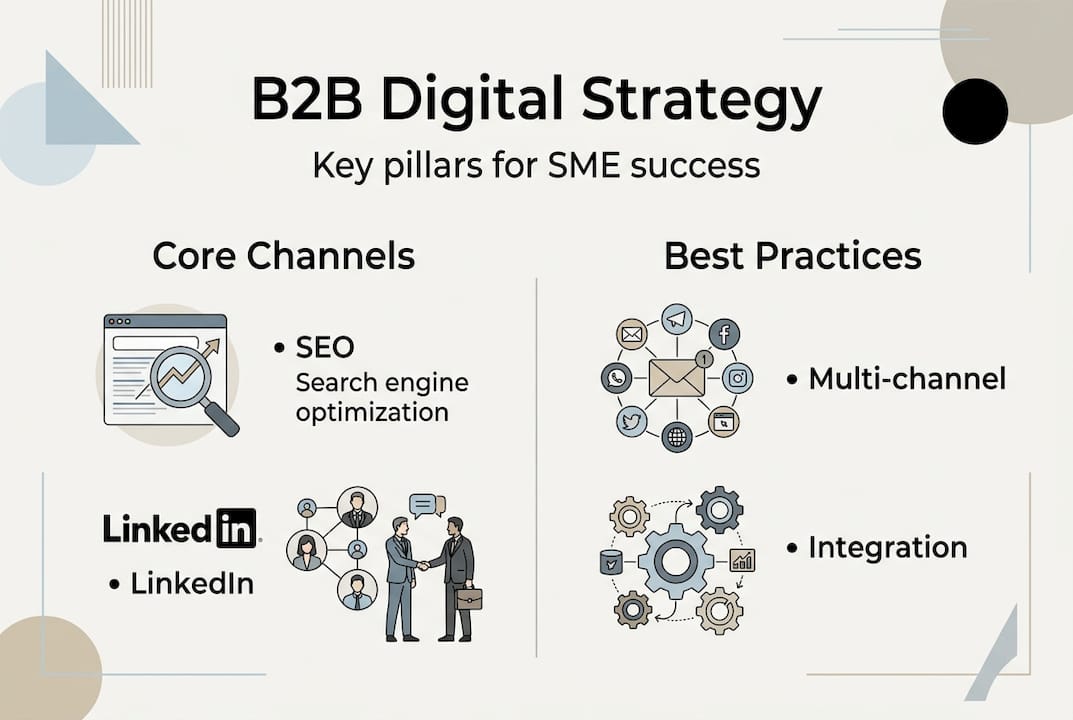
Multi-channel integration is where most SMEs fall short. Each channel should reinforce the others. A blog post drives organic traffic, a LinkedIn post amplifies it, an email sequence nurtures the leads it generates, and a retargeting ad brings back visitors who didn’t convert. That is a B2B sales funnel working as designed.
Looking at B2B digital campaigns that consistently perform well, the pattern is clear: integration beats volume every time. Businesses that coordinate across channels outperform single-channel approaches by a wide margin.
Pro Tip: If you’re an SME with limited resources, don’t spread yourself across every channel. Pick two or three where your buyers actually spend time, execute them well, and build from there. Consistent quality on fewer channels beats mediocre presence everywhere.
For B2B lead generation that compounds over time, SEO and content marketing remain the highest-ROI investments for most SMEs. They take longer to build but deliver leads at a fraction of the cost of paid channels.

Proven methodologies: From account-based to inbound
With the core components in place, let’s examine the strategic methodologies that top-performing B2B businesses use to maximize ROI.
Not all B2B strategies look the same. The methodology you choose should match your deal size, sales cycle length, and the complexity of your buyer’s decision process.
Account-Based Marketing (ABM) is the most targeted approach. Instead of casting a wide net, you identify 50 to 500 high-value accounts and build personalized, multi-channel campaigns specifically for them. ABM works exceptionally well for enterprise deals where the contract value justifies the investment. The buyer journey in ABM typically involves 6 to 10 decision-makers and requires 6 to 10 touchpoints before a deal closes.
Inbound marketing flips the script. Rather than reaching out, you create content and SEO assets that attract buyers to you. It’s slower to build but scales efficiently and positions your brand as a trusted authority. Most B2B marketing examples that demonstrate sustained growth over three or more years have a strong inbound foundation.
Hybrid strategies combine both. Inbound generates pipeline at scale; ABM converts the highest-value accounts within that pipeline. For SMEs, a hybrid approach often delivers the best balance of reach and efficiency.
Here is how the three methodologies compare:
| Methodology | Best for | Time to results | Resource intensity |
|---|---|---|---|
| ABM | High-value, complex deals | 3 to 6 months | High |
| Inbound | Scalable lead generation | 6 to 12 months | Medium |
| Hybrid | Growth-stage SMEs | 4 to 9 months | Medium to high |
One trend reshaping all three methodologies is AI in B2B digital strategies. AI tools now assist with content personalization, predictive lead scoring, and campaign optimization. The catch is that AI amplifies whatever strategy you already have. It does not replace the need for a clear plan.
Keeping up with content marketing trends is also essential when choosing your methodology. Interactive content, video case studies, and thought leadership pieces are increasingly influential at the consideration and decision stages.
- Align your methodology to your average deal size and sales cycle length.
- Map every content asset to a specific funnel stage and buyer persona.
- Measure touchpoints, not just conversions, to understand what’s actually moving deals forward.
Benchmarks, budgets, and pitfalls for SMEs
With those strategies in mind, setting realistic benchmarks and awareness of common pitfalls is crucial for successful implementation.
Numbers ground strategy in reality. Here is what the current data tells us about B2B digital marketing performance in 2026.
Cost per lead varies significantly by channel. SEO delivers leads at $33 while LinkedIn averages $124. Email open rates sit at 43% with a click-through rate of 2%. Overall B2B conversion rates run between 2% and 3%. These are not targets to beat immediately; they are baselines to measure against.
On budget, most B2B companies allocate 8.7% of revenue to marketing, with tech and SaaS companies pushing 11% to 15%. Content marketing absorbs about 26% of the total marketing budget. For SMEs just starting out, campaigns can begin at $5,000 to $20,000 per year when focused on inbound and CRM foundations.
Now the pitfalls:
- Overlong sales cycles — 73% of B2B companies report their sales cycles are getting longer. Plan your nurturing sequences accordingly.
- Measuring AI ROI — 40% of marketers report low confidence in measuring returns from AI tools. Don’t let AI become a black box in your reporting.
- Dark buyers — A growing share of B2B buyers research extensively without ever filling out a form. Signal stacks (intent data, content engagement tracking) help you identify them.
- Vanity metrics — Impressions and follower counts feel good but rarely correlate with revenue. Focus on pipeline contribution and cost per qualified lead.
- Ignoring managing digital campaigns as an ongoing discipline — Strategy without execution management is just a document.
Pro Tip: Choose three to five KPIs maximum and track them obsessively. Cost per qualified lead, pipeline influenced by marketing, and sales cycle length will tell you more than a dashboard full of 30 metrics. Clarity drives better decisions faster.
For email newsletter benchmarks specifically, a 43% open rate is achievable when your list is segmented and your subject lines address real business pain points rather than generic promotional language.
A fresh perspective: Why B2B digital strategy is about people, not just platforms
Here’s the uncomfortable truth that most strategy guides skip: the best tech stack in the world will not save a strategy that treats buyers as data points. We’ve seen SMEs with modest budgets outperform well-funded competitors simply because they invested in genuine relationship-building at every digital touchpoint.
The obsession with platforms, automation, and attribution models is understandable. These things are measurable. But the B2B buying decision is still fundamentally human. A CFO approving a six-figure contract is not responding to a retargeting ad in isolation. They are responding to months of trust built through relevant content, honest conversations, and consistent follow-through.
The brands that win in B2B digital are those that use technology to scale human connection, not replace it. Personalization at scale, genuine thought leadership, and responsive communication matter more than which marketing automation tool you use. Staying current with content marketing trends is part of this, but the underlying principle is timeless: people buy from people they trust, even in B2B.
How Web Spider Solutions can help you master B2B digital strategy
If you’re ready to move from scattered tactics to a strategy that actually drives pipeline, Web Spider Solutions brings the expertise to make that shift practical and measurable. Our team works with B2B-focused SMEs to build integrated digital programs across SEO, PPC, content, and social media. Start by exploring our SEO strategy guide to strengthen your organic foundation, then review how PPC advertising can accelerate results while your inbound engine builds momentum. For brands that need a consistent presence across LinkedIn and other platforms, our social media management service keeps your messaging sharp and your audience engaged.
Frequently asked questions
How does B2B digital strategy differ from B2C?
B2B digital strategy focuses on logical decision-making, long sales cycles, and multi-stakeholder decisions versus the emotion-driven, faster purchasing behavior typical of B2C. The channels, messaging, and measurement approaches are fundamentally different.
What are the main channels for B2B digital strategy?
SEO, LinkedIn, content marketing, email, and PPC are the most effective channels. SEO drives 71% of B2B searches and LinkedIn generates 80% of B2B social media leads, making both essential starting points.
What is Account-Based Marketing (ABM) in B2B?
ABM targets a defined list of high-value accounts with personalized, multi-channel campaigns. It boosts ROI by 171% and shortens sales cycles by 28% compared to broad-based marketing approaches.
How much should SMEs budget for B2B digital marketing?
Most SMEs invest 8.7% to 15% of revenue in marketing, with entry-level digital programs starting between $5,000 and $20,000 per year when focused on inbound marketing and CRM setup.