






Over 60% of B2B digital campaigns fail to meet ROI expectations because marketing teams focus exclusively on lead generation while neglecting brand building activities. This imbalance creates a fundamental disconnect between what drives long term growth and what gets measured daily. Digital campaigns offer powerful tools to boost visibility and generate qualified leads, but only when you understand how to balance brand awareness with performance marketing. This guide reveals the strategic framework successful B2B organizations use to design, execute, and optimize digital campaigns that drive measurable growth.
Table of Contents
- Key takeaways
- Understanding the role of digital campaigns in B2B marketing
- Balancing brand awareness and performance campaigns for optimal results
- Leveraging AI and automation while maintaining human oversight
- Measuring ROI and applying insights for continuous campaign improvement
- Enhance your digital campaign success with expert support
- Frequently asked questions about digital campaigns
Key Takeaways
| Point | Details |
|---|---|
| Balance Brand and Performance | Effective B2B digital campaigns require equal emphasis on brand building and performance tactics to drive sustainable long term growth and immediate results. |
| Balanced Budget Allocation | Successful campaigns allocate about 60 percent of the budget to performance and 40 percent to brand initiatives to support conversions and long term equity. |
| Run Pilot Campaigns | Start with a pilot focused on one buyer persona and two channels to test messaging and refine targeting before scaling. |
| Brand Demand Outperforms MQL | Brand demand strategies can outperform traditional MQL focused approaches by building market presence and credibility before prioritizing conversions. |
Understanding the role of digital campaigns in B2B marketing
Digital campaigns represent coordinated marketing efforts across multiple online channels designed to achieve specific business objectives. In B2B contexts, these campaigns combine search engine optimization, paid advertising, content marketing, and social media to attract decision makers and drive qualified leads. The integrated approach creates multiple touchpoints that guide prospects through lengthy buying cycles typical of business purchases.
Research shows that well executed digital campaigns drive brand visibility while generating measurable revenue attribution through precise targeting and channel integration. Companies implementing comprehensive digital strategies report 25% increases in organic traffic and generate over 150 qualified leads monthly. These results stem from aligning campaign elements with buyer journey stages and maintaining consistent messaging across channels.
The power of digital campaigns lies in their ability to deliver both immediate results and long term brand equity. Performance focused elements like paid search and remarketing generate quick wins through direct response tactics. Meanwhile, content marketing and SEO build authority that compounds over time. This dual benefit makes digital campaigns essential for B2B organizations competing in crowded markets.
Successful B2B digital marketing campaigns deliver four primary benefits:
- Lead generation through targeted paid advertising and optimized landing pages
- Brand awareness expansion via content distribution and social engagement
- Measurable ROI tracking with attribution across multiple touchpoints
- Competitive differentiation through thought leadership and educational content
Pro Tip: Start with a pilot campaign focused on one buyer persona and two channels before scaling. This approach lets you test messaging and refine targeting without overextending resources.
Balancing brand awareness and performance campaigns for optimal results
The tension between brand building and performance marketing creates confusion for many B2B marketers. Brand campaigns focus on awareness, perception, and long term equity through content marketing, thought leadership, and educational resources. Performance campaigns prioritize immediate conversions using tactics like paid search, remarketing, and lead magnets with clear calls to action.
Data reveals that successful campaigns allocate 60% of budget to performance and 40% to brand initiatives, with winning campaigns typically featuring higher overall spend and longer duration. This split recognizes that brand awareness creates the foundation for performance tactics to convert efficiently. Without brand recognition, even perfectly optimized landing pages struggle to convert cold traffic.

Recent research by marketing strategist Jon Miller demonstrates that brand-demand campaigns outperform MQL-focused approaches by 6x. His analysis shows that shifting from traditional MQL generation to brand-demand strategies with a 46/54 split produces superior outcomes. The brand-demand model prioritizes creating market presence and credibility before pushing hard for conversions.
| Campaign Type | Primary Goal | Key Metrics | Typical Timeline |
|---|---|---|---|
| Brand Awareness | Market presence and credibility | Impressions, reach, engagement rate | 6-12 months |
| Performance Marketing | Lead generation and conversions | CPC, conversion rate, cost per lead | 1-3 months |
| Brand-Demand Hybrid | Qualified pipeline with brand equity | Pipeline value, brand lift, CAC | 3-6 months |
Common pitfalls emerge when organizations ignore brand campaigns:
- Declining conversion rates as brand recognition erodes
- Rising customer acquisition costs without awareness support
- Difficulty differentiating from competitors in paid channels
- Inconsistent messaging that confuses prospects
Pro Tip: Track brand search volume monthly as a leading indicator of brand campaign effectiveness. Increases in branded searches signal growing awareness that will boost performance campaign efficiency.
“The most successful B2B campaigns don’t choose between brand and performance. They orchestrate both in a rhythm that matches their market maturity and competitive position.” — Jon Miller, Marketing Strategist
Implementing this balance requires honest assessment of current market position. Newer companies or those entering new markets need heavier brand investment initially. Established players in mature markets can weight performance more heavily while maintaining brand presence. Managing B2B digital campaigns effectively means adjusting this ratio quarterly based on results and market feedback.
Leveraging AI and automation while maintaining human oversight
Artificial intelligence transforms how marketing teams execute and optimize digital campaigns. AI powered tools automate repetitive tasks, personalize content at scale, and optimize bidding strategies in real time. These capabilities free marketers to focus on strategy, creative development, and relationship building rather than manual campaign adjustments.
Current AI applications in digital campaigns include:
- Workflow automation for campaign setup, monitoring, and reporting
- Dynamic content personalization based on behavioral signals
- Predictive analytics for budget allocation and channel selection
- Automated bid management across paid advertising platforms
- Audience segmentation using machine learning algorithms
The efficiency gains are substantial. Campaigns managed with AI assistance typically reduce manual work by 40% while improving targeting precision. Automation handles routine optimization tasks continuously, making adjustments based on performance data faster than human teams can process. This speed advantage becomes critical in competitive auctions where bid timing affects cost and placement.
However, research shows that 41% of marketers allocate budget to AI while 40% lack confidence in measuring AI’s ROI contribution. This gap reveals the challenge of implementing automation without losing strategic control. AI excels at optimization within defined parameters but struggles with creative strategy, brand positioning, and market context that requires human judgment.
Successful AI integration follows these principles:
- Start with narrow use cases like bid optimization before expanding to strategy
- Maintain human review of AI recommendations before implementation
- Set clear boundaries on automation authority and escalation triggers
- Monitor AI decisions for bias or drift from strategic objectives
- Combine AI insights with qualitative customer feedback
Pro Tip: Create a decision framework that specifies which campaign elements AI can adjust automatically versus those requiring human approval. This clarity prevents automation from making changes that conflict with brand guidelines or strategic priorities.
The role of AI in digital marketing continues evolving rapidly. Smart marketers view AI as a capability multiplier rather than a replacement for strategic thinking. The technology handles data processing and routine optimization exceptionally well, but humans must still define objectives, interpret results in business context, and make judgment calls about brand positioning and market strategy.
Measuring ROI and applying insights for continuous campaign improvement
Accurate measurement separates successful digital campaigns from resource drains. Without clear ROI tracking, marketing teams cannot distinguish effective tactics from wasteful spending or justify budget increases to leadership. B2B campaigns require sophisticated attribution because buying cycles span months and involve multiple decision makers across numerous touchpoints.
Key metrics for digital campaign performance include:
- ROI ratio calculating revenue generated per dollar spent
- Conversion rate tracking percentage of visitors who complete desired actions
- Cost per click measuring efficiency of paid advertising spend
- Click through rate indicating ad relevance and appeal
- Customer acquisition cost showing total investment to win new business
- Pipeline velocity measuring how quickly leads progress to close
Benchmark data shows that B2B digital campaigns achieve 5:1 ROI ratios with average conversion rates around 2.8%. These figures provide context for evaluating your own performance. Campaigns performing below these benchmarks need diagnostic analysis to identify bottlenecks, while those exceeding benchmarks may warrant increased investment.
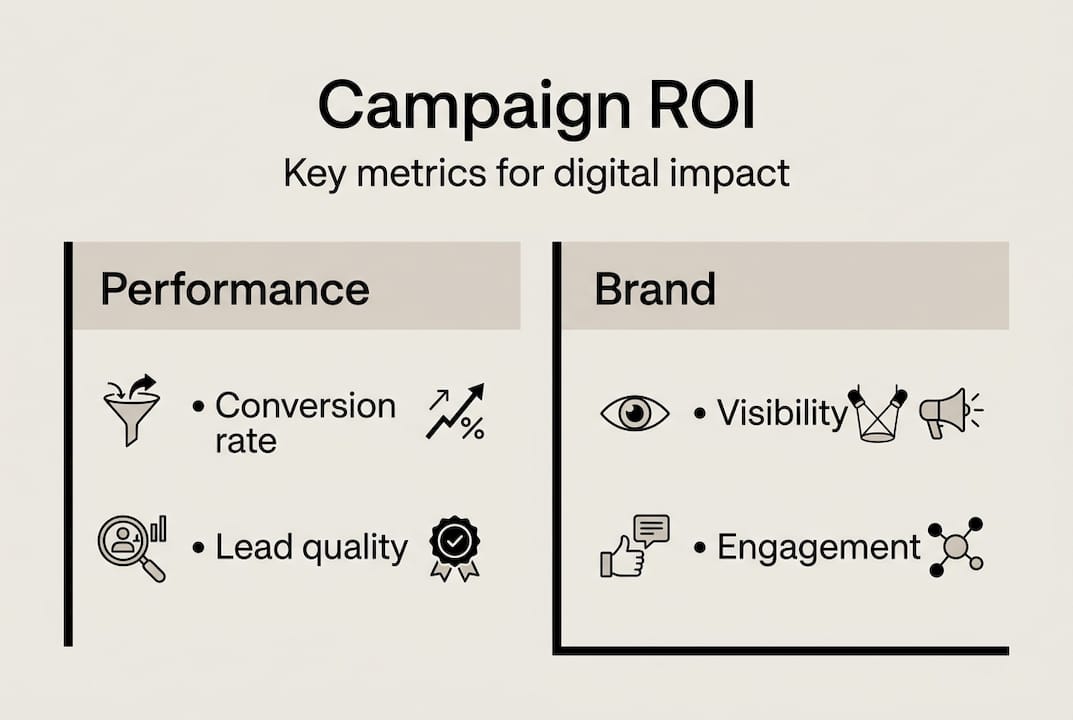
| Metric | B2B Benchmark | Excellent Performance | Action Threshold |
|---|---|---|---|
| ROI Ratio | 5:1 | 8:1 or higher | Below 3:1 requires review |
| Conversion Rate | 2.8% | 4.5% or higher | Below 1.5% needs optimization |
| Cost Per Click | $3.50 | Under $2.50 | Above $6.00 signals issues |
| Customer Acquisition Cost | $500-$1000 | Under $400 | Above $1500 unsustainable |
Implementing effective measurement requires a systematic process:
- Define clear campaign objectives with specific numeric targets before launch
- Configure tracking pixels and UTM parameters across all campaign elements
- Establish attribution model that reflects your typical buyer journey
- Create dashboards displaying key metrics with weekly update cadence
- Schedule monthly analysis sessions to identify patterns and opportunities
- Test optimization hypotheses through controlled experiments
- Document learnings and apply insights to future campaign planning
The analysis phase matters most. Raw data means nothing without interpretation that connects metrics to business outcomes. Look for patterns across channels, audience segments, and content types. Which combinations drive qualified leads versus tire kickers? What messaging resonates with different buyer personas? When do prospects typically convert during their research process?
Tracking ROI in digital marketing becomes easier with modern analytics platforms, but technology alone does not guarantee insights. You must ask the right questions and investigate anomalies. A sudden spike in traffic might indicate campaign success or bot activity. Rising click through rates with flat conversions suggest landing page problems rather than ad creative wins.
Pro Tip: Create a simple scorecard rating each campaign element on a 1-5 scale for performance and strategic fit. This qualitative overlay prevents over-optimizing for metrics that do not align with business priorities.
Continuous improvement stems from treating every campaign as a learning opportunity. Document what worked, what failed, and why. Build a knowledge base of insights that informs future strategy. The organizations that dominate their markets treat measurement as an ongoing discipline rather than a quarterly reporting obligation.
Enhance your digital campaign success with expert support
Implementing sophisticated digital campaigns requires specialized expertise across multiple disciplines. Web Spider Solutions helps B2B organizations design and execute integrated campaigns that balance brand building with performance marketing. Our team brings deep experience in competitive sectors where differentiation and precision targeting determine success.
Our comprehensive SEO strategy guide provides the foundation for organic visibility that amplifies paid campaign effectiveness. When prospects research solutions, your brand needs to appear in search results with authoritative content that builds credibility. We help you develop content strategies that capture attention at every buyer journey stage.
For organizations ready to scale their efforts, our guide to managing digital campaigns reveals the frameworks and processes that separate amateur efforts from professional results. You will learn how to coordinate multiple channels, allocate budgets strategically, and optimize continuously based on performance data.
Explore our AI in digital marketing guide to understand how automation and machine learning can multiply your team’s effectiveness while maintaining strategic control. We help you implement AI tools that enhance rather than replace human judgment.
Frequently asked questions about digital campaigns
What is the ideal budget split between brand and performance campaigns?
Allocate 60% of your digital marketing budget to performance campaigns focused on lead generation and conversions, with 40% dedicated to brand awareness initiatives. This ratio provides immediate results while building long term market presence. Adjust the split based on market maturity, with newer entrants investing more heavily in brand building initially.
How can AI improve digital campaign efficiency?
AI enhances campaign efficiency through automated bid management, dynamic content personalization, and predictive analytics for budget allocation. These tools reduce manual optimization work by 40% while improving targeting precision. However, maintain human oversight for strategic decisions about positioning, messaging, and budget priorities that require market context and business judgment.
What metrics best indicate digital campaign success?
Track ROI ratio as your primary success indicator, targeting 5:1 or better for B2B campaigns. Monitor conversion rates, customer acquisition cost, and pipeline velocity as secondary metrics that reveal campaign health. Combine quantitative metrics with qualitative feedback from sales teams about lead quality to ensure you are attracting the right prospects.
How long should B2B digital campaigns run before evaluating results?
Performance campaigns show initial results within 30-60 days, but allow 90 days for meaningful optimization. Brand awareness campaigns require 6-12 months to demonstrate impact on market perception and organic search visibility. Run campaigns long enough to account for B2B buying cycles, which average 3-6 months for complex purchases.
Should small B2B companies invest in digital campaigns?
Yes, but start with focused pilot campaigns targeting one buyer persona through two channels. This approach lets you test messaging and refine targeting without overextending limited resources. Digital campaigns offer small companies the ability to compete with larger competitors through precise targeting and thought leadership content that demonstrates expertise.